
Blog Posts
2026 Fresh Air Standards for Welding Enclosures
A single airflow figure cannot prove that a welding enclosure is adequately ventilated. The fresh air supply standards for welding enclosures depend on the governing jurisdiction, hot-work requirements, materials, work conditions, and hazards the enclosure must control. If you’ve encountered conflicting recommendations, the uncertainty is understandable: clean-air supply, fume extraction, and positive-pressure containment are related, but they are not interchangeable.
This guide explains how to identify the regulations, standards, and site procedures that apply to your project, then compare ventilation approaches according to their purpose. You’ll learn what to review in a project-specific plan, including its air supply, monitoring, and response criteria, without treating a general airflow figure as a universal answer.
We’ll distinguish air supplied to maintain enclosure pressure from local exhaust ventilation that captures welding fume at its source, and from general ventilation that dilutes contaminants. Use this framework to ask focused questions, document decisions, and confirm that qualified personnel have established and verified criteria for the worksite.
Key Takeaways
- Identify the regulations, site procedures, hazards, and welding-task details that determine which fresh air supply standards for welding enclosures apply.
- Use a structured project review to define the enclosure configuration and measurable acceptance criteria with qualified personnel.
- Distinguish supplied fresh air, local fume extraction, and pressurized-enclosure strategies by their purpose, verification evidence, and limitations.
- Before hot work, confirm that monitoring, instruments, readings, alarms, and responsible approvals align with the approved project plan.
- Assess enclosure documentation, setup support, training, and maintenance arrangements as part of a verifiable, site-specific safety plan.
Fresh air supply standards for welding enclosures: what governs the work?
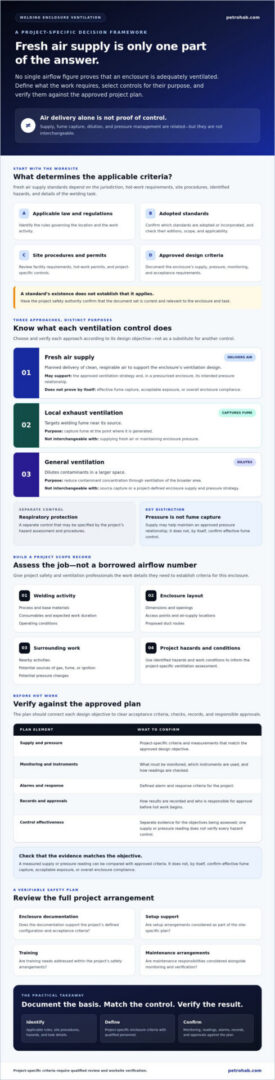
Fresh air supply is the planned delivery of clean, respirable air into an enclosure to support its ventilation design. Its role depends on the project. In a pressurized enclosure, supply may help maintain the approved pressure relationship with the surrounding area. It is not the same as local exhaust ventilation, which captures fume near the welding source, or general ventilation, which dilutes contaminants in a larger space.
There is no universal airflow figure that establishes compliance for every enclosure. The applicable fresh air supply standards for welding enclosures depend on jurisdiction, worksite rules, identified hazards, and the welding task. The project team needs a documented basis for its criteria, not a number detached from the conditions it must control. For foundational context on welding safety precautions, see the overview of welding hazards and protective measures.
For a practical look at precision welding used in ventilation products, watch this video:
Which documents should a project team review first?
Start by identifying the jurisdiction and the authorities responsible for occupational safety and hot-work approval at the site. Then assemble the requirements in a clear order:
- Applicable law and regulations: Identify the rules that govern the location and work activity.
- Adopted standards: Confirm which standards have been adopted or incorporated, and check their editions, scope, and applicability.
- Site procedures and permits: Review facility requirements, hot-work permits, and project-specific controls.
- Approved design criteria: Document the enclosure’s project-specific supply, pressure, monitoring, and acceptance requirements.
Ask the project safety authority to confirm that the document set is current and relevant. The existence of a standard alone does not establish that it applies to a particular enclosure or task.
What does fresh air supply control, and what does it not prove?
Supply air supports the planned ventilation strategy, but air delivery alone does not demonstrate that worker exposures are controlled or that every enclosure hazard is addressed. Local exhaust ventilation targets fume at its source. Respiratory protection is a separate control that may be specified by the project’s hazard assessment and procedures. These measures serve different purposes and should not be treated as substitutes.
Verification must match the design objective. A measured supply or pressure reading can provide evidence against approved criteria, but it does not by itself confirm effective fume capture, acceptable exposure, or overall enclosure compliance. The project plan should define what must be checked, how results are recorded, and who approves the system before hot work begins.
How to determine welding-enclosure air supply requirements for a specific job
Set the criteria by starting with the work. The same enclosure can face different ventilation demands depending on the welding process, materials, operating conditions, and surrounding hazards. Treat fresh air supply standards for welding enclosures as a project-specific assessment, not a figure copied from an unrelated job.
Which task and hazard details affect the assessment?
Before selecting supply or pressure criteria, create a scope record for the project safety and ventilation professionals to review. Include:
- Welding activity: Process, base materials, consumables, expected work duration, and operating conditions.
- Enclosure layout: Dimensions, openings and access points, air-supply locations, and proposed duct routes.
- Surrounding work: Nearby activities and potential sources of gas, fume, ignition, or pressure changes.
- Hazard assessment: Relevant gas, fume, oxygen, ignition, and pressure hazards identified through the site’s established process.
For U.S. construction work, review the scope and applicability of OSHA’s Fresh air supply standards for welding alongside the requirements that govern the specific site. A cited regulation is not automatically applicable to every industry or work setting. Confirm its jurisdiction, scope, and current applicability with the responsible safety authority.
How should the team turn requirements into design criteria?
Use a numbered review sequence to connect the job description to criteria that can be checked and approved:
- Define the scope. Record the work location, task boundaries, responsible authorities, and applicable site procedures.
- Characterize the work. Document process, materials, consumables, duration, expected operating conditions, and nearby activities.
- Assess the enclosure and hazards. Review configuration, openings, duct routes, and the hazards identified by the site process.
- Trace each criterion. Link every proposed airflow, pressure, exposure, or monitoring value to an applicable regulation, adopted standard, approved procedure, or documented engineering basis.
- Approve verification. Specify how each criterion will be measured, what constitutes acceptance, and who reviews and approves the result.
Do not use a numerical threshold unless its source and relevance to the application can be verified. The project team should document assumptions, operating limits, measurement methods, and how changed conditions will be handled. Qualified safety and ventilation professionals should make or review site-specific calculations and decisions. The project’s responsible technical and safety authorities should approve the final acceptance criteria.
When evaluating an enclosure, compare the project’s approved configuration and monitoring needs with the documented capabilities of PetroHab Hot Work Safety Enclosures. Keep the selection tied to the site’s reviewed design criteria.
Fresh-air supply, extraction, and positive pressure: compare the control approaches
These approaches address different parts of the hazard assessment. Fresh-air supply delivers air to support a designed ventilation arrangement. Local exhaust ventilation (LEV) captures fume near where welding generates it. Positive pressure is a condition an enclosure may be designed to maintain relative to its surroundings. General ventilation dilutes contaminants across a larger area, but it does not perform the same function as source capture.
The right combination depends on the hazards, work position, enclosure arrangement, and approved project criteria. The fresh air supply standards for welding enclosures do not make these controls interchangeable: each needs design inputs and verification that match its purpose.
| Approach | Purpose | Design inputs | Verification evidence | Limitations |
|---|---|---|---|---|
| Supplied fresh air | Provides planned air delivery, including make-up air where the design requires it. | Enclosure layout, air inlets, duct routing, work location, and the project’s ventilation objective. | Documented supply measurements and other checks specified in the approved design. | Supply alone does not establish fume capture or exposure control. |
| Local exhaust ventilation | Captures welding fume close to its source before it disperses through the work area. | Fume source, hood or nozzle position, worker posture, workpiece access, and exhaust route. | Inspection and performance measurements defined by the applicable criteria. | Capture may be affected if the work position or extraction point changes. |
| Positive-pressure enclosure | Maintains a specified pressure relationship as part of the enclosure’s hazard-control design. | Approved pressure criterion, enclosure integrity, air supply arrangement, and monitoring design. | Recorded pressure readings, monitor status, and enclosure checks against project requirements. | A pressure reading alone does not confirm control of every hazard or exposure. |
When is supplied air different from local fume extraction?
Make-up air replaces or supports air movement in the planned system. LEV draws contaminants toward an extraction point near the fume source. Placement matters: inlet or duct flow that disrupts a capture arrangement may affect its performance, while a poorly positioned extraction hood may not capture fume effectively. Qualified personnel should assess the work position and duct arrangement together. Neither approach should be assumed sufficient without task-specific review.
What does positive pressure contribute to an enclosure strategy?
Positive pressure is a design condition, not a universal compliance guarantee. Its intended role, pressure criterion, monitoring, and enclosure integrity must be defined in the approved project plan and verified as specified. PetroHab’s Safe-Stop Automatic Shutdown System monitors gas levels and pressure. Project teams should confirm how that monitoring fits their site procedures.
Positive pressure does not replace every ventilation or exposure control. For more on enclosure design, see Pressurized Welding Habitats: The Definitive Guide to HWSE Technology.
How to verify air supply, monitoring, and response before hot work
Before work begins, verify the enclosure against the approved design criteria and site procedures. The goal is not simply to confirm that equipment is running. The team needs evidence that required supply or pressure conditions meet the project’s acceptance criteria, monitoring is functioning as intended, and personnel know how to respond if conditions change.
What should commissioning and pre-job records show?
Use a documented pre-work sequence. Confirm that the enclosure configuration matches the approved plan, inspect relevant connections and access points, and check that instruments are suitable for the required measurements. Record test conditions so reviewers can interpret the readings.
- Instrument status: Record instrument identification and calibration status, along with any status checks required by the instrument instructions or site procedure.
- Measured results: Document supply and pressure readings where specified, then compare them with the project’s approved acceptance criteria. Record the conditions under which measurements were taken.
- Monitoring and alarms: Confirm required monitoring is operational and document alarm checks and results as directed by the approved plan.
- Authorization: Record who performed the checks, who reviewed the results, and who approved the enclosure for work under site procedures.
Brief the work team on applicable limits, alarm meaning, and escalation steps before hot work starts. PetroHab’s Safe-Stop Automatic Shutdown System monitors gas levels and pressure. Confirm how its monitoring fits the project’s approved design and site response procedures. Do not assume that any particular alarm threshold, test interval, or shutdown setting applies universally.
What should happen if supply or monitoring is disrupted?
A loss of required supply, an unacceptable reading, an alarm, or a monitoring fault should trigger the response established in the site’s hot-work permit and approved procedures. Those documents should identify who can suspend work, who must be notified, what conditions require reassessment, and who has authority to approve restart. Do not resume work based only on a restored display or restarted equipment. Confirm the cause, verify affected controls against the approved criteria, and obtain the required authorization.
Changes to work position, enclosure configuration, nearby activities, or operating conditions may affect the basis of the original verification. Use the site process to determine whether checks or approvals must be repeated. Follow the documented response rather than relying on an informal judgment.
For broader context on jurisdictional requirements and hot-work controls, see Hazardous Environment Standards: The 2026 Guide to Global Compliance and Hot Work Safety. To discuss how PetroHab Hot Work Safety Enclosures and monitoring capabilities relate to a project’s documented plan, review your enclosure requirements with PetroHab.
Selecting a welding enclosure with a verifiable air-supply safety plan
Select equipment against the approved project plan, not a generic airflow target. The enclosure configuration, air-supply arrangement, monitoring needs, and verification responsibilities should align with the hazards and acceptance criteria already established for the work. This makes fresh air supply standards for welding enclosures a practical procurement checklist: each requirement should have a documented basis and a clear owner.
What evidence should buyers request from an enclosure supplier?
Ask for the information needed to evaluate the proposed equipment against the project design. Confirm which documents are available and whether they apply to the specific configuration being considered. A supplier can provide equipment information and project support, but the site’s responsible authority retains its approval responsibilities under site procedures.
- Technical information: Request applicable equipment documentation, operating instructions, and confirmed specifications for the proposed configuration.
- Design alignment: Compare the enclosure layout, air-supply and duct connections, access points, and monitoring requirements with the approved plan.
- Setup and training: Clarify who handles setup support, any on-site supervision, and user training for the project.
- Maintenance responsibilities: Establish who is responsible for inspections, upkeep, and documenting equipment condition under the project’s arrangements.
- Verification and approval: Identify who performs required measurements, records results, reviews exceptions, and authorizes the enclosure for hot work.
Keep supplier documentation separate from project acceptance records. Product information can inform the review, but it does not establish that the selected configuration meets site-specific criteria or has been approved for the work.
How can PetroHab fit into project planning?
PetroHab manufactures, leases, and sells modular Hot Work Safety Enclosures for the oil and gas industry, including pressurized welding enclosures. Its stated capabilities include fire-resistant materials, patented Quadra-Lock technology, and the Safe-Stop Automatic Shutdown System, which monitors gas levels and pressure. Project teams should confirm how the proposed enclosure and monitoring arrangement fit the approved design and site procedures. Equipment selection alone does not guarantee compliance.
Use the review to close gaps before mobilization: confirm the supplied documents match the ordered configuration, assign setup and verification responsibilities, and ensure the workforce understands relevant operating instructions. For additional background, consult The Definitive Guide to Hot Work Safety Enclosures (HWSE) in 2026.
Discuss your enclosure requirements with PetroHab as part of the project’s technical review, and keep final acceptance tied to the site-approved plan.
Build a project-ready enclosure plan
Fresh air supply standards for welding enclosures depend on the governing requirements, worksite hazards, and welding task. Identify the applicable documents and have qualified personnel establish project-specific criteria. Air supply, local fume extraction, and positive pressure serve different purposes, so select and verify each control against the hazard it is intended to address.
Before hot work, compare measured conditions with the approved plan, record instrument and monitoring results, and confirm who can stop work and authorize a restart if a control is disrupted. These records help the project team review decisions and respond consistently as conditions change.
PetroHab manufactures, leases, and sells Hot Work Safety Enclosures. Its Safe-Stop Automatic Shutdown Systems monitor gas levels and pressure, and PetroHab offers on-site supervision and training. These capabilities can inform enclosure planning, but the site’s responsible authority must determine and approve project-specific requirements.
Discuss your welding-enclosure project requirements with PetroHab as you develop a documented, verifiable plan. With clear criteria, assigned responsibilities, and checks aligned to the work, your team can move forward with greater confidence.
Frequently Asked Questions
Is there one fresh-air supply standard for every welding enclosure?
No. Do not assume one airflow value applies to every enclosure or job. Requirements depend on the jurisdiction, adopted standards, site rules, welding process, hazards, and engineered design. Identify the documents that govern the work, then have qualified technical personnel review their applicability. Record the source and project basis for each acceptance criterion before work begins so the team can verify the design against approved requirements.
How do I determine the required airflow for a welding enclosure?
Start by identifying the worksite jurisdiction, applicable rules, permit conditions, enclosure design, and task-specific hazards. Qualified ventilation and safety personnel should determine the applicable criteria and how to measure them. For fresh air supply standards for welding enclosures, each numerical value needs a traceable source or an approved engineering basis. Document assumptions, technical review, measurement methods, and acceptance criteria before commissioning the enclosure.
What is the difference between fresh-air supply and welding fume extraction?
Fresh-air supply introduces air into the work area as part of an engineered ventilation arrangement. Fume extraction captures and removes contaminants, often close to where welding produces them. The controls serve different purposes and are not automatically interchangeable. The project’s hazard assessment should establish which controls are needed and how they interact. Design review should also consider work position and duct placement, then define how each control will be verified.
Does positive pressure make a welding enclosure compliant?
No. Positive pressure may be one condition in an enclosure design, but it does not by itself demonstrate compliance with ventilation, exposure, or hot-work requirements. Review applicable rules and site procedures, confirm the approved design criteria, and verify the enclosure under the specified operating conditions. Pressure monitoring is one part of the overall control plan. The project team should document how those readings will be assessed and who approves the results.
How can a team verify air supply before welding starts?
Follow the approved commissioning and pre-job procedure. Compare measured conditions with the project’s documented acceptance criteria, and confirm instruments are suitable and meet required calibration conditions. Record test conditions, readings, monitoring and alarm checks, and responsible approvals. Brief workers on relevant alarms and response steps. Do not use an assumed industry-wide airflow value in place of criteria approved for the specific enclosure and job.
What should workers do if ventilation or pressure monitoring fails?
Follow the site-approved response and hot-work permit procedure. It should identify how work is suspended, who receives the alarm, and who can authorize restart after the issue is assessed. Do not resume based only on an unverified reading or informal assurance. Confirm the affected control has been restored, complete the checks required by the project plan, and obtain the required approvals before restarting work.