Blog Posts
Hazardous Environment Standards: The 2026 Guide to Global Compliance and Hot Work Safety
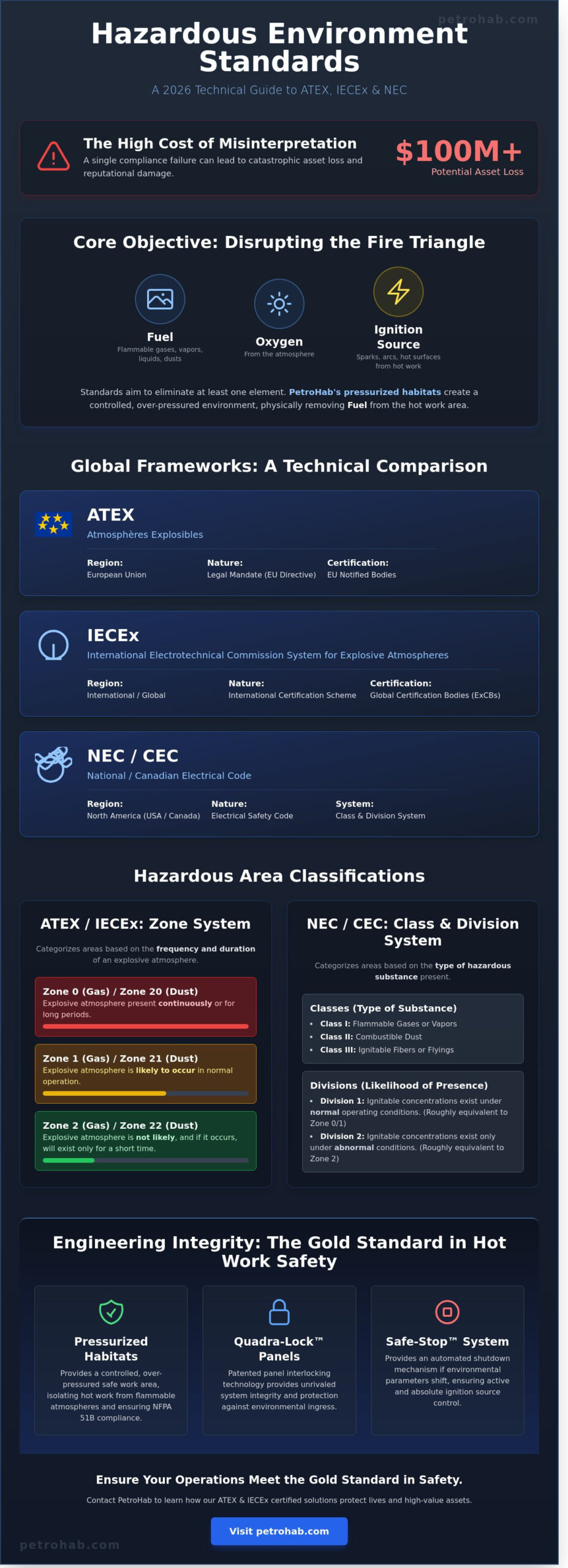
A single misinterpretation of ATEX or IECEx zone classifications can result in a catastrophic failure that costs an operator upwards of $100 million in asset loss and irreparable reputational damage. You’re likely aware that maintaining operational integrity requires more than just following basic guidelines; it demands a rigorous, uncompromising adherence to evolving hazardous environment standards. The complexity of aligning international protocols with field-ready safety protocols often creates a dangerous gap between compliance and actual site safety. PetroHab understands that for safety managers and engineers, there’s no room for ambiguity when human lives and high-value assets are on the line.
This 2026 guide provides the technical precision you need to master these complex regulations, ensuring your hot work operations remain secure against ignition risks. We’ll detail the specific differences between global zone classifications, offer a framework for selecting certified equipment, and explain how to mitigate liability through recognized engineering controls like pressurized habitats and ignition source control systems. By the end of this analysis, you’ll have a clear roadmap for implementing safety protocols that meet the gold standard in hot work safety.
Key Takeaways
- Understand the evolving global landscape of hazardous environment standards to ensure technical compliance and prevent industrial disasters.
- Compare the technical nuances of ATEX, IECEx, and NEC frameworks to navigate international regulatory requirements with precision.
- Learn to classify gas and dust zones accurately to implement effective engineering controls and mitigate ignition risks in high-risk environments.
- Discover how pressurized habitats and NFPA 51B guidelines provide a controlled atmosphere for hot work in volatile locations.
- Explore the integration of patented Quadra-Lock and Safe-Stop technologies to achieve the gold standard in operational safety and asset protection.
Navigating the Global Framework of Hazardous Environment Standards
Hazardous environment standards serve as the technical bedrock for operations within explosive atmospheres. These requirements dictate the design, installation, and maintenance of equipment to prevent catastrophic failures in high-risk sectors. As industrial facilities age, the reliance on these standards to protect high-value assets becomes more critical. By 2026, regulatory bodies expect a definitive transition toward enhanced ignition source control and real-time monitoring systems. This shift addresses the 12% rise in volatile organic compound leaks recorded globally since 2021.
Compliance depends on a triad of governing entities. The International Electrotechnical Commission (IEC) manages global certification through the IECEx system. In Europe, CENELEC enforces the ATEX directives, which categorize equipment based on the likelihood of an explosive atmosphere’s presence. Meanwhile, the Occupational Safety and Health Administration (OSHA) governs US operations. PetroHab maintains its status as an industry leader by engineering solutions that exceed these rigorous benchmarks, ensuring that every modular system provides unrivaled protection.
The Core Objective: Risk Mitigation and Life Safety
The fundamental goal of hazardous environment standards is the disruption of the Fire Triangle. This model identifies fuel, oxygen, and an ignition source as the three elements required for combustion. In safety-critical areas, standards aim to isolate or eliminate at least one leg of this triangle. PetroHab utilizes pressurized habitats to manage this risk, creating a controlled environment where hot work proceeds without compromising the facility’s integrity. The financial consequences of failing to meet these standards are immense. Beyond the immediate threat to life, non-compliance leads to civil penalties and the loss of production revenue, which often exceeds $2.5 million per day for major offshore platforms.
Primary Regulatory Pillars: OSHA and NFPA
In the United States, OSHA 1910.307 provides the legal framework for electrical safety in classified areas. This standard heavily incorporates NFPA 70, the National Electrical Code, ensuring that technical requirements for equipment remain consistent across state and federal jurisdictions. According to OSHA 1910.307, a hazardous location is an area where fire or explosion hazards may exist due to flammable gases or vapors, flammable liquids, combustible dust, or ignitable fibers or flyings. Our patented Safe-Stop system is designed specifically to interface with these requirements, providing an automated shutdown mechanism if environmental parameters shift. This technological remedy ensures that ignition source control remains active and absolute, mirroring the procedural nature of modern safety protocols.
Comparing ATEX, IECEx, and NEC: A Technical Breakdown
Global operations require a precise understanding of the overlapping frameworks governing industrial safety. Maintaining hazardous environment standards isn’t merely a regulatory hurdle; it’s a fundamental requirement for protecting high-value assets and personnel. In 2026, the industry is seeing a consolidation of these frameworks, yet technical distinctions remain critical for deployment across different jurisdictions.
ATEX vs IECEx: Understanding the Critical Differences
The ATEX directive is a legal mandate within the European Union, focusing on the safety of equipment used in explosive atmospheres. Conversely, the IECEx system serves as an international certification scheme designed to facilitate global trade by ensuring equipment meets identical technical specifications across borders. While ATEX relies on Notified Bodies within Europe, IECEx utilizes a network of global Certification Bodies. For projects requiring mobile units or modular habitats, knowing when to prioritize one over the other is vital. You can find more detail in our guide on ATEX vs IECEx: Understanding the Critical Differences for Hot Work Habitats.
The North American NEC and CEC Framework
North American facilities traditionally utilize the Class and Division system defined by the National Electrical Code (NEC) and the Canadian Electrical Code (CEC). This system categorizes environments based on the type of hazard, such as Class I for gases or Class II for dusts, and the probability of their presence. Compliance in the United States requires adherence to OSHA hazardous location standards, which mandate testing by Nationally Recognized Testing Laboratories (NRTLs) like UL, CSA, or FM Global.
The transition toward the Zone system, specifically through NEC Articles 505 and 506, continues to gain momentum. By 2026, approximately 65% of new large-scale energy projects in the US are expected to adopt Zone-based classification to align with international partners. This shift simplifies the application of Equipment Protection Levels (EPL), which provide a clear hierarchy of safety based on the severity of the risk. Key technical requirements for EPL include:
- EPL Ga/Da: Very high protection for Zone 0/20 environments where explosive atmospheres are present continuously.
- EPL Gb/Db: High protection for Zone 1/21 environments where hazards are likely to occur in normal operation.
- EPL Gc/Dc: Enhanced protection for Zone 2/22 environments where hazards are unlikely but possible.
Modern safety protocols demand versatile equipment. PetroHab’s modular systems, including the patented Petro-Wall, are engineered to meet these rigorous hazardous environment standards. The trend toward dual-certification ensures that pressurized habitats can transition between different regulatory jurisdictions without compromising integrity. This technical adaptability is the gold standard for ignition source control in modern oil and gas operations. If you’re planning a multi-regional project, consult with our technical experts to ensure your site remains compliant and secure.
Understanding ATEX Zone Classifications and Ignition Source Control
Effective risk management in the oil and gas sector begins with precise area classification. Under current hazardous environment standards, operators must distinguish between gas and dust risks to prevent catastrophic failure. These classifications determine the necessary engineering controls and the type of pressurized habitats required for hot work operations. Failure to accurately categorize an area leads to either insufficient protection or unnecessary operational costs. PetroHab provides the technical expertise to ensure your site meets these rigorous requirements without compromise.
Classifying Zones 0, 1, and 2 for Practical Operations
Zone classifications are based on the frequency and duration of the occurrence of an explosive atmosphere. In gas and vapor environments, three distinct levels exist. Zone 0 defines areas where an explosive atmosphere is present continuously or for long periods, typically exceeding 1,000 hours per year. Zone 1 identifies areas where such an atmosphere is likely to occur in normal operation, usually between 10 and 1,000 hours per year. Zone 2 covers locations where an explosive atmosphere isn’t likely to occur in normal operation, but if it does, it’ll persist for less than 10 hours per year.
Dust and fiber hazards follow a parallel structure with Zones 20, 21, and 22. Compliance with OSHA HAZWOPER standards is essential for operations involving hazardous waste, but ATEX specifically governs the equipment and protective systems used in these explosive atmospheres. For a deeper dive into the specific requirements for each area, refer to our ATEX Zone Classifications: A Technical Guide for Hot Work Safety in 2026.
Managing Sources of Ignition in Volatile Atmospheres
Ignition source control is the foundation of any hot work safety enclosure. While electrical sparks are a well-known threat, mechanical and thermal sources are often overlooked. PetroHab’s patented Petro-Wall systems are engineered to mitigate these risks by creating a physical barrier that isolates the work area from the surrounding environment. The specific zone classification directly dictates the protection level required for any equipment introduced to the environment.
- Surface Temperature Limits: Equipment must adhere to T-ratings (T1 to T6). For instance, a T4 rating ensures the equipment’s surface temperature doesn’t exceed 135°C, which is critical when working near gases with low auto-ignition temperatures.
- Mechanical Ignition: Friction sparks from grinding or impact can ignite volatile mixtures. Pressurized habitats prevent these sparks from reaching the external atmosphere.
- Static Electricity: Proper grounding and the use of antistatic materials in hazardous environment standards prevent electrostatic discharge.
Our Safe-Stop system provides an automated layer of protection. It’ll shut down hot work tools instantly if it detects a loss of pressure or the presence of gas. This proactive approach ensures that even if an ignition source is present, it can’t interact with a flammable medium. By integrating modular habitats with advanced monitoring, PetroHab remains the gold standard in protecting high-value assets and human life.
Implementing Standards in Hot Work: The Role of Pressurized Habitats
Adhering to hazardous environment standards requires moving beyond administrative controls toward robust engineering solutions. In high-risk facilities like offshore platforms or refineries, hot work safety enclosures (HWSE) function as the primary defense against ignition events. These systems create a controlled environment where welding and grinding can proceed without halting production. PetroHab’s modular habitats are designed to meet these rigorous demands, ensuring that operations remain both productive and compliant.
NFPA 51B and the Hierarchy of Fire Prevention
The NFPA 51B standard establishes a clear hierarchy for risk mitigation. It mandates that operators first attempt to relocate hot work to a non-hazardous area or move combustibles away from the work site. When these options are technically unfeasible, isolation becomes the mandatory protocol. PetroHab’s modular habitats provide the highest level of isolation by physically separating ignition sources from potential fuel sources. This engineering control is a critical component of modern safety management. For a deeper technical breakdown, consult our NFPA 51B Standard: The Definitive Guide to Hot Work Fire Prevention in 2026.
Achieving Compliance through Positive Pressure Habitats
The core of HWSE technology is positive pressure. By maintaining an internal air pressure higher than the external atmosphere, typically by 0.05 inches of water gauge, the habitat ensures that flammable gases cannot enter the enclosure. This mechanism is supported by a continuous air intake from a remote, verified source. Compliance requires more than just pressure; it demands automated oversight. Our Safe-Stop system provides continuous monitoring of the internal atmosphere, automatically cutting power to welding equipment if pressure drops or gas is detected. You can verify these requirements using The Comprehensive OSHA Hot Work Guidelines Checklist for 2026.
Integrating HWSE into a Permit-to-Work (PTW) system streamlines the approval process. It ensures that every hot work activity is preceded by a rigorous risk assessment and supported by active engineering controls. This approach aligns with OSHA 1910.146 requirements for confined spaces by providing necessary ventilation and gas monitoring. By incorporating these systems, safety managers can effectively manage the following:
- Ignition Source Control: Ensuring sparks and slag are contained within the Petro-Wall panels.
- Atmospheric Integrity: Continuous fresh air exchange prevents the buildup of toxic fumes or oxygen depletion.
- Automated Safety Loops: Immediate shutdown of tools if hazardous conditions are detected outside the habitat.
PetroHab remains the gold standard in hot work safety, offering unrivaled protection for your most critical assets. Explore our patented Petro-Wall systems today.
Engineering Integrity: How PetroHab HWSE Exceeds Global Standards
PetroHab’s Hot Work Safety Enclosures (HWSE) represent a definitive shift from passive protection to active hazard mitigation. As industrial operations push into more volatile territories, adhering to hazardous environment standards requires more than basic fabric barriers. Our engineering philosophy centers on structural rigidity and automated response, ensuring that hot work proceeds without endangering personnel or multi-million dollar assets. By integrating patented mechanical locking systems with advanced sensory arrays, PetroHab provides a controlled environment that exceeds the rigorous demands of ATEX, IECEx, and ISO certifications.
Quadra-Lock and Material Integrity
PetroHab’s Quadra-Lock technology eliminates the structural vulnerabilities found in legacy enclosures. Traditional methods often rely on zippers or adhesive tapes; these components frequently fail under high pressure or prolonged heat exposure. The Quadra-Lock system utilizes a patented interlocking panel design to create a rigid, unified structure that resists deformation. This mechanical bond ensures the enclosure maintains the 0.1 inch water gauge positive pressure differential required by international safety codes. Air-tight seals are critical for preventing the ingress of flammable gases. By securing every seam with Quadra-Lock, engineers maintain total control over the internal atmosphere. PetroHab panels are constructed from premium silicone-coated fiberglass cloth that is certified to withstand continuous temperatures of 1,000 degrees Fahrenheit.
Safe-Stop: Automated Monitoring and Ignition Source Control
The Safe-Stop system provides the technological foundation for 2026 safety protocols. It functions as an autonomous guardian, monitoring gas concentrations and internal pressure levels every second. If the system detects Lower Explosive Limit (LEL) levels exceeding 10% or Hydrogen Sulfide (H2S) concentrations reaching 10 ppm, it triggers an immediate response. The fail-safe mechanism isolates power to all ignition sources within the habitat instantly. This rapid isolation occurs in less than 5 seconds, preventing potential disasters before they manifest. PetroHab remains the global partner for companies demanding uncompromising compliance with hazardous environment standards through verified ignition source control.
Engineering excellence requires human oversight to reach peak efficacy. PetroHab provides certified on-site supervisors to manage the deployment and continuous monitoring of every enclosure. These experts ensure that modular configurations meet specific site requirements, from offshore platforms to refineries. This combination of patented hardware and professional expertise ensures 100% compliance with ISO 9001:2015 quality management systems. Our modular design allows for rapid assembly without specialized tools, reducing downtime while maintaining a resilient barrier against external hazards. We don’t just provide equipment; we deliver a comprehensive safety solution built on technical precision.
- Patented Quadra-Lock: Eliminates zipper failures and ensures structural integrity under pressure.
- Real-Time Detection: Continuous monitoring of LEL and H2S levels with automatic power isolation.
- High-Temperature Durability: Materials rated for 1,000°F continuous exposure.
- Expert Oversight: On-site certified supervisors ensure every installation meets global compliance benchmarks.
Securing Industrial Operations Through Rigorous Compliance
Maintaining operational continuity in 2026 requires more than basic compliance; it demands technical mastery of evolving global safety frameworks across ATEX, IECEx, and NEC. As regulations tighten, integrating pressurized Hot Work Safety Enclosures (HWSE) remains the definitive engineering method for managing ignition sources. PetroHab delivers this technical edge through patented Quadra-Lock technology, ensuring every interlocking panel maintains a rigorous, airtight seal under pressure. Our systems carry full ATEX and IECEx certifications to provide a verified barrier against industrial hazards in the most volatile conditions. With strategic operations in Houston, Dundee, and Brazil, we provide localized technical expertise on a global scale. Engineers and safety managers rely on our Petro-Wall modular designs to protect high-value assets and human life. It’s essential to prioritize engineering integrity now to secure your facility’s future against demanding offshore and onshore risks. We’re ready to help you implement the industry’s most resilient safety protocols to ensure every worker returns home safely.
Ensure your next project meets the highest hazardous environment standards with PetroHab HWSE.
Frequently Asked Questions
What is the difference between ATEX and IECEx for hazardous environment standards?
ATEX is a mandatory European Union directive for equipment used in explosive atmospheres, while IECEx is a voluntary international certification system aimed at global harmonization. ATEX 2014/34/EU and ATEX 99/92/EC govern the legal requirements within Europe. IECEx provides a unified platform for testing and certification that facilitates international trade across 33 member countries. Both frameworks ensure that equipment meets rigorous hazardous environment standards to prevent industrial accidents and protect personnel.
How does NFPA 51B impact hot work safety protocols in 2026?
NFPA 51B dictates the standard for fire prevention during welding, cutting, and other hot work activities. In 2026, compliance requires a mandatory 35 foot fire watch radius and rigorous permit to work documentation. These protocols ensure that ignition sources are isolated from flammable materials. PetroHab systems integrate these requirements by providing a physical barrier that contains sparks and heat within a controlled environment, ensuring your site meets the latest fire safety mandates.
Can I perform welding in a Zone 1 area without a pressurized habitat?
You can’t perform welding in a Zone 1 classified area without a pressurized habitat or total plant shutdown due to the high risk of ignition. Zone 1 identifies areas where explosive atmospheres are likely to occur during normal operations. Utilizing a PetroHab pressurized habitat allows for hot work by creating a localized area of positive pressure. This technology prevents the ingress of hydrocarbons, maintaining compliance with hazardous environment standards without requiring a costly production halt.
What are the main OSHA guidelines for hot work in classified locations?
OSHA 29 CFR 1910.252 mandates that no hot work shall be performed unless the atmosphere is proven non-combustible through gas testing. Employers must implement a written permit system and provide fire extinguishing equipment immediately available at the site. In classified locations, OSHA requires the isolation of all fuel sources and the use of protective enclosures. These enclosures must prevent the escape of sparks or slag, protecting the facility from potential fire hazards during maintenance.
How does a positive pressure habitat meet hazardous environment standards?
A positive pressure habitat meets hazardous environment standards by maintaining internal air pressure at least 0.05 inches of water gauge higher than the external atmosphere. This pressure differential ensures that flammable gases can’t enter the enclosure where hot work is occurring. PetroHab’s Petro-Wall panels provide the structural integrity needed to sustain this pressure. This system effectively isolates the ignition source from the surrounding hazardous zone, allowing for safe operations in volatile areas.
What is an automatic shutdown system and why is it required for safety compliance?
An automatic shutdown system, such as PetroHab’s Safe-Stop, is a safety mechanism that instantly terminates hot work operations if it detects gas or a loss of pressure. It’s required for compliance because it eliminates human error during an emergency. If gas levels reach 10% of the Lower Explosive Limit, the system cuts power to welding machines and closes air intake valves within milliseconds. This rapid response prevents a catastrophic event and ensures the integrity of the work site.
How are hazardous zones (0, 1, 2) determined for offshore platforms?
Hazardous zones are determined based on the frequency and duration of an explosive atmosphere as defined by API RP 505 or IEC 60079-10-1. Zone 0 represents a continuous hazard for over 1,000 hours per year. Zone 1 identifies areas where a hazard exists for 10 to 1,000 hours annually. Zone 2 covers locations where explosive gases are present for less than 10 hours per year. Engineers use these metrics to specify the required protection levels for equipment.
What certifications should I look for when leasing a hot work safety enclosure?
You should prioritize ATEX and IECEx certifications for the entire system, not just individual components, when leasing a hot work safety enclosure. Ensure the unit complies with ISO 9001:2015 for quality management and meets the structural requirements of NFPA 51B. PetroHab’s habitats are engineered to these global benchmarks. They provide a documented safety record that satisfies insurance underwriters and regulatory inspectors on offshore platforms and refineries, ensuring your project remains compliant and safe.