Blog Posts
Modular Habitat Panels: Materials, Design, and Selection for Hot Work
Modular habitat panels are one part of a hot-work enclosure, not a complete protection system on their own. In oil and gas environments, their material, connections, field assembly, and integration with the wider enclosure all affect how the setup fits the work.
When comparing panels, look beyond the material description. Consider how the panels join, what assembly involves, how the enclosure fits the work area, and which operating systems the habitat requires. This system-level review helps distinguish documented product information from assumptions about performance.
This guide explains how materials, joints, and system design inform panel selection, then offers practical criteria for assessing a setup against project conditions. It also covers PetroHab’s patented Quadra-Lock technology and how its panels fit into a Hot Work Safety Enclosure, alongside the Safe-Stop Automatic Shutdown System, which monitors gas levels and pressure.
Key Takeaways
- Assess modular habitat panels as components of a complete hot-work enclosure, not as standalone barriers.
- Compare material documentation, connection design, assembly requirements, maintenance, and system integration as distinct criteria.
- Use documented product properties to guide evaluation, and keep project-specific engineering decisions separate from assumptions.
- Plan panel assembly alongside pressure requirements, operating procedures, and monitoring for the habitat setup.
- PetroHab’s Quadra-Lock Panels use patented technology and fire-resistant materials as part of its modular Hot Work Safety Enclosure offering.
What Modular Habitat Panels Do in a Hot Work Enclosure
A modular habitat panel is a connectable component used to form the temporary boundary of a hot-work enclosure. It is not a complete habitat system. Panels help separate the work area from its surroundings. The suitability of the complete enclosure depends on how its panels, connections, access points, and operating systems work together under site conditions.
How panels form part of a hot-work habitat
Panels connect to create an enclosure boundary around the task. Each joint is part of that boundary, so connection design and assembly affect how consistently the enclosure is formed. Material properties alone cannot establish whether the assembled habitat suits a particular job. Review its configuration and any pressure or monitoring requirements as part of the system.
In a pressurized habitat, the operating approach involves maintaining pressure within the enclosure. A general explanation of a positive pressure enclosure can help clarify how this differs from relying on a physical barrier alone. To understand a specific habitat, consider how its panels fit with the enclosure design and operating requirements.
Where modular panels fit in industrial work
Oil and gas maintenance may involve hot work near equipment and operations that require controlled separation. Modular panels are assembled around the work area and task to create temporary containment, rather than a permanent building wall or fixed facility partition. Their format allows an enclosure to be configured for project needs, but it does not make every panel system suitable for every hazardous area.
Before selecting a system, align the enclosure design with site conditions, work scope, and the planned operating approach. Consider how the boundary will be assembled and how the complete habitat will function, not just the panel material. PetroHab’s modular Hot Work Safety Enclosures include Quadra-Lock Panels, which use patented Quadra-Lock technology. PetroHab uses fire-resistant materials in its systems. Evaluate the complete enclosure for the intended application.
The practical takeaway is to assess modular habitat panels as components in an engineered setup. Boundary continuity depends on the panels and their interfaces, while project suitability depends on the complete system and the conditions in which it will operate.
How Panel Materials and Connections Affect Enclosure Performance
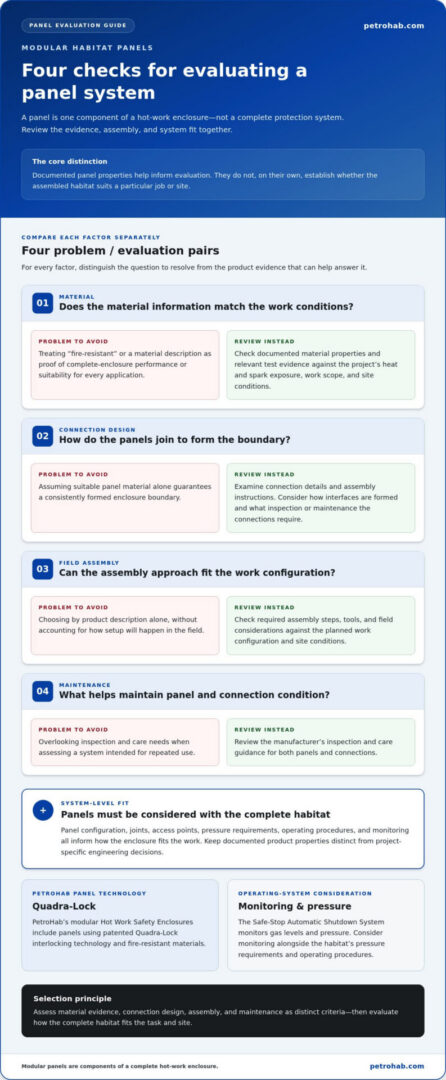
Panel selection involves more than choosing a fire-resistant material. The panel must suit the work conditions, connect into a consistent enclosure boundary, and be practical to assemble and maintain. Assess each factor separately, then consider how they work together in the complete habitat. A material description alone cannot establish system suitability.
What to evaluate in panel materials
Start with material information relevant to the project’s heat and spark exposure, work scope, and site conditions. “Fire-resistant” describes a material characteristic. On its own, it does not establish how a complete enclosure performs. The category of premium silicone-coated fiberglass panels is a material description, not proof of a particular temperature limit, test result, or suitability for every application. Review product documentation against the conditions the enclosure must address. A fire-resistant safety enclosures reference guide can provide broader context for this evaluation.
OSHA’s hot work regulations address precautions in marine terminal environments, including confining heat and sparks. Keep the standard’s scope in mind: project teams should assess the requirements that apply to their own work rather than assume one reference covers every site or enclosure.
Why panel joints and attachment design matter
Connections determine how panels join during assembly and contribute to continuity across the enclosure boundary. Review the assembly method, how interfaces are formed, and what inspection or maintenance the connections require. A suitable material cannot make up for an assembly approach that does not fit field conditions. PetroHab’s patented Quadra-Lock technology is its panel interlocking technology, and its role should be considered as part of the complete enclosure design.
Use the comparison below to separate the questions and evidence that inform panel selection:
| Evaluation criterion | Evidence to review | Operational relevance |
|---|---|---|
| Material | Documented properties and test evidence relevant to the project conditions | Helps assess whether the panel material matches the intended exposure |
| Connection design | Connection details and assembly instructions | Shows how panels join to form the enclosure boundary |
| Assembly | Required steps, tools, and field assembly considerations | Supports consistent setup for the work configuration |
| Maintenance | Inspection and care guidance | Helps maintain panel and connection condition over repeated use |
Keep documented properties distinct from questions that require project-specific engineering review. To explore how Quadra-Lock fits within PetroHab’s modular enclosure offering, visit PetroHab’s modular enclosure systems.
How to Compare Modular Habitat Panel Systems for Your Project
Compare systems against the work plan and site conditions, not a product description alone. Separate the review into four questions: what evidence supports the panel material, how connections form the enclosure boundary, what field assembly requires, and how the panels integrate with the complete habitat. These criteria help show what product information establishes and what needs project-specific engineering review.
Which project conditions should shape panel selection?
Begin with the work location, access constraints, planned hot-work scope, and deployment conditions. A maintenance task beside operating equipment may have different layout and access needs from work in a more open area. Offshore and remote-site projects also need deployment planning that accounts for how equipment and personnel reach the location. These factors guide evaluation, but the panel configuration still needs to be assessed against the project details.
Use the NFPA 51B standard as a reference for hot-work fire-prevention practices, while keeping applicable project requirements and site procedures in view. The panel system is one part of safety planning, not a substitute for it.
What evidence supports a meaningful comparison?
Review product documentation for material properties, connection details, assembly instructions, inspection guidance, and limitations relevant to the planned use. Record manufacturer statements as statements, and assess independent test results or other verifiable evidence separately. Do not infer a performance rating from a general material description. If the documentation does not answer a site-specific question, flag it for engineering review rather than filling the gap with an assumption.
Map how the panels fit the wider enclosure, including access and integration with operating equipment. For example, PetroHab’s Safe-Stop Automatic Shutdown System monitors gas levels and pressure. Reviewing monitoring alongside the enclosure helps place panel selection in the full operating arrangement. Panels themselves do not perform monitoring functions.
- Material evidence: Does the documentation address the conditions and work scope?
- Connection design: Does it explain how panels join to form the enclosure boundary?
- Assembly and maintenance: Are field setup, inspection, and care requirements clear?
- System integration: Does the panel arrangement fit the habitat’s access, operation, and monitoring needs?
Compare material evidence, connections, assembly, and system integration against the actual site and work scope. This separates documented properties from assumptions and gives you a practical basis for evaluating modular habitat panels without treating one feature as proof of whole-system suitability.
How Modular Panels Fit Assembly, Pressure, and Monitoring Requirements
Panel-system readiness depends on coordinated planning, not a panel inspection in isolation. The enclosure must match the work scope and site conditions, assemble as intended, and integrate with the habitat’s operating systems. Review these stages together so that panel boundaries, pressure management, and monitoring are considered as parts of one setup.
A practical sequence for assessing panel-system readiness
First, document the hot-work scope, work location, site conditions, and enclosure requirements. Include access constraints and the planned work arrangement, since these shape how the habitat must be positioned and assembled. Next, compare panel documentation and connection details with those requirements. Flag unanswered questions for project-specific engineering review instead of relying on assumptions.
Then coordinate assembly and system integration with the responsible project personnel. Review how panels connect, how the enclosure is configured, and how required operating equipment fits the setup. Before work proceeds, align operating checks and procedures with the project’s established safety process. This sequence connects design intent with field deployment.
How panels relate to positive pressure and monitoring
In a pressurized habitat, the enclosure boundary and pressure management work together. Panels form part of that boundary, while the complete system must support its intended operating conditions. Assess a panel connection or configuration as part of the assembled habitat, not as an independent pressure-control measure. Information on positive pressure habitats can explain the operating principles in greater depth.
Monitoring adds another layer to the operating setup, but it does not replace sound assembly or established procedures. PetroHab’s Safe-Stop Automatic Shutdown System monitors gas levels and pressure. Consider this function alongside the enclosure arrangement and project operating checks, while keeping the role of the panels separate. Pressure values, alarm thresholds, and control sequences are system-specific and should not be inferred from a general panel description.
Document requirements first, evaluate panel and connection information next, then coordinate assembly, integration, and operating checks with the project team. This keeps the role of modular habitat panels clear within the complete habitat and its procedures.
Explore PetroHab’s modular Hot Work Safety Enclosures to see how panel systems fit into a complete habitat solution.
Why Quadra-Lock Panels Belong in a Complete PetroHab Habitat Solution
Quadra-Lock Panels are part of PetroHab’s modular Hot Work Safety Enclosure offering. Their role is within the assembled habitat, where panel connections contribute to the enclosure boundary and the wider system supports the hot-work operation. PetroHab uses patented Quadra-Lock technology and fire-resistant materials in its systems. These details help identify the product approach, while project suitability still depends on review of the complete system and its intended use.
What PetroHab’s confirmed panel offering establishes
PetroHab offers Quadra-Lock Panels that use patented Quadra-Lock technology. This identifies the panel connection technology without implying performance comparisons or specifications. PetroHab’s Hot Work Safety Enclosures are complete offerings, so panel selection belongs alongside enclosure configuration and project requirements. Assess the system as a whole rather than treating panels as standalone protection.
Interpret material descriptions precisely. PetroHab uses fire-resistant materials in its systems, but that does not establish a particular temperature limit, certification, or test result. For a project review, distinguish product descriptions from supporting evidence and assess both against the intended work conditions.
Plan the next step around the project
Start with the hot-work scope, site context, access and deployment conditions, and required enclosure arrangement. Then evaluate panel documentation and connections alongside assembly needs and the way the habitat’s systems fit together. PetroHab manufactures, leases, and sells modular Hot Work Safety Enclosures, with on-site supervision and training for setup and operation. These services help align equipment use with project requirements, rather than selecting modular habitat panels by material description alone.
Monitoring is part of the broader habitat setup. Consider it alongside panel selection and enclosure operating requirements, while keeping the roles of the panels and monitoring system distinct.
A sound selection process connects the panel technology to the work scope, site conditions, assembly plan, and complete enclosure solution. For oil and gas hot work, this system-level view keeps evaluation focused on operational fit and protection needs without relying on unsupported performance assumptions.
Explore PetroHab’s modular habitat solutions to review the Hot Work Safety Enclosure options for your project.
Choose Panels as Part of the Complete Enclosure
Panel selection is strongest when it reflects the project’s work scope, site conditions, assembly needs, and enclosure requirements. Evaluate modular habitat panels as components of a complete system. Material evidence and connection design matter, as does integration with operating procedures and monitoring.
PetroHab manufactures, leases, and sells Hot Work Safety Enclosures for oil and gas applications. Its Quadra-Lock Panels use patented Quadra-Lock technology, while its Safe-Stop Automatic Shutdown System monitors gas levels and pressure. These offerings are part of a wider habitat setup, so evaluate panels alongside the complete enclosure rather than as standalone protection.
Use your project requirements to guide the next step. Explore PetroHab’s modular hot-work enclosure solutions and assess how a complete enclosure approach can support your planned work. A clear, system-level evaluation helps move the project forward with a practical basis for selection.
Frequently Asked Questions
What are modular habitat panels?
Modular habitat panels are components assembled to form the boundary of a temporary hot-work enclosure. They help separate the work area from its surroundings, but a panel is not a complete habitat or a standalone guarantee of protection. The assembled system’s suitability depends on panel materials, connections, configuration, operating equipment, and site conditions. Evaluate panels as part of the complete enclosure design and the procedures governing the work.
What should I compare when selecting modular habitat panels?
Compare documented material properties, connection design, field assembly requirements, maintenance guidance, and integration with the complete enclosure. Then consider the work scope, site conditions, access, and deployment needs. Keep manufacturer descriptions distinct from test evidence, and do not infer system suitability from a material name alone. These criteria show what the documentation establishes and which questions need project-specific engineering review before selecting modular habitat panels.
Are silicone-coated fiberglass panels suitable for hot-work habitats?
Silicone-coated fiberglass is a material category, but the name alone cannot establish suitability for a hot-work habitat. Review documentation for relevant material properties and evidence against the project’s expected conditions and work scope. Also assess the connections, assembly method, and complete enclosure design. Do not assume a temperature limit, test result, or fire-performance rating unless it is supported by product documentation applicable to the intended use.
How do modular panels connect to form a habitat?
Panels connect through the enclosure’s designed joining method to create a boundary around the work area. Connection details and the assembly approach matter alongside the panel material because they shape how the assembled enclosure is formed. PetroHab’s Quadra-Lock Panels use patented Quadra-Lock technology. Evaluate connection information and assembly requirements as part of the complete habitat design, rather than treating individual panels as independent barriers.
Do habitat panels maintain positive pressure on their own?
No. Panels form part of the enclosure boundary, but they do not independently create or maintain positive pressure. Pressure management belongs to the complete pressurized habitat system and its operating arrangement. Consider panel configuration and connections within that system, alongside project-specific operating requirements. Do not infer pressure performance from a panel description alone; use system documentation and engineering review for the intended application.
How do modular habitat panels work with gas monitoring and shutdown systems?
Panels form the physical enclosure boundary, while monitoring and shutdown equipment has a separate role in the overall habitat setup. Consider how that equipment fits alongside the enclosure configuration and operating procedures. Do not assume panels perform monitoring, or infer alarm thresholds and control sequences from a general product description. System-specific documentation should guide project planning and operational checks.
Can modular habitat panels be used for offshore hot work?
Modular panels can be evaluated as part of an offshore hot-work enclosure, but suitability depends on the project and complete habitat design. Consider the planned work scope, site conditions, access constraints, and deployment logistics alongside panel documentation, connections, and system integration. Do not infer offshore suitability from the modular format alone. Assess the enclosure and its operating requirements against the specific offshore location and work plan.