Hot Work Best Practices: A Technical Guide to Safe Operations in Hazardous Environments
The traditional belief that production must grind to a halt for essential maintenance is an outdated paradigm that costs offshore operators an average of $500,000 in lost revenue every day. You recognize that in high-hazard environments, the threat of a catastrophic ignition incident often outweighs the pressure to maintain uptime. Balancing ATEX and IECEx compliance with operational efficiency creates a constant tension for safety managers who can’t afford a single point of failure.
This guide provides the technical framework to implement hot work best practices through rigorous engineered isolation and ignition source control. You’ll master the industry-leading protocols required to execute zero-incident operations while maintaining full production integrity. It’s possible to protect your high-value assets without sacrificing your bottom line. We’ll examine the integration of patented pressurized habitats and automated systems like Safe-Stop to ensure your site meets the gold standard in safety. From modular Petro-Wall configurations to ISO-certified monitoring, we’ll detail how to transform hazardous zones into controlled work environments that prioritize human life and asset protection.
Key Takeaways
- Establish a rigorous Permit-to-Work (PTW) system and site-specific Job Safety Analysis (JSA) to identify and mitigate ignition risks before operations begin.
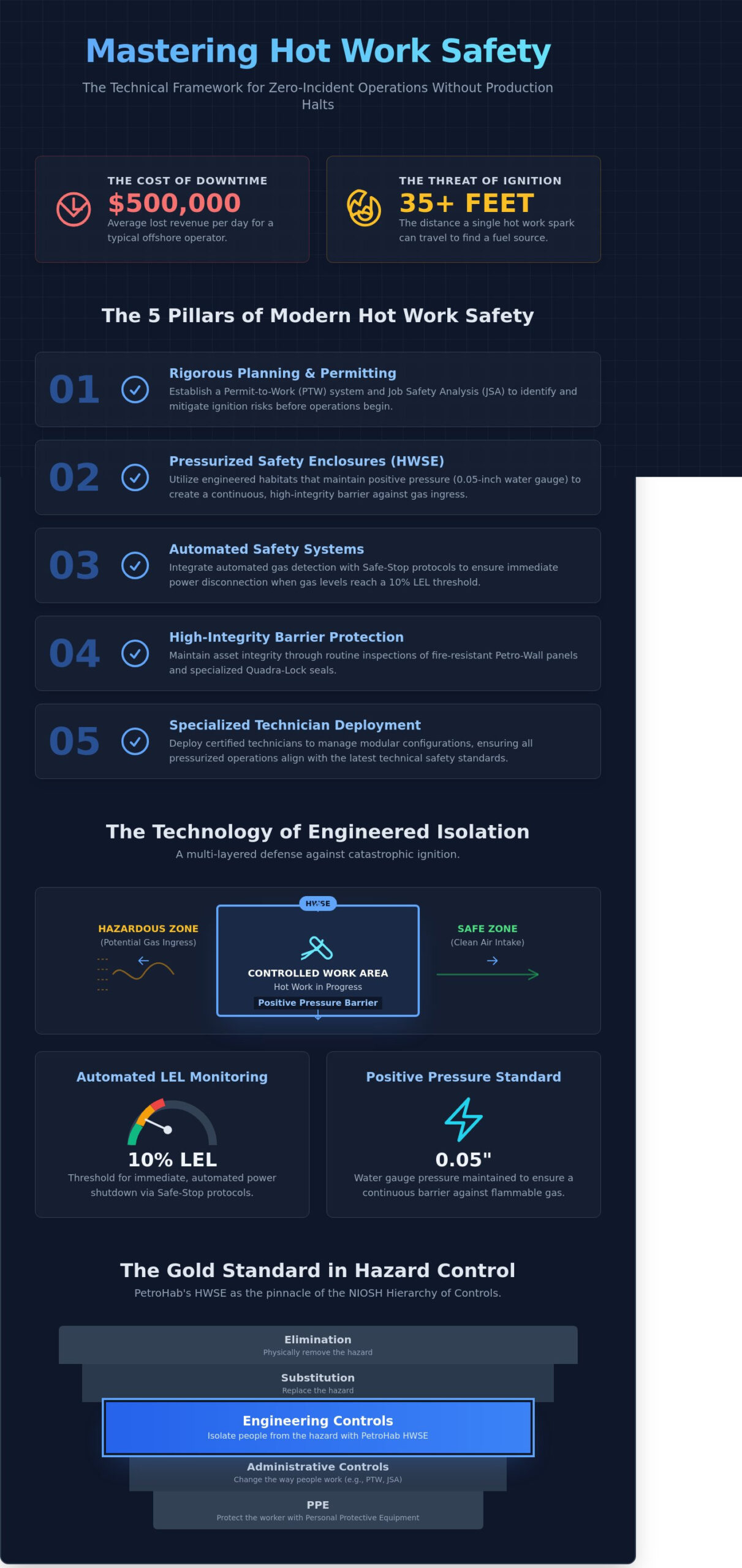
- Master industry-leading hot work best practices by utilizing pressurized Hot Work Safety Enclosures (HWSE) that maintain a 0.05-inch water gauge to prevent gas ingress.
- Integrate automated gas detection with Safe-Stop protocols to ensure immediate power disconnection when gas levels reach a 10% LEL threshold.
- Maintain high-integrity barrier protection through routine inspections of fire-resistant Petro-Wall panels and specialized Quadra-Lock seals.
- Deploy specialized habitat technicians to manage modular configurations, ensuring all pressurized operations align with the latest technical safety standards.
Defining Hot Work and the Hierarchy of Hazard Control
Hot work refers to any process that can provide a source of ignition when flammable materials or combustible atmospheres are present. To understand What is Hot Work? one must look beyond simple welding to include grinding, thermal cutting, and spark-producing power tools. By 2026 standards, these operations require absolute isolation from potential fuel sources. In hydrocarbon-rich environments, the stakes are absolute. Traditional safety measures like basic fire blankets or manual fire watches frequently fail because they don’t provide a continuous, pressurized barrier against gas ingress. A single spark can travel over 35 feet, making the containment of ignition sources a technical necessity rather than a suggestion.
Applying the NIOSH Hierarchy of Controls is essential for establishing hot work best practices. While elimination of the hazard is the most effective solution, maintenance in active oil and gas facilities often makes it impossible to move the work to a non-hazardous area. This shift in reality necessitates robust engineering controls. Our hot work safety enclosures represent the pinnacle of engineered isolation. These systems utilize our patented Petro-Wall technology to create a physical and atmospheric barrier. They’re designed to maintain positive pressure, ensuring that external gases cannot enter the workspace while hot work is performed.
The Science of Ignition in Hazardous Atmospheres
Industrial safety hinges on managing the Fire Triangle: fuel, oxygen, and heat. In a refinery or offshore platform, fuel is often present as fugitive emissions, which account for nearly 18% of unplanned ignition events in the sector. Safety managers rely on Lower Explosive Limits (LEL) to make critical decisions. When LEL levels reach 10%, operations must cease immediately. Our Safe-Stop system automates this process by integrating gas detection with power shutdown, providing a level of reliability that manual monitoring can’t match. This system prevents routine maintenance from turning into a catastrophic event by controlling the heat element of the triangle.
Regulatory Frameworks: NFPA 51B, OSHA, and Beyond
Compliance isn’t optional; it’s the foundation of operational integrity. NFPA 51B sets the baseline for fire prevention during welding and cutting, requiring a written permit system and a 35-foot clearance. OSHA 1910.252 mandates specific fire watch protocols and area preparation. For global operations, adapting hot work best practices to ATEX and IECEx standards ensures equipment integrity in explosive atmospheres. Violating these standards leads to more than just fines. It results in legal liabilities and potential loss of life. Utilizing certified, modular enclosures ensures both regulatory compliance and the protection of high-value assets.
Pre-Operational Best Practices: The Planning Phase
Planning is the primary defense against ignition in high-pressure environments. A robust Permit-to-Work (PTW) system ensures that every potential ignition source is documented and authorized before operations begin. Engineers must conduct a site-specific Job Safety Analysis (JSA) to identify localized risks that standard protocols might overlook. Adhering to OSHA Hot Work Standards requires clearing all combustible materials within a 35-foot (11-meter) radius of the work site. If materials cannot be relocated, they must be shielded using high-integrity, fire-rated barriers to prevent slag or sparks from reaching volatile substances.
The most effective hot work best practices prioritize the Alternatives Assessment. Safety managers should determine if the task can be moved to a non-hazardous area. Relocating a pipe section for shop welding is always preferable to performing live maintenance in a volatile zone. This rigorous evaluation reduces the duration of exposure and minimizes the potential for catastrophic failure.
Hazardous Area Classification and Site Survey
Before equipment deployment, technicians must verify Zone 0, 1, and 2 boundaries to determine the appropriate level of protection. This survey accounts for environmental variables such as wind direction and local ventilation patterns. Dead air spaces, where flammable gases often accumulate in concentrations exceeding 10% of the Lower Explosive Limit (LEL), require specific gas detection protocols. PetroHab’s modular systems are engineered to maintain integrity even when site surveys reveal complex airflow challenges or restricted access points.
The Role of the Fire Watch and Safety Supervisor
A designated Fire Watch holds the authority to stop operations immediately if site conditions shift. In 2026, industry standards have evolved; the traditional 30-minute cool down period is now considered insufficient for high-value assets. Modern protocols require a minimum 60-minute post-work monitoring phase to detect smoldering fires or latent heat signatures. Reliable communication between technicians and the control room is vital for rapid response. Integrating pressurized habitats into your workflow provides an additional layer of automated ignition control that complements human oversight and ensures total site integrity.
Implementing Pressurized Isolation: The HWSE Standard
Positive pressure serves as the primary defense against gas ingress during hazardous operations. By maintaining a minimum internal pressure of 0.05 inches of water gauge (w.g.), the system creates a physical barrier that prevents combustible gases from entering the workspace. This specific technical threshold is a cornerstone of hot work best practices in offshore and refinery environments. Achieving this requires high-tensile, fire-retardant fabric panels that withstand extreme heat and mechanical stress without degrading. Operators must choose between fixed and modular configurations based on the specific site geometry. Modular units offer superior adaptability for complex structural obstacles and pipe penetrations. Proper sealing at these junctions is vital. Technicians use specialized penetration kits and fire-stop materials to ensure the enclosure’s integrity remains uncompromised. Compliance with the OSHA Hot Work Standard 1917.152 ensures these procedures meet rigorous federal safety expectations for hazardous marine terminals and industrial sites.
The PetroHab Quadra-Lock Advantage
Our patented Quadra-Lock technology utilizes an interlocking panel system that eliminates traditional weak points found in velcro or zipper-based enclosures. This design significantly reduces leakage rates. It ensures a consistent internal environment even when external wind speeds fluctuate or structural vibrations occur. The modular nature of these pressurized welding habitats allows for rapid assembly in tight quarters. It’s a solution engineered for the restricted footprints typical of oil platforms and FPSOs. Structural integrity is guaranteed by the physical overlap of the panels, which provides a redundant seal against ignition sources. This mechanical locking mechanism ensures the habitat stays pressurized under the most demanding conditions.
Ventilation and Air Quality Management
Managing the internal atmosphere is a dual-purpose task. It involves maintaining positive pressure while simultaneously ensuring breathable air for the workforce. Engineers calculate air exchange rates based on the enclosure volume and the specific heat load of the welding task. Air intakes are positioned strictly in non-hazardous areas to prevent drawing in contaminated air or hydrocarbons. This setup effectively clears welding fumes and mitigates heat stress for the personnel inside. It’s not just about fire prevention; it’s about life support. Continuous monitoring of oxygen levels and toxic gas concentrations is mandatory to maintain the habitat’s protective status. High-capacity blowers ensure that even during heavy grinding or welding, the air remains clear and the pressure remains constant.
- Maintain 0.05″ w.g. pressure to prevent gas ingress
- Use fire-retardant, high-tensile panels for structural durability
- Position air intakes in verified non-hazardous areas
- Utilize interlocking panels to minimize air leakage
Automated Monitoring and Shutdown Protocols
Reliable ignition source control depends on the seamless integration of gas detection and power management. In high-risk environments, manual intervention doesn’t match the speed of digital sensors. Automated systems remove the variable of human reaction time. These protocols form the backbone of hot work best practices, ensuring that any breach in safety parameters results in an immediate cessation of hazardous activities. Manual shutdown remains a mandatory requirement, yet it acts only as a secondary backup to the millisecond response of automated hardware.
- Threshold Limits: Systems are programmed to trigger an automatic power disconnection at 10% of the Lower Explosive Limit (LEL).
- Pressure Integrity: Digital manometers maintain a minimum positive pressure of 50 Pascals within the enclosure.
- Redundancy: Dual-sensor arrays prevent single-point failures from compromising the site.
The Safe-Stop and Monitoring Ecosystem
The Safe-Stop system provides an uncompromising solution for equipment control. It acts as a definitive kill switch for all welding and sparking tools the moment a sensor detects hydrocarbons or a loss of habitat pressure. High-intensity visual strobes and audible alarms exceeding 100 decibels provide immediate notification to the workforce. This system integrates directly with facility-wide Emergency Shutdown (ESD) protocols through volt-free contacts, ensuring the entire site remains protected during a local event.
Sensor Calibration and Field Testing
Safety hardware is only as effective as its last calibration. Technicians must perform a bump test on all gas detectors before every 12 hour shift to verify sensor responsiveness. All electronic monitoring components must carry ATEX or IECEx certification to meet international safety standards. Detailed logs of these tests create a transparent audit trail, confirming that every component of the hot work best practices framework is fully operational. PetroHab maintains these rigorous standards to ensure unrivaled reliability in the field.
Ensure your site meets the highest safety standards by integrating our Safe-Stop ignition source control system into your next project.
Operational Excellence: Training and Maintenance
The integrity of a Hot Work Safety Enclosure (HWSE) depends as much on the technician as it does on the engineering. Even the most advanced pressurized habitat fails if the operator lacks the technical discipline to maintain the system. Since the 2023 update to international safety standards, the industry has shifted focus toward rigorous, data-driven maintenance and competency-based training. These elements form the final pillar of hot work best practices, ensuring that risk mitigation remains constant throughout the project lifecycle.
Training for Competence, Not Just Compliance
PetroHab-certified training programs mandate a 40-hour technical curriculum that goes beyond basic classroom instruction. Technicians must complete hands-on simulations involving 12 distinct assembly scenarios, including complex pipe penetrations and uneven flooring. We evaluate readiness through high-pressure testing and simulated gas leak responses. This ensures every technician can manage a pressurized environment under duress. Current data suggests that 85% of habitat failures stem from improper seal placement; therefore, our training focuses on the precise application of the patented Quadra-Lock system to eliminate human error.
Maintenance and Storage of HWSE Components
Maintenance protocols dictate that fire-resistant fabrics undergo a detailed inspection every 30 days of active service. Technicians look for specific end-of-life indicators, such as a 10% reduction in material tensile strength or visible degradation of the silicone coating. Cleaning requires pH-neutral solutions to preserve the reflectivity and thermal integrity of the Petro-Wall panels. In maritime climates where humidity often exceeds 85%, proper storage is critical. Components must be kept in climate-controlled environments to prevent fungal growth and salt-air corrosion, which can compromise the interlocking seals during the next deployment.
Operational safety also relies on the immediate response to system alerts. When the Safe-Stop system triggers, it terminates all ignition sources in under 0.5 seconds. Technicians must conduct weekly response drills to ensure evacuation and shutdown protocols are instinctive. Following every deployment, safety managers should perform a post-project analysis using the 24/7 data logs. These logs provide a granular record of pressure fluctuations and alarm events, allowing for a technical audit of the site’s hot work best practices. This empirical approach transforms raw data into actionable safety intelligence for future offshore operations.
Advancing Operational Integrity Through Engineered Controls
Adhering to hot work best practices requires a shift from passive observation to active, engineered intervention. The integration of pressurized isolation through HWSE technology ensures that ignition sources remain separated from combustible atmospheres. Utilizing ATEX and IECEx certified monitoring systems provides a critical layer of automated protection; meanwhile, the patented Quadra-Lock panel system maintains structural integrity under the most rigorous offshore conditions. These components work in unison to eliminate the variables that lead to catastrophic failures.
Safety isn’t a static goal but a continuous operational requirement that demands the highest technical standards. By combining rigorous pre-operational planning with the Safe-Stop automatic shutdown protocol, facilities mitigate risks that manual oversight often misses. PetroHab provides 24/7 technical support from strategic hubs in Houston and Dundee to ensure your teams have the equipment and expertise needed for zero-incident performance. Implementing these protocols protects your high-value assets and, more importantly, your personnel. We’re ready to help you elevate your safety standards today.
Secure your facility with PetroHab gold-standard Hot Work Safety Enclosures.
Frequently Asked Questions
What are the most common causes of hot work accidents in refineries?
Ignition of flammable vapors and failure to clear combustibles within the work area cause 85% of hot work accidents in refineries. According to NFPA data, inadequate gas monitoring and poor isolation of flammable materials lead to these incidents. These lapses often occur during maintenance turnarounds when oversight is stretched thin. Adhering to hot work best practices requires continuous atmospheric monitoring and physical barriers to prevent sparks from reaching volatile substances.
Can hot work be performed in a Zone 1 hazardous area?
Hot work can be performed in a Zone 1 hazardous area provided a pressurized habitat is utilized to isolate the ignition source. These environments are defined by the frequent presence of explosive atmospheres during normal operations. By maintaining overpressure within the enclosure, the system prevents the ingress of flammable gases. This technical solution allows critical repairs to proceed without a full facility shutdown, reducing operational downtime by up to 40% in offshore cases.
How does a pressurized welding habitat work?
A pressurized welding habitat works by maintaining an internal air pressure at least 50 pascals higher than the external atmosphere. This positive pressure creates a physical barrier that prevents hydrocarbon gases from entering the workspace. Fresh air is drawn from a remote location via high-capacity fans. If the pressure drops below the 50 pascal threshold or gas is detected, the Safe-Stop system automatically terminates power to all ignition sources in under 2 seconds.
What is the 35-foot rule in hot work safety?
The 35-foot rule is a safety standard from NFPA 51B that requires all combustible materials to be removed or protected within a 10.7 meter radius of the hot work site. If combustibles can’t be moved, they must be shielded with fire-resistant covers or guarded by a dedicated fire watch. This distance is calculated based on the maximum trajectory of typical welding sparks. Following this protocol is a core component of hot work best practices for preventing unplanned fires.
What certifications should I look for in a hot work safety enclosure?
You should look for ATEX and IECEx certifications to ensure a hot work safety enclosure meets international standards for explosive atmospheres. Specifically, components must comply with IEC 60079-13 for pressurized rooms. ISO 9001 certification further validates that the manufacturer maintains consistent quality control processes. PetroHab systems meet these rigorous benchmarks, providing documented proof that the equipment can withstand the extreme conditions found in 100% of offshore oil platforms.
How often should gas detection sensors be calibrated during a project?
Gas detection sensors must undergo a bump test before every shift to verify they respond correctly to target gases. Full calibration should occur every 90 days or whenever a sensor fails a bump test, according to OSHA 1910 standards. In high-risk environments, 100% of sensors are often checked twice daily to account for environmental drift. This rigorous schedule ensures the Safe-Stop system receives accurate data to maintain the integrity of the protected environment.
What is the difference between an enclosure and a pressurized habitat?
The primary difference is that a pressurized habitat uses active airflow to create a positive pressure barrier, while a standard enclosure only provides physical shielding. A standard enclosure might contain sparks, but it won’t prevent flammable gases from entering the workspace. PetroHab’s pressurized habitats utilize the patented Petro-Wall system to provide both heat resistance and gas exclusion. This dual-layer protection is necessary for operations in areas where gas presence is a constant 24/7 risk.
How does the Safe-Stop system differ from standard gas detectors?
The Safe-Stop system differs from standard gas detectors by providing an integrated, automatic shutdown of all power and ignition sources if gas is detected. While a standard detector only issues an audible or visual alarm, Safe-Stop actively mitigates the risk by killing power to welding machines and grinders in under 2 seconds. This immediate response eliminates human error and ensures that the ignition source is removed before the internal atmosphere becomes hazardous to the crew.