Blog Posts
FPSO Hot Work Habitats: Enhancing Safety During Offshore Maintenance
An FPSO hot work habitat can support safer maintenance, but the enclosure alone can’t control every hazard on a live vessel. Gas conditions, pressure integrity, nearby process equipment and changing operations all affect whether the worksite remains suitable for hot work.
Habitat planning should begin with the vessel and worksite, not just the task. Safety managers and engineers need to understand how a pressurized enclosure helps limit gas ingress, what its controls can and can’t do, and how those controls fit with site procedures and ongoing operations. Monitoring and shutdown systems support risk controls, but they don’t replace operational oversight.
This article explains the role and limits of an FPSO hot work habitat, then covers the interfaces to plan before work begins: vessel layout, pressure and gas monitoring, access, and nearby activities. It also looks at how PetroHab’s Hot Work Safety Enclosure, Safe-Stop automatic shutdown system and Quadra-Lock panels can support a project-specific hot work strategy. Use the guidance to assess the conditions, coordination and enclosure controls needed before maintenance starts.
Key Takeaways
- Match the FPSO hot work habitat configuration to the task, vessel layout and conditions at the worksite.
- Use gas and pressure monitoring to inform the planned response when conditions change.
- Assess access, nearby operations and fixed worksite constraints before mobilizing an enclosure.
- Plan the sequence from work scope and responsibilities through response arrangements and post-job review.
- Integrate enclosure, monitoring and shutdown controls with site procedures and the FPSO hot work strategy.
How an FPSO Hot Work Habitat Supports Safer Offshore Maintenance
An FPSO hot work habitat is a controlled enclosure used to support specified hot work, such as welding, cutting or grinding, within a floating production facility. It establishes a defined workspace around ignition-producing activity. A pressurized habitat uses an air supply to maintain pressure within the enclosure. Pressure and gas monitoring provide information about changing conditions. These controls support risk management, but they don’t establish that a task is suitable or eliminate every hazard.
An FPSO’s layout makes that distinction important. The planned work may be close to process equipment, structural members, narrow deck areas and active access routes. Vessel operations can also change while maintenance is underway. A habitat configuration that suits one location or task may not suit another, so the worksite and operating conditions need to shape the plan.
What makes FPSO hot work different from an onshore task?
On a floating facility, teams must consider how equipment, people and concurrent activities interact within a limited footprint. The enclosure needs to fit the work area without obstructing access or conflicting with nearby operations. Planners should assess the task location, personnel and equipment routes, adjacent process areas, and changes that could affect the worksite. These are site-specific planning factors, not universal rules for every FPSO.
The assessment should establish whether the proposed enclosure can be positioned and operated as planned, and whether conditions around it remain compatible with the work. If the layout or operating state changes, review the work plan before activity continues.
What a pressurized habitat is designed to contribute
A pressurized habitat creates a controlled enclosure around hot work. Positive pressure is intended to help limit the entry of surrounding atmosphere while the system operates as configured. For a broader explanation of the principle, see this overview of a positive pressure enclosure. PetroHab’s pressurized habitats monitor gas levels and pressure, giving personnel indications that can inform the planned response when conditions change.
The enclosure remains one part of the control strategy. It doesn’t replace the permit, task risk assessment, approved work plan or site procedures. Those arrangements govern whether hot work can proceed, who is responsible for monitoring conditions, and what actions follow an alarm or operational change. Integrate the habitat’s controls with those arrangements and the FPSO’s ongoing activities.
How Pressurization and Monitoring Support FPSO Habitat Controls
Pressurization and monitoring work together, but serve different purposes. A pressurized habitat uses an air supply to maintain pressure inside the enclosure, helping limit the entry of surrounding atmosphere while the system operates as designed. Monitoring provides information about conditions within the work area, including gas levels and pressure. These indications matter on an FPSO because external operations and site conditions can change during a job.
Gas and pressure monitoring in the work area
Monitoring is useful only when the team knows how to respond to the indications. Before work starts, the work plan should define applicable alarm limits, who monitors readings, how information is communicated, and what response follows an alarm or unexpected change. Set these details for the task and site. Don’t assume that one threshold or response timing applies to every FPSO or habitat configuration.
Monitoring supports effective control when defined limits are tied to clear response actions in the approved work plan. For example, a change in pressure or a gas indication can prompt the response established for that worksite, which may include stopping hot work and notifying responsible personnel. The plan should also cover communication and coordination with facility operations, so an indication isn’t treated as an isolated equipment event.
Automatic shutdown as one layer of the control strategy
PetroHab’s Safe-Stop is an automatic shutdown system. Its response depends on the system configuration and the conditions it is designed to address. Automatic shutdown can support work controls by initiating a defined response, but personnel still need to recognize system status, communicate promptly and follow site procedures. The shutdown function doesn’t replace supervision, work authorization or decisions about whether conditions remain suitable for the task.
Before mobilization, align the habitat’s monitoring and shutdown functions with the vessel’s response arrangements. Identify how alarms will reach the work team and relevant operations personnel, who can stop the task, and how work may resume under the approved plan. This interface matters especially when the work area is near active equipment or concurrent activity.
For project planning, PetroHab’s pressurized welding enclosures and Safe-Stop system can be considered as components of a broader risk-control strategy, alongside the vessel’s procedures and task-specific assessment. Explore PetroHab habitat systems to review equipment options relevant to that planning.
Assessing FPSO Worksites: When a Habitat Fits the Task
Assess the task and location before selecting enclosure arrangements. On an FPSO, the available footprint, nearby equipment, personnel routes and operational activity can constrain where a habitat can be positioned and how the work can be accessed. Compare the demands of the job with conditions at the specific worksite instead of assuming one enclosure arrangement suits every task.
Match enclosure arrangements to the work scope
First define the hot work activity, expected duration, work envelope and access needs. Welding on fixed pipework, for example, may require a different workspace and tool access than work on an accessible structural surface. Modular panels support project-specific habitat arrangements. PetroHab’s Quadra-Lock panels use a mechanical interlocking system. The configuration still needs to account for the actual work area and approved plan.
Use the table below to compare task demands with worksite constraints. It’s a planning aid, not a substitute for a task-specific assessment.
| Task example | Worksite constraint | Operating condition to consider | Planning question |
|---|---|---|---|
| Welding on fixed pipework | Limited room around the workpiece or adjacent equipment | Nearby activity and available access | Can the planned enclosure arrangement accommodate the work envelope and required access? |
| Grinding on a structural surface | Personnel routes close to the work area | Movement through the surrounding deck area | How will the enclosure placement relate to routes and task access? |
| Cutting in an area affected by changing operations | Worksite boundaries or access may need adjustment | Changes to nearby activity or site conditions | What conditions require reassessment under the approved work plan? |
Account for the FPSO operating environment
Before mobilization, map the proposed enclosure location against surrounding equipment, personnel routes and interfaces with ongoing work. Consider whether the habitat can be assembled and accessed without obstructing the task or conflicting with nearby activity. Focus on the specific location: a fixed obstruction, a route through the area or a change in operations may alter the practical arrangement.
Build reassessment into the approved plan in case site conditions change, including nearby activity, access availability or the work boundary. For an FPSO hot work habitat, task selection and enclosure configuration should follow this site-specific review. Identifying constraints early helps teams plan before equipment is mobilized and the work area is set up.
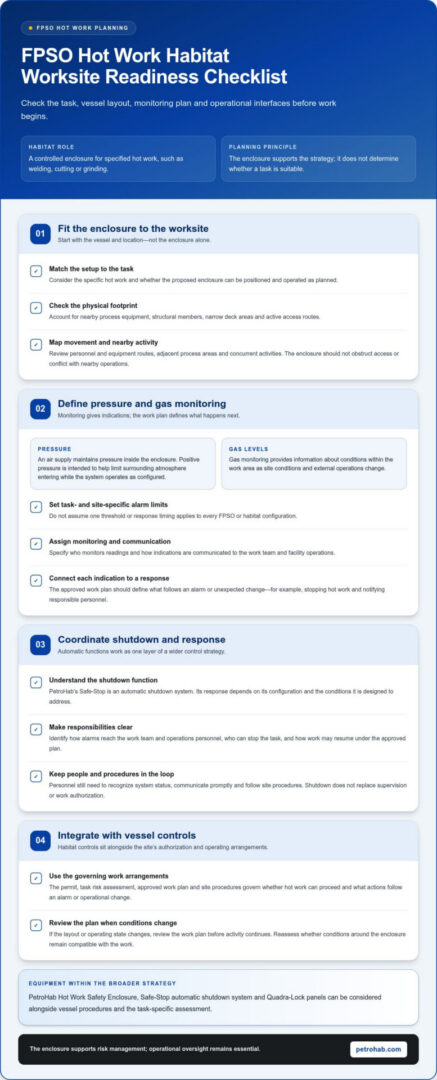
Planning FPSO Hot Work Habitat Use Before Mobilization
Plan habitat use as part of the work package, not as a last-minute equipment decision. The sequence below connects the task scope to site conditions, operating responsibilities and closeout. Project teams must follow applicable site procedures and verified requirements for the facility and work.
- Define the work scope. Describe the hot work activity, work boundaries, expected duration, tools and access needs. Record what could change the scope or require the team to pause and reassess.
- Review the worksite. Confirm the proposed location, access routes, surrounding equipment and operational interfaces. Account for concurrent activity and identify site conditions that could affect the work or enclosure arrangement.
- Select and plan the habitat configuration. Match the enclosure arrangement to the work envelope and location. Document setup needs, monitoring arrangements and how the configuration fits the approved work plan.
- Assign responsibilities and responses. Identify who oversees the work, monitors gas and pressure indications, communicates alarms and has authority to stop the task. Set out response arrangements in the work package, including how the work team coordinates with facility operations.
- Brief, operate and reassess. Ensure personnel understand their roles and the planned response before work starts. Reassess if the task scope, worksite conditions or nearby operations change, and follow site procedures before work resumes.
- Close out and review. Complete required inspections and documentation under site procedures. Record relevant observations and lessons to inform future planning.
Coordinate setup, operation, and closeout
Project supervision and trained personnel help align habitat setup and operation with the work package. Before starting, confirm communication paths for alarms and unexpected changes, and make sure the team understands the work-stoppage response. For wider coordination of simultaneous activities, consult the related SIMOPS hot work management article alongside the facility’s procedures.
PetroHab provides habitat equipment leasing, direct sales, and on-site supervision and training. Plan habitat equipment for your FPSO project with the work scope, site interfaces and operating responsibilities in view.
Integrating PetroHab HWSE into an FPSO Safety Strategy
A habitat contributes most effectively when its features are planned as part of the FPSO’s wider hot work controls. The enclosure defines the work area; pressure and gas monitoring provide indications of conditions; and Safe-Stop can provide an automatic shutdown function according to its configuration. The work plan connects these equipment controls to responsibilities, communication and the response required if conditions change. None replaces site procedures or the task risk assessment.
Relate system features to project requirements
Start with the work scope and vessel location. Consider whether a pressurized habitat arrangement fits the task, how monitored conditions will be reviewed, and what response the approved plan requires. PetroHab’s patented Quadra-Lock panel interlocking technology is part of its enclosure system. Assess its relevance alongside the planned configuration and worksite constraints, rather than treating it as standalone assurance of suitability.
Compliance decisions also depend on the project and jurisdiction. Identify and verify the requirements that apply to the equipment and work before mobilization, then align them with facility procedures. Don’t assume that a certification or requirement applies universally across FPSO projects.
Choose a practical project support route
PetroHab manufactures modular Hot Work Safety Enclosures and offers equipment through leasing and direct sales. Leasing can support a project-specific equipment need without direct purchase; purchasing provides equipment for the buyer to own. Choose the route that fits the project’s equipment planning and intended use.
PetroHab also provides on-site supervision and training. These services support teams with habitat setup and operation, while the FPSO’s approved work package continues to define work authorization, responsibilities, monitoring and response arrangements. Keep that division clear: equipment and support contribute to the strategy, while facility procedures govern the work.
For further technical context, use PetroHab’s habitat technology guide and advanced hot work systems guide alongside project documentation and applicable site procedures. A considered FPSO hot work habitat strategy brings the enclosure, monitoring, shutdown function and operational plan together around the actual task and vessel conditions. Review PetroHab’s equipment and project support options as part of that planning.
Build a More Deliberate Hot Work Plan
On an FPSO, habitat decisions need to reflect the task, vessel layout and operating conditions. A pressurized enclosure, gas and pressure monitoring, and shutdown functions can support the work, but they must sit within a clear plan for responsibilities, communication and response. Reassess the arrangement if the scope or worksite conditions change.
A well-planned FPSO hot work habitat is part of a coordinated risk-control strategy, not a substitute for site procedures. PetroHab manufactures, leases and sells Hot Work Safety Enclosures featuring patented Quadra-Lock technology, and offers on-site supervision and training to support habitat setup and operation.
Aligning equipment selection and project support with the work scope helps teams prepare with greater clarity. Discuss your FPSO hot work requirements with PetroHab and take the next planning step with confidence.
Frequently Asked Questions
What is an FPSO hot work habitat?
An FPSO hot work habitat is a controlled enclosure used to support specified hot work, such as welding, grinding or cutting, on a floating production facility. A pressurized habitat uses an air supply to maintain pressure within the enclosure and help limit the entry of the surrounding atmosphere. Its configuration and controls must align with the task, worksite conditions and approved procedures. It supports risk controls, but doesn’t replace them.
Why use a pressurized habitat for hot work on an FPSO?
A pressurized habitat establishes a defined work area around ignition-producing activity and is designed to help limit surrounding atmosphere entering the enclosure. This can support hot work planning in areas where site conditions require additional controls. It isn’t blanket authorization to proceed: the task assessment, facility procedures, monitoring arrangements and operating conditions determine whether the planned setup is appropriate for that worksite.
How does a hot work habitat monitor gas and pressure?
PetroHab’s pressurized habitats monitor gas levels and pressure. These indications help personnel assess conditions during the job and follow the response set out in the work plan if readings change or an alarm occurs. The project plan should identify who monitors the indications, how they’re communicated, and what action follows. Setpoints and response timings depend on the approved system configuration and site arrangements.
Can hot work habitats be used during FPSO operations?
They may be used when the task, habitat arrangement and operating conditions are assessed as compatible with the approved work plan. An FPSO’s layout, nearby equipment, access routes and concurrent activity can affect where an enclosure can be placed and how the work is managed. Conditions can change during a job, so teams need defined procedures for reassessment, communication and stopping work if required.
What should be assessed before mobilizing an FPSO hot work habitat?
Before mobilization, define the work scope, proposed location, work envelope, access needs and surrounding operational interfaces. Plan the habitat configuration, gas and pressure monitoring, responsible personnel, alarm communication and response arrangements. Consider how changes to the task or nearby activity will trigger reassessment under site procedures. Verify applicable project and jurisdiction requirements as part of planning, rather than relying on assumptions about a different facility or worksite.
Does a hot work habitat replace an FPSO permit-to-work process?
No. A hot work habitat is equipment that supports the worksite control strategy; it doesn’t replace the facility’s permit-to-work process, task risk assessment or approved procedures. Those arrangements govern authorization, responsibilities, monitoring and the response to changing conditions. Integrate the habitat’s pressure, gas monitoring and any shutdown functions into the work package, with clear communication between the work team and relevant facility personnel.
How do I assess whether a habitat arrangement fits an FPSO task?
Compare the task’s hot work activity, expected duration, work envelope and access requirements with the fixed constraints at the proposed location. Map nearby equipment, personnel routes and operational interfaces, then consider how the enclosure can be configured around those conditions. PetroHab’s modular Hot Work Safety Enclosures use Quadra-Lock panels. Evaluate the final arrangement against the approved plan and reassess if the scope or site conditions change.