Blog Posts
Overcoming Offshore Installation Manager Hesitation on Aging Production Spars
An aging production spar isn’t automatically unsuitable for hot work, but its condition must never be treated as a routine detail. Overcoming offshore installation manager hesitation on aging production spars starts with a documented review of structural integrity, corrosion, seabed conditions, and the controls needed to manage ignition risk. The OIM’s caution is part of sound safety decision-making, not an obstacle to work around.
That hesitation is understandable: the OIM is accountable for protecting personnel while operations continue around aging infrastructure. Approval depends on a clear understanding of the work scope and site-specific hazards, as well as effective controls that can be maintained throughout the job.
This article explains how OIM accountability shapes hot work decisions on production spars, why corrosion and seabed changes matter, and how a pressurized hot work enclosure can support ignition prevention. It also covers when concerns call for stronger controls and when the asset’s condition may make hot work inappropriate.
Key Takeaways
- Keep the OIM’s safety accountability central: hot work approval depends on a clear understanding of the work scope, hazards, and controls.
- Assess an aging spar as a whole asset, considering structural condition alongside corrosion and seabed changes.
- Use inspection findings and structural integrity assessments to identify uncertainties that could affect hot work decisions.
- Match ignition-prevention measures to the site’s hazards, and withhold approval when effective controls cannot be established.
OIM responsibilities and safety accountability
An Offshore Installation Manager (OIM) coordinates the rig, crews, equipment, and overall operation. The role also connects offshore workers with onshore clients, helping decision-makers stay informed about hazards and changing conditions. Technical experience as a driller or navigator alone does not establish effective leadership. The OIM oversees work, equipment, and work sites to assess whether requirements are met and workers are protected. On a production spar, that oversight includes understanding how planned hot work interacts with ongoing operations. A sound approach to overcoming offshore installation manager hesitation on aging production spars begins by defining these responsibilities.
Offshore experience and training underpin that accountability. Almost every flag state and operator requires at least four years of onboard service on mobile offshore units as a minimum for an OIM. Most flag states, including Liberia/LISCR, require at least one year in a supervisory technical role before OIM training. The course is delivered in line with IMO Resolution A.1079(28), and the OIM certificate is typically valid for five years. An OIM on a drilling mobile offshore unit needs IWCF Well Control Level 2 or higher. BOSIET, HUET, and GWO are examples of mandatory offshore training courses; limited availability can delay deployment.
Emergency readiness depends on procedures workers can follow before an incident occurs. The OIM can establish safety procedures, inspect work areas, and ensure emergency arrangements reflect the current operation. For hot work, this means accounting for ignition sources, nearby activities, communications, and how crews will respond if conditions change. Clear instructions matter offshore, where operational demands and worksite hazards can shift during a shift.
Independent verification, audits, and assurance can help address concerns by checking whether the hazard assessment, work controls, and emergency arrangements match site conditions. A documented review by a competent, independent party can identify gaps, while follow-up audits can confirm that corrective actions are complete. A practical framework for overcoming offshore installation manager hesitation on aging production spars links those findings to approval conditions, work pauses when controls fail, and productivity improvements that do not weaken safety. This supports responsible offshore leadership throughout the asset’s operating life.
Aging offshore production infrastructure
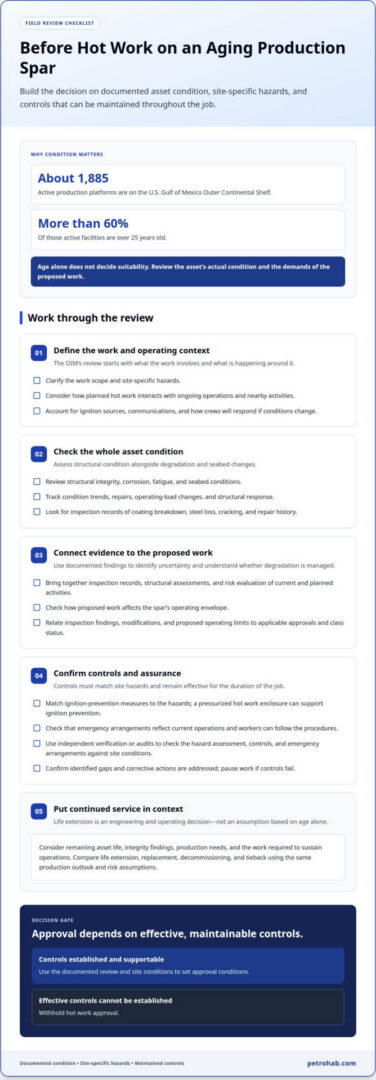
The U.S. Gulf of Mexico Outer Continental Shelf has about 1,885 active production platforms, according to the Bureau of Safety and Environmental Enforcement. More than 60% of these active facilities are over 25 years old, making asset condition central to operating and hot work decisions.
Life Extension and Alternative Costs
Life extension keeps an existing spar in service following engineering review and necessary maintenance. The decision depends on remaining asset life, integrity findings, production needs, and the work required to sustain operations. Replacement, decommissioning, and tieback each involve different engineering scopes and operational consequences. Compare these options using the same production outlook and risk assumptions. This gives decision-makers a clearer basis for determining whether continued service fits the asset’s broader operating plan.
Inspection and Life-Extension Requirements
Inspection and life-extension requirements are the regulatory and class obligations that apply to a spar’s operating condition and approved design basis. In the U.S. Gulf of Mexico, decisions must reflect the requirements applicable to the installation, its approvals, and its class status. The review should connect inspection findings, modifications, and proposed operating limits to those obligations. This ties continued-operation decisions to documented engineering evidence rather than age alone, while recognizing that requirements differ between spars.
Evidence for Continued Operation
Evidence for continued operation combines inspection records, structural assessments, and risk evaluation of current and planned activities. Review condition trends, repairs, changes in operating loads, and structural response. The assessment should also address corrosion, seabed conditions, and how proposed work affects the asset’s operating envelope. Together, these records show whether degradation is understood and managed. They also help distinguish a maintenance issue that can be controlled from a condition that could compromise continued operation or hot work approval.
Life-Extension and Decommissioning Cases
Case studies can show how operators weigh continued service against removal, but project details must match the asset type. A Gulf of Mexico decommissioning project involving reassigned assets covered 11 leases, nine platforms, nearly 200 wells, and more than 30 pipeline segments. Promethean Energy and its partners began decommissioning within 100 days. This illustrates project scale and execution, but does not establish a production-spar life-extension outcome. Such distinctions matter when applying examples to a spar-specific decision.
Corrosion and seabed erosion
Corrosion, fatigue, and seabed changes can affect different parts of a production spar, from hull steel to mooring components. Their combined condition matters because hot work can introduce ignition hazards while repairs address existing asset risks.
Inspection Data and Structural Integrity
Inspection data and structural integrity assessments compare observed condition with design assumptions and operating demands. They help identify where degradation could affect continued service or planned work. For example, records can track coating breakdown, steel loss, cracking, and repair history across hull sections and topside structures.
Assessors can also review fatigue-sensitive connections, mooring line condition, riser supports, and seabed surveys around anchors. Comparing inspection findings over time helps distinguish a stable indication from a changing one. The technical review should connect each finding to its location, severity, and effect on load paths or worksite controls.
Retrofit and Maintenance Options
Retrofit and maintenance options are engineered repairs or modifications designed to address specific degradation while preserving required function. The appropriate scope depends on the affected component and its impact on spar integrity. Corroded steel may need surface preparation and renewed protective coating, or engineered steel replacement if section loss affects capacity. Fatigue concerns may require detailed examination, repair, or changes to reduce local stress.
Mooring issues may require line or connection repairs and reassessment of the system’s condition. Riser work may involve repairing supports or affected sections, while topside maintenance can address corroded structures and equipment supports. Seabed survey findings should guide action around anchors and nearby support conditions. Coordinate these measures carefully: repairs involving hot work need controls suited to nearby hydrocarbons and ongoing operations.
Almost every intervention must account for the spar’s operating state, access limits, and interactions between systems. For example, a topside steel repair may affect adjacent piping, access routes, and simultaneous work. Linking inspection findings to the repair scope allows engineering and operations teams to assess whether the work addresses the defect without creating unmanaged risks elsewhere.
What inspection data and structural integrity assessments are needed to evaluate an aging production spar?
Start with the spar’s design basis, inspection history, repair records, and changes in operation. These records show whether current assessment assumptions match the asset’s actual condition. For example, compare drawings with modifications to the hull, deck structures, mooring systems, and riser supports. Track inspection findings by component and location so engineers can identify recurring defects, changing conditions, and areas with limited inspection coverage.
Field inspections should target relevant structural details, not just general visible condition. Ultrasonic thickness measurements can document steel loss, while weld examinations can assess cracking and other discontinuities. Corrosion mapping helps locate affected areas, and inspection records show coating deterioration and previous repairs. Mooring and riser assessments should cover component condition and connection details. Seabed survey information helps engineers assess conditions around anchors and identify changes that could affect support or load transfer.
Structural integrity assessment connects these findings to expected loads and operating conditions. Using the spar’s design information and current condition data, engineers can evaluate local strength, fatigue-sensitive details, and overall structural response. The assessment should account for modifications, repair history, and changes in operation. Where data gaps affect the analysis, targeted inspection can strengthen the basis for conclusions rather than leaving them to assumptions.
For hot work planning, link each proposed work location to nearby structural findings and operating systems. A repair near a corroded connection, riser support, or fatigue-sensitive detail may need engineering review before work begins. Document the defect, its assessed significance, the proposed repair, and the controls required during execution. This gives the OIM a traceable basis for the decision and clarifies which conditions require work limits or a pause.
Use those findings to define containment needs for hot work on an operating spar. Plan hot-work containment controls around the work scope and identified hazards.
PetroHab
PetroHab provides hot work containment options for teams planning controlled welding on aging production spars. The Petro-Habitat™ Hot Work Safety Enclosure (HWSE) and pressurized welding enclosures support hot work in hazardous environments. PetroHab’s Safe-Stop Safety Shutdown System monitors differential pressure and gas levels, and can be equipped with oxygen and/or carbon-dioxide detectors. PetroHab’s habitats use patented Quadra-Lock® technology, which joins panels without zippers. These options can support an ignition-prevention plan alongside the spar’s inspection findings, work scope, and site-specific controls. They do not replace structural assessment or the OIM’s approval process. Match the enclosure and monitoring approach to the planned work and its hazards, then include it in the hot work review. Contact PetroHab to discuss hot work enclosures for your operation.
Turn the Assessment Into a Controlled Work Plan
The next step is to connect the spar’s condition assessment to a defined hot work scope. Identify the work location, nearby operating systems, required ignition controls, and the conditions that would stop the job. This gives the OIM a clear basis for reviewing the proposed work and its boundaries. A disciplined approach to overcoming offshore installation manager hesitation on aging production spars depends on making controls specific to the asset and task.
PetroHab offers the Petro-Habitat™ Hot Work Safety Enclosure (HWSE), the Safe-Stop Safety Shutdown System, and Quadra-Lock® panels. Their relevance depends on the work plan and the hazards identified for the spar. Consider them as components of a site-specific containment and monitoring approach, not as substitutes for engineering review or OIM approval.
Bring the planned work scope and its safety requirements into the discussion early. Contact PetroHab to discuss spar work and identify an appropriate hot work containment approach for your operation.
Frequently Asked Questions
What causes offshore installation managers to hesitate about extending the life of aging production spars?
OIMs hesitate when the work plan depends on uncertain asset condition or creates conflicts with live operations. For example, a repair location may sit beside active process equipment, while access restrictions limit isolation or emergency egress. Unclear responsibility for managing simultaneous operations can also complicate approval. The key concern is whether the proposed work can be controlled without exposing crews or disrupting critical operating functions.
What are the main failure modes and safety risks for aging production spars?
Potential failure modes include corrosion-related steel loss, fatigue cracking, mooring-system deterioration, riser damage, and structural movement associated with seabed changes. A defect can affect adjacent components or change how loads transfer through the spar. For hot work, damaged coatings or nearby hydrocarbon systems add ignition concerns. A practical risk review considers both the defect itself and how repair work could interact with operating equipment.
What production, downtime, and schedule impacts should be considered when planning spar repairs or upgrades?
Assess whether the work requires process isolation, restricted access, temporary equipment shutdown, or changes to the sequence of simultaneous operations. A repair may also depend on weather windows, specialist access, materials, and inspection findings that emerge during execution. Map these dependencies against production priorities and emergency arrangements. A defined contingency for scope changes helps the team manage schedule disruption without bypassing safety controls or exceeding the approved work plan.