
Blog Posts

Positive Pressure Habitat vs Nitrogen Purging: A Technical Comparison for Hot Work
If you assume that nitrogen purging is the only way to safely manage ignition risks during hot work, you’re likely sacrificing millions in avoidable…
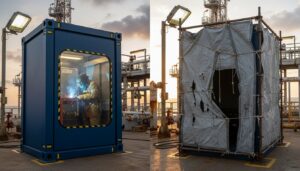
Engineered Habitat vs. Traditional Scaffold and Tarp: A Technical Safety Comparison
Is a traditional scaffold and tarp enclosure sufficient for hot work in a Zone 1 or Zone 2 environment? Most safety engineers rely on these passive…

Demonstrating Due Diligence in Hot Work Safety: A 2026 Regulatory Guide
In 2026, a signed hot work permit is no longer a legal shield. It’s merely a piece of paper if it isn’t backed by verifiable engineering containment…

Reducing Hot Work Incident Frequency Rate: Engineering Controls for Hazardous Zones
Explosions, fires, and burns accounted for 41% of the 32 fatalities in the oil and gas exploration sector in 2024. This data confirms that…

Achieving the Zero Hot Work Incidents Goal: A Technical Framework for 2026
Is achieving the zero hot work incidents goal a realistic operational target, or is it merely an aspirational metric for safety reports? With OSHA…

Hot Work Safety Presentation for Management: A 2026 Strategic Guide
How many industrial fires must occur before the financial cost of a single incident outweighs the investment in advanced containment technology? In…

Recertification Requirements for Welding Habitats: The 2026 Compliance Guide
Unplanned downtime in the offshore energy sector costs an average of $416,000 per hour. This massive financial risk often stems from regulatory…

Welding Fume Extraction Requirements for Habitats: The 2026 Engineering Guide
What if your safety enclosure is actually concentrating the very hazards it was designed to contain? In the offshore energy sector, the margin for…

Safe Habitat Entry and Exit Protocol: Ensuring Integrity in Pressurized Hot Work Environments
A single door cycle during hot work represents the most vulnerable moment in your containment strategy. You already know that maintaining positive…

Integrating Automatic Shutdown System with Habitat: A 2026 Technical Guide
A single hour of unplanned downtime in the offshore energy sector costs an average of $416,000, while onshore refineries can lose up to $1.2 million…