Blog Posts
Effects of Weather on Habitat Stability: A Hot-Work Enclosure Guide
A habitat can remain pressurized while changing weather alters the conditions around it. Wind, rain, temperature, and humidity can affect the enclosure and the work environment, which is why the effects of weather on habitat stability need attention throughout a hot-work project, not just during setup. A pressure reading alone can’t confirm that panels, connections, or the surrounding work area remain in suitable condition.
Weather changes are a practical concern for site teams. Shifting conditions may call for a fresh physical inspection and an operational reassessment, even when gas and pressure monitoring shows no alarm. A repeatable process helps the team notice changes, record them, and respond in line with site controls.
This guide explains which weather changes warrant attention and how to plan, inspect, and reassess a temporary hot-work habitat as conditions evolve. It also distinguishes physical stability checks from monitoring systems such as Safe-Stop, which monitors gas levels and pressure. PetroHab Hot Work Safety Enclosures with Quadra-Lock Panels can be incorporated into a site-specific weather plan, with the enclosure configuration and operating procedures matched to project requirements.
Key Takeaways
- The effects of weather on habitat stability vary by condition and site. Assess wind, rain, temperature, and humidity against project-approved criteria.
- Use physical inspections to assess the enclosure and surrounding area. Pressure and gas monitoring provide different operational information.
- Follow a repeatable response sequence: review conditions, inspect, check monitoring, document findings, and reassess when conditions change.
- Assign clear responsibility for inspections, monitoring, and work authorization. Follow established stop-work processes when needed.
- Include enclosure configuration in the site-specific weather plan. Modular Hot Work Safety Enclosures can support project planning but don’t replace site controls.
What Weather-Related Habitat Stability Means for Hot Work
This guide addresses engineered hot-work habitats used in industrial settings, not wildlife or ecosystem habitat stability. Here, stability means maintaining the enclosure’s intended physical condition and controlled operating environment as site conditions change. The Hot work safety overview provides general context on hazards and precautions associated with work that can create ignition sources. Weather adds another planning consideration: its effects on habitat stability depend on the site, enclosure configuration, and operating conditions.
Stability has several dimensions. A habitat may meet one check while requiring attention in another, so assess each control separately. For example, a pressure reading can be within the project’s criteria even when a physical inspection identifies a loose connection. The checks answer different questions and should not be treated as substitutes.
For general context on changing weather and precautions, watch this video:
Which kinds of stability matter at an industrial worksite?
Physical condition concerns the enclosure itself: panels, connections, supports, anchoring, access points, and any observed movement. Inspections look for visible changes that could affect the installed structure. Pressure stability is a monitored operating condition. A pressure reading can indicate whether pressure is being maintained, but it doesn’t prove that panels, connections, or supports are physically sound.
Gas monitoring and hot-work authorization address operational conditions, not the results of a visual inspection. A gas monitor reading within the project’s approved parameters, for instance, doesn’t rule out movement or damage to the enclosure. Keep these checks distinct, assign responsibility for each, and follow established procedures if an inspection or monitoring result prompts reassessment.
Why weather assessment must be site-specific
Exposure varies from one installation to another. A habitat beside surrounding structures may face different wind and precipitation conditions than one at an open site or offshore location. The effects also depend on how the enclosure is configured and installed, nearby structures, and the phase of work. Conditions during installation, operation, and changes to the work area may each call for different checks.
Use approved project and equipment documentation to establish applicable operating limits and response steps. Don’t apply a universal wind, rainfall, or temperature threshold to every habitat. Reassess when weather or site conditions change, and keep physical inspection findings separate from pressure and gas readings. This site-specific approach helps teams determine whether the enclosure and its controlled operating environment remain appropriate for the planned work.
How Wind, Rain, Temperature, and Humidity Can Affect Habitat Stability
Weather observations help teams identify when to reassess a hot-work habitat, but they don’t establish what the equipment can withstand. Wind may create movement or loading; rain can change access and conditions around the enclosure; temperature and humidity may affect work planning and equipment checks. OSHA’s Environmental heat factors guidance identifies air temperature, humidity, sunlight, and air speed as factors to consider when assessing heat hazards. Apply relevant site procedures alongside the habitat’s approved project and equipment documentation.
Wind exposure, enclosure movement, and connections
A sheltered placement and an exposed location can experience different wind conditions. During inspections, look for movement, loosened connections, or changes in panel alignment. These observations warrant assessment against project-specific criteria and documented stop-work processes. Don’t assume that an enclosure’s appearance or pressure reading establishes its wind capability. Use the approved documentation for the installed configuration.
Rain, temperature, and changing site conditions
After rain, check for water accumulation, affected access, changes to surrounding surfaces, and visible changes to the enclosure. Include temperature and humidity in the site work plan, along with decisions about work conditions and equipment checks. Treat each observation as a prompt to follow the established reassessment process, not as evidence that a product has a specific weather-resistance or performance rating.
Keep the assessment practical. A change in exposure, standing water near the work area, or an unexpected change in panel alignment can prompt a closer inspection. Record what changed, where it occurred, and which project criteria informed the response. If conditions reach a documented stop-work point, follow the site’s established process before work proceeds.
Weather observation is a trigger for assessment, not proof of an equipment limit or rating. Evaluate the effects of weather on habitat stability against the approved criteria for the project, the habitat, and its installed configuration. Avoid applying a universal wind, rainfall, temperature, or humidity threshold unless the relevant documentation establishes one.
PetroHab’s modular Hot Work Safety Enclosures can be included in a site-specific weather and hot-work plan. Review modular hot-work enclosure options alongside the project requirements that guide configuration and operation.
Compare Physical, Pressure, and Operational Stability Before Work
Before hot work begins, assess the enclosure’s physical condition separately from its monitored operating conditions and work authorization. Weather changes can prompt reassessment, but no single reading confirms that every control remains effective. This comparison clarifies what each check can show, what it cannot establish, and who should respond under site procedures.
| Check category | What it indicates | What it cannot prove | Appropriate response owner |
|---|---|---|---|
| Physical condition | Visible condition of panels, connections, supports, access points, and signs of movement. | That pressure and gas conditions meet project requirements, or that work is authorized. | Personnel assigned to inspect the enclosure; escalate findings through site procedures. |
| Pressure monitoring | The monitored pressure condition within the system’s documented operating scope. | That the enclosure is physically undamaged, gas readings are acceptable, or work can proceed. | The designated monitoring operator or responsible site personnel. |
| Gas monitoring | Gas levels monitored within the system’s documented scope. | That panels, supports, and connections are intact, or that work authorization is current. | The personnel assigned to monitor and respond to gas readings. |
| Work authorization | Whether work has been reviewed and authorized under site procedures. | That conditions remain unchanged after authorization or that enclosure and monitoring checks have passed. | The designated site authority responsible for work authorization. |
What pressure and gas monitoring can tell the work team
Safe-Stop monitors gas levels and pressure. These readings provide operational information within the system’s documented scope; they don’t measure weather or replace a physical inspection. A normal reading doesn’t establish that the enclosure has no movement or visible damage. An alarm calls for the response defined by site procedures, not an assumption about its cause. Weather changes should prompt assessment against project criteria rather than assumptions about system performance.
What a visual enclosure inspection can reveal
Inspect panels, connections, supports, access, and any visible movement. If rain, wind, or other changing conditions coincide with a shift in panel alignment or a loosened connection, record the observation and escalate it through the site’s established process. Inspection findings complement pressure and gas monitoring: they assess physical condition, while monitoring tracks specified operating conditions.
Assess the effects of weather on habitat stability with checks that work together, not as substitutes for one another. Keep inspection records, monitoring results, and authorization status distinct. If any check identifies a concern, follow the applicable reassessment or stop-work process before work continues.
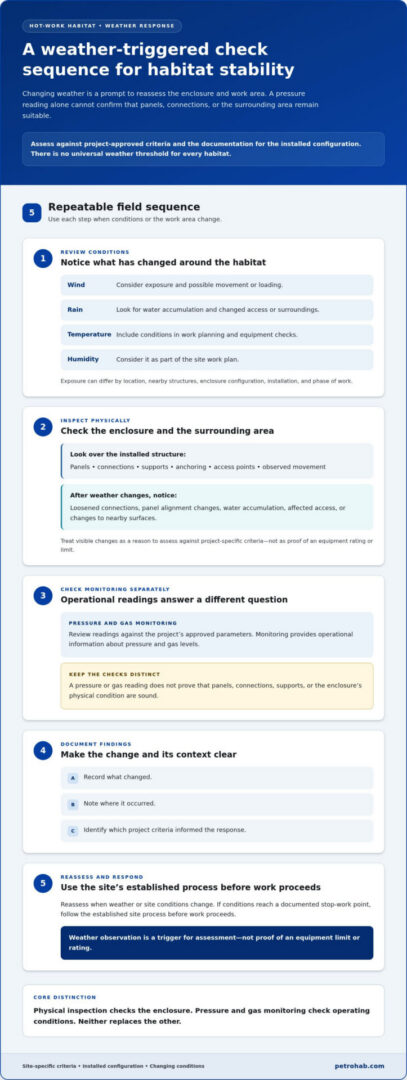
Use a Weather-Response Checklist for Hot-Work Habitats
A repeatable sequence helps the site team respond consistently as conditions change. Use the project’s approved criteria, assign each check to responsible personnel, and follow established stop-work procedures when a concern arises. This checklist supports site procedures and competent assessment; it doesn’t replace either.
- Review conditions. Before work begins, review forecast information alongside the project’s approved weather-related operating criteria. Recheck conditions when exposure changes or material weather develops. Don’t substitute a general forecast for the limits and instructions that apply to the project and equipment.
- Inspect the installed habitat. Compare the setup with the documented configuration. Check panels, connections, supports, access, and visible movement. Record findings and report changes through the site’s established process.
- Check monitoring arrangements. Confirm that pressure and gas monitoring are set up and reviewed according to documented system procedures. Monitoring results provide operational information, but they don’t replace physical checks or work authorization.
- Document findings and decisions. Record weather observations, inspection results, monitoring status, anomalies, and the names or roles of responsible decision-makers. Clear records help the team understand what changed and why work was paused, continued, or reassessed.
- Reassess before affected work resumes. After a material weather change, repeat the relevant checks before restarting affected work. If an inspection or monitoring result raises concern, escalate it and follow the site-defined suspension and approval process. Resume only after required checks and approvals are complete.
Before weather changes or work begins
Establish who reviews forecasts, inspects the enclosure, checks monitoring, and makes work-status decisions. Note the installed configuration and applicable project criteria so the team has a clear basis for reassessment. Responsibilities should be understood before conditions deteriorate, not assigned during an incident.
During and after changing conditions
Use observed changes to guide the response. For example, if wind or rain is followed by visible movement, affected access, or a change in enclosure condition, document it and escalate under site procedures. Recheck relevant monitoring as well. Don’t treat a normal reading as authorization to restart when physical checks or required approvals remain outstanding.
The effects of weather on habitat stability are project-specific, so the response must follow the approved limits and procedures for the installation. For information about modular enclosure configurations, explore PetroHab Hot Work Safety Enclosures.
How Engineered Hot-Work Habitats Support Weather Planning
A hot-work habitat is one part of a site-specific control plan. Consider its configuration alongside the proposed work, placement, site exposure, surrounding structures, and conditions expected during each work phase. These factors help the project team define inspection points, applicable operating criteria, and reassessment steps. The effects of weather on habitat stability can’t be managed through enclosure selection alone; planning must also account for how the installed habitat will be assessed and operated as conditions change.
Connect enclosure selection to exposure and work conditions
PetroHab manufactures modular Hot Work Safety Enclosures for industrial hot-work applications. Modularity allows the enclosure arrangement to be considered in relation to the project scope and site requirements. It doesn’t, by itself, establish a weather rating or confirm performance under particular conditions.
Quadra-Lock Panels are part of PetroHab’s offering. Consider them within the documented enclosure configuration, not as proof of a specific weather capability. Project teams should use approved equipment documentation and site criteria when evaluating how the habitat is installed and exposed.
Integrate enclosure checks with monitoring and site controls
Engineered equipment works within a broader operating framework. Keep responsibilities distinct: personnel inspect the enclosure’s physical condition, designated operators review monitoring, and the responsible site authority manages work authorization under project procedures. Safe-Stop monitors gas levels and pressure. It doesn’t replace visual inspection, establish weather conditions, or authorize work on its own.
After a change in exposure or other material site conditions, reassess the installed configuration, relevant monitoring, and work status under established procedures. Record findings and follow the project’s decision process before affected work continues. This connects enclosure planning to operational controls without relying on an assumed performance claim.
For related guidance, use this article’s earlier sections on hot-work enclosure inspections and pressurized habitat monitoring as part of the planning review. Information about habitat options is available through PetroHab hot-work habitat solutions.
Build Weather Reassessment Into Every Hot-Work Plan
The effects of weather on habitat stability depend on site exposure, installation, and changing work conditions. A consistent response starts with project-approved limits and timely reassessment when weather shifts. Keep physical enclosure inspections separate from pressure and gas monitoring, and treat both as distinct from work authorization. Each check answers a different question; together, they support informed site decisions.
PetroHab manufactures modular Hot Work Safety Enclosures for oil and gas operations. Quadra-Lock Panels are part of its offering, while the Safe-Stop Automatic Shutdown System monitors gas levels and pressure. These engineered systems support site controls alongside project procedures and physical inspections.
Plan deliberately, document changes, and follow established stop-work and restart processes. Review PetroHab hot-work habitat solutions to explore modular enclosure options for your project requirements. With a disciplined, site-specific plan, teams can respond to changing conditions with greater clarity and control.
Frequently Asked Questions
How does wind affect a hot-work habitat?
Wind can place load on an enclosure and may contribute to movement or changes in panel alignment and connections. Exposure varies by location, so a sheltered installation and an open or offshore site shouldn’t be assessed using the same assumptions. Compare actual conditions with the project’s approved criteria and equipment documentation. If an inspection finds movement or another concern, follow the site’s reassessment and stop-work procedures before continuing.
Can rain affect the stability of a welding habitat?
Rain can change conditions around a habitat even if it doesn’t visibly affect the enclosure. Check for water accumulation, changes to nearby surfaces, affected access, and visible changes to panels or connections. These observations help determine whether the work area and installed habitat need reassessment. Follow project procedures and approved equipment guidance to decide on next steps; don’t assume that rain alone confirms either a problem or acceptable conditions.
What weather conditions should be checked before hot work?
Review forecast and current conditions for wind, rain, temperature, and humidity, along with the habitat’s exposure and the planned work conditions. Consider whether nearby structures shelter or expose the enclosure, and check project-approved weather criteria and equipment documentation for applicable limits. The effects of weather on habitat stability depend on the specific installation. Reassess if conditions change instead of relying on a forecast reviewed only at setup.
Does normal pressure monitoring prove a habitat is stable?
No. A normal pressure reading provides information about a monitored operating condition, but it doesn’t prove that panels, connections, or supports are physically sound. Safe-Stop monitors gas levels and pressure; it doesn’t measure weather or replace an enclosure inspection. Check physical condition separately, review monitoring under documented system procedures, and confirm work authorization through site processes. Each check answers a different question.
What should workers do if weather changes during hot work?
Follow the site’s established process for reassessing conditions and suspending work when required. Responsible personnel should review the change, inspect the enclosure and surrounding area, and check relevant monitoring under documented procedures. Record concerns and escalate them to the designated decision-maker. Resume affected work only after required checks and approvals are complete. Don’t treat an unchanged pressure reading as sufficient reason to continue or restart.
How often should a hot-work habitat be inspected in changing weather?
There isn’t a universal inspection interval that applies to every habitat and site. Follow the project’s inspection schedule and equipment documentation, and reassess after material weather or exposure changes and before affected work resumes. The inspection should consider the installed enclosure and surrounding conditions, while pressure and gas monitoring follow their own documented procedures. Assign inspection responsibility clearly and record findings so the team can act on changes consistently.
Can a pressurized habitat eliminate weather-related risks?
No. A pressurized habitat is one element of a site-specific hot-work control plan, not a guarantee that weather-related risks are eliminated. Configuration, placement, exposure, physical inspections, monitoring, and work authorization all matter. Use project-approved criteria to guide operation and reassessment as conditions change. Engineered enclosures and systems such as Safe-Stop can support site controls, but they don’t replace established procedures or competent assessment.