Blog Posts
Fire-Resistant Safety Enclosures: A Reference Guide for Industrial Hot Work
The assumption that any fire-rated material provides sufficient protection during offshore welding is a dangerous misconception that compromises site integrity. While static fire-rated barriers serve their purpose in civil construction, high-stakes industrial hot work requires modular fire-resistant safety enclosures engineered to withstand the relentless thermal stresses of a Grade A-60 environment. It’s often difficult to reconcile the conflicting demands of stringent ATEX and IECEx requirements with the need for rapid, modular deployment on aging offshore assets where salt spray and humidity degrade standard materials.
This guide serves as your definitive technical reference for the engineering principles and material standards, such as NFPA 51B, that define the gold standard in ignition source control. We’ll provide a rigorous framework for evaluating the durability of pressurized habitats and demonstrate how to present concrete evidence of risk mitigation for your next permit-to-work approval. We examine the specific material science behind the patented Petro-Wall system and the critical role of automated shutdown protocols in protecting your high-value assets and personnel.
Key Takeaways
- Evaluate the technical performance of silicone-coated fiberglass and advanced composites against NFPA 51B standards to ensure material integrity during high-heat operations.
- Understand the critical engineering distinction between passive barriers and pressurized fire-resistant safety enclosures that utilize positive pressure to exclude explosive gases.
- Navigate complex regulatory landscapes by aligning hot work protocols with ATEX and IECEx requirements for hazardous Zone 1 and Zone 2 environments.
- Discover how patented Quadra-Lock panel technology provides a modular, airtight seal that surpasses traditional static protection methods.
- Integrate habitat technology into the Permit-to-Work (PTW) process to streamline operations while maintaining an uncompromising commitment to asset protection and risk mitigation.
Understanding Fire-Resistant Safety Enclosures in Industrial Hot Work
Fire-resistant safety enclosures serve as the primary engineering control for managing ignition risks in high-hazard industrial sectors. These systems provide a definitive physical barrier between high-temperature activities and potentially explosive atmospheres. Unlike passive fire protection, which focuses on structural fireproofing, an active Positive pressure enclosure creates a controlled environment by managing air pressure and filtration. This technology is indispensable for welding, grinding, and cutting operations in refineries and offshore platforms where hydrocarbon vapors are a constant threat. The fundamental goal is simple: eliminate the possibility of an ignition source meeting a fuel source.
The Evolution of Hot Work Safety
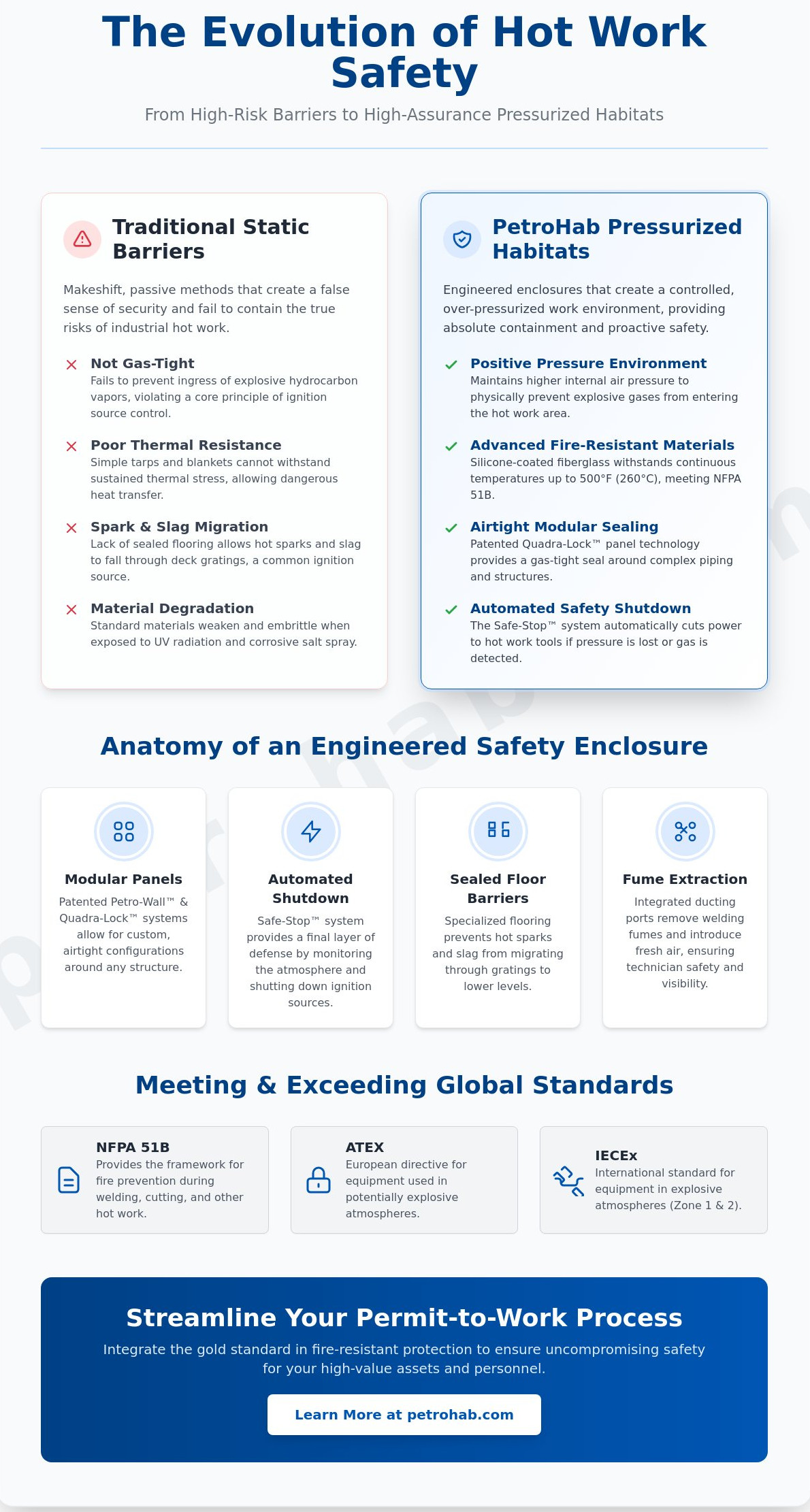
Industrial safety has moved far beyond the era of makeshift welding blankets and simple tarps. These early methods often failed because they couldn’t provide a gas-tight seal or withstand sustained thermal stress. Lessons from historical incidents, such as the 1988 Piper Alpha disaster, proved that containment must be absolute. Today’s standards demand engineered modular enclosures that meet rigorous certifications like ATEX or IECEx. Modern fire-resistant safety enclosures, such as the patented Petro-Wall system, utilize advanced materials that maintain their integrity under extreme heat. These systems don’t just resist flames; they provide a structured, repeatable safety process for every hot work permit issued.
Key Components of a Safety Enclosure
The effectiveness of an enclosure depends on its mechanical design and the quality of its components. A high-performance system isn’t a single unit but a collection of integrated parts designed to work in unison. Key elements include:
- Modular Panels: These allow for custom configurations around existing piping and structural steel. Overlapping seams are critical, as they ensure the internal pressure remains higher than the external atmosphere, preventing gas ingress.
- Extraction Systems: Integration points for air ducting allow for the removal of welding fumes and the introduction of fresh air. This maintains visibility and technician health.
- Floor Barriers: A specialized floor barrier prevents spark migration through deck gratings. This is a common failure point in less sophisticated setups.
By utilizing the Safe-Stop system alongside these physical barriers, operators gain an automated layer of protection. This technology monitors the internal atmosphere and shuts down hot work equipment if it detects a loss of pressure or the presence of gas. This proactive approach defines the gold standard in modern industrial safety.
The Science of Thermal Resistance: Material Standards and Certifications
Engineering effective fire-resistant safety enclosures requires a precise selection of materials capable of withstanding extreme thermal energy. Silicone-coated fiberglass serves as the primary substrate for many high-performance panels; it offers continuous operating temperature resistance up to 500°F (260°C). Advanced polymer composites enhance this baseline by providing superior tensile strength and chemical resistance. When evaluating these materials, engineers must distinguish between thermal conductivity and flame spread. While flame spread measures how quickly a fire moves across a surface, thermal conductivity dictates how much heat transfers through the barrier to the external atmosphere. Effective ignition source control depends on minimizing both metrics to prevent the combustion of external hydrocarbons. For further guidance on comparing panel materials, joints, and assembly, see this guide to modular habitat panels for hot-work enclosures.
Compliance with the NFPA 51B standard is non-negotiable for industrial hot work operations. This standard provides the framework for fire prevention during welding, cutting, and other spark-producing activities. It mandates that enclosures act as a definitive barrier against sparks and slag. Beyond immediate fire risks, environmental degradation poses a silent threat to material integrity. Exposure to UV radiation and salt spray in offshore environments can embrittle standard fabrics over a 24-month period, reducing their protective capacity. PetroHab’s materials undergo rigorous testing to ensure they maintain their fire-retardant properties despite these harsh conditions.
Recognised International Standards
Technical data sheets often use “fire-rated” and “fire-resistant” interchangeably, but they represent different performance levels. A fire-resistant material inherently resists ignition, while a fire-rated system, tested under ASTM E119 or UL 2196, has proven its ability to maintain structural integrity for a specific duration, such as 60 or 120 minutes, under intense heat. ISO 9001 certification in the manufacturing process ensures that every modular panel meets these exacting specifications consistently. These certifications provide the technical assurance required by safety managers to deploy innovative habitat solutions in high-risk zones.
- ASTM E119: Evaluates the duration for which an enclosure can contain a fire and retain its structural integrity.
- UL 2196: Tests the ability of electrical circuit protective systems to function during and after fire exposure.
- ISO 9001: Guarantees standardized quality control throughout the production of safety hardware.
Material Durability in Harsh Climates
Offshore assets face 100% humidity and constant salt-laden air, which can corrode inferior safety equipment. Petro-Wall panels utilize non-flammable insulation that resists moisture absorption, preventing the “wicking” effect that can lead to internal corrosion or mold. These systems also demonstrate high resistance to hydrocarbon splashes and common industrial chemicals. In a 2022 performance review, modular panels with advanced coatings showed zero degradation after 2,000 hours of accelerated salt spray testing. This resilience ensures that the habitat remains a robust barrier, protecting personnel and high-value assets in the most demanding global climates.
Beyond the Barrier: Comparing Static Fire Protection vs. Pressurized Habitats
Industrial safety requires more than physical barriers. While fire-resistant safety enclosures effectively block sparks, they can’t address the invisible threat of hydrocarbon gases. A static wall provides passive protection; it acts as a shield but remains reactive. In high-risk environments like offshore platforms or refineries, a passive barrier is insufficient. True risk mitigation demands an active system that controls the atmosphere inside the enclosure.
Engineers must recognize that a fire-resistant wall is only the first line of defense. The physics of positive pressure provides the second, more critical layer. By maintaining internal air pressure higher than the surrounding atmosphere, these systems physically prevent explosive gases from entering the enclosure. If the seal is compromised, air flows out rather than allowing hazardous vapors in. This proactive approach ensures the work environment remains free of combustibles throughout the duration of the hot work operation.
Active vs. Passive Protection Systems
Active systems utilize pressurized technology to create a differential between the internal and external environments. These positive pressure habitats prevent flammable gases from migrating into the workspace. This methodology exceeds the OSHA General Requirements for Hot Work, which mandate basic fire prevention and guarding but don’t always account for pressurized gas ingress. PetroHab integrates gas detection sensors that monitor for LEL (Lower Explosive Limit) levels at the air intake and inside the unit. If pressure drops below the 0.05 inches of water column threshold or gas is detected, the Safe-Stop ASD (Automatic Shutdown System) terminates power to the ignition source within milliseconds. This automated response eliminates the risks associated with manual monitoring and human error.
Managing Ignition Sources
Effective fire-resistant safety enclosures must manage the physical byproducts of welding, such as slag and sparks, while preventing the “chimney effect.” This phenomenon occurs when heat rises through gaps in an enclosure, creating a vacuum that pulls external hazardous air into the bottom of the structure. PetroHab’s modular Petro-Wall panels utilize airtight, interlocking seals to eliminate these drafts. Unlike simple fire blankets that often leave gaps or fail to provide a complete perimeter, our patented modular systems ensure total containment of hot particles.
- Containment: Ensuring all sparks and slag remain within the fire-resistant boundary.
- Integrity: Utilizing modular panels to create a 100% airtight seal around complex piping.
- Pressure Maintenance: Eliminating air leaks that could compromise the internal atmosphere.
A rigorous risk assessment dictates when a simple fire blanket is insufficient. If a work area contains potential fuel sources within a 35-foot radius, or if volatile gases are a constant operational reality, a pressurized habitat is the only acceptable solution. Relying on passive shields in high-consequence zones ignores the technical reality of gas migration. PetroHab’s systems provide the engineering controls necessary to isolate the ignition source from the hazard with absolute precision.
Operational Standards and Regulatory Compliance
Fire-resistant safety enclosures serve as the technical cornerstone of the Permit-to-Work (PTW) process in high-risk environments. They aren’t merely physical barriers. These systems provide a localized, pressurized environment that isolates ignition sources from surrounding volatile hydrocarbons. In Zone 1 and Zone 2 areas, the presence of a certified enclosure is often the deciding factor in whether a hot work permit is granted or denied. This isolation is critical for maintaining operational uptime while conducting essential maintenance.
Adherence to ATEX and IECEx standards is mandatory for all enclosures deployed in explosive atmospheres. Specifically, these systems must comply with IEC 60079-13, which governs the protection of equipment by pressurized rooms. OSHA 1910.252 and HSE HSG253 guidelines further dictate that fire-resistant materials must contain all sparks and slag within the immediate work area. Compliance is verified through rigorous documentation. Every site must maintain a certification log and Material Safety Data Sheets (MSDS) for all enclosure panels to confirm their fire retardancy and chemical composition.
Selection Criteria for Safety Managers
Evaluating an enclosure system begins with its modularity and portability. PetroHab’s Petro-Wall panels offer a flexible solution that adapts to the complex geometries of offshore platforms. Safety managers must verify that the fire resistance rating meets site-specific heat loads, typically requiring testing against ASTM E119 standards. Choosing a manufacturer with a 20 year track record in the oil and gas industry minimizes the risk of equipment failure. Reliability in the field is the ultimate metric for protecting high-value assets and personnel.
Training and On-site Supervision
Certified personnel must oversee the assembly of fire-resistant safety enclosures to ensure every seal is airtight. A single gap can compromise the entire pressurized habitat. Pre-operational inspections are a mandatory step. This checklist includes verifying that the Safe-Stop system is calibrated to trigger an automatic shutdown if internal pressure falls below 50 pascals. Common compliance pitfalls often involve improper sealing around structural penetrations or neglecting to update the certification log. These oversight errors can lead to immediate work stoppages during HSE audits. Rigorous training ensures that the controlled area remains secure throughout the duration of the hot work.
Implementing PetroHab HWSE: The Gold Standard in Fire-Resistant Protection
PetroHab engineered the Hot Work Safety Enclosure (HWSE) to address the extreme risks of ignition in hydrocarbon-rich environments. These fire-resistant safety enclosures utilize patented Quadra-Lock panel technology to ensure a modular yet airtight seal. Unlike traditional habitats that rely on hook-and-loop fasteners or zippers, the Quadra-Lock system creates a physical interlock between panels. This design maintains structural integrity even when internal pressures exceed 0.5 inches of water column. It’s a system built for the rigors of offshore and onshore refineries where failure isn’t an option.
The technical advantage extends to the integration of the Safe-Stop Automatic Shutdown System (ASD). This system acts as the brain of the enclosure; it monitors gas levels and internal pressure with millisecond precision. If the sensors detect a loss of pressure or the presence of flammable gases, the Safe-Stop ASD immediately terminates power to all ignition sources. This automation eliminates the lag of human reaction time. It ensures that fire-resistant safety enclosures provide a controlled environment for high-risk activities.
PetroHab systems facilitate live-plant welding by creating a pressurized barrier between the hot work and the surrounding volatile atmosphere. This capability allows operators to perform critical maintenance without the massive financial burden of a total plant shutdown. In a 2023 deployment for a major operator, PetroHab units enabled 15 consecutive days of welding on a live platform. This saved the client an estimated $2.4 million in deferred production costs while maintaining a zero-incident safety record.
The PetroHab Difference: Material Integrity
Petro-Wall panels define the standard for material resilience in the safety industry. These panels meet ANSI/FM 4950 standards for welding curtains and withstand temperatures exceeding 1,000 degrees Celsius. They don’t just resist flames; they maintain their tensile strength under high-pressure conditions. During a project in the North Sea, PetroHab panels successfully protected workers against 55-knot winds while internal welding operations continued without interruption. This level of durability ensures that the enclosure remains a functional safety barrier throughout the project duration.
Global Availability and Support
PetroHab provides flexible procurement options through both leasing and purchasing models. This flexibility allows safety managers to scale their protection based on specific project timelines and budgetary requirements. Every installation is backed by a worldwide network of certified safety technicians who provide 24/7 onsite support. These experts ensure that every component, from the Quadra-Lock seals to the ASD sensors, functions according to ISO and ATEX certifications. Securing your site begins with deploying a specialized hot work safety enclosure designed to mitigate the most volatile industrial risks.
Advancing Operational Integrity through Engineered Protection
Managing industrial hot work requires more than a simple barrier. It demands a rigorous approach to ignition source control through certified fire-resistant safety enclosures. Integrating ATEX and IECEx compliant systems ensures your facility meets international safety standards while protecting personnel and high-value assets. PetroHab’s engineered solutions utilize patented Quadra-Lock technology to provide a modular, interlocking seal that maintains internal pressure and prevents the ingress of flammable gases. By shifting from static protection to active pressurized habitats, safety managers eliminate the risks associated with volatile environments. Our team provides global 24/7 technical support to maintain operational integrity across every project phase. Selecting the right habitat isn’t just a compliance step; it’s a fundamental commitment to zero-incident performance in the oil and gas sector. You’re not just buying equipment; you’re implementing a proven safety protocol that’s been tested in the world’s most demanding offshore and onshore environments.
Request a Technical Consultation for Your Hot Work Project
Frequently Asked Questions
What is the difference between fire-rated and fire-resistant safety enclosures?
Fire-rated enclosures are tested to maintain structural integrity for a specific duration, such as 60 or 120 minutes, under standardized fire conditions. In contrast, fire-resistant safety enclosures utilize materials designed to resist ignition and prevent the spread of flames during active hot work. PetroHab’s Petro-Wall panels are engineered to withstand continuous high-temperature exposure from sparks and molten slag without combusting. This material-level resistance ensures that the enclosure remains a reliable barrier throughout the duration of the welding or grinding task.
Can fire-resistant enclosures be used in ATEX Zone 1 environments?
Yes, PetroHab’s systems are specifically engineered for use in ATEX Zone 1 and Zone 2 hazardous areas. These enclosures facilitate hot work in locations where explosive atmospheres are likely to occur by creating a controlled environment. The system’s design prevents the ingress of flammable gases, allowing operators to perform critical maintenance without shutting down entire production lines. By maintaining rigorous compliance with ATEX and IECEx standards, these habitats provide the technical reliability required for high-risk offshore and onshore facilities.
How does a pressurized welding habitat enhance fire resistance?
A pressurized welding habitat enhances fire resistance by maintaining a positive internal pressure of at least 0.05 mbar, which creates a physical barrier against external hydrocarbon vapors. This pneumatic seal ensures that flammable gases can’t enter the work area even if there’s a leak in the surrounding facility. PetroHab’s technology pairs this pressure with fire-retardant Petro-Wall panels to create a dual-layered defense. It’s a system that isolates the ignition source from the hazardous environment, effectively neutralizing the risk of external combustion.
What are the main materials used in PetroHab safety enclosures?
PetroHab safety enclosures are primarily constructed from patented Petro-Wall panels made of high-grade fiberglass fabric coated with specialized silicone polymers. These materials are tested to withstand continuous temperatures of 500 degrees Celsius and intermittent exposure to molten metal. The modular panels are joined using heavy-duty, flame-retardant hook-and-loop fasteners to ensure a secure, airtight seal. Every component is selected for its ability to maintain integrity in the harsh conditions typical of oil and gas refineries and offshore platforms.
Is on-site training required for the assembly of modular safety enclosures?
PetroHab requires all personnel involved in the assembly and operation of their habitats to complete a formal competency training program. This typically involves a 2-day on-site session where technicians learn to manage habitat construction, seal integrity, and the Safe-Stop automatic shutdown system. Proper training ensures the enclosure’s installed correctly to meet strict safety protocols. It’s a necessary step to guarantee that the system performs as engineered, protecting both the workers inside and the facility’s high-value assets.
What happens if the fire-resistant safety enclosures lose positive pressure?
If fire-resistant safety enclosures lose positive pressure, the Safe-Stop system immediately detects the pressure drop below the 0.05 mbar threshold and cuts power to all hot work tools. This automated response happens in milliseconds to prevent any potential ignition of entering gases. The system also activates audible and visual alarms to alert the crew to the breach. Work can’t resume until the pressure is stabilized and the internal atmosphere is confirmed to be clear of any hazardous vapors.
How do these enclosures integrate with a Permit-to-Work (PTW) system?
These enclosures act as a critical physical control measure that’s documented within a facility’s Permit-to-Work (PTW) system. The PTW process requires safety managers to verify the habitat’s integrity and the Safe-Stop system’s functionality before issuing a hot work permit. Data from the habitat’s monitoring unit provides objective evidence that the work environment is controlled and monitored. This integration ensures that all welding and grinding activities align with the site’s broader safety management and risk mitigation strategies.
Are PetroHab enclosures compliant with NFPA 51B standards?
PetroHab enclosures fully comply with the NFPA 51B Standard for Fire Prevention During Welding, Cutting, and Other Hot Work. The Petro-Wall panels meet the rigorous flame resistance and heat transmission requirements specified in the 2024 edition of the standard. This compliance provides engineers and safety managers with the assurance that the equipment meets the gold standard for fire protection. By adhering to these recognized benchmarks, PetroHab ensures its systems provide unrivaled protection in the most demanding industrial environments.