Blog Posts
Habitat Supervisor Roles and Responsibilities: Ensuring HWSE Operational Integrity
What if the only thing standing between a routine weld and a catastrophic ignition in a Zone 1 environment isn’t the equipment, but the person overseeing it? Most safety managers recognize that even the most advanced Hot Work Safety Enclosure (HWSE) is only as effective as the rigorous protocol governing its use. Ambiguity in permit-to-work (PTW) compliance and confusion over habitat supervisor roles and responsibilities often create dangerous gaps in operational integrity. When high-value assets and personnel lives are at stake, assuming competence isn’t a strategy; it’s a liability.
This article provides a definitive breakdown of the duties required to maintain pressurized containment and ensure absolute safety in hazardous areas. You’ll gain a clear checklist of supervisor obligations that align with the IEC 60079-13:2017 standards and the updated January 2026 ATEX guidelines. We’ll examine how a certified expert manages technical components like Quadra-Lock panels and the Safe-Stop Automatic Shutdown System to eliminate ignition risks. By clarifying these critical functions, PetroHab LLC helps you move from uncertainty to a state of disciplined, incident-free productivity.
Key Takeaways
- Distinguish the specialized technical authority of a habitat supervisor from standard fire watchers to ensure clear accountability in high-risk zones.
- Identify critical habitat supervisor roles and responsibilities during the pre-operational phase, including the verification of Quadra-Lock panel integrity and comprehensive site hazard assessments.
- Understand how continuous monitoring of internal pressure differentials and management of the Safe-Stop system prevent ignition during hazardous gas excursions.
- Recognize the mandatory technical competencies and certifications required to maintain compliance with IEC 60079-13:2017 and updated ATEX guidelines.
- Learn how integrating professional on-site supervision with advanced HWSE technology provides a redundant safeguard for complex industrial projects.
Defining the Habitat Supervisor in Hazardous Zones
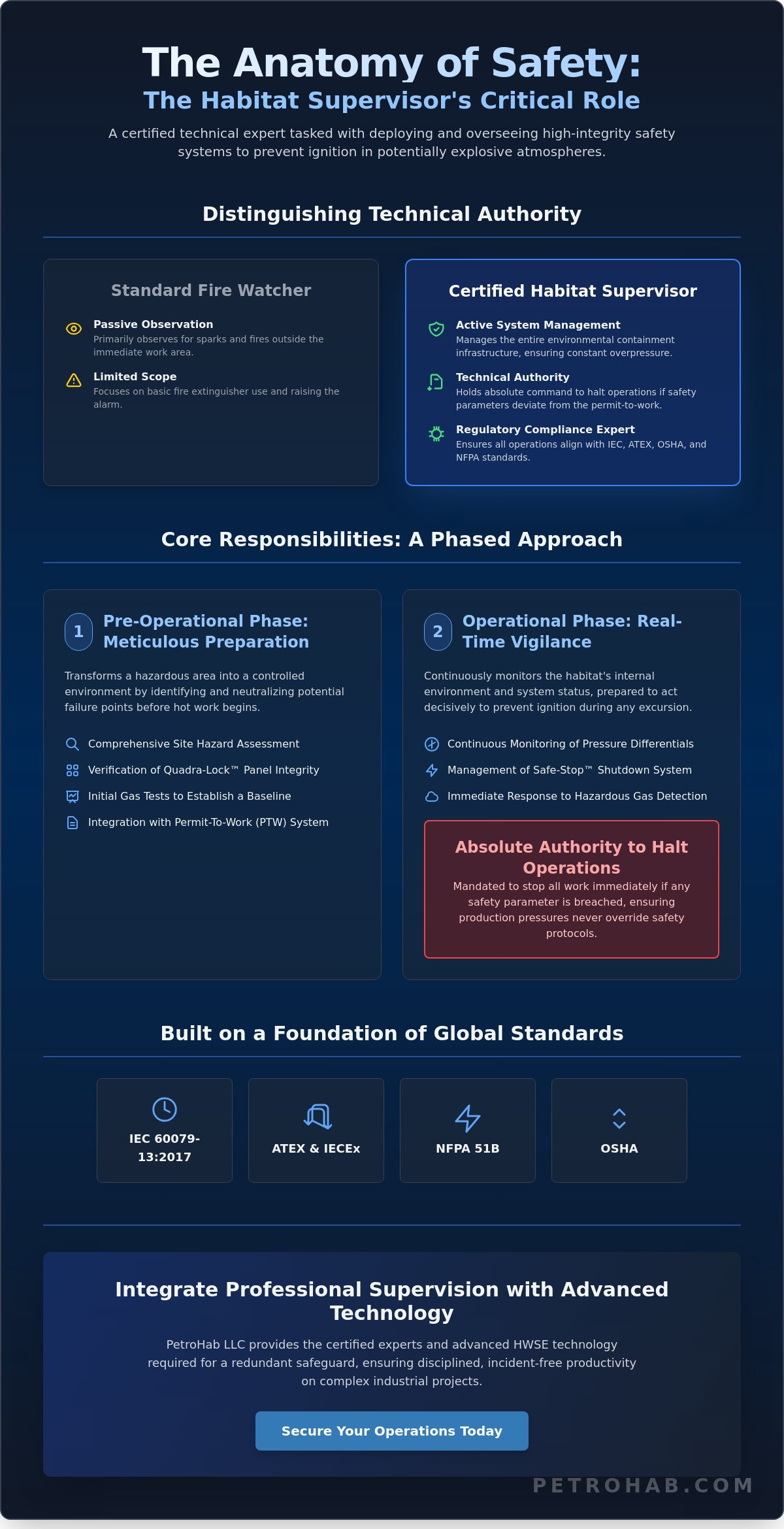
The industrial habitat supervisor serves as a certified technical expert, tasked with the deployment and continuous oversight of high-integrity safety systems. This individual isn’t a passive observer. They’re the primary technical guardian against ignition in potentially explosive atmospheres. A deep understanding of habitat supervisor roles and responsibilities reveals that this position requires specialized knowledge far exceeding the scope of standard fire watching. While a welder focuses on the mechanical integrity of a joint, the supervisor trained to the standards of PetroHab LLC manages the entire environmental containment infrastructure.
This role is vital for maintaining the operational integrity of a pressurized welding habitat. They ensure the enclosure maintains a constant overpressure relative to the external environment. This engineering control prevents flammable gases from entering the hot work area. If a single seal fails or a sensor detects an excursion, the supervisor is the first line of defense. They possess the technical training to identify failure modes that a general laborer would overlook.
To gain a deeper perspective on the collaborative environment these professionals manage, watch this overview of habitat operations:
The Scope of Authority
Within the hierarchy of an industrial site, habitat supervisor roles and responsibilities grant the individual absolute command over the hot work area and the work party. They act as the technical liaison between the welding crew and facility leadership. This authority includes the mandate to halt operations immediately if any safety parameter deviates from the permit-to-work (PTW) conditions. They coordinate with Platform Managers and Safety Officers to confirm that the habitat’s integrity is documented and maintained. This high level of authority ensures that production pressures never override safety protocols. It’s their duty to advocate for the protection of personnel and high-value assets.
Regulatory Foundations
Every action taken by the supervisor is rooted in strict regulatory compliance. They ensure all operations align with Hot Work Safety Principles and meet the standards set by NFPA 51B and OSHA. In Zone 1 and Zone 2 environments, the supervisor is responsible for upholding ATEX and IECEx certification requirements. This involves verifying that the enclosure meets the benchmarks of IEC 60079-13:2017. By adhering to these international standards, the supervisor validates the enclosure as a resilient barrier against industrial hazards. Their oversight ensures that every component, from the Quadra-Lock panels to the air intake systems, functions within its certified parameters.
Core Responsibilities: Pre-Operational Phase
Before hot work begins, the habitat supervisor must transform a hazardous area into a controlled environment. This phase is defined by meticulous preparation. The habitat supervisor roles and responsibilities during this time center on identifying potential failure points before they become active risks. This includes conducting a comprehensive site assessment to evaluate the surrounding environment for volatile substances or structural impediments. The supervisor then performs initial gas tests to establish a baseline. This data ensures the atmosphere is non-explosive before any equipment is powered on. These steps are not mere formalities. They’re the technical foundation of the entire safety protocol.
Effective integration with the Permit-to-Work (PTW) system is a hallmark of professional habitat management. The supervisor doesn’t work in isolation. They coordinate directly with the PTW coordinator to align the habitat’s operational status with the facility’s broader safety permits. This handshake verifies that all isolation procedures are active and that the proposed work doesn’t conflict with other site activities. If the facility’s safety parameters change, the supervisor must recalibrate the habitat’s status accordingly. This continuous alignment ensures that the HWSE remains a valid engineering control throughout the project lifecycle.
Enclosure Integrity Verification
The supervisor oversees the assembly of the HWSE to ensure an airtight seal. This involves inspecting every Quadra-Lock panel connection for mechanical security. They verify the correct installation of air ducting and intake fans to ensure the flow path is unobstructed. Beyond the panels, they scan the enclosure footprint for internal ignition sources. Every seam and penetration must be validated to prevent the egress of sparks or the ingress of hydrocarbons. For projects requiring high-performance containment, utilizing Quadra-Lock Panels provides the structural reliability necessary for Zone 1 operations.
Equipment Calibration and Testing
System reliability depends on precise calibration. The supervisor tests the Safe-Stop automatic shutdown system to confirm its response time meets design specifications. They calibrate manometers to ensure positive pressure readings are accurate within a fraction of a millibar. This process ensures compliance with OSHA General Requirements for Hot Work. Finally, they confirm the functionality of ATEX certified gas detection sensors. These sensors are the primary triggers for the Safe-Stop system; their pre-operational validation is non-negotiable. This rigorous testing phase confirms that the technology is ready to protect the work party from sudden environmental changes.
Real-Time Monitoring and Incident Prevention
Once hot work commences, the supervisor transitions from a technical installer to a tactical monitor. This active phase is where the technical precision of habitat supervisor roles and responsibilities becomes most visible. They maintain a constant vigil over the enclosure’s atmospheric integrity, ensuring that the engineering controls established during the pre-operational phase remain effective. The supervisor oversees fire watch protocols during every minute of active welding or grinding, standing ready to intervene the moment a hazard is detected. They also act as a gatekeeper, ensuring only authorized, trained personnel enter the pressurized environment. This control prevents overcrowding and ensures that every individual inside the habitat understands the emergency egress routes.
Integrating these duties with institutional safety policies, such as the Hot Work Supervisor’s Role, reinforces a culture of accountability. The supervisor must remain stationed at the control console, where they can observe both the physical work and the digital telemetry provided by the HWSE. This constant presence ensures that the human element of safety is as reliable as the automated systems protecting the site.
Managing Positive Pressure
Standardizing internal pressure is the primary method for preventing hydrocarbon ingress. The supervisor monitors manometers to maintain a differential that keeps external gases at bay. Environmental factors, such as wind gusts on offshore platforms or temperature shifts, can cause pressure fluctuations. The supervisor must distinguish between these benign changes and a genuine loss of enclosure integrity. Every reading is documented in a pressure log, creating a verifiable safety audit trail that proves the habitat remained pressurized throughout the shift. This documentation is vital for post-operational reviews and regulatory compliance.
Gas Detection and Response
The Safe-Stop Automatic Shutdown System serves as the primary technical remedy for gas excursions. The supervisor manages this system by interpreting real-time data from Lower Explosive Limit (LEL) sensors located at the air intake. If gas is detected, the Safe-Stop system automatically terminates power to the welding equipment. However, the supervisor’s role is to execute the manual emergency shutdown procedures and manage the work party’s response. They maintain clear communication with the work party, guiding them through a controlled cessation of work. This coordination prevents panic and ensures that the cessation of hot work is as systematic as its commencement.
Technical Competencies and Training Requirements
Technical mastery is the prerequisite for operational integrity in hazardous environments. A professional habitat supervisor must possess a skill set that bridges the gap between mechanical assembly and advanced atmospheric monitoring. The habitat supervisor roles and responsibilities demand more than basic construction knowledge; they require a comprehensive understanding of fluid dynamics, ignition prevention, and system failure modes. This technical depth allows the supervisor to anticipate risks before they manifest as incidents. They also serve as an educator, conducting on-site safety inductions for welders and helpers to ensure the entire work party understands the constraints of the pressurized environment.
Proficiency in interpreting technical drawings and Piping and Instrumentation Diagrams (P&IDs) is essential. Supervisors use these documents to identify potential leak paths or cross-contamination points within the facility’s infrastructure. This foresight is critical when integrating hot work safety systems into complex industrial layouts. By analyzing the site’s technical architecture, the supervisor ensures that air intake locations are positioned in non-hazardous areas, far from potential gas vents or relief valves. Understanding the full scope of habitat supervisor roles and responsibilities is the only way to guarantee zero-incident performance.
Certification Standards
PetroHab LLC maintains rigorous manufacturer-specific training requirements for all personnel operating its systems. Certification isn’t a one-time event; it involves mandatory annual re-certification and competency assessments. These evaluations confirm that the supervisor remains current with the latest safety standards and technological updates. For large-scale operations, ‘Train the Trainer’ programs provide the necessary scalability, allowing senior experts to instill the uncompromising safety culture of PetroHab LLC across multiple teams. This structured approach ensures that every supervisor on-site meets the same high benchmark of excellence.
Soft Skills in Safety Leadership
Technical knowledge must be paired with decisive leadership. It’s vital to communicate effectively under high-stress conditions, especially during gas excursions or equipment malfunctions. The supervisor often faces pressure to prioritize production speed over safety protocols. Conflict resolution skills are necessary to navigate these situations without compromising the enclosure’s integrity. Meticulous record-keeping is equally important. Documenting every gas test, pressure log, and safety briefing creates a robust audit trail for regulatory compliance. This disciplined approach to data management reflects the professional stoicism required to manage high-stakes industrial projects. To ensure your next project’s managed by experts who prioritize risk mitigation, explore the on-site habitat supervision services provided by PetroHab LLC.
PetroHab LLC’s Role in Professional Habitat Supervision
PetroHab LLC recognizes that the highest level of safety is achieved when advanced technology is paired with uncompromising human oversight. While the PetroHab Hot Work Safety Enclosure (HWSE) provides the physical barrier, it’s the professional application of habitat supervisor roles and responsibilities that ensures zero-incident performance. PetroHab LLC bridges the gap between hardware and execution by offering certified on-site supervision and comprehensive training programs. This approach transforms a safety product into a total risk mitigation solution. It ensures that every component of the system is utilized to its maximum protective potential.
The integration of the Safe-Stop Automatic Shutdown System provides supervisors with a redundant technical safeguard. This system doesn’t replace the supervisor; it supports their decision-making process by providing real-time atmospheric data. Similarly, the proprietary Quadra-Lock technology simplifies the physical inspection process. The interlocking design of Quadra-Lock Panels allows for rapid verification of enclosure integrity, making the supervisor’s pre-operational checks both faster and more reliable. These technological remedies are designed to reduce the margin for human error in high-stakes environments.
On-Site Supervision Services
PetroHab LLC deploys highly trained technicians to oversee high-risk offshore and onshore operations. These experts bring a level of field experience that significantly reduces client liability and enhances site safety. A notable project involved the assembly and dismantling of nearly 500 habitats, ranging in size from 2 to 200 cubic meters, on an offshore platform. This massive undertaking was completed with zero lost-time accidents or incidents. This track record is the direct result of supervisors from PetroHab LLC applying rigorous standards to every phase of the project. By utilizing professional third-party oversight, facility managers can focus on production while the expert team manages the complexities of environmental containment and ignition prevention.
Training and Support
For organizations that prefer client-led supervision, PetroHab LLC offers global training modules designed to instill the same level of technical proficiency. These programs cover the granular details of the Safe-Stop and Quadra-Lock systems, ensuring that internal safety officers can fulfill habitat supervisor roles and responsibilities with absolute confidence. Experts from PetroHab LLC remain available globally for technical consultation; they provide a continuous support loop for complex turnarounds or live-plant maintenance. This commitment to education ensures that the principles of pressurized containment are upheld across every industry sector, regardless of the project’s geographic location. To secure your site with an expert technical partner, contact PetroHab LLC for certified supervisor training or on-site support.
Securing Your Industrial Operational Future
Maintaining the integrity of a pressurized enclosure requires more than just high-quality hardware. It demands the disciplined execution of habitat supervisor roles and responsibilities to ensure that every engineering control functions as intended. By integrating technical mastery with real-time monitoring, these professionals transform hazardous Zone 1 and Zone 2 environments into controlled work spaces. The combination of patented Quadra-Lock technology and certified Safe-Stop automatic shutdown systems creates a redundant safety architecture that protects both personnel and high-value assets from ignition risks.
PetroHab LLC continues to set the industry benchmark for safety excellence across our global footprint in Brazil, the UK, and the USA. Our commitment to rigorous training and technical precision ensures that your hot work projects proceed without interruption or incident. Don’t leave your site safety to chance when you can partner with seasoned experts who understand the granular details of industrial hazards. Request a Quote for Certified On-Site Supervision today to strengthen your operational integrity. We look forward to helping you achieve your next zero-incident milestone.
Frequently Asked Questions
What is the primary role of a habitat supervisor during hot work?
The primary role is to serve as the technical authority responsible for the pressurized enclosure’s operational integrity. They manage the engineering controls that prevent flammable gas ingress during hot work. This includes overseeing atmospheric monitoring and ensuring all personnel adhere to the permit-to-work requirements. Their focus remains on preventing a catastrophic ignition through disciplined oversight of the HWSE system.
Is a habitat supervisor the same as a fire watcher?
No, a habitat supervisor possesses technical competencies that far exceed those of a standard fire watcher. While a fire watcher monitors for immediate spark hazards, the supervisor manages the entire environmental containment infrastructure. This includes calibrating gas sensors and maintaining pressure differentials. The habitat supervisor roles and responsibilities encompass the total technical management of the hot work environment rather than just visual observation.
What certifications are required to be a pressurized habitat supervisor?
Supervisors must hold manufacturer-specific certifications that validate their ability to operate complex HWSE systems. This typically includes three levels of technical training and annual competency assessments. They must also demonstrate a deep understanding of international standards like IEC 60079-13:2017. These certifications ensure the supervisor can identify system failure modes and execute emergency response protocols with technical precision.
Can hot work continue if the habitat supervisor leaves the site?
Hot work must cease immediately if the supervisor is not present at the work site. Their continuous presence is a non-negotiable requirement for maintaining the safety permit’s validity. If a supervisor must leave the area, the work party must perform a controlled shutdown of all ignition sources. Operations can only resume once the supervisor has returned and re-verified the enclosure’s integrity.
How does a supervisor verify the integrity of an HWSE?
Verification begins with a physical inspection of all Quadra-Lock panel connections to ensure mechanical security. The supervisor then monitors manometers to confirm that the internal air pressure remains higher than the external environment. This positive pressure differential is the primary engineering control against hydrocarbon ingress. Any deviation in these readings requires an immediate investigation into the enclosure’s seals or air supply fans.
What happens if the Safe-Stop system triggers an automatic shutdown?
The Safe-Stop system immediately terminates power to all welding and grinding equipment if it detects a gas excursion or loss of pressure. The supervisor’s role is to lead the work party through a systematic emergency response protocol. They must identify the source of the trigger and confirm the atmosphere is safe before attempting to reset the system. This automated shutdown acts as a fail-safe that supports the supervisor’s tactical control.
How often should a habitat supervisor conduct gas testing?
Gas testing occurs continuously through integrated LEL sensors at the habitat’s air intake. Additionally, the supervisor performs manual gas tests before the start of every shift and after any break in operations. This dual-layer approach ensures that the baseline atmosphere remains non-explosive. Regular manual checks validate the accuracy of the automated sensors and provide a redundant layer of protection for the work party.
Does the supervisor need to be present for habitat assembly?
A supervisor must oversee every stage of the habitat assembly process. Their involvement ensures the enclosure is configured correctly according to the initial site assessment and P&ID diagrams. They verify that all air ducting is positioned in non-hazardous locations and that the Quadra-Lock panels are properly interlocked. This oversight during assembly prevents structural failures that could compromise the system’s integrity during active hot work.