
Blog Posts
IEC 60079 Pressurized Enclosures: Practical Guide
A certificate can cite the right IEC 60079 standard and still leave the scope of a complete hot-work enclosure unclear. That distinction is central to the IEC 60079 standards for pressurized enclosures: IEC 60079-2 and IEC 60079-13 address related protection methods, but not the same type of installation. Uncertainty often arises when a certificate covers a shutdown system or component rather than the habitat itself.
This guide explains how the two standards differ, what their scopes mean for pressurized hot-work applications, and how to assess documents against a proposed installation. The practical starting point is to identify exactly what equipment or room the certification covers, then compare that scope with the items being used.
IEC 60079-2 addresses pressurized equipment enclosures, while IEC 60079-13 addresses pressurized and artificially ventilated rooms. We’ll outline what to examine in certificates and supporting documentation. PetroHab’s automatic shutdown systems are ATEX- and IECEx-certified (IEC 60079-13). That certification applies to the systems, not automatically to an entire habitat. Understanding this boundary helps connect standard terminology to hot-work safety decisions without overstating certification.
Key Takeaways
- Distinguish IEC 60079-2’s equipment scope from IEC 60079-13’s room scope before assessing a pressurized hot-work application.
- Read the IEC 60079 standards for pressurized enclosures alongside the stated scope, edition, and exact equipment named in the documentation.
- Review the habitat, electrical equipment, monitoring devices, and shutdown system as separate items. Don’t assume one certificate covers the complete installation.
- Use IEC 60079-0 for general requirements and IEC 60079-14 for electrical installation design, selection, and erection.
- Check what a shutdown system monitors, including differential pressure and gas levels, and note whether optional oxygen and/or carbon-dioxide detectors are included.
What IEC 60079 Standards Mean for Pressurized Enclosures
The IEC 60079 series sets out standards for equipment and installations used where explosive atmospheres may occur. In this context, an explosive atmosphere is a mixture of flammable substances with air that can ignite under relevant conditions. The series covers different protection concepts, so the applicable requirements depend on what is being assessed and how it will be used.
What does the IEC 60079 series cover?
IECEx’s standards overview helps locate standards associated with explosive-atmosphere equipment. It lists IEC 60079-2 for Type of Protection “p” equipment and IEC 60079-13 for pressurized and artificially ventilated rooms. This overview is useful for finding the relevant standard within the wider framework, but it does not certify a product or show that a certificate covers a complete installation.
IEC 60079-2 specifies requirements for the construction and testing of equipment using Type of Protection “p” against explosive atmospheres. This is a defined equipment scope, not a blanket designation for every structure that uses pressurization. A hot-work project may include a personnel-accessible habitat, electrical equipment inside it, and a separate monitoring or shutdown system. Each item can have its own documentation and certification scope.
What does “pressurized enclosure” mean in this standards context?
Pressurization is a protection concept, but the applicable requirements depend on what is being assessed. IEC 60079-2 addresses equipment using Type of Protection “p.” IEC 60079-13 addresses pressurized rooms and artificially ventilated rooms, including room-like structures designed to protect equipment and allow personnel entry. These scopes are related, but they are not interchangeable.
A hot-work habitat may resemble a room in its scale and use, but that resemblance alone doesn’t determine which standard applies to every part of the system. Nor does it make the habitat equivalent to an item of electrical equipment covered by IEC 60079-2. Identify the application, design, and boundaries of the item being assessed. A certificate for a shutdown system, for example, should not be read as a certificate for the entire habitat unless its scope explicitly says so.
The title of a standard is a starting point, not proof of product certification. When reviewing the IEC 60079 standards for pressurized enclosures, read three details together: the intended application, the publication edition, and the exact scope stated in the certificate or supporting documentation. IEC 60079-2 is Edition 6.0, published in 2014; IEC 60079-13 is Edition 2.0, published in 2017. Compare the edition cited in project documents with the IEC catalogue and the applicable certification documents. This keeps standard terminology tied to the equipment or room under review.
IEC 60079-2 vs IEC 60079-13: Compare Their Stated Scopes
The difference between these parts is the subject being assessed, not simply whether a project uses pressurization. IEC 60079-2 describes requirements for Type of Protection “p” equipment. IECEx lists IEC 60079-13 for pressurized rooms and artificially ventilated rooms. These descriptions point to different scopes. Don’t apply either part to an entire project based only on a shared word in its title.
| Standard | Subject | Stated application | Source | Limit of interpretation |
|---|---|---|---|---|
| IEC 60079-2 | Equipment using Type of Protection “p” | Requirements for construction and testing of this equipment | IEC publication page | Does not cover pressurized rooms or analyser houses; the publication directs readers to Part 13 for those subjects. |
| IEC 60079-13 | Rooms | Pressurized rooms and artificially ventilated rooms | IECEx standards overview | The listed title does not establish that a particular habitat or complete installation is certified. |
IEC 60079-2 addresses Type of Protection “p” equipment, while IEC 60079-13 is listed for pressurized rooms and artificially ventilated rooms. The applicable part depends on the item and its intended application. This distinction is central when reviewing the IEC 60079 standards for pressurized enclosures for a hot-work project. A personnel-accessible habitat and electrical equipment installed within it aren’t automatically assessed as the same subject.
Where IEC 60079-2 fits
The IEC publication description sets out construction and testing requirements for equipment protected by pressurization, Type of Protection “p.” It also states that Part 2 supplements IEC 60079-0. Its scope excludes pressurized rooms and analyser houses, directing those applications to IEC 60079-13. In a project review, first identify the equipment under assessment. Then determine whether the Part 2 reference applies to that equipment rather than assuming it covers a larger enclosure or habitat.
Where IEC 60079-13 fits
IECEx lists IEC 60079-13 as “Equipment protection by pressurized room ‘p’ and artificially ventilated room ‘v’.” Treat the title as a scope indicator, not proof that a particular hot-work habitat is certified. Read the certificate and supporting documents to identify the item, application, and boundaries they cover. The International Electrotechnical Commission (IEC) publishes the standards and provides the authoritative reference for publication details.
A project may include a habitat, electrical equipment, monitoring devices, and a shutdown system. Their documentation may refer to different standards or cover different components. Match each document to its named subject and application, then compare its stated scope with the item proposed for use. PetroHab’s pressurized hot-work enclosures provide a practical context for this review. Certification of a system should not be presented as certification of the complete habitat.
How IEC 60079-0, -14, and IECEx Relate to Pressurized Systems
Project files may cite several parts of the IEC 60079 series because each addresses a different layer of the safety case. The references aren’t interchangeable, and seeing them together doesn’t prove that one enclosure or a complete installation meets every requirement. Read each reference against the item, activity, and documentation it applies to.
Why IEC 60079-0 and IEC 60079-14 may appear in project documents
IEC 60079-0 provides general requirements for equipment used in explosive atmospheres. The IEC publication page for IEC 60079-2 states that Part 2 supplements Part 0, linking general requirements to specific requirements for equipment using Type of Protection “p.” This helps explain why both parts may appear in equipment documentation. Their appearance alone doesn’t show that an entire habitat has been assessed or certified.
IECEx lists Part 14 as “Explosive atmospheres – Part 14: Electrical installations design, selection and erection.” Its subject is electrical installation, rather than the construction and testing of Part 2 equipment. In a pressurized hot-work project, use the distinctions to organize the document review:
- Equipment construction: Identify the equipment and the protection standard cited for it.
- Installation: Identify documentation addressing design, selection, and erection of the electrical installation.
- General requirements: Read Part 0 references alongside the applicable equipment standard and its stated scope.
These are related parts of a project review, not interchangeable proof points. A Part 14 reference doesn’t establish product certification, and a Part 2 reference doesn’t automatically describe the installation or the complete room-like enclosure.
What IECEx certification does and does not establish
IECEx is a certification system that uses international standards, including standards in the IEC 60079 series. IECEx itself is not a protection standard. A standards overview can identify publications relevant to a protection concept, but a listing is not evidence that a particular product has been certified.
Read certification documentation by identifying the equipment named on the certificate, then checking its stated scope and applicable standard references. A certificate may apply to a monitoring device or shutdown system used within a larger pressurized habitat. That does not establish that the habitat, its electrical installation, and every other component share the same certification.
For the IEC 60079 standards for pressurized enclosures, keep three questions separate: what item is covered, which standard and edition are cited, and whether the evidence addresses equipment, installation, or a room. This prevents a list of standards from being mistaken for approval of a complete system. Resolve project-specific interpretations through the relevant certification documents and responsible review.
How to Assess IEC 60079 Applicability for a Hot-Work Project
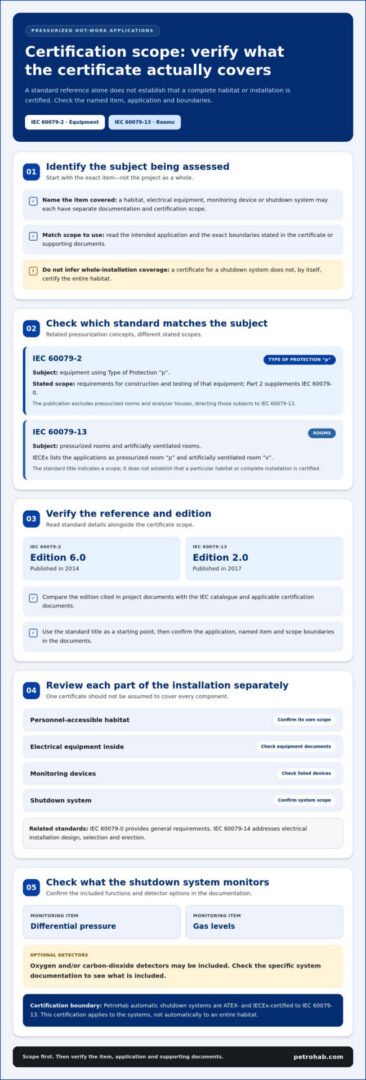
Start a document review by defining the boundaries. A hot-work project may include the habitat, electrical equipment inside it, monitoring devices, and an automatic shutdown system. These items have different functions and may have different documentation. Review each separately, then consider how the documents relate to the proposed configuration. This prevents a standard reference for one component from being treated as evidence for the complete system.
A five-step document review
Use this sequence to organize the review. Record findings against the specific item and its intended use, not just the project name.
- Identify the equipment. Write down the exact equipment or system named in each certificate, report, or declaration. Separate the habitat from electrical equipment, monitoring devices, and the shutdown system.
- Define the application. Describe the item’s intended function and installation context. A personnel-accessible habitat and pressurized electrical equipment are distinct subjects, even if both use pressurization.
- Match the standard to its scope. Compare the cited part with its published scope, including stated exclusions. Don’t infer that a nearby title covers a room, analyser house, component, or complete installation.
- Check edition and certificate scope. Record the edition stated in the documentation and compare publication details with the IEC catalogue. Read the certificate’s equipment description, conditions, and scope. Don’t extend it to items it doesn’t name.
- Record unresolved interpretations. Note configuration limits, document gaps, or questions about project applicability for review by the responsible safety and engineering personnel and, where relevant, against the responsible authority’s interpretation.
Common interpretation errors to avoid
Keep evidence tied to its subject. IEC 60079-2 and IEC 60079-13 aren’t interchangeable labels: the former addresses Type of Protection “p” equipment, while the latter is listed for pressurized and artificially ventilated rooms. A certificate for a device or shutdown system doesn’t establish certification of the habitat around it. Citing a standard also doesn’t replace project approvals, operating procedures, or a project-specific safety assessment.
Certification evidence must match the equipment named in the document and the scope it declares. Apply this test to every record in the package. If a system has been modified or the proposed configuration differs from what the document describes, flag the difference rather than assuming the evidence extends to it. Resolve project interpretations through applicable certification documentation and responsible review.
This method makes the IEC 60079 standards for pressurized enclosures more practical to assess: identify the item, align its use with the standard, and verify the edition and scope before drawing conclusions. For project context, explore PetroHab pressurized habitats and their role in hot-work applications.
PetroHab Shutdown Certification and Pressurized Habitat Applications
Certification language should identify exactly what has been assessed. PetroHab’s automatic shutdown systems are ATEX- and IECEx-certified (IEC 60079-13). This certification applies to the shutdown systems, not automatically to the complete Petro-Habitat™ Hot Work Safety Enclosure or every component installed within it.
What PetroHab’s stated IEC 60079-13 certification refers to
The certified item is the automatic shutdown system, not the entire pressurized habitat. In a project document review, identify the shutdown system named in the certification documentation and distinguish it from the enclosure, electrical equipment, and other devices. The standard reference and certification apply within the stated scope, not automatically to every part of a configured hot-work system.
PetroHab automatic shutdown systems monitor differential pressure and gas levels. Optional oxygen and/or carbon-dioxide detectors are available. The Safe-Stop Safety Shutdown System (SSS) provides immediate shutdown in unsafe conditions. These system functions support the safety arrangement, alongside project-specific procedures, approvals, and review of the complete installation.
How the shutdown system fits the habitat safety context
The Petro-Habitat™ Hot Work Safety Enclosure is PetroHab’s main hot-work safety enclosure. Its function is distinct from the shutdown system’s monitoring and shutdown functions. The enclosure and supporting systems form part of the project’s overall safety arrangement, while each item’s documentation must be interpreted against the equipment it names and the scope it declares.
The Petro-Habitat™ Hot Work Safety Enclosure uses patented Quadra-Lock® panel interlocking technology. This enclosure feature is separate from the automatic shutdown system’s certification. Keeping the descriptions distinct prevents a habitat feature, or a certificate for one system, from being presented as evidence that the entire assembly holds the same certification.
For a practical review, organize project documentation by item: the habitat, the shutdown system, electrical equipment, and monitoring devices. Match each certificate or supporting document to the named equipment and its declared scope. This gives project teams a clearer basis for assessing how each item fits the intended application and which interpretations require engineering and safety review.
Explore PetroHab’s pressurized habitat solutions to learn how the enclosures fit hot-work applications.
Carry Scope Clarity Into Your Next Project
Turn the document review into a working project record. Tie each certificate and standard reference to the specific equipment, configuration, and intended application it covers. Keep the record aligned as project details develop, so safety and engineering teams can make decisions from clear, traceable evidence rather than assumptions based on a standard number alone.
The same discipline supports informed evaluation of the IEC 60079 standards for pressurized enclosures and the systems used within a hot-work habitat. PetroHab reports well over a million incident-free man-hours, reflecting its experience in pressurized hot-work safety. That record complements, but doesn’t replace, project-specific assessment and documentation.
For your next step, review PetroHab’s habitat solutions against your hot-work requirements. Explore PetroHab’s pressurized habitat solutions.
Frequently Asked Questions
What is IEC 60079-2 for pressurized enclosures?
IEC 60079-2 addresses construction and testing requirements for electrical equipment using Type of Protection “p” in explosive gas or dust atmospheres. The IEC publication page says it supplements IEC 60079-0 and excludes pressurized rooms and analyser houses, referring readers to IEC 60079-13 for those subjects. Compare the equipment name and application on the certificate with the standard’s stated scope, and check the applicable edition.
Is IEC 60079-13 the same as IEC 60079-2?
No. IECEx lists IEC 60079-2 for equipment protection by pressurized enclosures and IEC 60079-13 for pressurized rooms and artificially ventilated rooms. The Part 2 publication also excludes pressurized rooms and refers readers to Part 13. A room-level reference and a certificate for equipment inside that room may cover different items. Use the application and documentation scope to determine which part is relevant.
Does IEC 60079-13 certify an entire pressurized habitat?
No. A reference to IEC 60079-13 alone doesn’t show that every part of a habitat is certified. Read the certificate and supporting documents to identify the named system, equipment, configuration, and scope. PetroHab’s stated ATEX- and IECEx-certified (IEC 60079-13) status applies to its automatic shutdown systems, not as a blanket claim about the complete habitat. Keep these items distinct in project records.
What does Type of Protection “p” mean in IEC 60079-2?
Type of Protection “p” identifies the pressurization protection concept used for equipment covered by IEC 60079-2. IECEx lists the part as equipment protection by pressurized enclosures, and the IEC publication describes construction and testing requirements for the electrical equipment within its scope. To assess a specific installation, compare the equipment’s certification documents with the proposed application and configuration rather than relying on the “p” marking alone.
Does IECEx certification mean a product meets every IEC 60079 standard?
No. IECEx certification is tied to the equipment and scope identified in its documentation. A certificate citing one part of IEC 60079 doesn’t establish conformity to every part or cover an entire project configuration. For instance, documentation for a shutdown system shouldn’t be treated as evidence for separate electrical equipment or a habitat unless those items are expressly within its scope. Check the certificate’s named equipment, standard, and edition.
How can I tell which IEC 60079 standard applies to a pressurized system?
Start by defining the item being assessed: electrical equipment, a room, an installation, or a shutdown system. Compare its intended application with the published scope and exclusions of the relevant standard, then review the cited edition and certificate. This method helps interpret the IEC 60079 standards for pressurized enclosures without relying on the word “pressurized” alone. Refer unresolved project questions to the responsible engineering and safety review.