Blog Posts
Performing Hot Work in Zone 1 Hazardous Area: The 2026 Safety & Compliance Guide
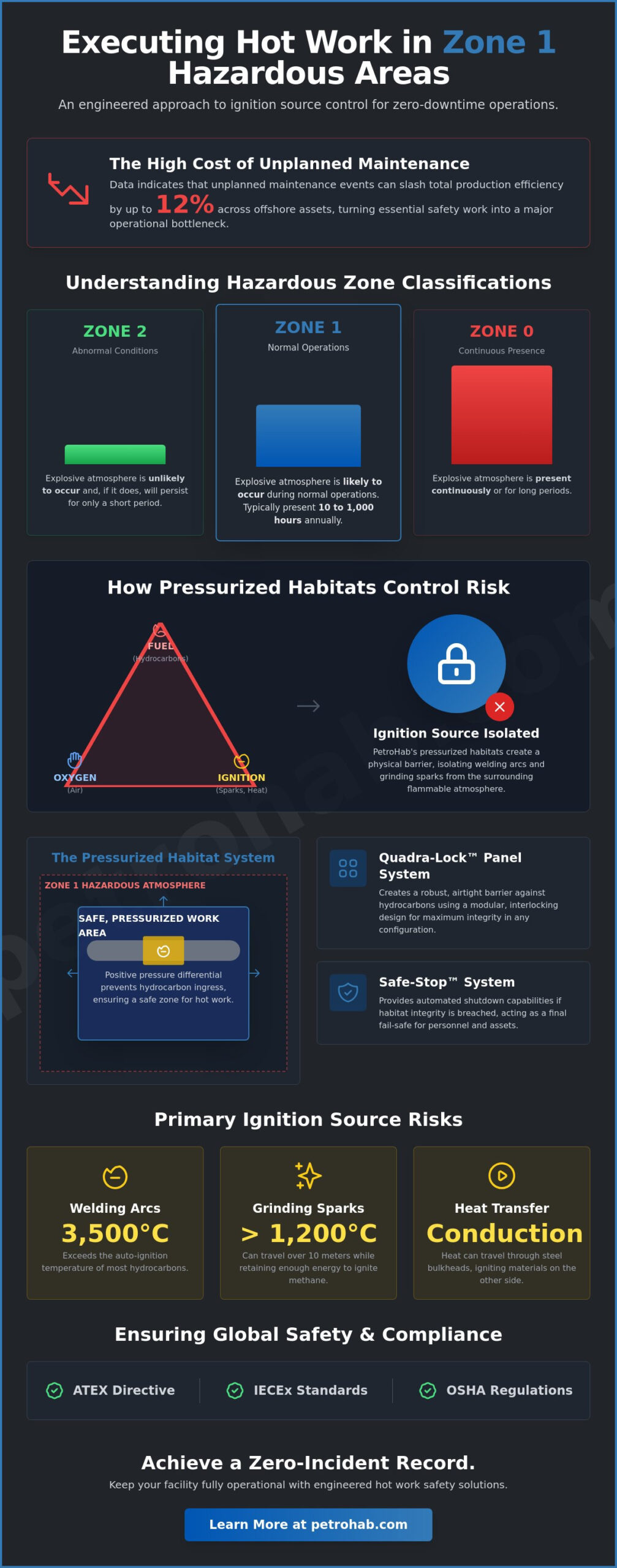
Shutting down a high-yield production facility for essential maintenance isn’t a safety strategy; it’s an operational bottleneck. You’re likely facing the relentless pressure of maintaining ATEX and IECEx compliance while stakeholders demand zero downtime. Safely executing hot work in Zone 1 hazardous area locations requires more than just caution. It demands a rigorous, engineered approach to ignition source control that eliminates risk without compromising output. Data from 2024 suggests that unplanned maintenance events can reduce total production efficiency by up to 12% across offshore assets.
We recognize that the margin for error in volatile environments is non-existent. This guide provides the technical framework to perform welding and grinding operations using pressurized habitats and certified safety systems. You’ll learn how the Quadra-Lock modular system and Safe-Stop technology provide an airtight barrier against hydrocarbons. We’ll outline the specific protocols necessary to achieve a zero-incident record while keeping your facility fully operational throughout 2026. This technical overview covers everything from initial gas detection to final integrity testing.
Key Takeaways
- Identify the technical distinctions between Zone 1 and surrounding hazardous classifications to implement effective ignition source isolation.
- Explore how pressurized habitats and Quadra-Lock technology create a localized area of atmospheric integrity for welding and grinding operations.
- Establish rigorous operational protocols by mastering the target manometric readings required for maintaining positive pressure differentials.
- Learn the essential engineering controls for executing hot work in Zone 1 hazardous area while ensuring full compliance with global safety standards.
- Optimize your procurement process by identifying the critical criteria for selecting specialized hot work safety enclosure suppliers worldwide.
Understanding Zone 1 Hazardous Areas for Hot Work Operations
Zone 1 classifications represent a critical risk threshold in oil and gas facilities. By definition, a Zone 1 area is a location where an explosive atmosphere is likely to occur during normal operations. This distinguishes it from Zone 0, where the risk is present continuously, and Zone 2, where flammable concentrations only appear during abnormal conditions. A fundamental grasp of Understanding Zone 1 Hazardous Areas is vital for any engineer planning maintenance. Performing hot work in Zone 1 hazardous area operations requires a complete suppression of at least one leg of the explosion triangle: fuel, oxygen, or the ignition source.
To better understand the risks associated with these environments, watch this technical overview:
Traditional welding generates sparks and heat that exceed the auto-ignition temperature of most hydrocarbons. Without specialized engineering controls, these ignition sources interact with the ambient fuel and oxygen, leading to catastrophic failure. PetroHab addresses this by deploying pressurized habitats featuring the Quadra-Lock panel system to isolate the ignition source from the surrounding atmosphere. This modular approach ensures that the habitat remains a controlled environment, even when the external atmosphere is volatile.
The Frequency and Duration of Explosive Atmospheres
In refinery and offshore environments, “likely to occur” typically signifies that flammable gases are present between 10 and 1,000 hours annually. Common Zone 1 locations include pressure relief vents, sampling points, and pump seal areas. Volatility in these areas isn’t static. Wind speeds exceeding 15 knots or temperatures rising above 35°C can shift gas dispersion patterns, potentially expanding the hazardous perimeter. Safety managers must account for these variables when authorizing hot work in Zone 1 hazardous area sites to ensure the integrity of the habitat remains uncompromised.
Regulatory Standards for Zone 1 Compliance
Global operations must adhere to rigorous frameworks like the ATEX Directive 2014/34/EU and the IECEx international standards. These regulations dictate the design and use of equipment in explosive atmospheres. In the United States, OSHA 1917.152 mandates strict fire prevention measures for welding and heating in hazardous locations. Adhering to hazardous environment standards ensures that procurement teams select systems capable of maintaining integrity under extreme pressure. Our Safe-Stop system integrates directly with these standards to provide automated shutdown capabilities if habitat integrity is breached, acting as a final fail-safe for human life and high-value assets.
The Mechanics of Risk: Ignition Source Control
Performing hot work in Zone 1 hazardous area requires an absolute decoupling of the ignition source from the surrounding environment. Primary ignition sources include welding arcs reaching temperatures up to 3,500°C, grinding sparks exceeding 1,200°C, and localized heat-treating processes. Ignition Source Isolation serves as the primary safety objective. Without it, hydrocarbon ingress into the work area creates a high-probability path to catastrophic failure. Engineers must evaluate the “Zone of Influence,” accounting for the fact that grinding sparks can maintain sufficient energy to ignite methane at distances exceeding 10 meters from the point of origin. Molten slag poses a vertical risk, often falling through grating and traveling significantly further than horizontal sparks.
Managing Heat and Spark Transfer
Steel structures in offshore environments act as efficient thermal conductors. Heat from a weld can travel through a bulkhead, igniting flammable materials on the opposite side. Unsealed deck penetrations allow sparks to travel “blind” to lower levels, often bypassing traditional fire blankets. It’s critical to distinguish between fire-resistant materials, which maintain structural integrity under extreme heat, and fire-retardant materials, which merely resist ignition. PetroHab utilizes the Quadra-Lock panel system to ensure a pressurized, physical barrier that stops spark migration. Following a strict Operational Protocol for Hot Work ensures these physical barriers are verified before work begins. This protocol demands a 35-foot clearance or equivalent shielding for all combustible materials.
Atmospheric Monitoring Requirements
Continuous Lower Explosive Limit (LEL) monitoring is mandatory when performing hot work in Zone 1 hazardous area. If hydrocarbon levels reach 10% of the LEL, all hot work must cease immediately. Multi-gas detection must also track the following parameters:
- Oxygen (O2): To ensure levels remain between 19.5% and 23.5%.
- Hydrogen Sulfide (H2S): Critical for sour gas environments.
- Carbon Monoxide (CO): To monitor for incomplete combustion within the enclosure.
Sensors require strategic placement. One sensor must monitor the intake of the pressurized habitat while another remains at the work site. This dual-layer approach identifies threats before they enter the enclosure. Systems like PetroHab’s Safe-Stop automatically shut down power and gas lines if any sensor detects a breach. This level of automation removes human error from the safety equation. For those managing high-risk maintenance, integrating these pressurized safety solutions provides the necessary redundancy to protect high-value assets and personnel.
Engineering Controls: Pressurized Habitats and HWSE Technology
Managing hot work in Zone 1 hazardous area demands engineered isolation that exceeds basic administrative controls. PetroHab’s Hot Work Safety Enclosures (HWSE) function as a critical barrier, isolating potential ignition sources from volatile atmospheres. These systems operate on the principle of positive pressure. By maintaining an internal pressure higher than the surrounding environment, the enclosure physically prevents the ingress of flammable gases. It’s a method that transforms a high-risk Zone 1 location into a controlled workspace where welding, grinding, and cutting can proceed without halting production.
The implementation of pressurized welding habitats provides a mobile safety solution for offshore platforms and refineries. These enclosures don’t just shield the work; they actively monitor and manage the localized atmosphere. In complex offshore geometries where pipes, beams, and bulkheads create obstacles, modularity becomes essential. A rigid, one-size-fits-all structure fails in these environments. PetroHab’s modular approach ensures that the enclosure conforms to the specific layout of the asset, maintaining the integrity of the pressure seal regardless of the structural complexity.
Quadra-Lock Panel Integrity and Modular Design
The engineering behind Quadra-Lock panels ensures superior seal integrity without the need for specialized tools. Each panel interlocks to form a gas-tight environment, a requirement for any hot work in Zone 1 hazardous area. This patented design allows for rapid assembly and disassembly, significantly reducing downtime. The modular flexibility is unrivaled, as it permits the habitat to be built around existing infrastructure. Whether it’s a 4-inch pipe or a massive structural bulkhead, the Quadra-Lock system adapts to ensure a continuous, pressurized boundary that protects both personnel and high-value assets.
Safe-Stop Automatic Shutdown Systems
Safety in 2026 relies on automated ignition source control. The Safe-Stop system acts as the intelligent interface between gas detection sensors and the welding power source. While manual shutdowns were once the industry norm, modern 2026 standards mandate automation to eliminate human error. If the system detects a loss of internal pressure or the presence of hydrocarbons, typically at a threshold of 10% LEL, Safe-Stop triggers an immediate shutdown of all power to the welding equipment. This rapid termination occurs within milliseconds of a breach, ensuring that the ignition source is neutralized before hazardous gases can enter the enclosure.
Operational Protocol for Hot Work in Zone 1 Environments
Operational success during a hot work in Zone 1 hazardous area depends on rigid adherence to localized pressure control and structural integrity. Before any ignition source is introduced, technicians perform a comprehensive pre-work inspection of the hot work safety enclosure. This inspection focuses on the Quadra-Lock interlocking panels, which provide the primary mechanical barrier against gas ingress. Every seam and penetration point is scrutinized to ensure the habitat can maintain the required internal environment without leakage.
Establishing the correct pressure differential is the most critical technical step. In Zone 1 environments, the system must sustain a minimum manometric reading of 0.05 mbar (5 Pascals) relative to the external atmosphere. This positive pressure creates a constant outflow of air, effectively barring hydrocarbon vapors from entering the enclosure. The Safe-Stop system monitors these levels in real-time. If pressure drops below the 0.05 mbar threshold, the system automatically terminates power to all welding and grinding equipment within milliseconds.
During live work, two distinct roles provide continuous oversight. The Fire Watch remains stationed to detect sparks or smoldering materials, while the Habitat Technician manages the control systems and monitors gas detection arrays. Once work is complete, a 30-minute cooling period is mandatory. This duration ensures that the temperature of the workpiece falls below the auto-ignition point of surrounding gases. Only after this period and a successful atmospheric re-test using calibrated detectors can the enclosure be safely decommissioned.
Permit to Work (PTW) Integration
Habitat deployment isn’t an isolated activity; it’s a core component of the corporate safety management system. The Job Safety Analysis (JSA) for a hot work in Zone 1 hazardous area specifically addresses the risks of gas migration from nearby processing units. Clear communication protocols are established with the Central Control Room (CCR), including mandatory status check-ins every 60 minutes. This ensures that the CCR can immediately signal a platform-wide shutdown if an external emergency occurs.
Emergency Response and Fail-Safes
Reliability in high-risk zones requires redundant engineering. Our systems utilize dual-redundant air supply blowers to maintain pressurization even during a mechanical failure. If external gas detectors sense a 10% Lower Explosive Limit (LEL) concentration, the Safe-Stop system triggers an immediate shutdown within 0.5 seconds. Personnel must undergo 8 hours of site-specific training to master evacuation procedures and the use of emergency breathing apparatus. These protocols ensure that every worker is prepared for rapid egress in the event of an external facility upset.
Protect your assets with the industry gold standard in pressurized habitats. Contact PetroHab to discuss your Zone 1 safety requirements.
Achieving Compliance with PetroHab HWSE Solutions
PetroHab remains the definitive gold standard for high-stakes oil and gas repairs. We provide the technical infrastructure required to manage risk during hot work in Zone 1 hazardous area environments. As global hot work safety enclosure suppliers, we ensure that operators have access to pressurized habitat technology across every major energy hub. Our systems actively prevent Loss of Primary Containment (LOPC) incidents. These events cost the industry billions annually in environmental fines and lost production. By implementing HWSE solutions, facilities maintain 100% uptime during critical maintenance cycles. We don’t just provide equipment; we provide a barrier against disaster.
Our custom engineering approach addresses the specific challenges of offshore assets, including:
- Ignition Source Control: Automated shutdown systems that respond to gas detection in milliseconds.
- Structural Integrity: Systems designed to withstand high wind loads and pressure differentials.
- Modular Versatility: Enclosures that adapt to complex pipe geometries and confined spaces.
Unrivaled Quality and Technical Support
Engineering integrity defines our approach. Our patented Quadra-Lock technology utilizes a modular interlocking panel system. This design eliminates the inherent weaknesses found in traditional zipper-based habitats. Zippers often fail under pressure or degrade in harsh conditions. Quadra-Lock panels provide a rigid, airtight seal that withstands the 2026 standards for offshore durability. We deploy certified technicians to provide on-site supervision and technician training. This ensures every installation meets ATEX and IECEx requirements. Our materials are specifically treated to resist the corrosive effects of salt spray and high humidity. This durability extends the lifecycle of the enclosure by 40% compared to standard PVC alternatives used by competitors.
Next Steps: Procurement and Consultation
Selecting the right engagement model depends on your project’s scope. Large-scale refinery turnarounds often benefit from our rental models. These offer flexibility for short-term, high-intensity work. Permanent offshore assets may find the purchase model more cost-effective for long-term maintenance needs. We recommend a technical site assessment before starting any hot work in Zone 1 hazardous area projects. Our engineers evaluate your specific ventilation and ignition source control needs. They provide a custom engineering report within 48 hours of the assessment. Contact PetroHab today to secure your site’s operational integrity and protect your workforce. Safety isn’t just a goal; it’s our standard operating procedure.
Advancing Operational Integrity in High-Risk Environments
Maintaining safety during 2026 operations requires a shift from passive observation to active engineering control. Successful hot work in Zone 1 hazardous area locations depends on the seamless integration of pressurized habitats and automated ignition source control. PetroHab’s systems provide this definitive remedy, utilizing patented Quadra-Lock technology to ensure a gas-tight seal that protects both personnel and high-value assets. Our ATEX and IECEx compliant enclosures are engineered for the most demanding offshore and onshore conditions.
Global majors across Houston, Dundee, and Brazil trust our technology and Safe-Stop systems to uphold the gold standard in industrial safety. We’ve designed these modular units to meet rigorous ISO standards, providing a reliable barrier against ignition risks. Safety remains non-negotiable. You’ll find that our hardware acts as a resilient guardian, allowing critical maintenance to proceed without compromising site security. It’s time to elevate your compliance strategy with a partner that understands the granular details of hazardous environments. We’re ready to support your next project with unrivaled technical precision and field-tested reliability.
Request a Quote for PetroHab Zone 1 Safety Solutions
Frequently Asked Questions
Is it legal to perform hot work in a Zone 1 hazardous area?
It’s legal to perform hot work in a Zone 1 hazardous area as long as operators comply with IEC 60079-13:2017 and local regulatory frameworks like OSHA or ATEX Directive 1999/92/EC. These regulations mandate that the ignition source is effectively isolated from the explosive atmosphere. Using a pressurized habitat provides the necessary physical barrier to downgrade the internal environment to a non-hazardous classification during active operations.
Can a pressurized habitat be used for grinding as well as welding?
Pressurized habitats are engineered to contain both welding arcs and grinding sparks efficiently. The Quadra-Lock panel system utilizes flame-retardant materials that withstand temperatures exceeding 1,000 degrees Celsius without compromising structural integrity. By maintaining internal overpressure, the system prevents flammable gases from entering the workspace, allowing high-heat tasks to proceed safely in proximity to hydrocarbon risks on offshore platforms or refineries.
What happens if the positive pressure fails during hot work?
If internal pressure drops below the 25 Pascal threshold, the Safe-Stop system immediately terminates power to all ignition sources. This automated response occurs within 0.5 seconds to prevent gas ingress. Safety protocols require a full gas clear and manual reset by a certified technician before hot work can resume, ensuring no residual risk remains within the enclosure after a pressure loss event.
How much pressure is required inside a Zone 1 hot work safety enclosure?
A minimum overpressure of 25 Pascals (0.1 inches of water gauge) is required to maintain the integrity of the enclosure. PetroHab systems typically operate at 50 Pascals to provide a 100% safety margin against external wind loads or minor structural leaks. This constant positive pressure ensures that any airflow moves from the inside out, effectively blocking flammable vapors from reaching the hot work site.
Is an automatic shutdown system mandatory for Zone 1 habitats?
Automatic shutdown systems are mandatory under IEC 60079-13:2017 for Type A and Type B enclosures used in Zone 1. The Safe-Stop system integrates gas detection and pressure monitoring to provide an autonomous fail-safe. If sensors detect 10% Lower Explosive Limit (LEL) concentrations or a loss of pressure, the system cuts power to tools instantly, removing the human error factor from safety decisions.
Can PetroHab habitats be customized for irregular offshore structures?
PetroHab’s modular Quadra-Lock panels allow for 100% customization around complex offshore geometries like I-beams, pipes, and valves. The 1-meter by 1-meter panel design adapts to fit 95% of standard oil and gas infrastructure configurations. This flexibility ensures a gas-tight seal even on aging platforms where standard rectangular enclosures would fail to provide adequate isolation for critical maintenance tasks.
What certifications should I look for in a Zone 1 safety enclosure?
You must verify that the enclosure meets ATEX Zone 1 standards and IECEx requirements for explosive atmospheres. Look for ISO 9001:2015 certification to ensure manufacturing quality and BS EN 1127-1 for explosion prevention. PetroHab systems carry these credentials to provide documented proof of compliance for safety audits and insurance risk assessments in high-risk energy sectors globally.
How often must gas detectors be calibrated for hot work monitoring?
Gas detectors require a bump test before every 12-hour shift to verify sensor responsiveness and alarm functionality. A full technical calibration must occur every 180 days according to manufacturer specifications and ISO 17025 standards. Regular maintenance ensures that the Safe-Stop system receives accurate data, maintaining the 99.9% reliability rate required for hot work in a Zone 1 hazardous area.