Blog Posts
Pressurized Welding Habitat Manufacturers: A 2026 Global Procurement Guide
The integrity of your facility’s ignition prevention strategy rests not on the fire-resistant fabric of a welding tent, but on the mechanical interlocking of its panels and the precision of its automated shutdown logic. You understand that in Zone 1 and Zone 2 environments, the cost of facility downtime is only eclipsed by the catastrophic risk of an ignition event during hot work. Selecting from the global pool of pressurized welding habitat manufacturers requires more than a cursory review of brochures. It demands a rigorous audit of technical certifications and engineering redundancy to protect personnel and high-value assets.
This 2026 procurement guide provides the technical clarity you need to select a world-class partner. You’ll discover the critical technical standards, patented technologies, and compliance requirements necessary for zero-incident hot work execution. We’ll examine the essential differences between ATEX and IECEx compliance, the structural advantages of modular systems using Quadra-Lock technology, and how automated systems like Safe-Stop provide the definitive technological remedy for hazardous area operations.
Key Takeaways
- Understand how leading pressurized welding habitat manufacturers utilize environmental containment to eliminate ignition sources in hydrocarbon-rich zones.
- Evaluate structural integrity by prioritizing patented Quadra-Lock interlocking panel technology over standard fire-resistant fabrics.
- Ensure full regulatory alignment by verifying manufacturer adherence to IEC 60079-13 standards and ATEX/IECEx certifications for Zone 1 and Zone 2 environments.
- Assess global service capabilities to ensure rapid mobilization and technical support across major energy hubs including Houston, Aberdeen, and Macaé.
- Discover how the Safe-Stop Automatic Shutdown System provides a definitive technological remedy for maintaining safety during unplanned pressure loss or gas detection.
The Critical Role of Pressurized Welding Habitat Manufacturers in Risk Mitigation
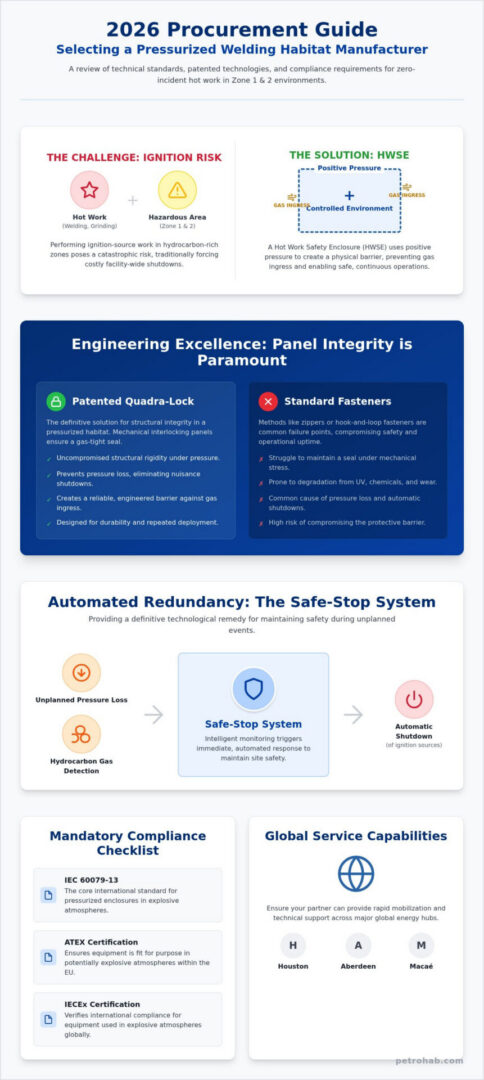
Pressurized welding habitat manufacturers provide the engineering foundation for conducting high-risk maintenance in explosive atmospheres. These specialized companies design and build controlled environments that isolate ignition sources from flammable gases. By utilizing a Positive pressure enclosure, operators can perform welding, grinding, and cutting in Zone 1 and Zone 2 areas while the facility remains online. This capability is essential for offshore platforms, refineries, and petrochemical plants where shutting down production for minor repairs results in massive revenue loss.
The primary objective of these manufacturers is the systematic mitigation of ignition risks. They achieve this through rigorous environmental containment and pressure differential management. When a habitat is correctly deployed, the internal air pressure is kept higher than the external atmosphere. This physical law prevents hydrocarbon gas from entering the workspace, effectively shielding the facility from potential disasters.
To better understand how these systems function in real-world industrial settings, watch this technical overview:
The Evolution from Simple Enclosures to Intelligent HWSE
The industry has moved beyond the era of passive fire-blanket setups. Early containment methods provided localized spark protection but failed to address the risk of gas ingress. A modern pressurized welding habitat functions as a sophisticated safety ecosystem. Manufacturers now integrate digital sensors and automated monitoring to track pressure levels and gas concentrations in real time. This shift from manual oversight to intelligent HWSE technology ensures that human error doesn’t compromise the safety of the site. Manufacturers like PetroHab utilize patented Quadra-Lock technology to ensure the structural integrity of these enclosures remains uncompromised under pressure.
Protecting High-Value Assets and Personnel
A Hot Work Safety Enclosure (HWSE) is a modular, fire-retardant enclosure designed to maintain positive pressure against external gas ingress. This technology serves as a critical component of a facility’s Permit-to-Work (PTW) system. Manufacturers provide the certified hardware that allows safety managers to sign off on hot work permits with confidence. The cost-benefit analysis is clear; preventing a single catastrophic incident justifies the investment in high-tier containment. Beyond safety, the economic impact of using habitats is significant. They allow for “hot” repairs during normal operations, eliminating the need for facility-wide turnarounds for isolated maintenance tasks. This ensures that production targets are met while keeping personnel out of harm’s way.
Engineering Excellence: Evaluating Patented Panel Technology and Structural Integrity
Structural integrity serves as the primary differentiator when evaluating pressurized welding habitat manufacturers. While fire-retardant fabric is a baseline requirement, the engineering of the panel junctions determines the system’s operational reliability. A habitat is a pressurized vessel; any compromise in the interlocking mechanism leads to pressure loss, which triggers automatic shutdowns and halts production. Manufacturers who prioritize structural rigidity ensure that the enclosure remains a reliable barrier against hazardous external atmospheres.
The most critical feature of any Hot Work Safety Enclosure (HWSE) is the seal between its modular components. Standard connection methods, such as industrial zippers or hook-and-loop fasteners, often struggle to maintain a gas-tight seal under the mechanical stress of positive pressure. These methods are also prone to degradation from UV exposure and industrial contaminants, increasing the risk of failure during critical maintenance windows.
Maintaining Structural Stability in High-Wind Environments
Ensuring structural stability is paramount in high-wind offshore environments. Quadra-Lock technology ensures a superior seal compared to traditional fastening methods by utilizing a mechanical interlock. This engineering choice provides a secure, interlocking assembly that minimizes pressure leakage and maintains a consistent internal environment. Unlike flexible panels that may catch the wind and create a “sail” effect, rigid or semi-rigid panels equipped with Quadra-Lock provide a stable barrier that withstands the rigors of the North Sea or the Gulf of Mexico. This stability is essential for the safety of the technician performing the hot work, as it prevents sudden shifts in the enclosure’s geometry.
Material Science and Fire Resistance Standards
Material selection must exceed basic welding blanket specifications to be effective in heavy industrial applications. While many pressurized welding habitat manufacturers use standard fiberglass, high-tier providers utilize specialized silicone-coated fabrics. These materials are engineered to withstand not only grinding sparks but also the sustained heat of molten slag, which can exceed the temperature thresholds of basic fire-retardant textiles. Compliance with OSHA 1917.152 requires rigorous fire protection measures during hot work. Manufacturers must provide third-party verification of their material’s fire retardancy to ensure they meet these legal requirements.
Modularity is the final pillar of engineering excellence. Industrial sites are rarely open spaces; they’re dense networks of piping, valves, and structural beams. Interchangeable panels allow for flexible configurations that wrap around these obstructions without compromising the pressure seal. This adaptability ensures that the habitat can be deployed in the most challenging locations on an offshore rig or within a refinery. If you’re evaluating your current risk mitigation strategy, it’s beneficial to analyze how PetroHab Hot Work Safety Enclosures utilize these engineering principles to protect your personnel.
Global Operational Support: Evaluating Manufacturer Service Capabilities
Leading pressurized welding habitat manufacturers distinguish themselves through their logistical reach and technical support infrastructure. High-tier equipment is only effective when it’s deployed correctly and maintained by competent personnel. Proximity to major energy hubs like Houston, Aberdeen, and Macaé is essential for minimizing project lead times. This local presence ensures that critical hardware and technical expertise arrive at the job site within hours, preventing costly delays in hot work execution.
Mobilization strategies differ significantly between emergency repairs and planned turnarounds. For emergency hot work, manufacturers must maintain ready-to-deploy inventory to minimize asset downtime. During planned shutdowns, the focus shifts to large-scale coordination and the delivery of multiple units. Top-tier manufacturers provide on-site supervision to oversee every aspect of the enclosure’s setup. This expert oversight ensures that the habitat maintains its integrity throughout the entire work permit duration, acting as a definitive technological remedy for hazardous area operations.
Certified technicians play a vital role in maintaining habitat integrity during active hot work. These professionals are trained to monitor environmental conditions and ensure that the positive pressure differential remains constant. Their presence on-site provides an additional layer of risk mitigation, ensuring that personnel and high-value assets remain protected against gas ingress or structural failure. This commitment to active guardianship is what separates a mere equipment provider from a true safety partner.
Rental vs. Direct Purchase: Which Model Fits Your Project?
Decisions regarding asset acquisition depend on project frequency and duration. Leasing offers significant flexibility for short-term maintenance projects, allowing operators to access the latest HWSE technology without the burden of long-term storage or maintenance. Conversely, direct purchase is often the logical choice for facility asset management on permanent installations where hot work is a recurring requirement. For a deeper dive into these options, consult our procurement guide for HWSE suppliers.
Training and Personnel Competency
Safety isn’t just about the equipment; it’s about the people operating it. Manufacturer-led training is a non-negotiable requirement for maintaining high safety standards. This curriculum covers everything from initial assembly to emergency response protocols, ensuring that client personnel can operate the system with confidence. PetroHab’s supervision fees reflect the value of having a seasoned expert on-site to manage complex safety protocols. These supervisors ensure that every aspect of the habitat’s operation aligns with the facility’s strict safety guidelines, prioritizing the protection of life and property above all else.
Compliance and Certification: IEC 60079-13 and ATEX/IECEx Standards
Compliance defines the operational legality of hot work in hazardous areas. Pressurized welding habitat manufacturers must adhere to IEC 60079-13, which governs the design and verification of pressurized rooms used in explosive atmospheres. This standard ensures the enclosure functions as a protective barrier, preventing external gas ingress through maintained overpressure. Without documented compliance, an enclosure is merely a tent, lacking the engineering credentials required for high-stakes energy sector projects. The 2017 edition of this standard introduced significant technical changes that manufacturers must implement to ensure global recognition.
Validation by third-party certification bodies like DNV or ABS provides the necessary assurance for safety managers and engineers. These organizations audit the manufacturer’s quality systems and technical files to verify that the equipment performs as claimed under industrial stress. Every component within the system, from lighting to ventilation fans, must carry individual ATEX or IECEx certifications. This holistic approach ensures that no single part of the habitat introduces a secondary ignition risk. Rigorous testing protocols confirm that materials and electronics can withstand the harsh conditions of offshore and petrochemical environments.
Navigating ATEX and IECEx Zone Classifications
Zone 1 and Zone 2 classifications dictate the level of protection required during maintenance. In Zone 1, an explosive atmosphere is likely to occur during normal operation, necessitating stringent hardware redundancy and automated monitoring. Zone 2 environments involve areas where explosive atmospheres are unlikely but still possible. For both, an Automatic Shutdown System is essential to maintain safety and regulatory alignment. Learn more about these requirements in our hazardous environment standards guide. Understanding these distinctions is critical for selecting the correct equipment for your specific site conditions.
The Role of Automatic Shutdown Systems (ASDS)
The Safe-Stop Automatic Shutdown System serves as the brain of the HWSE. It continuously monitors for toxic and combustible gases, including H2S and LEL, while tracking internal pressure levels via integrated manometers. If pressure drops below the 25-pascal threshold or if gas is detected at the intake, the system triggers a fail-safe mechanism. This logic instantly isolates all ignition sources, including welding machines and power tools, before a hazardous concentration can enter the workspace. This immediate response is the definitive technological remedy for maintaining asset integrity. To ensure your project meets these rigorous standards, explore the PetroHab Hot Work Safety Enclosure options today.
PetroHab: The Benchmark for Pressurized Habitat Manufacturing
PetroHab LLC stands as the definitive authority among pressurized welding habitat manufacturers, pioneering the world’s most advanced enclosures for high-risk environments. Based in Houston, Texas, the company engineers modular solutions that set the global benchmark for Hot Work Safety Enclosure (HWSE) innovation. Every system is built on a foundation of technical precision and an unwavering commitment to safety, reflecting the high-stakes nature of heavy industry. By focusing on engineered risk mitigation rather than passive protection, PetroHab acts as an active guardian for industrial sites. This ensures that personnel and high-value assets remain protected during critical maintenance operations where the risk of ignition is a constant reality.
The company’s personality is defined by competence and a sense of duty, acting as a trusted safety partner for engineers who can’t afford operational failures. Because the stakes include both human life and facility integrity, the brand avoids hyperbolic marketing in favor of stoic, reliable engineering. This approach has solidified its reputation as a seasoned veteran of the field, understanding the granular details of industrial hazards better than anyone else. The result is a suite of products that are as durable and resilient as the offshore platforms and refineries they protect.
The Safe-Stop™ Shutdown System: Unmatched Detection Precision
The Safe-Stop Automatic Shutdown System represents the pinnacle of ignition prevention technology. It monitors internal pressure levels and external gas concentrations simultaneously, providing continuous, real-time oversight of the work environment. The monitoring hardware carries full ATEX certification, ensuring it functions reliably even in the most volatile Zone 1 and Zone 2 atmospheres. If safety parameters are breached, such as a drop in positive pressure or the detection of LEL or H2S, the Safe-Stop system automatically isolates all power and gas to the habitat. This immediate response is the definitive technological remedy that ensures ignition sources don’t interact with hazardous ingress.
Why PetroHab is the Preferred Partner for Global Energy Firms
Reliability in the field is the primary reason global energy firms partner with PetroHab for their safety needs. The patented Quadra-Lock panel system allows for rapid, tool-free assembly, ensuring that maintenance schedules remain on track without compromising structural integrity. This interlocking technology provides a superior pressure seal that is far more durable than zippers or velcro, especially in high-wind offshore conditions. PetroHab offers a versatile range of solutions, including the Petro-Habitat, Petro-Shield, and Petro-Lite product lines, to accommodate various industrial footprints and thermal requirements. Houston-based manufacturing ensures that every component undergoes rigorous quality control before global mobilization. For deep technical specs on these engineered solutions, consult The Definitive Guide to HWSE to evaluate the best fit for your facility’s safety protocol.
Securing the Future of Hazardous Area Operations
Selecting from the global pool of pressurized welding habitat manufacturers is a decision that directly impacts both personnel safety and facility uptime. A reliable system must integrate patented Quadra-Lock technology for structural integrity and the Safe-Stop system for automated ignition prevention. These engineered remedies ensure that your hot work protocols meet the rigorous demands of IEC 60079-13 and ATEX standards without compromise. You’ve seen how structural rigidity and automated monitoring differentiate a professional safety enclosure from a basic containment tent.
PetroHab maintains a commitment to manufacturing excellence from its Houston base, providing the technical reliability required for high-stakes environments. With operational support spanning the USA, UK, and Brazil, we ensure that your projects remain on schedule and within safety parameters. Reliability isn’t just a goal; it’s the result of meticulous engineering and a duty to protect your most valuable assets. Taking proactive steps now prevents catastrophic incidents later. We’re ready to serve as your critical safety partner and active guardian on-site.
Contact PetroHab for a Pressurized Welding Habitat Quote to implement a definitive technological remedy for your site’s risk mitigation needs. We look forward to securing your next project.
Frequently Asked Questions
What is the standard for pressurized welding habitats in 2026?
The primary international standard is IEC 60079-13, which governs the design, construction, and verification of pressurized rooms used in explosive atmospheres. This standard ensures that the enclosure functions as a reliable barrier by maintaining a constant overpressure relative to the external environment. Compliance with this standard, alongside ATEX Directive 2014/34/EU, is mandatory for legal operation in most global energy sectors and high-risk industrial sites.
How do manufacturers ensure positive pressure in high-wind offshore environments?
Manufacturers utilize mechanical interlocking systems like Quadra-Lock technology to create a rigid structural seal that resists wind-induced pressure fluctuations. High-capacity centrifugal fans maintain a constant overpressure of at least 25 pascals, preventing gas ingress even when external conditions are volatile. This structural stability is essential in the North Sea or Gulf of Mexico, where flexible enclosures often fail to maintain the necessary pressure differential against heavy gusts.
What is the difference between a welding habitat and a Hot Work Safety Enclosure (HWSE)?
A Hot Work Safety Enclosure (HWSE) is a more technical and precise term for what is commonly called a welding habitat. While “habitat” is a colloquial industry term, HWSE specifically refers to a modular, fire-retardant system designed to maintain positive pressure and integrate with automatic shutdown logic. Professional pressurized welding habitat manufacturers use the HWSE designation to emphasize the system’s role as a certified safety instrument rather than a simple containment tent.
Can pressurized habitats be used in Zone 1 hazardous areas?
Yes, pressurized habitats are specifically engineered for use in both Zone 1 and Zone 2 hazardous areas. For Zone 1 operations, the system must include a certified automatic shutdown system that monitors environmental conditions in real time. This ensures that all ignition sources are isolated immediately if the system detects a loss of pressure or the presence of flammable gases, providing a definitive technological remedy for high-risk maintenance.
How long does it take to assemble a modular pressurized habitat?
Assembly time typically ranges from two to four hours depending on the size of the enclosure and the complexity of surrounding obstructions like piping or valves. Modular systems using Quadra-Lock technology facilitate faster deployment because they don’t require specialized tools or complex framing. This rapid setup is a key advantage for pressurized welding habitat manufacturers, as it minimizes the preparation time required before hot work can safely commence.
What gas levels do automatic shutdown systems monitor?
Automatic shutdown systems like Safe-Stop monitor Lower Explosive Limit (LEL) percentages and toxic gas concentrations, specifically Hydrogen Sulfide (H2S). The system is programmed to trigger a fail-safe isolation of all power and gas to the work area if levels reach pre-set safety thresholds, typically 10% LEL. This automated monitoring eliminates the risk of human error and ensures that ignition sources are never present in a potentially explosive atmosphere.
Do pressurized welding habitat manufacturers provide on-site training?
Professional manufacturers provide comprehensive on-site training and competency assessments for client personnel to ensure safe operation. This curriculum covers assembly protocols, pressure monitoring, and emergency response procedures. Top-tier providers often include a dedicated supervisor during the initial setup to verify that the habitat maintains its integrity and aligns with the facility’s Permit-to-Work system, prioritizing the protection of personnel and high-value assets at all times.
Should I rent or buy a hot work safety enclosure for a 30-day turnaround?
Renting is generally the most cost-effective solution for a 30-day turnaround project. Leasing provides access to the latest HWSE technology and manufacturer-led maintenance without the long-term capital expenditure or storage requirements associated with direct ownership. For permanent installations where hot work is a recurring requirement, direct purchase might be more logical; however, the flexibility of a rental model is ideal for short-term maintenance and emergency repairs.