Blog Posts
Reducing Hot Work Incidents: A Strategic Guide to Engineered Containment
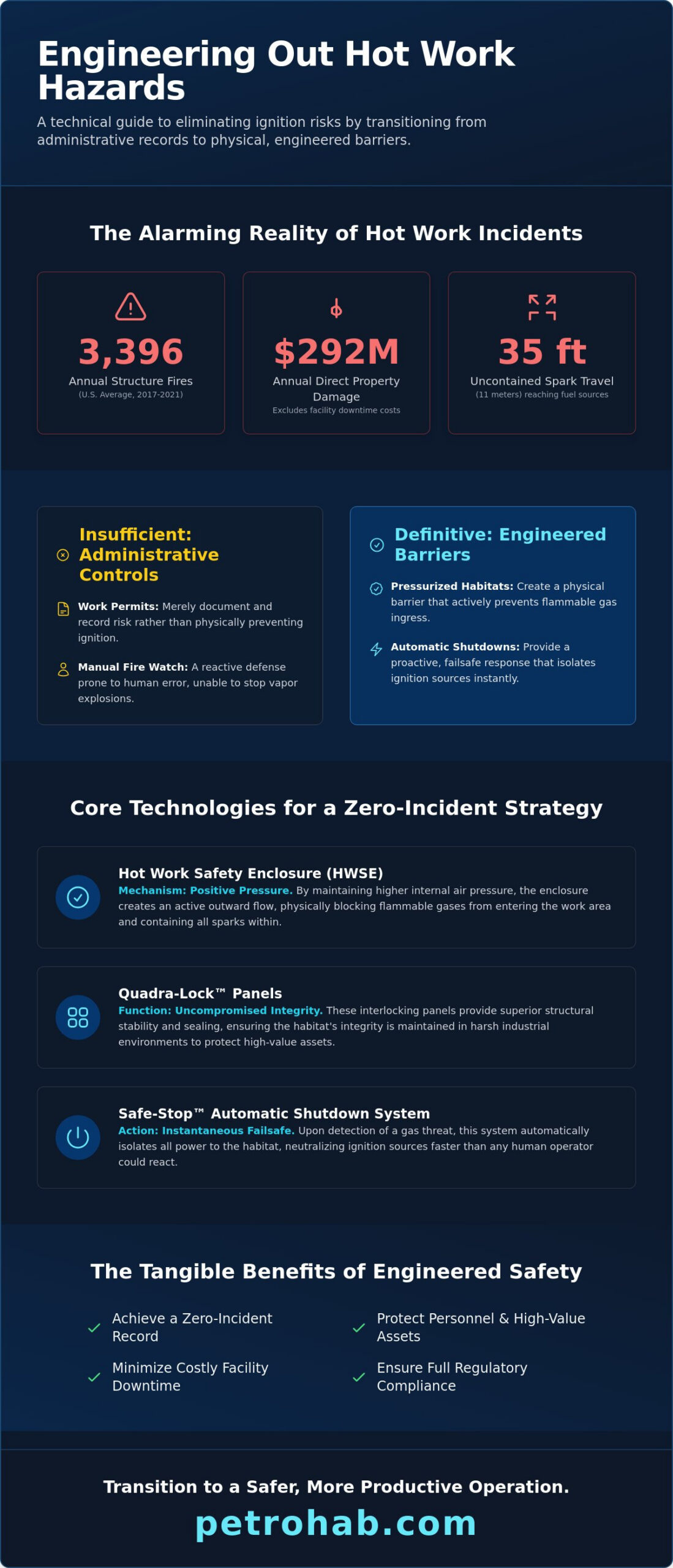
Between 2017 and 2021, an annual average of 3,396 structure fires involving hot work occurred in the United States, resulting in $292 million in direct property damage. These statistics confirm that administrative permits alone cannot physically prevent a spark from reaching a volatile fuel source. You likely understand that while documented permits are required under the 2024 NFPA 51B standards, they record risk rather than eliminate it. The mission of reducing hot work incidents in high-stakes ATEX zones requires a transition toward definitive technological remedies that prioritize personnel protection and asset integrity.
This strategic guide provides the technical framework for implementing engineered containment systems to neutralize ignition risks. You’ll learn how to deploy pressurized habitats and Quadra-Lock panels to create a controlled environment within hazardous areas. By integrating advanced engineering controls like the PetroHab Hot Work Safety Enclosure and the Safe-Stop Automatic Shutdown System, you can achieve a zero-incident safety record while minimizing facility downtime. We will explore the precise application of these systems to ensure full compliance with international safety regulations and protect your operations from catastrophic failure.
Key Takeaways
- Understand why administrative permits are insufficient alone and how engineered containment provides a physical barrier against ignition sources in hazardous zones.
- Discover the mechanics of positive pressure in Hot Work Safety Enclosures (HWSE) to prevent the ingress of flammable gases during welding operations.
- Learn how integrating the Safe-Stop Automatic Shutdown System creates a failsafe environment by isolating power the moment a gas threat is detected.
- Evaluate the technical superiority of Quadra-Lock panels in maintaining habitat integrity and protecting high-value assets from catastrophic incidents.
- Implement a comprehensive strategy for reducing hot work incidents by transitioning from manual gas monitoring to automated, technology-driven safety protocols.
The Critical State of Hot Work Safety in 2026
The term Hot work encompasses any industrial process that involves welding, burning, brazing, or similar spark-producing activities. In the high-stakes environment of 2026, the strategy for reducing hot work incidents has evolved beyond simple administrative oversight. Heavy industry, particularly within hazardous ATEX zones, faces an increasingly volatile landscape where traditional safety measures often prove insufficient. The 2024 edition of NFPA 51B now mandates documented permits to accommodate digital workflows, yet this administrative shift doesn’t change the physical reality of ignition. Engineers must recognize that a permit is a record of risk, not a physical barrier against it.
Manual fire watches represent a reactive layer of defense that frequently fails to detect the onset of vapor explosions in time to prevent disaster. Human error, complacency, and the inherent limitations of portable gas detectors mean that a fire watch cannot always identify a hydrocarbon leak before it reaches an ignition source. In the oil and gas sector, the stakes are absolute. A single spark in a refinery or on an offshore platform can lead to catastrophic loss of life and total asset destruction. Relying solely on a person with a fire extinguisher is no longer a viable engineering strategy for high-risk maintenance in live facilities.
To better understand the hidden dangers associated with these activities, watch this helpful video:
Common Ignition Sources and Fuel Hazards
Industrial maintenance environments frequently contain the three essential elements of the Fire Triangle: heat, fuel, and oxygen. The primary challenge in refineries and tank farms is the presence of invisible flammable vapors that bypass standard visual inspections. These gases can accumulate in low-lying areas or be carried by wind currents far from their source. Without engineered containment, sparks and molten slag can travel up to 35 feet (11 meters). This distance often exceeds the perceived protection radius of a work site, allowing hot particles to bridge the gap between a welding torch and a volatile fuel source.
The Economic and Human Cost of Incidents
The financial impact of a hot work incident extends far beyond immediate property damage. US statistics from 2017 to 2021 show an average of $292 million in direct damage annually, but this figure doesn’t account for the massive cost of facility downtime and lost production. A safety breach can lead to the immediate suspension of operational licenses and aggressive regulatory scrutiny from bodies like OSHA. Investing in preventative safety hardware, such as pressurized habitats and Quadra-Lock panels, is a calculated decision. It ensures the long-term viability of the enterprise by protecting both human capital and high-value assets while reducing hot work incidents across the site.
Engineering Out the Risk: The Role of Pressurized Habitats
Administrative permits only record risk. To physically eliminate it, safety managers must implement a Hot Work Safety Enclosure (HWSE) as a primary engineering control for reducing hot work incidents. This technology creates a physical barrier between the ignition source and the external environment. Unlike passive measures, an HWSE actively manages the atmosphere where the work occurs. It transforms a hazardous location into a controlled workspace, ensuring that sparks and molten metal remain contained within the designated area.
The Physics of Positive Pressure Enclosures
The core mechanism of an HWSE relies on positive pressure. By maintaining a higher internal pressure relative to the outside atmosphere, the system creates a physical barrier against flammable vapors. If a gas leak occurs nearby, the internal air pressure forces air outward, preventing gas ingress. The system utilizes spark-arresting intake fans to pull clean air into the enclosure, ensuring the internal atmosphere remains breathable and safe for technicians. Manometers provide real-time monitoring of this habitat integrity. They ensure that the pressure differential remains within strict safety parameters at all times. An HWSE is a modular, pressurized environment designed to isolate sparks from flammable atmospheres. This constant monitoring allows welding to proceed without the threat of external ignition.
Advanced Panel Technology: Quadra-Lock
The effectiveness of a pressurized habitat depends on the integrity of its seals. Standard fire blankets don’t provide a gas-tight environment, especially in high-wind offshore conditions. The Quadra-Lock panel system addresses this vulnerability through superior seal integrity. These panels are constructed from specialized fire-resistant materials that withstand extreme temperatures and mechanical stress. Each Quadra-Lock panel interlocks with the next to eliminate gaps that could allow sparks to escape or vapors to enter. This robust construction ensures that the enclosure remains durable throughout the duration of the project.
The modular design of these panels allows for rapid assembly around complex industrial geometries, such as protruding pipes and structural beams. This versatility ensures that even the most difficult work sites receive full protection. You can explore the technical specifications of these pressurized welding enclosures to see how they integrate into your existing safety protocols. Reducing hot work incidents requires hardware that can withstand the rigors of heavy industry. Quadra-Lock panels offer significant durability advantages over traditional materials. They resist tearing and degradation, maintaining a reliable seal under harsh conditions. By choosing engineered solutions over manual observation, you establish a rigorous safety standard that protects personnel and high-value assets.
Comparing Administrative Controls vs. Technological Barriers
A standard Permit-to-Work system functions as a procedural checklist. It establishes a specific window of time where conditions are deemed acceptable for maintenance. However, industrial environments are dynamic. A gas leak can occur minutes after a manual test is completed, rendering the previous assessment obsolete. Engineered containment shifts the strategy from periodic checks to continuous, active protection. This transition is fundamental to reducing hot work incidents in complex facilities like refineries or offshore platforms. By utilizing a physical enclosure, you move beyond the limitations of paperwork and implement a verified safety standard.
Administrative rules rely on human compliance, which is inherently variable. Technological barriers, conversely, provide a constant and measurable level of protection. They ensure that safety protocols are physically enforced rather than just theoretically followed. When you deploy hardware designed to isolate ignition sources, you create a fail-safe environment that doesn’t depend on a worker’s memory or attention span. This methodical approach to risk mitigation is the only way to achieve a zero-incident record in high-stakes heavy industry.
The Human Element in Safety Failures
Manual fire watches are often the weakest link in the safety chain. Even the most diligent personnel can miss localized pockets of flammable vapor that settle in recesses or behind structural members. Workers in busy industrial environments also experience alarm fatigue. This psychological state occurs when a high volume of alerts leads to a delayed or absent response. Automated systems remove this cognitive load. They provide 24/7 objective monitoring, ensuring that every detection event triggers an immediate, programmed response without the risk of human hesitation. This objectivity is essential for maintaining habitat integrity during long-duration welding projects.
Active vs. Passive Protection Systems
Passive protection, such as fire blankets and non-pressurized shields, only provides a barrier against physical sparks. They offer no protection against the ingress of combustible gases. In contrast, active protection systems use mechanical ventilation to maintain a higher internal pressure relative to the external atmosphere. This physical phenomenon ensures that even if a leak occurs, the hazardous gas cannot enter the workspace. For high-risk ATEX Zone 1 and 2 areas, active systems are the only reliable method for isolating an ignition source.
Deploying pressurized welding habitats during live plant maintenance allows engineers to perform critical repairs without the massive economic burden of a total facility shutdown. These technological barriers don’t replace administrative rules. Instead, they make those rules enforceable by providing the physical infrastructure necessary to meet safety standards. By integrating active systems into your safety framework, you ensure that reducing hot work incidents becomes a predictable outcome of your engineering strategy.
Implementing a Zero-Incident Strategy with Automatic Shutdowns
While pressurized habitats provide a physical barrier, the ultimate layer of protection is an automated response system. Human observation is fallible. Electronic detection is not. Integrating gas detection with automatic power isolation is a critical step in reducing hot work incidents. It removes the “human error” variable from the safety equation by ensuring that power is severed the moment a hazard is detected. This technological override acts as a fail-safe that administrative permits simply cannot provide.
Effective shutdown systems must operate on a “Safe-Stop” logic: detect, alert, and isolate. This sequence ensures that the response is immediate and absolute. The system must monitor both the internal environment of the habitat and the external atmosphere simultaneously. If the monitoring hardware detects a breach in safety parameters, it doesn’t wait for a manual intervention. It kills the power to the ignition source instantly, protecting the site from a potential explosion before a technician even realizes a threat exists.
Step-by-Step: How Automatic Shutdown Works
The operational cycle begins with the continuous monitoring of internal habitat pressure and external gas levels. High-precision sensors track hydrocarbon concentrations in real-time. When gas concentrations reach a critical threshold of 10% LEL (Lower Explosive Limit), the system triggers an immediate cessation of welding power. This threshold is a standard safety benchmark designed to prevent ignition before gas reaches a combustible density. Simultaneously, the system activates visual and audible alarm protocols. These alerts provide clear, unambiguous instructions for worker evacuation, ensuring that personnel can exit the area while the equipment is already safely isolated.
Compliance with Global Safety Standards
Adopting automated shutdown technology is essential for meeting the rigorous requirements of NFPA 51B and OSHA. These regulatory bodies increasingly favor engineering controls that provide objective, documented safety data. In global procurement, adhering to hazardous environment standards is a prerequisite for operating in high-risk territories. All monitoring hardware must carry valid ATEX and IECEx certifications to ensure it’s fit for purpose in explosive atmospheres.
Engineers must verify that their equipment meets the specific ATEX zone classification of their site. Whether you are working with Quadra-Lock panels in a Zone 1 area or performing maintenance in a Zone 2 environment, the hardware must be resilient. You can secure your site by implementing the Safe-Stop Automatic Shutdown System as your primary safety barrier. This commitment to technical excellence is the most effective method for reducing hot work incidents and maintaining operational continuity in the energy sector.
The PetroHab Solution: Protecting Personnel and Assets
PetroHab defines the industry benchmark for environmental containment and ignition prevention. The PetroHab Hot Work Safety Enclosure (HWSE) operates as a definitive technological remedy for high-hazard environments. By combining the physical barrier of pressurized habitats with the logic-driven Safe-Stop Automatic Shutdown System, operators establish a rigorous defense against catastrophic failure. This integrated approach is the most reliable method for reducing hot work incidents in facilities where the margin for error is non-existent.
Reliability in heavy industry is built on technical precision and meticulous engineering. PetroHab doesn’t just provide hardware; it delivers a comprehensive safety partnership. This includes global availability for leasing and sales, supported by on-site training to ensure that every deployment meets the highest operational standards. Certified technicians play a critical role in this ecosystem. They verify habitat integrity during the initial setup, ensuring that every seal and sensor functions according to its technical specifications before work begins.
Why Industry Leaders Choose PetroHab
Patented Quadra-Lock technology provides the structural foundation for these systems. In extreme environments, such as North Sea offshore platforms or high-temperature refineries, the durability of Quadra-Lock panels ensures that the habitat remains resilient against mechanical stress and environmental pressure. PetroHab’s track record in reducing hot work incidents is established through the protection of high-value assets in diverse global sectors. The brand acts as a trusted advisor, offering authoritative safety guidance that prioritizes the protection of personnel above all else.
Next Steps for Safety Managers
Achieving a zero-incident record requires a transition from passive observation to active engineering. Safety managers should begin by conducting a comprehensive gap analysis of their current hot work protocols. This process identifies areas where administrative controls, like manual fire watches, fail to provide adequate protection. Consulting with hot work safety enclosure suppliers allows for the development of custom solutions tailored to specific site geometries and ATEX zone classifications.
Transitioning to engineered safety isn’t just a technical upgrade. It represents a shift in corporate values toward operational excellence. By implementing Petro-Habitats and automated shutdown systems, you demonstrate an unwavering commitment to safety that aligns with global regulatory standards like NFPA 51B. Protecting your site from ignition risks is a calculated investment in the future of your facility.
Advancing Toward a Zero-Incident Industrial Future
The transition from administrative oversight to engineered containment is the only viable path for reducing hot work incidents in high-hazard environments. By implementing pressurized habitats, you move beyond the limitations of manual monitoring and establish a physical barrier against volatile vapors. The integration of automated detection and power isolation ensures that safety isn’t dependent on human observation alone.
Reliability is maintained through patented Quadra-Lock technology. This system provides maximum seal integrity under mechanical stress and high-wind conditions. The Safe-Stop Automatic Shutdown System carries essential ATEX and IECEx certifications. These certifications provide the technical precision required for hazardous Zone 1 and Zone 2 operations. PetroHab offers global support and on-site supervision worldwide to ensure every deployment meets rigorous safety standards. Our certified technicians verify every installation to guarantee habitat integrity.
Request a Quote for PetroHab Hot Work Safety Enclosures to secure your facility today. Protecting your personnel and high-value assets is a calculated engineering decision that ensures long-term operational continuity.
Frequently Asked Questions
How does a pressurized welding habitat reduce the risk of fire?
A pressurized welding habitat reduces fire risk by creating a physical barrier that prevents flammable gases from reaching an ignition source. The system utilizes spark-arresting intake fans to maintain a higher internal air pressure relative to the external atmosphere. This positive pressure ensures that any ambient vapors are forced away from the enclosure rather than entering the workspace. It effectively isolates the hot work environment from the surrounding hazardous area.
What are the main differences between administrative and engineering controls in hot work?
Administrative controls rely on human-led procedures, such as documented permits and manual fire watches, to manage risk. Engineering controls, like the PetroHab HWSE, use physical technology to eliminate the risk entirely. While administrative systems record the presence of hazards, engineering controls provide a definitive technological remedy that physically separates fuel from heat. This distinction is fundamental for safety managers committed to reducing hot work incidents in high-risk zones.
Is an automatic shutdown system required for all hot work in refineries?
Refineries often mandate automatic shutdown systems for high-risk ATEX Zone 1 and Zone 2 areas to meet the intent of NFPA 51B and OSHA standards. While specific regulations may vary by jurisdiction, an automated system like Safe-Stop provides the only reliable failsafe against human error. These systems ensure that power is severed the moment gas is detected, providing a level of protection that manual monitoring cannot match during live plant maintenance.
How does the Quadra-Lock panel system improve safety compared to traditional habitats?
The Quadra-Lock panel system improves safety by providing superior seal integrity and mechanical durability. Traditional habitats often rely on standard fire blankets that can tear or leave gaps under high-wind conditions. Quadra-Lock panels use an interlocking design that eliminates these vulnerabilities, ensuring the habitat remains gas-tight. This robust construction maintains habitat integrity around complex geometries like piping and structural beams, offering much greater protection than non-modular alternatives.
Can hot work be performed safely on a live offshore platform?
Hot work can be performed safely on live offshore platforms provided that engineered containment systems are deployed. By using a PetroHab Hot Work Safety Enclosure, operators can isolate welding sparks from the volatile hydrocarbon environment. This approach allows for critical repairs without the massive economic loss of a total facility shutdown. The enclosure acts as an active guardian, ensuring that maintenance activities don’t compromise the safety of the entire asset.
What are the key standards for hot work safety in 2026?
The primary standards include the 2024 edition of NFPA 51B and OSHA’s National Emphasis Program on Heat. The updated NFPA 51B standard emphasizes documented permits and clearer definitions for management responsibilities. These regulations prioritize the use of engineering controls to mitigate ignition risks. Adhering to these international certifications is a prerequisite for any global strategy focused on reducing hot work incidents and ensuring full regulatory compliance on industrial sites.
What happens if the pressure drops inside a hot work safety enclosure?
If the internal pressure drops below the safety threshold, the Safe-Stop Automatic Shutdown System immediately isolates the power source. This response prevents work from continuing if the physical barrier against gas ingress is compromised. The system also activates visual and audible alarms to alert personnel to the breach. This automated logic ensures that the work environment remains secure, even if mechanical ventilation fails or a seal is damaged during operation.
How often should gas detectors be calibrated in a pressurized habitat?
Gas detectors must be calibrated according to manufacturer specifications and site-specific safety protocols, typically before every new deployment or shift. Regular bump tests verify that sensors accurately detect hydrocarbons at the 10% LEL (Lower Explosive Limit) threshold. Rigorous calibration schedules ensure that the Safe-Stop system remains a reliable failsafe. This meticulous maintenance of monitoring hardware is essential for protecting personnel and high-value assets in explosive atmospheres.