Blog Posts
Requesting a PetroHab LNG Habitat Quote: Scope, Options, and Next Steps
What details help shape a useful PetroHab LNG habitat quote? Start with the hot-work scope, conditions at the work area, habitat requirements, and shutdown-system needs. Those details give the project team a practical basis for discussing configuration and choosing between lease and purchase options.
PetroHab manufactures, leases, sells, and maintains hot-work safety enclosures (HWSEs) for hazardous environments. Its habitat options include the Petro-Habitat™ HWSE, Petro-Shield™ HWSE, and Petro-Lite™ HWSE. Each has distinct features, so describe the work and site conditions before comparing models. PetroHab’s Safe-Stop Safety Shutdown System (SSS) provides immediate shutdown in unsafe conditions.
This article outlines the project information to gather, the features to compare, and the considerations for leasing or purchasing. It also explains how training for assembly, disassembly, and maintenance can fit into project planning, helping you prepare for a focused quote discussion.
Key Takeaways
- Prepare a project brief covering the hot-work activity, work area, relevant operating conditions, equipment needs, and procurement preference.
- Compare Petro-Habitat™, Petro-Shield™, and Petro-Lite™ using their confirmed features and the requirements of the work scope.
- Include automatic shutdown-system requirements and any optional oxygen and/or carbon-dioxide detectors in the configuration discussion.
- Weigh lease and purchase options against the expected period of use, anticipated reuse, and ownership requirements.
- Identify training needs for habitat and shutdown-system assembly, disassembly, and maintenance as part of project planning.
What a PetroHab LNG Habitat Quote Needs to Cover
A project-specific quote discussion starts with the planned hot work and the conditions around it. Share the work activity, where it will take place, relevant operating conditions, habitat requirements, automatic shutdown-system needs, and whether you are considering a lease or purchase. This information helps connect the equipment discussion to the job.
Describe the work in context, such as construction, maintenance, or repair, and identify its location within the facility. LNG’s properties, production, storage, and transportation shape the broader facility context; What is Liquefied Natural Gas (LNG)? provides background on those fundamentals. For a habitat discussion, focus on the conditions relevant to the planned hot work rather than relying on a general facility description.
Which LNG project details shape the habitat scope?
The work area and operating conditions help frame questions about habitat configuration and automatic shutdown-system requirements. Describe the hot-work activity, access needs, and any project-specific factors that could affect the enclosure or monitoring setup. The project’s responsible personnel determine site-specific hazard assessments, work controls, and approvals. Equipment planning supports that work, but does not replace it.
Gather these core inputs for a concise scope summary:
- Work activity: What hot work is planned, and is the project construction, maintenance, repair, or another type of work?
- Location and conditions: Where will the work take place, and what conditions around the work area may affect configuration?
- Equipment and system needs: What habitat features and shutdown-system requirements should the quote discussion address?
- Procurement preference: Is the project considering a lease or purchase?
What belongs in a quote brief versus a logistics plan?
A quote brief describes the habitat and system requirements tied to the work. A logistics plan covers coordination for moving equipment, preparing the work area, deploying the habitat, and demobilizing after the work. Keeping the two plans distinct helps teams see which decisions define the equipment scope and which require coordination across project, site, and logistics functions.
For example, the hot-work activity and relevant operating conditions belong in the scope brief. Shipment timing, access arrangements, site readiness, and handoffs belong in deployment planning. Keep connected planning details visible and assign responsibility within the project team. PetroHab’s remote LNG logistics guide can support planning for transport and deployment alongside the habitat scope.
Treat the brief as a working summary, not a safety approval. Keep the work scope, operating conditions, configuration questions, shutdown-system needs, and procurement preference together. Track transport, site readiness, and demobilization separately, then coordinate those plans with habitat requirements as the project develops.
How LNG Work Conditions Connect to PetroHab Habitat Features
Habitat selection depends on the task and the conditions at the work area. Compare features that relate to the required access, enclosure configuration, and operating setup. For example, consider whether the scope calls for interchangeable panels, a modular enclosure, or particular shutdown-system monitoring. Use those requirements to guide the options discussion while leaving site-specific safety decisions with the responsible project team.
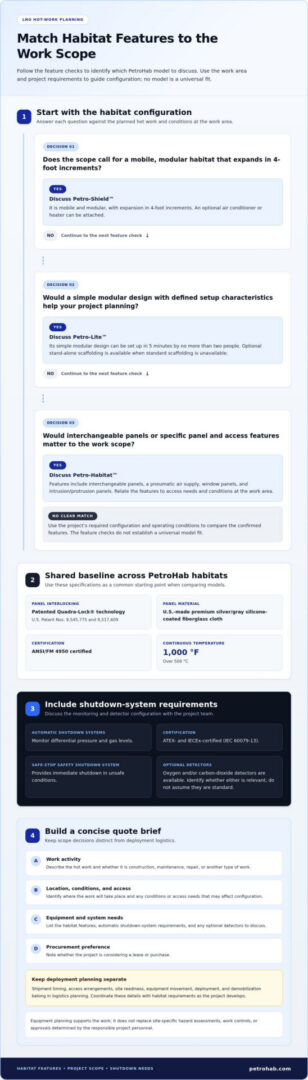
All PetroHab habitats use patented Quadra-Lock® panel interlocking technology, covered by U.S. Patent Nos. 9,545,775 and 9,517,609. Panels are made from U.S.-made premium silver/gray silicone-coated fiberglass cloth, are ANSI/FM 4950 certified, and can withstand continuous temperatures of 1,000 °F (over 500 °C). These shared specifications provide a baseline for comparing models. Each model also has features that may be relevant to a particular work scope.
Which PetroHab habitat features should an LNG buyer consider?
The Petro-Habitat™ has interchangeable panels, a pneumatic air supply, window panels, and intrusion/protrusion panels. Discuss these features in relation to the work area and access requirements. Petro-Shield™ is mobile and modular, and expands in 4-foot increments. Petro-Lite™ has a simple modular design and can be set up in 5 minutes by no more than two people. Compare these confirmed features with the project’s operating and configuration needs rather than treating one model as a universal fit.
For Petro-Shield™, consider whether its 4-foot expansion increments suit the intended configuration. Petro-Lite™ setup characteristics may be useful to consider in project planning. Optional stand-alone scaffolding is available for Petro-Lite™ when standard scaffolding is unavailable. An optional air conditioner or heater can be attached to Petro-Shield™.
What safety-system details belong in the quote discussion?
PetroHab’s automatic shutdown systems monitor differential pressure and gas levels and are ATEX- and IECEx-certified (IEC 60079-13). The Safe-Stop Safety Shutdown System (SSS) provides immediate shutdown in unsafe conditions. Include the project’s shutdown-system requirements in the configuration discussion. Optional oxygen and/or carbon-dioxide detectors are available, so identify whether either is relevant to the project rather than assuming these detectors are standard.
Keep regulatory references precise. The linked OSHA standard for liquefied petroleum gases concerns LPG, not LNG, so it should not be treated as an LNG habitat requirement. Project teams should apply requirements relevant to their facility and work scope. PetroHab’s habitat options provide a starting point for reviewing confirmed features against defined project needs.
Lease or Purchase: Which PetroHab Quote Path Fits the Project?
PetroHab offers both lease and purchase options for its habitat systems. The project’s expected period of use, anticipated future work, and ownership requirements are useful criteria for comparing the paths. PetroHab stands almost alone in offering its patented and certified habitat systems for either lease or sale.
Consider procurement alongside the defined work scope. A project with a specific, limited equipment requirement may have different ownership considerations from a program with planned repeat use. A PetroHab LNG habitat quote discussion can take the intended equipment use and procurement preference into account without presuming a rental term or financial outcome. API’s publication on LNG measurement on marine carriers provides context for one aspect of LNG operations, but does not determine whether a habitat should be leased or purchased.
When might a project assess a lease option?
A lease is worth assessing when the equipment requirement is tied to a defined scope and duration. Consider how long the habitat is expected to be used, what work it needs to support, and whether the project may need the equipment again. Include those details in the quote discussion rather than assuming a rental term. The project schedule and procurement approach should guide the comparison.
Leasing can also be considered when ownership is not the project’s objective. This is one procurement factor, not a recommendation: project controls, contracting arrangements, and expected reuse vary. Define the anticipated period of use and known future needs, then compare leasing with purchase against those requirements.
When might a project assess a purchase option?
Purchase may suit an organization planning to own habitat equipment and expecting future use to inform that decision. Identify whether anticipated work extends beyond the current LNG scope and whether ownership fits the project’s procurement structure. PetroHab manufactures, sells, and maintains Hot Work Safety Enclosures, so the discussion can cover equipment ownership and maintenance needs without assuming a savings or payback outcome.
Keep the comparison grounded in operational planning. If repeat work is anticipated, document where future use is expected. If the equipment is intended for a defined project, describe its scope and duration. Neither factor alone determines the right path. Project procurement stakeholders can assess ownership needs alongside the technical configuration and planned use.
Before the quote discussion, summarize the expected period of use, anticipated reuse, and whether ownership is required. Keep those procurement factors distinct from habitat configuration, then compare both paths against the same project scope. For an overview of the available options, review PetroHab habitat procurement options.
How to Prepare a Clear PetroHab LNG Habitat Quote Request
A concise project brief keeps the quote discussion tied to the actual hot-work scope. Organize known information, mark decisions still under review, and leave site-specific safety approvals with the responsible project personnel. The following sequence helps bring the main inputs together.
What project information can buyers organize first?
- Summarize the work. Describe the hot-work activity, its location within the LNG project, and the project context, such as construction, maintenance, or repair.
- Describe relevant operating conditions. Note conditions around the work area that may affect habitat configuration. Track transport, site readiness, and deployment coordination separately.
- Identify habitat features for discussion. Name the PetroHab habitat or features under consideration and explain what the scope requires. For example, note whether the team is evaluating interchangeable panels, window panels, or a modular configuration.
- Record shutdown-system needs. State whether the scope includes the Safe-Stop Safety Shutdown System and identify any optional oxygen and/or carbon-dioxide detectors under consideration.
- Set out procurement preference. Indicate whether the project is considering a lease or purchase. If the decision is open, say so and summarize expected use and anticipated reuse.
This sequence gives a PetroHab LNG habitat quote discussion a practical starting point without turning the project brief into a safety approval. Separate confirmed requirements from open questions. For example, record the planned work activity and preferred habitat features as defined inputs, then flag configuration or shutdown-system decisions that remain under engineering or safety review. That distinction helps the team discuss equipment needs without presenting unresolved decisions as final.
How should a buyer move from scope to quote discussion?
Keep the brief direct and easy to review. Include the work activity, project context, relevant operating conditions, requested habitat features, shutdown-system considerations, and procurement preference. Add internal contacts or decision ownership when the project team has established them. Identify information that remains under review instead of filling gaps with assumptions; the responsible teams can resolve site-specific requirements.
Keep supplier-selection considerations separate from technical scope and purchasing preference. Once the project information is organized, use PetroHab’s website to begin a quote discussion. Discuss your LNG habitat project with PetroHab using the scope and procurement details your team has assembled.
What to Expect When Moving Forward with PetroHab
A prepared project brief gives the next discussion a practical basis. The work scope, operating conditions, habitat requirements, shutdown-system needs, and procurement preference can guide conversations about configuration and project support. List open questions clearly so safety, engineering, and procurement stakeholders can distinguish established requirements from decisions that still need input.
How can training and manufacturing support project requirements?
PetroHab provides training and certification programs for habitat and shutdown-system assembly, disassembly, and maintenance. Include anticipated equipment handling and maintenance needs in project planning so training requirements can be considered alongside configuration and procurement. These are planning considerations, not an assumption that training is included in a habitat quote.
PetroHab’s in-house manufacturing enables custom HWSE designs for project requirements. Bring specific configuration needs to the design discussion and explain how they relate to the planned work. This keeps the conversation grounded in the work scope and operating conditions rather than assumptions about a standard setup.
What makes PetroHab relevant to LNG hot-work projects?
PetroHab’s safety-focused products include engineered Hot Work Safety Enclosures and automatic shutdown systems for hazardous environments. All habitats use patented Quadra-Lock® panel interlocking technology, and their panels are made from U.S.-made premium silver/gray silicone-coated fiberglass cloth. These are specific product details teams can use in internal reviews and configuration discussions.
PetroHab reports well over a million incident-free man-hours. This company-reported figure is not a guarantee of a project outcome. It provides context for teams evaluating habitat systems for hazardous industrial work, while site-specific controls and decisions remain with the responsible project personnel.
As you move forward, keep the scope, configuration questions, training needs, and procurement path aligned. PetroHab manufactures, leases, sells, and maintains HWSEs, so project requirements can inform both the habitat discussion and the equipment ownership approach. The panel material and manufacturing details also give procurement and engineering teams concrete information for their review.
Bring your defined LNG work scope and outstanding configuration questions to PetroHab to begin a quote discussion. Discuss your LNG habitat requirements with PetroHab.
Move Your LNG Work Plan Toward a Defined Next Step
Turn your project brief into a shared reference for the people responsible for equipment, safety, engineering, and procurement. Record decisions already made alongside questions still under review. This helps keep the habitat discussion focused as the work plan develops and gives the team a practical basis for coordinating configuration and procurement priorities.
Use the PetroHab LNG habitat quote discussion to connect those priorities with a habitat scope suited to the planned work. Bring the relevant details together, identify a preferred procurement path where possible, and keep site-specific approvals with the responsible project teams. A clear brief supports a more purposeful conversation about what the job requires and what should happen next.
Take the next step with your project scope in hand. Discuss your LNG habitat requirements with PetroHab and move your planning forward with clarity.
Frequently Asked Questions
How much does a PetroHab LNG habitat cost?
Pricing depends on project requirements and the procurement path, so one amount will not fit every scope. PetroHab offers lease and purchase options. To frame the cost discussion, define the habitat configuration, planned work, expected period of use, and whether ownership is preferred. Consider a PetroHab LNG habitat quote against those project details rather than an assumed rental term or market-rate estimate.
Can PetroHab provide a non-pressurized HWSE for a non-classified area?
Yes. PetroHab offers non-pressurized HWSEs for non-classified areas. Include the area classification and planned hot-work activity in the project brief so the equipment discussion reflects the work environment. The responsible project team determines the site’s classification and applicable work controls; choosing a non-pressurized enclosure does not replace that assessment. Distinguish confirmed site conditions from details still under safety or engineering review.
Can PetroHab customize a habitat for a project-specific hot-work scope?
Yes. PetroHab’s in-house manufacturing enables custom HWSE designs for project requirements. Describe the work scope and configuration needs behind the request, such as access requirements in the work area or habitat features under consideration. Those details help guide the design discussion. Frame customization around defined work and operating requirements, not assumptions about an unreviewed site condition.
Does PetroHab offer training for habitat assembly and maintenance?
Yes. PetroHab provides training and certification programs for habitat and shutdown-system assembly, disassembly, and maintenance. Project planners can identify which activities their personnel expect to perform and include those needs in planning discussions. For example, a team anticipating repeated habitat assembly can consider training alongside equipment procurement and maintenance planning. The project remains responsible for its own work procedures and responsibilities.
Can an automatic shutdown system include oxygen or carbon-dioxide detectors?
Yes. Optional oxygen and/or carbon-dioxide detectors are available for the automatic shutdown system. Identify relevant gas-monitoring considerations and list detector requirements as options under discussion rather than assuming they are standard equipment. The responsible project safety team determines monitoring needs for the work scope and site. This gives the configuration discussion a clear basis without replacing site-specific decisions.
Can PetroHab habitats be used for grinding as well as welding?
Yes. PetroHab habitats support hot-work activities that include grinding as well as welding. Include the specific activity in the project scope because it helps shape the habitat configuration discussion. If the job includes both processes, describe each rather than referring only to welding. The responsible project personnel should assess site conditions and establish controls for the planned work.
What does the Safe-Stop Safety Shutdown System do when conditions become unsafe?
The Safe-Stop Safety Shutdown System (SSS) provides immediate shutdown in unsafe conditions. Include it in the shutdown-system discussion alongside the planned habitat configuration and applicable site requirements. Define system needs with the responsible safety and engineering teams, including any optional oxygen and/or carbon-dioxide detectors under consideration. Their review helps align monitoring and shutdown decisions with the work scope.