Blog Posts
Welding Habitat Sale: 2026 HWSE Procurement Guide
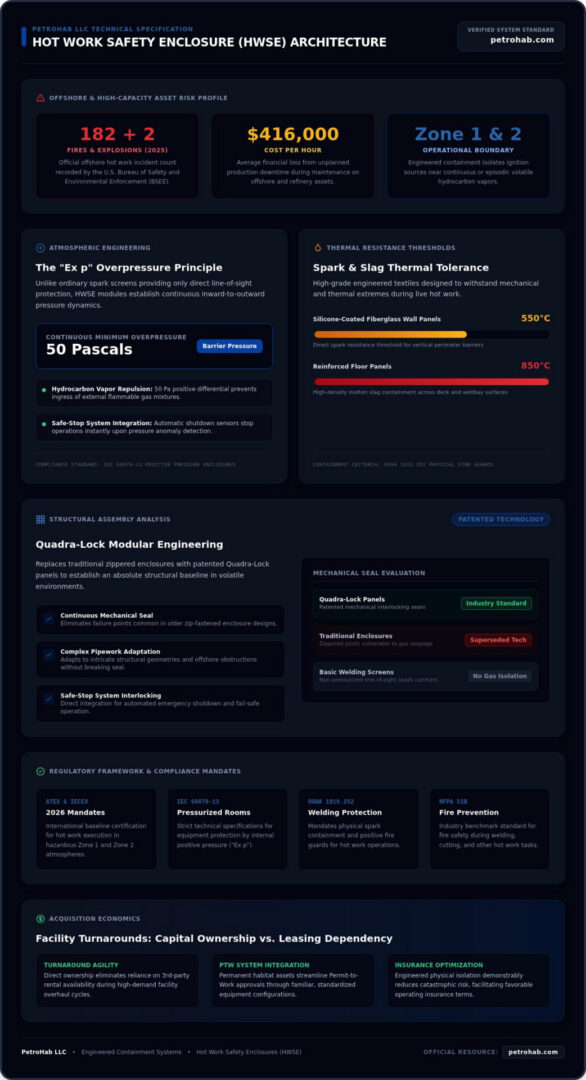
In 2025, the U.S. Bureau of Safety and Environmental Enforcement recorded 182 fires and two explosions related to offshore hot work. This data underscores a harsh reality for energy sector operators. You understand that maintaining production while conducting essential maintenance is a high-stakes balancing act. The threat of ignition in Zone 1 and Zone 2 environments isn’t just a theoretical risk; it’s a direct threat to personnel and assets that can cost upwards of $416,000 per hour in unplanned downtime.
When you source a welding habitat for sale from PetroHab LLC, you aren’t just buying equipment. You’re investing in a definitive technological remedy to mitigate these hazards. This 2026 HWSE procurement guide helps you navigate the technical and regulatory complexities of hot work safety enclosures to ensure operational integrity and personnel protection. We will analyze the engineering behind Quadra-Lock technology, the necessity of Safe-Stop automatic shutdown systems, and the latest ATEX and IECEx compliance mandates required for modern industrial sites.
Key Takeaways
- Learn how engineered containment reduces the extreme costs of unplanned downtime on high-capacity offshore and refinery assets.
- Discover why patented Quadra-Lock technology is replacing traditional zippered enclosures as the baseline for structural integrity in hazardous areas.
- Navigate the complexities of 2026 ATEX and IECEx certification to ensure your procurement aligns with the latest international safety mandates.
- Evaluate the financial benefits of long-term ownership versus leasing when searching for a welding habitat for sale to support facility turnarounds.
- Understand the critical role of integrated Safe-Stop automatic shutdown systems in achieving zero-incident hot work operations.
The Strategic Value of Investing in a Welding Habitat
In the high-stakes environment of the energy sector, the Hot Work Safety Enclosure (HWSE) functions as an active guardian of industrial sites. When evaluating a welding habitat for sale, procurement managers must view the asset through the lens of risk mitigation rather than simple equipment acquisition. These systems provide a definitive technological remedy for the dangers inherent in performing ignition-source work near live hydrocarbon processes. By isolating the ignition source, operators can effectively manage the risk of catastrophic events in environments where flammable gases are a constant presence.
The economic justification for this investment is calculated and precise. With unplanned downtime across high-capacity offshore assets costing an average of $416,000 per hour, the ability to maintain production during maintenance is a strategic necessity. Owning a habitat allows for more agile project planning, as it removes the dependency on third-party rental availability during critical facility turnarounds. This long-term durability ensures that the enclosure remains a reliable safety asset for years of operation. For a deeper technical dive into these systems, consult The Definitive Guide to Hot Work Safety Enclosures (HWSE) in 2026.
To better understand the operational mechanics of these systems, watch this technical overview:
Defining the HWSE for Hazardous Environments
Unlike basic welding screens that only provide line-of-sight spark protection, true HWSE systems are engineered positive pressure enclosures. They utilize the “Ex p” protection principle to maintain a continuous minimum overpressure of 50 Pascals, effectively repelling hydrocarbon vapors. This engineering is essential for safe operations in Zone 1 and Zone 2 areas where explosive atmospheres may occur. Modular construction, utilizing Quadra-Lock panels, ensures that the enclosure can adapt to the complex pipework and structural geometries of refineries without compromising the mechanical seal.
Risk Mitigation and Insurance Compliance
HWSE ownership streamlines the integration of hot work into established Permit-to-Work (PTW) systems. By providing physical, engineered isolation, these enclosures meet the stringent requirements of international safety standards like NFPA 51B and IEC 60079-13. This level of protection often results in more favorable insurance terms, as it demonstrably reduces the probability of a catastrophic ignition event. Protecting high-value assets and personnel from the thousands of annual industrial fires caused by hot work is a core mandate for any safety-focused organization seeking to maintain operational excellence.
Engineering Excellence: Key Components of Pressurized Enclosures
The engineering of a pressurized enclosure transcends simple fire containment. While basic fire blankets provide minimal heat resistance, a professional HWSE is a complex system designed to satisfy OSHA 1910.252 general requirements for welding. These regulations mandate physical spark containment and positive fire guards, which are only achievable through rigorous mechanical design. When researching a welding habitat for sale, engineers must look beyond simple fiberglass textiles to ensure the system can withstand the thermal and mechanical stresses of a live industrial site.
High-grade silicone-coated fiberglass panels represent the current benchmark for industrial containment. These textiles withstand direct sparks up to 550°C, while reinforced floor panels contain molten slag reaching 850°C. This material selection is critical for maintaining integrity in the volatile conditions of refineries or offshore wellbays. You can find more detailed specifications in our resource on Pressurized Welding Habitats: The Definitive Guide to HWSE Technology.
The Quadra-Lock Advantage in Habitat Construction
Structural integrity in a hazardous environment depends on the mechanical seal of the enclosure walls. Traditional systems often rely on zippers or hook-and-loop fasteners, which degrade under UV exposure and chemical stress. Quadra-Lock is a tool-less, interlocking panel system for safety enclosures. This patented technology utilizes a 4-way mechanical interlocking seal that eliminates gas slippage and maintains the required 50 Pascal overpressure. These panels are engineered for rapid deployment, allowing a two-person team to assemble a 3×3 meter unit in approximately two to four hours. This modularity doesn’t just save labor; it ensures the enclosure remains durable across multiple project cycles in extreme offshore or desert climates.
Integrating Automatic Shutdown Systems (ASD)
A pressurized enclosure is only as effective as the monitoring system that governs it. Modern HWSE engineering integrates hardware with logic-controlled safety systems like Safe-Stop. This automatic shutdown system acts as a fail-safe guardian by continuously monitoring atmospheric conditions and internal pressure. If the system detects hydrocarbon gas ingress or a drop in differential pressure, it isolates and cuts power to all ignition sources within 500 milliseconds. This rapid response time is critical for preventing accidents in Zone 1 environments. Redundancy is built into these systems to ensure that even if one sensor fails, the overall safety protocol remains intact. If you’re ready to upgrade your facility’s safety infrastructure, you can explore our certified HWSE solutions.
Compliance Standards for Hazardous Environment Procurement
Procurement of a welding habitat for sale is a technical undertaking that requires a rigorous understanding of the international regulatory landscape. It’s not merely a transaction; it’s a commitment to audit-ready safety. Compliance ensures that hot work operations don’t compromise the integrity of Zone 1 and Zone 2 environments. While the NFPA 51B hot work fire prevention standard establishes the baseline for fire watch and combustible clearance, pressurized enclosures must satisfy much stricter engineering protocols to prevent ignition in explosive atmospheres. As of July 2026, new digital ATEX certification mandates require immediate, verifiable traceability for all habitat components. For a detailed breakdown of these requirements, consult our Hazardous Environment Standards: The 2026 Guide to Global Compliance and Hot Work Safety.
ATEX vs. IECEx: Choosing the Right Certification
Procurement managers must distinguish between regional mandates and global frameworks to ensure site-wide compliance. The ATEX Directive is a legal requirement for equipment used within the European Economic Area, focusing on both hardware design and the manufacturer’s quality management systems. In contrast, the IECEx system provides a global standard that facilitates international trade by ensuring equipment meets the same rigorous safety criteria regardless of the country of origin. PetroHab maintains compliance with both standards, ensuring that Quadra-Lock panels and Safe-Stop systems meet the third-party verification required for deployment in the UK, Brazil, or the Gulf of Mexico. Using uncertified equipment in a hazardous zone is an unacceptable risk that introduces massive liability.
Regulatory Requirements for Pressurized Systems
The “Ex p” protection principle relies on precise atmospheric control to maintain a safe working environment. A continuous minimum positive differential pressure of 50 Pascals (Pa) is mandatory to repel flammable vapors. This requires high-accuracy manometers and logic controllers capable of detecting minute pressure fluctuations. Ventilation systems must use spark-proof blowers to draw air from confirmed non-hazardous locations via specialized ducting. Beyond the hardware, regulatory compliance demands a comprehensive audit trail. You must maintain detailed records of sensor calibration, technician certifications, and daily pressure logs to satisfy BSEE or OSHA inspections. Meticulous documentation is the only way to prove that your safety assets are functioning within their engineered parameters.
Buying vs. Leasing: Evaluating Your HWSE Acquisition Strategy
Deciding between a capital purchase and a short-term lease is a critical financial determination for safety managers. When evaluating a welding habitat for sale, the primary variable is the projected utilization rate across your facility’s maintenance lifecycle. If your site requires frequent hot work operations or multi-year production support, direct ownership provides significant long-term advantages. Conversely, specialized turnarounds lasting fewer than 60 days often justify a rental model to offload maintenance overhead. For a comprehensive look at vendor selection, review our Choosing the Right Hot Work Safety Enclosure Suppliers: A 2026 Procurement Guide.
Capital Expenditure (CAPEX) vs. Operational Expenditure (OPEX)
A Total Cost of Ownership (TCO) analysis reveals that the durability of Quadra-Lock panels makes direct sales an attractive CAPEX investment. While the initial outlay is higher, owning the asset eliminates recurring mobilization fees that can exceed $2,000 per project. From a tax perspective, industrial safety equipment often qualifies for depreciation, providing a fiscal benefit over several years. However, ownership requires a commitment to internal recertification programs every six months and dedicated climate-controlled storage to prevent fabric degradation. If your operational rhythm involves constant maintenance, ownership ensures that a certified HWSE is always available without the lead times associated with leasing fleets.
The Role of On-site Supervision and Training
Procuring a habitat is only half the solution. Operational integrity depends on the competence of the personnel who assemble and monitor the system. Purchasing a welding habitat for sale necessitates a robust training program for your internal HSE teams. PetroHab provides professional training programs that certify technicians in the proper handling, erection, and storage of HWSE assets. This expertise is vital for maximizing the lifespan of the equipment and ensuring that the Safe-Stop system is correctly integrated with site-specific power sources. Proper handling of the silicone-coated fiberglass panels during teardown prevents mechanical wear, preserving the gas-tight seal for future deployments. To secure your facility’s long-term safety infrastructure, you should contact our procurement team for a custom HWSE quote.
PetroHab: The Global Standard for Hot Work Safety Enclosures
PetroHab defines the industry benchmark through a rigorous commitment to engineering excellence and risk mitigation. When you evaluate a welding habitat for sale, you’re choosing a partner that understands the granular details of industrial hazards better than anyone else. Our leadership is built on the technological synergy between Quadra-Lock panels and the Safe-Stop Automatic Shutdown System. This combination creates a pressurized micro-climate where the structural integrity of the enclosure is matched by active, logic-controlled monitoring. While competitors often focus on passive containment, PetroHab prioritizes the integration of hardware and automation to eliminate the risk of ignition in high-stakes environments.
The Safe-Stop system represents a critical advancement in Automatic Shutdown (ASD) technology. It functions as the brain of the Petro-Habitat, continuously analyzing atmospheric data from multi-gas detection sensors. If the system detects hydrocarbon gas ingress or if positive pressure falls below the mandatory 50 Pascal threshold, it isolates electrical power to all ignition sources within 500 milliseconds. This rapid response isn’t a secondary feature; it’s an essential component of a zero-incident safety strategy. From our headquarters in Houston to our operational hubs in the UK and Brazil, we provide global reach with the technical precision required for the energy and safety sectors.
Customized Solutions for Complex Facilities
Industrial sites rarely present uniform workspaces. Refineries and offshore platforms often feature dense pipework and structural obstructions that challenge standard enclosure designs. PetroHab addresses these site-specific constraints through the modularity of Quadra-Lock technology. We provide engineering support to tailor habitats for specialized applications, ensuring a gas-tight seal regardless of the geometric complexity. This flexibility allows operators to maintain production on live assets while conducting critical hot work in the most hazardous environments. Our systems act as active guardians, providing protection and control where traditional methods fail.
Securing Your Safety Infrastructure
Initiating a procurement request for a PetroHab system starts with a technical consultation to assess your specific site requirements. Our team analyzes your operational goals, project duration, and environmental hazards to recommend the optimal HWSE configuration. For 2026, we maintain streamlined lead times and global delivery capabilities to support urgent facility turnarounds and long-term maintenance cycles. Every Petro-Habitat we deliver is a testament to our mission: protecting personnel and high-value assets through uncompromising safety standards. To begin your procurement process, you can request a technical consultation and quote through our global sales office.
Securing the Future of Industrial Hot Work
Securing hazardous environments requires more than administrative oversight; it demands engineered containment. This procurement guide has detailed how technical precision and regulatory alignment define the true return on investment for any safety asset. By integrating patented Quadra-Lock Technology with Safe-Stop Automatic Shutdown systems, you establish a definitive technological remedy against ignition hazards. Reliability is the foundation of every zero-incident operation.
Whether you’re evaluating a welding habitat for sale for a long-term capital project or a short-term turnaround, prioritize durability and verifiable certification. Our global technical support teams ensure that your equipment maintains peak operational integrity across its entire lifecycle. Protecting your personnel and high-value assets is a continuous duty that demands the industry benchmark in pressurized enclosures. Take the next step in fortifying your site’s safety infrastructure by choosing a partner dedicated to uncompromising safety excellence.
Request a Quote for PetroHab HWSE Systems and ensure your facility remains a benchmark for operational integrity.
Frequently Asked Questions
What is the difference between a welding habitat and a standard fire blanket?
A welding habitat provides active, engineered containment, whereas a standard fire blanket offers only passive spark protection. Unlike a blanket, a pressurized enclosure utilizes the “Ex p” principle to create a positive pressure differential. This prevents the ingress of flammable gases into the work area. When you evaluate a welding habitat for sale, you’re investing in a system that isolates ignition sources from the surrounding atmosphere, ensuring a higher level of safety than simple fire-resistant fabrics.
How do pressurized habitats maintain a gas-free environment?
Pressurized habitats maintain a gas-free environment by sustaining a continuous positive pressure differential of at least 50 Pascals relative to the external atmosphere. Spark-proof pneumatic or ATEX-rated blowers draw air from a confirmed non-hazardous location and pump it into the enclosure. This over-pressurization ensures that any accidental gas release outside the habitat is repelled away from hot work ignition points, maintaining a secure internal micro-climate for welding operations.
Can PetroHab habitats be used in ATEX Zone 1 environments?
PetroHab habitats are specifically engineered and certified for use in ATEX Zone 1 and Zone 2 environments. These systems meet the rigorous requirements of international standards like IEC 60079-13. The combination of fire-resistant textiles and active monitoring ensures that hot work can proceed safely even where explosive atmospheres are likely to occur. Our enclosures undergo third-party verification to guarantee compliance with the latest safety mandates required for global offshore and onshore operations.
What training is required to set up a Quadra-Lock habitat?
Setting up a Quadra-Lock habitat requires professional training to ensure the mechanical integrity of the enclosure. PetroHab provides comprehensive certification programs for client personnel, covering the proper interlocking of panels and the integration of atmospheric monitoring systems. This training ensures that the tool-less assembly process is performed correctly, maintaining the gas-tight seal necessary for pressurized operation. Certified technicians understand the nuances of environmental containment and the critical handling of silicone-coated fiberglass components.
Is it better to rent or buy a welding habitat for a six-month project?
For a six-month project, purchasing a welding habitat for sale is often more cost-effective than long-term leasing. Ownership eliminates recurring rental fees and mobilization costs, which can be substantial over half a year. Additionally, having the asset on-site allows for greater flexibility during unscheduled maintenance. You should consider the Total Cost of Ownership, including internal recertification and storage, but a six-month duration typically marks the threshold where direct capital investment yields a better return.
How does the Safe-Stop system interact with the pressurized enclosure?
The Safe-Stop system acts as the logic-controlled guardian of the pressurized enclosure. It integrates multi-gas detection sensors with the habitat’s power supply. If the system detects hydrocarbon gas ingress or a loss of positive pressure below the 50 Pascal threshold, Safe-Stop isolates all electrical power to ignition sources within 500 milliseconds. This synergy ensures that the physical containment of the habitat is always supported by an active, automated fail-safe mechanism to prevent accidents.
What materials are used to ensure the habitat is fire-resistant?
PetroHab utilizes high-grade silicone-coated fiberglass textiles that meet ANSI/FM 4950 standards. These specialized industrial textiles are engineered to withstand direct sparks up to 550°C. For the floor sections, reinforced panels are used to contain molten slag and spatter reaching temperatures of 850°C. These materials are selected for their durability and thermal resistance, ensuring the enclosure remains intact during high-intensity hot work operations in the most demanding industrial environments.
Do you provide on-site technicians for habitat assembly?
PetroHab provides certified on-site technicians to oversee the assembly and operation of our safety habitats globally. These experts ensure that the Quadra-Lock panels are correctly interlocked and that the Safe-Stop system is fully integrated with site-specific utilities. Whether your project is in the United States, Brazil, or the United Kingdom, our technical support teams offer the expertise required to maintain operational integrity. We also provide professional training to empower your internal HSE teams for future deployments.