Blog Posts
Live Condensate Line Welding: Prevent Shock and Hesitation
Welding beside live condensate lines calls for a controlled electrical setup, not pressure to work through uncertainty. Eliminating welder hesitation when working adjacent to live condensate lines starts with understanding the shock hazard, planning a separate workpiece ground, and routing cables away from damage and traffic. Hot, moist conditions can reduce the body’s resistance to electrical shock, so include the work environment in the risk assessment.
That caution is justified. A worker can receive a shock if their body bridges the live welding supply and return, and changing an electrode can expose them to the welding machine’s no-load voltage. Clear procedures replace uncertainty with specific controls. This article covers hazards around live condensate lines, how grounding and cable layout affect exposure, and how a suitable welding enclosure can help control the wider hot-work environment.
Key Takeaways
- Assess electrical exposure around live condensate lines, then plan grounding and cable routing to reduce the chance of shock or cable damage.
- Identify the site’s hot-work permit and approval process before planning the job; requirements depend on the facility and work conditions.
- Determine whether the line needs isolation, depressurization, drainage, or other protection as part of the work-specific hazard review.
- Set hot-work boundaries and fire-watch arrangements for the actual site conditions, and consider a PetroHab Hot Work Safety Enclosure (HWSE) when containment is needed.
What safety hazards arise when welding adjacent to live condensate lines?
Welding beside live condensate piping places an active hot-work operation near process equipment. The welding arc can reach 6,000 to 11,000 degrees Fahrenheit. That heat makes control of sparks and the work area essential. A damaged line can also expose workers to its contents or operating conditions. The specific consequences depend on the process and the condition of the piping. Treat the line and the welding circuit as separate hazards in the job assessment.
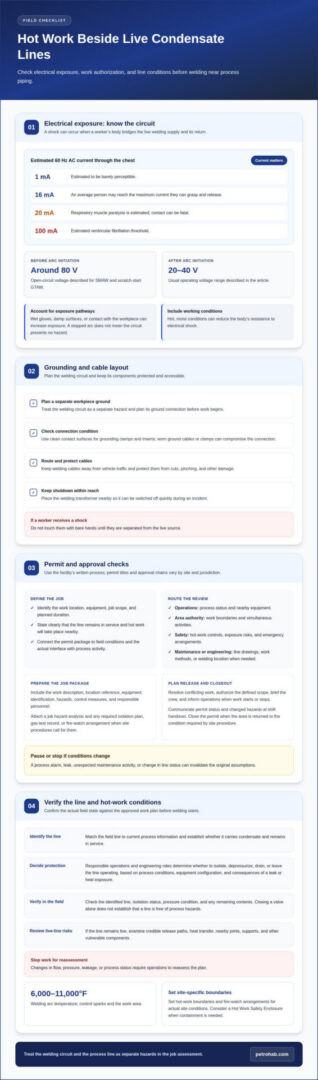
Electrical shock can occur when a worker’s body bridges the live welding supply and the return, such as the workpiece. For 60 Hz AC current passing through the chest, 1 mA is estimated to be barely perceptible. At 16 mA, an average person may reach the maximum current they can grasp and release. At 20 mA, respiratory muscle paralysis is estimated; contact with that current can be fatal. The estimated ventricular fibrillation threshold is 100 mA. Hot, moist working conditions reduce the body’s resistance to shock.
The welding circuit can present risk even before an arc forms. For SMAW and scratch-start GTAW, open-circuit voltage is described as hovering around 80 V. After arc initiation, operating voltage is usually between 20 V and 40 V. During electrode changes, shock exposure can equal the welding machine’s no-load voltage output. Wet gloves, damp surfaces, or contact with the workpiece can increase exposure pathways. A worker should not assume that a stopped arc means the circuit presents no hazard.
Damaged cables create another exposure risk. Route welding cables away from vehicle traffic and protect them from cuts, pinching, and other hazards. Place the welding transformer nearby so it can be switched off quickly during an incident. Grounding clamps and inserts need clean contact surfaces; worn ground cables or clamps can compromise the connection. If a worker receives a shock, responders must not touch them with bare hands until they are separated from the live source.
What permits and approvals are required for hot work near live process piping?
Start with the facility’s permit-to-work process. The permit title and approval chain depend on site procedures and jurisdiction, so do not assume one form applies everywhere. For welding near a live condensate line, identify the work location, equipment, job scope, and planned duration. Make clear in the permit that the line remains in service and hot work will take place nearby. This helps operations and safety personnel assess the actual interface between welding and process activity.
Route the request through the roles specified in the site procedure. Operations can provide process status and identify nearby equipment. The area authority can confirm work boundaries and simultaneous activities. The safety function can review hot-work controls, exposure risks, and emergency arrangements. Maintenance or engineering may need to review line drawings, work methods, or the proposed welding location. These roles are examples; the facility’s written authorization process determines who approves the job.
Before approval, prepare a job package that connects the permit to field conditions. Include a work description, location reference, equipment identification, hazards, control measures, and responsible personnel. Attach the job hazard analysis and any required isolation plan, gas-test record, or fire-watch arrangement when site procedures call for them. State how changing conditions will pause or stop the work. A process alarm, leak, unexpected maintenance activity, or change in line status can invalidate the original assumptions.
Use a clear release and closeout sequence. The approving authority reviews the package, resolves conflicting work, and authorizes the defined scope. The crew receives the conditions before starting, and operations is informed when work begins or stops. At shift handover, communicate permit status and any changed hazards. Close the permit after the work area is returned to the condition required by site procedure. For projects needing a controlled enclosure, review hot-work enclosure options as part of the planning package.
How should live condensate lines be isolated, depressurized, drained, or protected before welding nearby?
Start by confirming the line’s identity and operating status. Operations personnel should match the field line to current process information, then establish whether it carries condensate and remains in service. A misidentified branch or connected system can undermine the work plan. The decision to isolate, depressurize, drain, or leave the line operating belongs to the responsible operations and engineering roles at the site. It depends on process conditions, equipment configuration, and the consequences of a leak or heat exposure.
If the work plan calls for isolation, define the boundaries around the specific line and connected equipment. The site procedure should identify the isolation points, responsible personnel, and method for controlling hazardous energy. Depressurizing or draining may be appropriate only if the process and equipment allow it. Those actions also require a defined destination for released condensate and a plan to manage residual pressure or liquid. Closing a valve alone does not establish that a line is free of process hazards.
Before welding starts, operations should verify that field conditions match the approved work plan. Check the identified line, isolation status, pressure condition, and any remaining contents. If the line must remain live, the work review should examine credible release paths, heat transfer, nearby joints, supports, and other vulnerable components. Changes in flow, pressure, leakage, or process status require stopping work while operations reassesses the plan.
Protection measures must address the hazards that remain. Barriers or shielding can help control sparks and heat exposure, but they do not isolate a process line or prevent pressure release. Keep the planned weld location and protective measures within the approved scope. If the work area or line condition changes, reassess before resuming. Physical protection around welding complements process controls; it cannot replace isolation or operating decisions made by the responsible site team.
What clearance distances and fire-watch requirements apply to hot work near condensate piping
No single clearance distance applies to every condensate-piping job. The work permit and site procedure should define the hot-work boundary for the actual location. Assess spark travel, wind, nearby openings, combustible materials, and surfaces that can carry heat. For example, sparks passing through a floor opening may reach equipment below the welding point. Measuring only around the welder would miss that exposure path.
Map the area around the weld before setting the boundary. Include pipe supports, insulation, cable trays, drains, adjacent levels, and any penetrations where sparks or heat could travel. Identify condensate-line components that may be affected, such as nearby joints or connections. If the plan uses a barrier or heat-resistant covering, account for its placement and the access needed to monitor the work. Reassess the boundary if wind, work position, or nearby operations change.
Set fire-watch coverage through the permit process. The assigned person needs a clear view of the welding area and identified exposure points, such as the far side of a barrier or a lower level. Define how the fire watch communicates with the welder and operations, how to raise an alarm, and when work must stop if sparks reach an uncontrolled area. Site procedures should also specify what fire-response equipment is available and where it is positioned.
Do not treat the end of welding as automatic release from fire-watch duties. The permit should state how the area is monitored after the arc stops and who authorizes closeout. The required duration depends on the facility’s procedure and the hazards identified, including concealed spaces or combustible materials. Record the boundary, watch position, communication method, and release criteria in the job plan. Plan hot-work containment around the specific exposure paths and work-area layout.
PetroHab: PetroHab Hot Work Safety Enclosure (HWSE)
PetroHab Hot Work Safety Enclosure (HWSE) is an option when welding near live condensate piping calls for a dedicated hot-work enclosure. It provides a defined enclosure for welding, complementing the site’s permit, process controls, and fire-watch plan. It does not replace line-isolation decisions or site authorization.
For hazardous work environments, PetroHab’s Safe-Stop Safety Shutdown System monitors differential pressure and gas levels. PetroHab also offers pressurized welding enclosures and Quadra-Lock® panels. The appropriate setup depends on the work area, operating conditions, and project requirements.
Contact PetroHab to discuss the hot-work enclosure for your project.
Make the Work Plan the Shared Reference
Use the next planning cycle to turn the job’s approved controls into a shared field reference. Keep the work scope, process status, communication roles, and stop-work triggers aligned across operations, safety, and the welding crew. A consistent reference reduces ambiguity during shift changes and helps everyone recognize when conditions have moved beyond the original plan.
Eliminating welder hesitation when working adjacent to live condensate lines depends on clear decisions before work begins and prompt reassessment when conditions change. Teams can support that process by making responsibilities and escalation paths explicit. It also means treating uncertainty as a reason to pause and resolve an issue, not as pressure to proceed.
For the next project, bring the work location, operating context, and enclosure needs into the planning discussion early. Contact PetroHab about hot work to discuss your project requirements. Clear planning creates a stronger basis for the work ahead.
Frequently Asked Questions
How can a job safety analysis address welder hesitation and uncertainty around live lines?
A job safety analysis supports eliminating welder hesitation when working adjacent to live condensate lines by turning concerns into assigned controls, decision points, and stop-work triggers. To make eliminating welder hesitation when working adjacent to live condensate lines practical, document who communicates changes in line status and how the crew pauses work. Review the welding sequence together, then resolve uncertainties before authorizing the task.
What OSHA, NFPA, and industry standards cover hot work near operating process lines?
ANSI Z49.1:2005 is identified as a safety standard for welding, cutting, and allied processes, and NFPA 70 as the National Electrical Code. Hot-work approval follows the facility’s permit-to-work procedure.
What welding procedures and equipment reduce heat transfer or damage to adjacent condensate lines?
Barriers or shielding can help control sparks and heat exposure, but they do not isolate the line or prevent pressure release. Review nearby vulnerable components, and keep the weld location and protective measures within the approved work scope.
What monitoring is needed for line temperature, pressure, leaks, and flammable or toxic vapors during welding?
Before welding, operations should verify the line’s identity, isolation status, pressure condition, and remaining contents. Stop work if flow, pressure, leakage, or process status changes, and have operations reassess the plan.