Blog Posts
Long-Term Habitat Leasing Options: A Strategic Guide for Industrial Hot Work
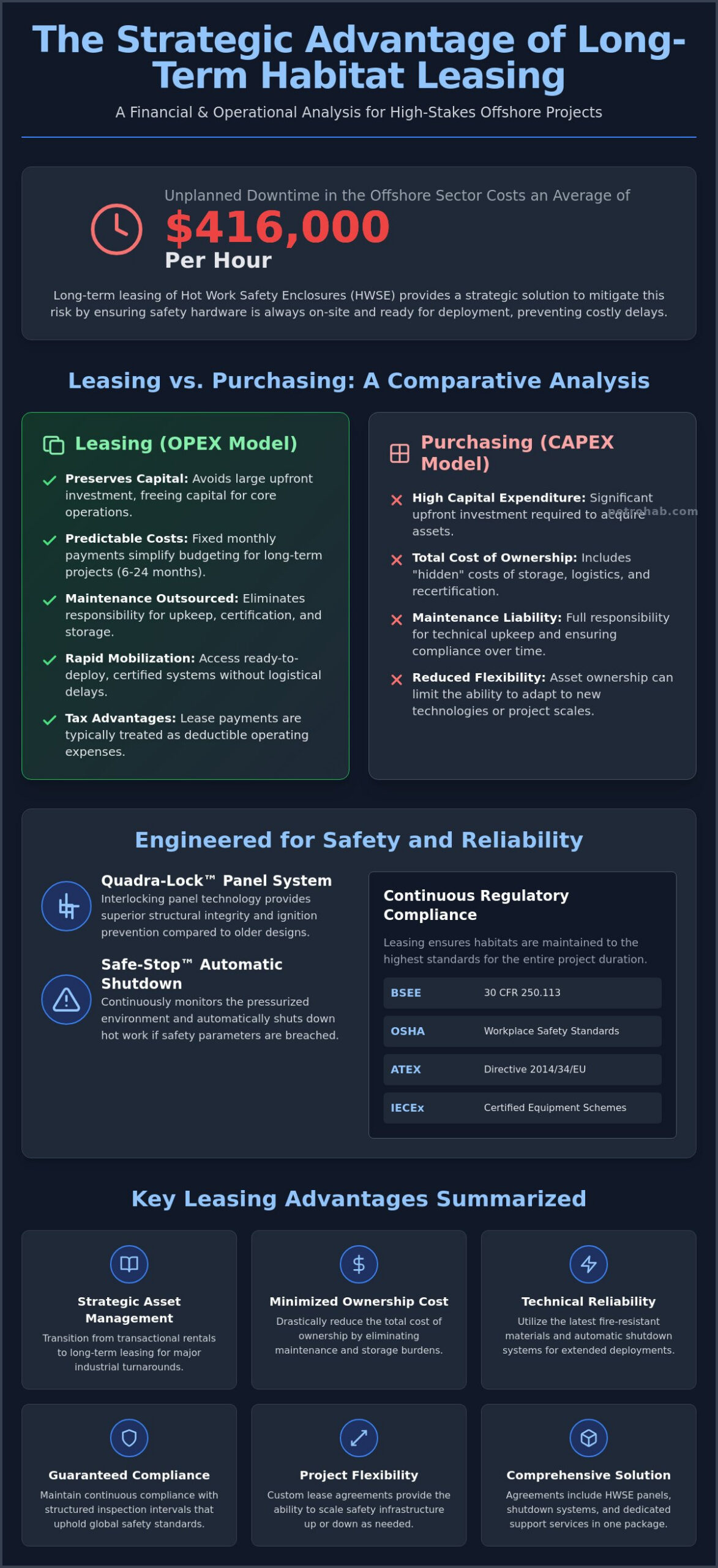
With unplanned downtime in the offshore energy sector costing an average of $416,000 per hour, the financial stakes of hot work safety are absolute. You recognize that maintaining ignition prevention over months of deployment demands a solution that balances technical rigors with fiscal responsibility. For extended project lifecycles, the high capital expenditure of purchasing hardware often limits operational flexibility. Consequently, long-term habitat leasing options have emerged as the strategic choice for managers who prioritize both safety integrity and predictable cost structures.
This guide demonstrates how long-term HWSE leasing provides a cost-effective, compliant, and flexible safety solution for your most demanding oil and gas projects. You’ll learn how to eliminate the logistical burden of maintaining habitat integrity while ensuring your site remains compliant with BSEE 30 CFR 250.113 and OSHA standards. We will examine the operational advantages of accessing the latest Quadra-Lock panel technology and Safe-Stop automatic shutdown systems through a model that reduces maintenance liability and stabilizes your monthly operational budget.
Key Takeaways
- Analyze the transition from transactional daily rentals to strategic long-term leasing to better manage the complexities of major industrial turnarounds.
- Compare CAPEX versus OPEX models to determine how long-term habitat leasing options minimize the total cost of ownership through outsourced maintenance.
- Secure technical reliability by utilizing fire-resistant materials and Safe-Stop Automatic Shutdown Systems engineered for multi-month exposure in hazardous environments.
- Maintain continuous regulatory compliance by implementing structured inspection intervals that uphold ATEX and IECEx standards for the entire lease duration.
- Learn how customized lease agreements provide the flexibility to scale safety infrastructure according to specific project timelines and global location requirements.
Understanding Long-Term Habitat Leasing in the Energy Sector
In the high-stakes environment of offshore oil and gas, a Hot Work Safety Enclosure (HWSE) acts as a primary barrier against ignition hazards. It isn’t merely rental equipment; it’s a sophisticated, controlled environment designed for high-risk zones. Engineering teams are increasingly moving away from short-term, daily rentals toward strategic long-term habitat leasing options to secure these assets for extended maintenance cycles. This shift ensures that critical safety hardware remains permanently on-site, fully integrated into the facility safety architecture. It eliminates the logistical delays and mobilization costs often associated with fragmented, short-term contracts.
A positive pressure enclosure functions by maintaining a minimum differential pressure of 0.1 inches of water column relative to the external atmosphere. This specific pressure gradient prevents flammable gases from entering the workspace where hot work occurs. By utilizing these pressurized systems, operators can perform essential welding and grinding without shutting down production. This capability is vital in an industry where unplanned downtime can cost upwards of $416,000 per hour. Relying on verified technology ensures that safety managers meet the stringent requirements of BSEE 30 CFR 250.113.
To better understand this concept, watch this helpful video:
The Scope of Long-Term Lease Agreements
Long-term industrial contracts typically span durations of 6 to 24 months, aligning with major turnaround schedules or facility upgrades. These agreements provide a comprehensive package that includes HWSE panels, the Safe-Stop automatic shutdown system, and dedicated support services. Modularity remains the cornerstone of effective site planning in these scenarios. Using modular components allows safety managers to adapt the enclosure footprint as project requirements evolve on deck. It’s a proactive approach to risk mitigation that ensures continuous protection for personnel and high-value assets throughout the project lifecycle.
Terminology: Habitats vs. Safety Enclosures
Precise nomenclature is mandatory for Permit-to-Work (PTW) compliance and regulatory reporting. While many professionals use the term “habitat” colloquially, regulatory bodies often require technical descriptions such as “pressurized welding enclosures.” PetroHab defines its systems through the use of interlocking Quadra-Lock panels, which provide superior structural integrity and ignition prevention compared to older, zippered designs. This technical precision is critical during safety audits. Compliance with BSEE regulations often hinges on the ability to demonstrate that a certified, pressurized environment is actively monitored and maintained before any hot work commences.
Leasing vs. Purchasing: Financial and Operational Analysis
Deciding between asset acquisition and long-term habitat leasing options requires a rigorous analysis of project-specific financial variables. For many energy companies, capital expenditure (CAPEX) for high-specification hardware presents a significant hurdle. Choosing an operational expenditure (OPEX) model through leasing allows organizations to preserve capital for core production activities. This approach shifts the financial burden from a large upfront investment to a manageable, predictable monthly cost. It aligns perfectly with the budget structures of multi-month turnarounds or offshore construction projects.
The Economic Case for Long-Term Leasing
Monthly lease rates offer a clear advantage over the total cost of purchasing, especially when considering the hidden expenses of ownership. When you buy equipment, you’re also buying the responsibility for storage, certification, and technical upkeep. Leasing eliminates these variables. It also provides distinct tax benefits, as lease payments are typically treated as deductible operating expenses. Rapid mobilization is another critical factor. Leased systems are maintained in a ready-to-deploy state, ensuring that compliance with OSHA hot work safety standards is met without the lead times required for purchasing and certifying new hardware.
Operational Flexibility and Scalability
Project scopes in heavy industry are rarely static. A welding project that begins with a small footprint may expand as structural integrity issues are discovered. Long-term habitat leasing options provide the agility to scale the physical dimensions of the enclosure by adding or removing Quadra-Lock panels as needed. You aren’t locked into a fixed configuration. This flexibility extends to the technology itself. If a project spans several years, a lease agreement often allows for mid-project upgrades to the latest Safe-Stop automatic shutdown system. This ensures the site always utilizes the current industry benchmark for ignition prevention.
This model ensures that maintenance and calibration are handled by the provider, which reduces your internal liability. If you’re currently evaluating the financial impact of your next turnaround, you can review specific PetroHab leasing configurations to see how they align with your operational goals. Avoiding the depreciation of owned assets while maintaining a state-of-the-art safety profile is the most logical path for modern industrial sites. It allows you to focus on production while professionals manage the complexities of environmental containment.
Technical Specifications for Extended HWSE Deployments
Extended deployments expose safety hardware to unrelenting environmental stress. Unlike temporary setups that might rely on basic containment, long-term habitat leasing options provide access to industrial-grade fire-resistant materials engineered for multi-month exposure. These systems utilize silicone-coated fiberglass panels that maintain their structural properties despite continuous contact with welding slag and grinding sparks. Standard grade materials often degrade under UV radiation or salt spray; however, premium enclosures are designed to withstand these offshore and refinery conditions without compromising the integrity of the pressurized environment.
Durability Features of the Quadra-Lock System
The structural integrity of a pressurized enclosure depends entirely on the strength of its joints. Traditional habitats often use velcro or zip-ties, which are prone to failure under the weight of heavy cables or during high-wind events. The Quadra-Lock system replaces these weak points with a mechanical interlocking mechanism. This design ensures a consistent, airtight seal that doesn’t loosen over time. Quadra-Lock stands as the industry standard for modular panel integrity in pressurized welding environments. These panels resist UV degradation and maintain their flame-retardant ratings throughout the entire lease term, even in the harshest climates.
Automated Monitoring and Shutdown Integration
Maintaining a constant differential pressure of 0.1 inches of water column is a regulatory mandate that requires automated precision. The Safe-Stop automatic shutdown system integrates directly with the HWSE to monitor internal and external conditions in real time. If the system detects a loss of pressure or the presence of hydrocarbons, it immediately terminates power to the hot work equipment. This methodology ensures compliance with the NFPA 496 standard, which governs the requirements for purged and pressurized enclosures in hazardous locations.
For long-duration projects, these safety systems don’t operate in isolation. The Safe-Stop technology is designed to interface with existing plant Emergency Shutdown (ESD) systems. This creates a redundant safety loop where the habitat can trigger a broader site alarm or respond to facility-wide emergencies. ATEX and IECEx certified gas detectors are strategically positioned to provide continuous monitoring of the air intake and the surrounding environment. This level of technical integration reduces human error and provides a verifiable data log of safety metrics, which is essential for ongoing compliance audits and risk mitigation strategies.
Maintenance and Compliance for Long-Duration Projects
Long-duration deployments demand a rigorous maintenance schedule to prevent hardware fatigue. When assets remain on-site for months, environmental stressors such as UV exposure and corrosive salt spray can compromise seal integrity. Utilizing long-term habitat leasing options ensures that the responsibility for asset recertification and technical support remains with the provider. This model includes scheduled inspection intervals where technicians verify the structural integrity of every Quadra-Lock panel and the calibration of Safe-Stop sensors. It’s a proactive strategy that eliminates the risk of using degraded or non-compliant safety hardware during critical path work.
Regulatory Compliance and Standards
Maintaining a compliant work environment requires strict adherence to hazardous environment standards. For multi-month projects, third-party certifications like ATEX and IECEx must be verified periodically. These checks ensure that aging components still meet the legal requirements for Zone 1 and Zone 2 areas. Your habitat lease must also satisfy the core requirements of NFPA 51B and OSHA guidelines to avoid severe penalties. As of June 2026, OSHA penalties for willful violations can exceed $161,000. Implementing a leased HWSE ensures you’re utilizing equipment that’s regularly audited for compliance with these evolving safety mandates.
The Role of On-site Supervision
Certified technicians are essential for managing the complexities of a pressurized environment over time. PetroHab provides comprehensive hot work habitat training for client personnel, ensuring they can perform necessary daily integrity checks. This includes verifying that the system maintains the mandatory 0.1 inches of water column differential pressure. A disciplined routine for manometer and gas detector calibration is vital. It creates a verifiable digital audit trail of safety metrics, moving your project from a “best effort” safety model to one of verifiable data logging and accountability.
Managing the logistics of spare parts is a critical component of long-term habitat leasing options. Leased agreements typically include a protocol for on-site repairs and immediate replacement of worn components. This minimizes the risk of production shutdowns due to hardware failure. If a gas sensor fails or a panel is damaged, a replacement is often readily available through the lease support network. To ensure your project remains within these safety parameters, you should consult with a PetroHab compliance expert to review your long-term site requirements. This level of oversight protects your personnel and prevents the catastrophic costs of unplanned downtime.
Custom Leasing Solutions from PetroHab
PetroHab engineers customized lease agreements to meet the specific demands of the global energy sector. Standardized rental models often fail to account for the unique variables of a 24-month offshore project or a complex refinery turnaround. By selecting long-term habitat leasing options, operators gain a partner that understands the granular details of environmental containment. We provide the infrastructure necessary to maintain production while upholding the highest safety standards in the industry. Our approach eliminates the uncertainty of equipment availability and ensures that every deployment is backed by technical precision.
The core of our solution lies in the synergy between Quadra-Lock panels and the Safe-Stop automatic shutdown system. This combination creates a robust, pressurized welding enclosure that actively mitigates risk. Unlike generic enclosures that rely on inferior fastening methods, our systems utilize interlocking technology to maintain a definitive seal. This is the PetroHab advantage. We don’t just provide hardware; we deliver a managed safety environment that acts as an active guardian of your site. This ensures that ignition prevention remains constant, even during the most demanding phases of industrial hot work.
Global Logistics and Support
Deploying safety equipment to remote offshore locations requires a sophisticated logistics network. PetroHab maintains global availability, securing habitats for critical projects in Brazil, the UK, and the United States. Working with a single hot work safety enclosure supplier ensures fleet consistency across international operations. This uniformity is vital for multinational companies that require standardized safety protocols regardless of geographic location. It simplifies procurement and ensures that every site utilizes the same high-performance engineering. Our logistics team manages the mobilization of HWSE systems to ensure they arrive on-site, certified and ready for immediate integration into your safety workflow.
Next Steps: Securing Your Habitat Lease
Securing a lease begins with a technical consultation. We analyze your site-specific hazards, required footprint, and project timeline to determine the optimal configuration. This process ensures that the HWSE is neither undersized for the work scope nor an unnecessary drain on the budget. Long-term habitat leasing options are designed to align with your project milestones, providing predictable monthly costs and reducing maintenance liability. We provide a clear roadmap for equipment deployment, personnel training, and scheduled inspections.
Finalizing your lease terms involves a comprehensive review of your operational goals. Contact PetroHab to initiate a technical and financial assessment. Our experts provide the data necessary to justify the transition from asset ownership or daily rentals to a strategic leasing model. We act as a critical safety partner, protecting your personnel and high-value assets through every phase of the project. Secure your site with the industry benchmark in pressurized habitat technology today.
Securing Operational Continuity for Extended Hot Work Projects
Managing the complexities of ignition prevention during multi-month deployments requires a shift from transactional rentals to strategic partnerships. You’ve seen how long-term habitat leasing options stabilize project budgets by converting high capital costs into predictable operational expenses. By integrating patented Quadra-Lock technology and Safe-Stop automatic shutdown systems, your site maintains a definitive safety barrier that exceeds global compliance standards. These systems don’t just protect personnel; they safeguard your production schedule against the catastrophic costs of unplanned downtime.
PetroHab provides the technical expertise and global reach necessary to support your most remote offshore or refinery operations. Our localized support teams ensure your hardware remains certified and operational throughout the entire project lifecycle. You can take the next step toward a more resilient safety infrastructure today. We’re ready to help you engineer a solution that meets your specific technical and financial requirements.
Request a Quote for Your Long-Term Habitat Leasing Needs
Frequently Asked Questions
What is the typical duration for a long-term habitat lease?
Typical durations for long-term habitat leasing options range from 6 to 24 months. These agreements are engineered to align with major facility turnarounds, offshore construction, or extended refinery maintenance schedules. By securing a multi-month contract, you ensure that critical safety infrastructure remains on-site and integrated into your facility’s safety protocols. This duration provides the stability needed for complex projects while eliminating the logistical friction of repeated mobilizations.
Is it more cost-effective to lease or buy a pressurized welding habitat?
Leasing is generally more cost-effective for project-based budgets where capital expenditure must be minimized. While purchasing a system suits companies with continuous, year-round needs, leasing shifts the financial burden to operational expenditure. It eliminates the hidden costs of ownership, such as long-term storage, certification renewals, and technical maintenance. You also avoid asset depreciation while ensuring your site always utilizes the most current ignition prevention technology available.
How does PetroHab ensure the safety of its leased enclosures?
Safety is guaranteed through the integration of interlocking Quadra-Lock panels and the Safe-Stop automatic shutdown system. Every leased enclosure undergoes a rigorous inspection and recertification process before deployment. During the lease term, we implement scheduled maintenance intervals to verify the structural integrity of the HWSE and the calibration of all gas detection sensors. This proactive approach ensures that the habitat maintains the mandatory 0.1 inches of water column differential pressure at all times.
Can I upgrade my habitat monitoring system during a long-term lease?
Yes, our long-term habitat leasing options provide the flexibility to upgrade monitoring hardware as technology evolves. If a project spans several years, you aren’t locked into legacy systems. We can integrate the latest iterations of the Safe-Stop automatic shutdown system or advanced gas detection arrays mid-project. This ensures your facility remains at the forefront of industrial safety standards without the need for a new capital purchase or a complete system overhaul.
What maintenance is required for a habitat during a 12-month project?
Maintenance during a 12-month project involves daily integrity checks by trained personnel and periodic technical inspections. Personnel must verify that Quadra-Lock panels remain securely interlocked and that there’s no visible degradation from UV exposure or mechanical stress. Additionally, gas detectors and manometers require regular calibration to ensure precise monitoring. PetroHab provides the necessary training and support protocols to ensure these safety checks are performed accurately and documented for compliance audits.
Are PetroHab habitats compliant with international ATEX standards?
PetroHab habitats are fully compliant with international ATEX and IECEx standards for use in Zone 1 and Zone 2 hazardous areas. Compliance is a legal requirement for hot work in explosive atmospheres where ignition prevention is paramount. Our systems are engineered to meet these rigorous technical benchmarks, providing a verifiable level of protection for your personnel and assets. Using ATEX-certified equipment ensures your operations align with global safety regulations and reduces the risk of willful OSHA violations.
Do you provide on-site training for long-term lease agreements?
We provide comprehensive on-site training for client staff as part of every long-term lease agreement. This training covers the operational best practices for the Hot Work Safety Enclosure (HWSE) and the Safe-Stop system. Technicians learn how to assemble Quadra-Lock panels, monitor differential pressure, and respond to automated shutdown events. Empowering your team with this technical knowledge ensures that the habitat is managed correctly on a day-to-day basis, maintaining site safety and compliance.
What happens if a habitat panel is damaged during a long-term lease?
Damaged panels are addressed immediately through our on-site repair and replacement protocols. Because our HWSE systems utilize modular Quadra-Lock panels, a single damaged section can be replaced without dismantling the entire enclosure. This minimizes downtime and ensures that the pressurized environment is restored to full integrity quickly. Our lease agreements typically include provisions for spare parts and technical support to handle these operational contingencies without delaying your project timeline.