
Blog Posts
Premium silicone coated fiberglass panels for hot work protection
A temperature rating alone doesn’t show how a panel will perform under welding spatter, sparks, molten splash, or slag. Premium silicone coated fiberglass panels combine a fiberglass base with a silicone-rubber coating, and premium-grade, two-sided fabric is rated for continuous exposure up to 450°F. That rating describes continuous exposure, not every brief or direct contact with hot material.
It’s reasonable to expect hot-work protection to withstand more than ambient heat. Construction, exposure patterns, and hazards all matter when selecting a barrier. This article explains how premium silicone coated fiberglass panels handle heat and hot-work hazards, what material ratings mean, and where careful assessment is essential.
Fiberglass-reinforced silicone rubber sheet construction matters when assessing panels for industrial use. Focus on what the material can do, the difference between continuous temperature ratings and resistance to spatter or splash, and the details that guide a sound protection decision.
Key Takeaways
- Match a fabric’s continuous temperature rating to the exposure conditions; brief contact with hot material is a separate performance consideration.
- Assess welding spatter, sparks, molten splash, and slag as distinct hazards when selecting hot-work protection.
- Compare coating coverage, fabric weight, and roll width against the panel’s intended use and installation requirements.
- For hot-work containment needs, PetroHab’s Quadra-Lock Panels are one offering to consider alongside its pressurized welding enclosures.
Continuous and intermittent temperature exposure
Silicone-coated fiberglass fabrics have different continuous temperature ratings depending on their construction. Assess sustained operating temperatures separately from brief exposure to welding heat.
Continuous High-Temperature Exposure
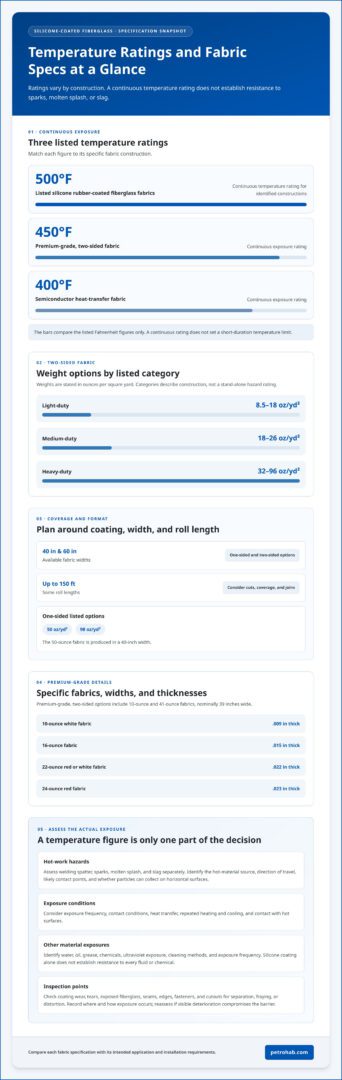
Continuous ratings describe sustained operating conditions, not every short heat event. Listed silicone rubber-coated fiberglass fabrics include constructions rated to 500°F continuously. Premium-grade, two-sided fabric is rated up to 450°F, while semiconductor heat-transfer fabric is rated up to 400°F. Match the rating to the specific fabric construction rather than assuming every panel has the same limit.
Premium silicone coated fiberglass panels can vary in width, weight, and thickness. Premium-grade two-sided options include 10-ounce and 41-ounce fabrics, nominally 39 inches wide. A 10-ounce white fabric is .009 inches thick; a 16-ounce fabric is .015 inches thick. A 22-ounce version is .022 inches thick and comes in red or white. Coated fabric can be cut into shapes, fastened with standard fasteners, or sewn using industrial sewing machines.
Intermittent exposure needs separate assessment: a continuous rating does not establish a short-duration temperature limit. Consider the heat source, exposure frequency, contact conditions, and how heat reaches the fabric. Radiant heat and direct contact with hot material, for example, create different conditions even in the same work area.
Temperature-Related Service Limitations
Temperature limits, hazards, and service life depend on the fabric’s operating history. Repeated heating and cooling, contact with hot surfaces, and coating damage can change a panel’s condition. A continuous rating alone does not establish performance against molten splash, sparks, or slag. Assess these hazards separately.
For service-life decisions, inspect panels for coating wear, tears, exposed fiberglass, and changes around seams or fasteners. Record where heat exposure occurs and whether the panel undergoes repeated thermal cycling. These checks can reveal damage that a temperature rating cannot describe. Replace or reassess a panel if visible deterioration compromises its barrier function.
Welding spatter, sparks, molten splash, and slag resistance
Welding spatter, sparks, molten splash, and slag create different contact conditions. Small sparks may pass or cool quickly, while molten material can remain in contact and concentrate heat. Assess each hazard separately rather than treating a temperature rating as proof of splash resistance. A barrier beside a welding arc, for example, faces a different exposure pattern from a panel below overhead cutting.
Start with the work process: identify the source of hot material, its direction of travel, likely contact points, and whether particles can collect on horizontal surfaces. Then consider fabric weight and construction alongside panel placement. A heavier fabric may suit a different installation than a lighter one, but weight alone does not establish resistance to molten metal or slag. Match the fabric’s intended application to the actual hazard.
Water, oil, grease, chemicals, and ultraviolet exposure also affect material selection. Do not assume silicone-coated fiberglass resists every fluid or chemical simply because it has a silicone coating. Identify the substance, contact conditions, cleaning method, and exposure frequency. A panel near oil-handling work, for example, needs a different compatibility assessment from one exposed to water spray. Factor UV exposure and outdoor use into inspection and replacement planning.
Chemical resistance and dimensional stability depend on the application. Repeated wetting, cleaning, or chemical contact can affect the coating and fabric, while thermal cycling can stress installed panels. After exposure, inspect seams, edges, fasteners, and cutouts for coating separation, fraying, distortion, or tears. Record the type and location of exposure so maintenance teams can identify recurring damage. These checks help determine whether a barrier remains suitable for its assigned task, rather than relying on a general “resistant” label.
What are the key specifications and performance ratings of silicone coated fiberglass panels?
Compare coating coverage, fabric weight, width, and roll length before selecting material. Silicone rubber-coated fiberglass fabrics are available in 40-inch and 60-inch widths. Two-sided options span light-duty weights from 8.5 to 18 ounces per square yard, medium-duty weights from 18 to 26, and heavy-duty weights from 32 to 96. These categories describe fabric construction, not a stand-alone rating for every hazard.
One-sided fabrics include 50-ounce and 98-ounce-per-square-yard options. The 50-ounce fabric is produced in a 40-inch width, while two-sided fabric is also available in 60-inch widths. Some rolls extend to 150 feet. These dimensions affect coverage planning, seams, and installation layout. For example, a wide panel may reduce the number of joins across a broad barrier, while the required cut dimensions determine how much material the job needs.
- Weight: compare the listed ounces per square yard with the panel’s intended application.
- Coating: distinguish one-sided from two-sided silicone rubber coverage.
- Format: account for available roll width and length when planning cuts and joins.
Temperature ratings also vary by construction. Listed silicone rubber-coated fiberglass fabrics include continuous ratings up to 500°F; premium-grade, two-sided fabric is rated up to 450°F. A 24-ounce red fabric is listed at .023 inches thick. Treat each rating and thickness as a specification for its identified fabric, not as a universal property of all silicone-coated panels.
Standards and test references require equally precise interpretation. Fiberglass-reinforced silicone rubber sheet meets AMS3320 and AMS3315 specifications. Some silicone rubber-coated fabrics meet NRC 1.36 for use in nuclear facilities. These identifiers apply to the stated materials. Compare the exact construction, listed rating, and intended application rather than transferring a specification from one fabric type to another.
How do silicone coated fiberglass panels compare with PTFE-coated fiberglass and other materials?
Compare silicone-coated fiberglass, PTFE-coated fiberglass, and other candidate materials under the same operating conditions. Start with the hazard: sustained heat, sparks, molten splash, chemical contact, or outdoor exposure. Then define the barrier’s function, installation method, and maintenance requirements. This avoids treating a material name as proof of suitability. A panel separating welding work from nearby equipment, for example, needs assessment against the actual exposure path.
Use a consistent comparison matrix instead of relying on one headline property. Record each material’s documented temperature rating, coating configuration, fabric weight, width, and applicable standards. Include how the panel will be cut, joined, fastened, and inspected. A specification for one construction cannot be applied to another. Compare the exact product data for the selected silicone or PTFE-coated fiberglass, then match it to the work process and exposure pattern.
Assess other materials using the same criteria. A rigid panel, flexible fabric, and installed enclosure serve different roles, so compare each with the required coverage and mounting arrangement. Consider the location of seams, edges, and penetrations. A large opening, for instance, may require a different layout from a small equipment screen. Material selection should account for both barrier performance and how the assembly functions in the work area.
Before choosing, define the exposure, compare documented specifications, and assess installation and inspection needs. Give priority to the exact construction and its stated ratings, not broad claims about silicone, PTFE, or fiberglass as categories. Where hot work requires a contained workspace rather than a standalone sheet, consider the enclosure requirement as part of the protection design. Discuss hot-work enclosure requirements for an application that needs integrated containment.
Silicone fiberglass cloth is used as a heat shield, gasket, or insulation material in automotive, aerospace, and manufacturing applications. These uses provide context for comparing constructions, but suitability still depends on the specific exposure, installation, and documented product specifications.
PetroHab: Quadra-Lock Panels
PetroHab offers Quadra-Lock Panels for panel-based hot-work containment. Consider them when your selection process needs to address how the work area will be enclosed, not just fabric ratings. For a broader setup, PetroHab also offers its Hot Work Safety Enclosure (HWSE) and pressurized welding enclosures. The Safe-Stop Automatic Shutdown System monitors gas levels and differential pressure.
The right configuration depends on worksite hazards and containment requirements. Contact PetroHab to discuss Quadra-Lock Panels for your hot-work application.
Turn material selection into a protection plan
Choosing premium silicone coated fiberglass panels is one part of planning hot-work protection. The next step is to connect the material decision to the work area, containment needs, and safeguards required around active welding. A panel may suit a particular barrier role, while a broader operation may call for an enclosure-based approach.
PetroHab offers Quadra-Lock Panels and the PetroHab Hot Work Safety Enclosure (HWSE). Its Safe-Stop Automatic Shutdown System monitors gas levels and differential pressure. Consider how these products fit your site’s hot-work setup rather than treating a fabric rating as the whole protection plan. Clear work-area requirements help focus the discussion on an appropriate solution.
Bring your panel requirements and hot-work containment needs together in the next planning conversation. Contact PetroHab about panel options to discuss the application and determine a practical next step. A deliberate selection process helps keep the decision grounded in the hazards and operating conditions your team needs to address.
Frequently Asked Questions
Why choose this fabric construction?
Choose silicone-coated fiberglass when an application calls for coated fiberglass fabric rather than an uncoated textile or rigid sheet. It combines a fiberglass base with a silicone-rubber coating. Its use across aerospace, shipbuilding, metalworking, power generation, and manufacturing makes it relevant to varied industrial environments. Begin by identifying the barrier’s role, installation format, and exposure conditions.
What temperatures can silicone coated fiberglass panels withstand?
Continuous temperature ratings depend on the fabric construction. Listed silicone rubber-coated fiberglass fabrics include ratings of 500°F; premium-grade, two-sided fabric is rated up to 450°F, and semiconductor heat-transfer fabric up to 400°F. PetroHab’s own silicone-coated fiberglass cloth is rated for continuous temperatures of 1,000°F. Treat each rating as specific to its stated material and application, not as a universal limit.
What are common applications for silicone coated fiberglass panels?
Common applications include heat shields, gaskets, insulation, and coated fabric barriers in aerospace, shipbuilding, metalworking, power generation, and manufacturing. A gasket or conveyor belt, for example, may call for premium-grade, two-sided silicone-coated fiberglass fabric. A heat shield serves a different function and faces a different exposure pattern. Match the fabric construction to the component’s role and operating environment.