Blog Posts
Deepwater Regulatory Support for MODU Safety Credibility
Regulatory confidence is built before a MODU’s safety case reaches the review desk. Establishing technical safety credibility with deepwater maritime regulators starts with early engagement: project teams can clarify expectations, identify evidence gaps, and align safety decisions before they become harder to address.
Early dialogue is strongest when backed by more than assurances. Regulators need clear, traceable evidence that safety controls suit the operating environment and can be verified. This article explains how to organize that evidence through independent verification, local regulatory expertise, certified equipment, and measurable safety goals.
These elements work together across a MODU project, from initial planning through operational readiness. A disciplined approach supports productive regulator engagement and keeps personnel protection central to technical decisions.
Key Takeaways
- Engage regulators early to clarify expectations and surface evidence gaps while project decisions can still respond to them.
- Build confidence with independent verification and specialist knowledge of the jurisdictions and standards relevant to the MODU.
- Use equipment certification and traceable technical evidence to support decisions about safety controls and operating conditions.
- Set measurable safety goals, then assess whether enclosure and shutdown solutions such as PetroHab’s support the work scope.
Agency capture and independent verification
Regulatory confidence depends on evidence that stands apart from the operator’s own assurance process. The Minerals Management Service was created in 1982, combining offshore royalty collection, leasing, permitting, environmental oversight, and safety oversight within one agency. This history highlights the need for clear accountability. A disciplined process for establishing technical safety credibility with deepwater maritime regulators identifies who owns each safety decision, who reviews it, and how conflicts are managed.
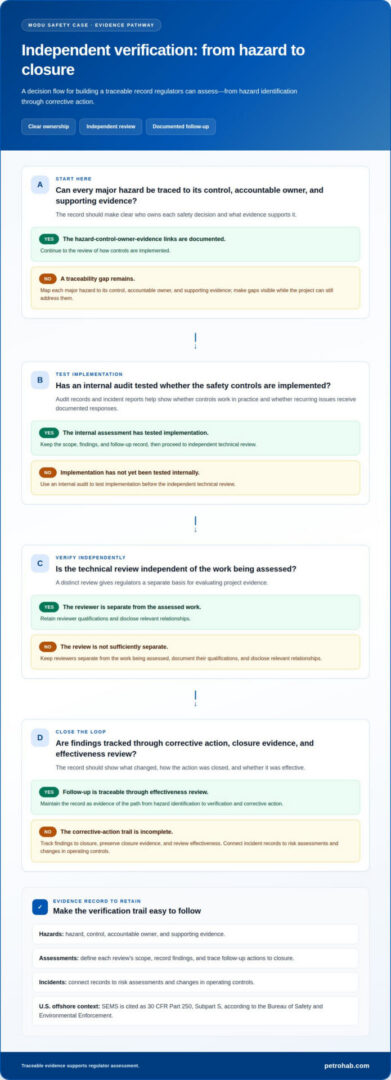
How do regulators assess safety management systems, audits, and incident reporting? They look at whether systems identify hazards, assign controls, and drive corrective action. Audit records and incident reports show whether controls work in practice and whether recurring issues receive documented responses.
In the United States, the offshore Safety and Environmental Management Systems (SEMS) regulation is cited as 30 CFR Part 250, Subpart S, according to the Bureau of Safety and Environmental Enforcement. Audit arrangements may involve distinct reviews, so their scopes and follow-up should be clearly defined. Treat these as distinct assessments. Define each review’s scope, record findings, and trace follow-up actions to closure.
Build independence into the verification plan before an assessment begins. Use two layers: an internal audit to test implementation, followed by an independent technical review. Keep reviewers separate from the work being assessed, document their qualifications, and disclose relevant relationships. Independent assessment supports establishing technical safety credibility with deepwater maritime regulators by giving them a distinct basis for evaluating project evidence.
- Map each major hazard to its control, accountable owner, and supporting evidence.
- Track findings through corrective action, closure evidence, and effectiveness review.
- Connect incident records to risk assessments and changes in operating controls.
This record gives regulators a traceable path from hazard identification to verification and corrective action. It also makes gaps visible while the project can still address them.
International regulatory knowledge and local specialist support
Deepwater projects cross regulatory boundaries, so teams need to connect vessel, facility, and operational requirements early. Local specialists can map these interfaces and clarify which authority reviews each part.
Regulatory Requirements and Standards
U.S. offshore safety draws on federal statutes, agency regulations, and technical standards. The Outer Continental Shelf Lands Act was enacted in 1953. The SEMS regulation is cited as 30 CFR Part 250, Subpart S, according to the Bureau of Safety and Environmental Enforcement. The Coast Guard uses 46 CFR Subchapter L for vessels serving offshore energy-resource projects when its scope applies.
Which regulations and standards govern deepwater offshore safety in the United States? The applicable framework depends on the activity, facility, and vessel. Technical references can include NORSOK S-001 and ISO 13702 for fire and explosion control and mitigation. Which agencies regulate technical safety for deepwater maritime operations? BSEE, the Bureau of Ocean Energy Management, and the U.S. Coast Guard have relevant offshore and vessel roles. Define each agency interface against the actual project scope.
Local regulatory specialists can translate requirements into a project-specific obligations matrix. Map each system to its governing authority, evidence owner, and review milestone. This helps prevent international standards from being treated as automatic substitutes for U.S. requirements. Record the rationale whenever the project adopts a consensus standard or applies it alongside an agency rule.
Permits and Regulatory Approval
Start permit planning by defining the project’s location, operational scope, facility, and vessel interfaces. What are the steps for obtaining permits and regulatory approval for deepwater projects? Identify the authorities, map applicable requirements, prepare the necessary technical and safety evidence, submit required applications, and address agency questions before work proceeds. Local expertise helps sequence these activities and track decisions.
Maintain a review register that links each submission to its assumptions, supporting documents, comments, and resolutions. This gives the project team a controlled record of approval status and outstanding actions.
Regulatory findings often point to gaps in hazard assessment, control documentation, or corrective-action tracking. Enforcement measures and penalties depend on the applicable authority and violation; 46 U.S.C. § 70036 authorizes criminal enforcement for violations of Coast Guard port and waterways safety regulations. Keep findings, responses, and closure evidence traceable to the relevant requirement.
Third-party equipment certification
Independent equipment assessment can strengthen the evidence supporting a MODU safety case. Match certification scope to the equipment, hazards, and applicable regulatory requirements.
Equipment Engineering Standards
What engineering standards apply to deepwater vessels, drilling systems, and subsea equipment? No single standard governs every system in these categories. Determine applicable requirements based on the asset, system function, operating location, and regulatory framework.
For fire and explosion control, the offshore example includes NORSOK S-001 and ISO 13702. These standards do not replace equipment-specific design requirements. A vessel’s regulatory treatment also depends on its role; the Coast Guard uses 46 CFR Subchapter L for vessels serving offshore energy-resource projects when its scope applies.
Build a certification register for each safety-critical component. Record the governing design basis, applicable standard, certification body, test evidence, limitations, and document revision. For a drilling system, for example, connect component test records to system-level design assumptions and the operating envelope. This traceability lets reviewers assess reliability without treating a certificate as proof of every installation condition.
Certification Costs and Timelines
What are the costs and timelines for deepwater safety certification and regulatory review? They depend on equipment scope, evidence quality, testing needs, and the review path. A complete technical file can reduce clarification cycles, while design changes or missing records can add assessment work and extend the schedule.
The U.S. Bureau of Safety and Environmental Enforcement finalized revisions to the Production Safety Systems Rule on September 28, 2018, removing a requirement for independent third-party equipment certification. That change should not be read as a blanket determination for every component or project. Establish which requirements apply to the specific equipment and operation.
Plan certification around design maturity. First, define the equipment boundary and applicable standards. Then assemble drawings, calculations, material records, test results, and operating limits. Resolve reviewer findings and control revisions. Finally, link approved evidence to the installed configuration. This sequence helps project teams budget assessment effort and schedule reviews around real technical dependencies, rather than assuming a fixed duration or certification route.
Clear, measurable safety goals
Safety goals give a MODU project defined criteria for assessing whether controls address identified hazards. They also make risk decisions traceable from engineering assumptions to operating procedures.
How do operators qualify and document deepwater safety cases and risk assessments? They identify hazards, assess consequences and controls, record the basis for risk decisions, and link each control to responsible roles and verification evidence. Update the record when design, equipment, or operating conditions change.
Deepwater plans should address loss of well control, fire and explosion, hazardous releases, equipment failure, vessel interactions, and emergency response. For each hazard, document initiating conditions, preventive barriers, consequences, mitigation measures, and how control systems will be tested. This structure helps reviewers see how risk assessments inform practical operating limits.
Measurable goals need clear boundaries and defined evidence. A goal might require a specified control to remain functional under documented operating conditions. The project should identify the inspection, test, or record used to demonstrate performance. Avoid targets that express intent, such as “improve safety,” without criteria for evaluating progress.
Numerical risk examples require careful context. British petroleum regulation uses a risk level of one in 1,000 deaths. Two U.S. statutory examples tolerate no more than a one-in-1,000,000 level of risk: Section 408(b)(2)(A)(iii) of the Food Quality Protection Act and Section 112 of the Clean Air Act. These examples do not establish one universal target for every MODU hazard. Apply each standard only within its relevant legal context.
- Connect each hazard to preventive and mitigative barriers.
- Assign an owner and evidence record to every safety-critical control.
- Review performance indicators alongside incident findings and corrective actions.
For hot-work scenarios, review control-system safety considerations alongside the project’s documented hazard controls and operating conditions.
PetroHab: PetroHab Hot Work Safety Enclosure (HWSE)
PetroHab Hot Work Safety Enclosures (HWSE) support controlled hot work in hazardous oil and gas environments. For MODU teams, a pressurized enclosure can be considered when welding work requires one as part of the project’s hazard-control plan. Document the enclosure’s role alongside the applicable work scope, risk assessment, and operating procedures.
PetroHab’s Safe-Stop Safety Shutdown System (SSS) monitors differential pressure and gas levels. Petro-Habitat™ HWSE panels use Quadra-Lock® technology, which joins panels without zippers. These systems support operational controls, but do not replace regulator engagement, independent assessment, or project-specific safety evidence.
Contact PetroHab to discuss hot-work enclosure requirements for your project.
Turn safety evidence into project decisions
Your next step is to connect the safety case to the work planned on the MODU. Define the hazard, operating conditions, control ownership, and evidence needed to support each decision. This gives engineering and operations teams a shared basis for resolving gaps before work proceeds.
Establishing technical safety credibility with deepwater maritime regulators is an ongoing project discipline, not a single approval milestone. Keep technical records aligned with the equipment configuration and work scope as plans develop. For hot-work planning, consider how an enclosure fits the documented hazard controls and operating procedures.
PetroHab offers the PetroHab Hot Work Safety Enclosure (HWSE), Safe-Stop Automatic Shutdown System, and Quadra-Lock Panels. These offerings can inform the project’s equipment planning where they fit the defined work scope.
Contact PetroHab about MODU safety to discuss your project’s hot-work requirements. A clear next step helps keep safety decisions focused and actionable.
Frequently Asked Questions
Why is early regulatory engagement important for MODU projects?
Early engagement lets a MODU team test project assumptions before they shape procurement and work planning. For example, clarify whether a proposed vessel interface belongs in the vessel submission, the offshore installation review, or both. This helps sequence technical packages and avoid preparing evidence against the wrong review boundary. It also gives regulators time to identify questions that need engineering input.
What technical evidence do maritime regulators require to demonstrate safety credibility?
Organize evidence so reviewers can trace a safety claim to its design basis and operational proof. For a gas-detection shutdown function, records could include the cause-and-effect description, sensor and logic documentation, functional test results, maintenance controls, and alarm response procedures. Keep revision status visible and connect deviations to documented dispositions. Ensure the submission set reflects requirements applicable to the project.
How do U.S. deepwater safety requirements compare with international maritime and offshore standards?
U.S. requirements combine statutes, agency rules, and project-specific review, while international maritime and offshore standards provide technical frameworks used across jurisdictions. Applying an international standard does not by itself establish U.S. acceptance. Compare scope, definitions, design assumptions, and evidence criteria in a cross-reference matrix. Flag differing clauses, then document how the project resolves each gap for its vessel and offshore systems.
How can operators build trust with regulators through transparent data, independent verification, and stakeholder engagement?
Trust grows when operators disclose supporting results and unresolved exceptions in a consistent record. Give each dataset an owner, revision, collection context, and link to the relevant safety decision. Invite vessel, installation, and technical stakeholders to review interfaces before submission, then record their comments and dispositions. Independent reviewers should be able to reproduce the reasoning without relying on undocumented verbal explanations.