
Blog Posts
How to Reassure Marine Barge Superintendents During Floatel Tie-Ins
Control at a floatel tie-in starts with a clear plan for barge placement, site access, and changing marine conditions. Reassuring marine barge superintendents during floatel tie-ins means explaining how the team will monitor water depth, currents, tides, and weather, and how the barge will be positioned and secured. The plan should also define communication routes and response actions.
Superintendents need practical information to assess operational risks, not broad assurances. Before and during the tie-in, address access routes, mooring, weather and water-condition monitoring, and contingency arrangements. These controls give the marine team a clear basis for coordinating work and protecting personnel and equipment.
Key Takeaways
- Assess water depth, currents, and access before positioning the barge, then make the placement plan clear to the marine team.
- Track equipment distribution and changing draft so the barge’s balance and operating condition remain visible during the tie-in.
- Agree in advance on weather triggers, barge-securing actions, personnel evacuation, and movement plans for severe conditions.
- Use reliable radios and clear communication protocols to coordinate marine and shore-side personnel and communicate operational changes.
1. Barge placement and site access
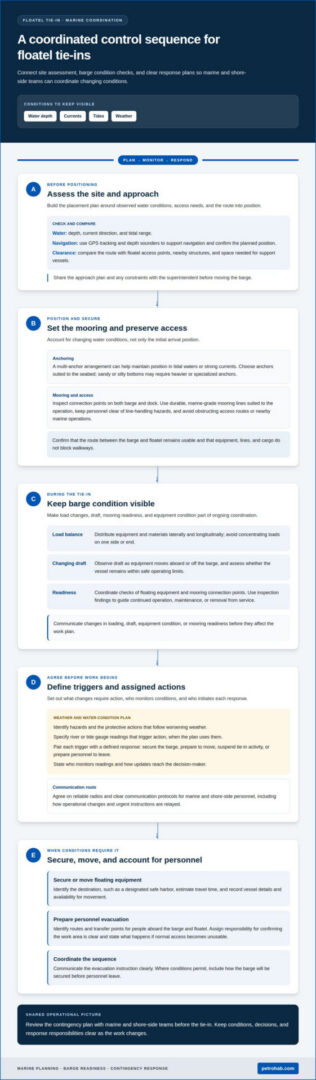
Before positioning the barge, assess water depth, current direction, tidal range, and the approach route. Use GPS tracking and depth sounders to support navigation and confirm the planned position. Compare readings with the floatel’s access points, nearby structures, and the space needed for support vessels. Share the approach plan and any constraints with the superintendent before moving the barge.
Positioning must account for changing water conditions, not just the initial arrival. In tidal waters or strong currents, a multi-anchor arrangement can help maintain position. Choose anchors suited to the seabed, as sandy or silty bottoms may require heavier or specialized anchors. Confirm that the anchoring pattern will not obstruct access routes or interfere with nearby marine operations.
Inspect mooring points on both the barge and dock before connecting lines. Use durable, marine-grade mooring lines suited to the operation, and keep personnel clear of line-handling hazards. Confirm that access between the barge and floatel remains usable and that equipment, lines, and cargo do not obstruct walkways. These checks show the superintendent how the barge will remain in position and how personnel will reach the work area.
U.S. requirements depend on the activity. U.S. Coast Guard transfer rules require a Declaration of Inspection for oil transfers involving a vessel with a capacity of 250 barrels or more. In the United States, the vessel and shore-side facility must retain at least one signed Declaration of Inspection for one month after it is signed, according to the U.S. Coast Guard. For benzene exposure, the Occupational Safety and Health Administration limit cited by the procedure is 5 PPM over any 15-minute period.
Access planning should also define how personnel and materials will move during the tie-in. Identify the route from the landing point to the work area, note access restrictions, and coordinate planned vessel movements with the marine team. A clear placement plan, supported by navigation readings and an agreed mooring arrangement, helps the superintendent see how the team will manage changing site conditions.
3. What are marine barge superintendents responsible for during floatel tie-ins?
During a floatel tie-in, the marine barge superintendent coordinates the barge’s condition, loading, and interface with the dock. A key responsibility is managing how equipment and materials are distributed across the deck. Balance loads laterally and longitudinally rather than concentrating them on one side or end. This helps maintain an appropriate vessel attitude as work progresses.
Loading changes call for active draft monitoring. As equipment moves aboard or off the barge, crews should observe the draft and assess whether the vessel remains within safe operating limits. The superintendent needs visibility into planned load movements and their effect on balance. For example, placing heavy machinery near one edge can affect lateral balance, while shifting cargo toward one end can affect longitudinal balance.
Mooring readiness is another direct responsibility. Before mooring, inspect the strength of connection points on both the barge and dock. A sound point on one side does not make up for a weak point on the other. The superintendent should coordinate the inspection, address any concerns, and ensure the connection arrangement suits the tie-in operation.
Periodic inspections and tests help establish whether floating equipment remains in safe operating condition. The superintendent should coordinate checks around the equipment’s intended use and the changing demands of the work. Use inspection findings to guide decisions about continued operation, maintenance, or removing equipment from service. Documenting results also helps the marine team track whether identified issues have been addressed.
These responsibilities call for clear coordination between the barge crew, dock personnel, and floatel team. The superintendent should communicate changes in loading, draft, equipment condition, or mooring readiness before they affect the work plan. This gives the teams a shared basis for sequencing activities and responding to changing conditions. Consistent oversight keeps the barge’s status visible throughout the tie-in, not just at arrival or departure.
3. What contingency and emergency plans should be agreed before a floatel tie-in?
Before work begins, agree on how the barge team will respond to worsening weather. The plan should identify hazards, protective actions, and who initiates each step. Set clear conditions for securing equipment, suspending tie-in activity, and preparing personnel to leave. Define when each measure takes effect so the crew does not have to interpret an urgent instruction as conditions deteriorate.
Severe-weather planning should explain how the barge or other floating equipment will be secured or moved. Identify the destination, such as a designated safe harbor, and estimate the time needed to reach it. Record vessel details and availability for movement. These specifics help the superintendent assess whether the response can be completed before conditions threaten the barge or personnel.
Use river or tide gauge readings as operational triggers when the plan calls for moving equipment. Specify which readings require action and who monitors them. Pair each trigger with a defined response, such as securing the barge, preparing to move, or evacuating personnel. Set out how changing readings will reach the decision-maker, rather than relying on informal updates during a weather event.
Personnel evacuation needs a practical sequence of its own. Identify routes and transfer points, account for people working aboard the barge and floatel, and assign responsibility for confirming that the work area is clear. State how the crew will communicate an evacuation instruction and what happens if normal access becomes unusable. Where conditions permit, include how the barge will be secured before personnel leave.
Review the contingency plan with marine and shore-side teams before the tie-in begins. Walk through a scenario involving a forecast change, rising gauge reading, or restricted access. Confirm that each person understands the trigger, action, and communication route. A shared plan gives the superintendent a clear basis for pausing work, securing equipment, moving the vessel, or evacuating personnel as conditions require.
4. How should communications and decision authority be organized during a floatel tie-in?
Before the tie-in, agree on reliable radios and communication protocols for barge and shore personnel. Identify who provides routine status updates, who receives operational information, and how urgent messages are flagged. Use consistent terms for the floatel, barge, work area, and access points. Clear references reduce ambiguity when teams coordinate across water and machinery noise.
Set decision-making authority for each phase of the work. Name the person who can pause an operation, the marine lead coordinating barge activity, and the shore-side contact responsible for relaying site changes. Make the escalation route clear. For example, a change in barge position should reach the marine lead and tie-in coordinator before the next connected task proceeds. Clear authority helps reassure marine barge superintendents during floatel tie-ins.
Use closed-loop radio exchanges for instructions that affect personnel or equipment. The sender gives a concise direction, the receiver repeats the key detail, and the sender confirms it. Include the location and intended action. For example, “hold movement at the landing point” is clearer when the receiver repeats the location and confirms that movement has stopped.
Agree on how teams will report changing conditions and record key decisions. A status update can state the observation, its location, and the requested response. The decision-maker should acknowledge the report, communicate the action, and notify affected crews. Keep a shared log of significant instructions, pauses, and resumptions so incoming personnel can understand the current status without relying on informal handovers.
Test the radio procedure before work begins. Confirm that barge and shore personnel can reach the intended contacts, then rehearse a routine update and an urgent stop instruction. Address missed calls by defining how the sender retries and escalates the message. For tie-ins involving hot work, coordinate safety planning for the work area alongside the marine communication plan. This structured communication approach supports reassuring marine barge superintendents during floatel tie-ins and helps teams act on shared information.
PetroHab LLC
PetroHab LLC helps teams manage hot-work hazards around floatel tie-ins with engineered enclosure systems and automatic shutdown equipment. When the work requires an enclosure or monitoring controls, PetroHab’s Hot Work Safety Enclosure (HWSE), pressurized welding enclosures, and Safe-Stop Safety Shutdown System can support the site’s hot-work safety plan.
These products complement marine planning for barge position, access, weather response, and communication authority. Consider them when a tie-in involves hot work in a hazardous environment.
Contact PetroHab LLC to discuss hot-work safety needs for your tie-in.
Put the Tie-In Plan into Practice
A coordinated marine plan gives each team a clear operational framework. The next step is to align it with the hot-work controls the site requires. This keeps the marine and work-area plans connected and helps the superintendent review how each control supports the operation.
For projects involving hot work, PetroHab LLC offers the PetroHab Hot Work Safety Enclosure (HWSE), Safe-Stop Safety Shutdown System, and Quadra-Lock Panels. These products address enclosure and shutdown needs within the broader site safety plan. Include them in planning when hot work requires dedicated containment or monitoring controls.
Reassuring marine barge superintendents during floatel tie-ins depends on clear roles, relevant controls, and shared operational information. Align these elements with the work scope before the tie-in proceeds.
Contact PetroHab LLC to discuss your floatel tie-in and identify how its offerings may fit your hot-work safety requirements. A well-coordinated plan gives the team a stronger basis for moving forward.
Frequently Asked Questions
What information should be shared with barge superintendents before a floatel tie-in?
Share the tie-in sequence, work boundaries, expected vessel movements, and points where activities depend on one another. Include a marked interface drawing that shows connection locations and nearby obstructions. Explain how simultaneous work could affect access or require a pause. Give the superintendent a current contact list and identify who can approve changes, so revised work steps reach the responsible people before operations continue.
What are the weather, sea-state, and vessel-motion limits for floatel tie-ins?
Set operating limits in the project’s marine procedures before the tie-in, based on the vessel, floatel interface, connection method, and expected environmental conditions. State which conditions require work to pause and who makes that decision. Compare forecasts with the vessel’s observed response during the operation. If relative movement affects alignment or the connection, stop the affected activity until the designated decision-maker assesses conditions.
What are the main safety risks during floatel tie-ins and how are they controlled?
Key risks include changing gaps at the interface, moving equipment, line-handling hazards, and ignition or gas hazards where hot work occurs. Control them with coordinated work boundaries, secured materials, clear transfer routes, and agreed stop-work communication. For hot work, follow the site’s approved hazard controls. PetroHab’s Safe-Stop Safety Shutdown System monitors differential pressure and gas levels in hazardous environments.
What mooring, gangway, and access checks reassure barge superintendents before tie-in?
Confirm that the mooring arrangement keeps the barge appropriately positioned and that lines do not obstruct personnel routes. Check the gangway landing at the connection point, including its alignment as the interface changes. Keep loose tools and materials clear of the route, and ensure personnel know the designated transfer path. If the gangway shifts, becomes obstructed, or no longer provides controlled access, suspend transfers until access is restored.