
Blog Posts
Live Pipeline Sleeve Repairs and When Work Can Stay Online
A pipeline doesn’t always need to leave service for a repair sleeve installation. Reassuring pipeline integrity managers during live repair sleeve installations starts with matching the repair method to the defect, operating conditions, and work controls. Composite wraps, bolt-on clamps, and many full-encirclement sleeves can be installed while a pipeline remains in service, when pressure and safety conditions allow.
That does not make every live repair suitable. Welded sleeves involve hot work, permits, and possible downtime. Engineering review must account for line pressure, product, and welding controls. The repair decision must protect people and assets while restoring pipeline integrity, not simply avoid an outage.
This article explains how sleeve types and applicable standards shape the decision, how hot-work controls and permits affect downtime, and why installer qualifications and workmanship matter. It outlines the factors that determine whether work can proceed online and the conditions that may call for a different repair plan.
Key Takeaways
- Determine whether the pipeline can stay online by matching the sleeve method to the defect, pressure, and safety conditions.
- Understand how repair standards and engineering review shape installation requirements, including for composite and steel sleeves.
- Account for hot-work controls, permits, and operating constraints when estimating downtime for a welded sleeve repair.
- Recognize how qualified installers and PetroHab hot-work safety enclosures support controlled work in hazardous environments.
Mechanical and installation standards
Mechanical and installation standards guide sleeve selection, fit, and verification. The assessment must match the defect, loading conditions, and applicable repair method.
Inspection and Monitoring Data
Inspection and monitoring data describe the defect and pipeline condition before and during sleeve installation. In-line inspection, pressure testing, and direct assessment are common inputs. Inspection, excavation, and repair records help the integrity management program track anomalies and support remediation decisions.
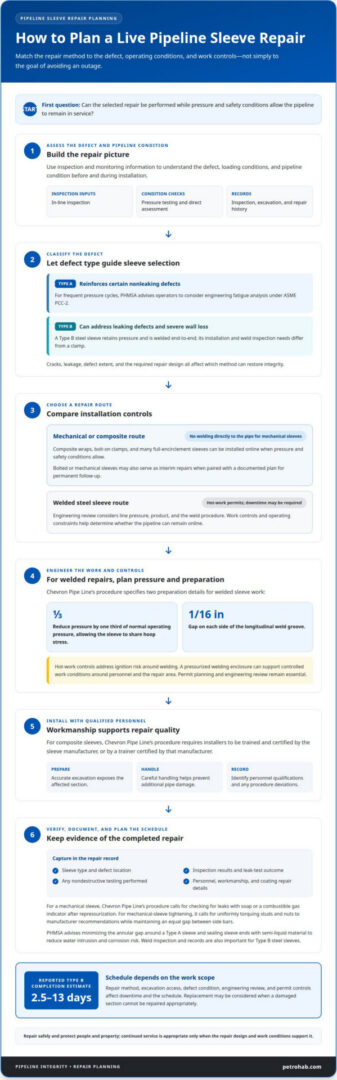
Type A sleeves reinforce certain nonleaking defects; Type B sleeves can address leaking defects and severe wall loss. According to PHMSA, operators should consider engineering fatigue analysis under ASME PCC-2 when Type A repairs face frequent pressure cycles. That assessment helps determine whether the sleeve’s structural role fits the defect and operating conditions.
Leak Testing and Weld Inspection
Leak testing and weld inspection help verify that a completed sleeve installation has no identified leakage or unacceptable weld condition. A Type B steel sleeve retains pressure and is welded end-to-end, so weld quality and inspection records are important to the repair assessment.
After a mechanical sleeve is installed and the pipeline is repressurized, Chevron Pipe Line’s procedure calls for checking for leaks with soap or a combustible gas indicator. Post-repair nondestructive testing and documentation add evidence of installation condition. Under 49 CFR 195.422, repairs must be made safely and prevent damage to persons or property.
Post-Installation Verification
Post-installation verification documents whether the repair meets its design and installation requirements. Record the sleeve type, defect location, inspection results, leak-test outcome, and any nondestructive testing performed.
Fit details matter, too. Chevron Pipe Line’s procedure calls for uniformly torquing mechanical-sleeve studs and nuts to the manufacturer’s recommendations while maintaining an equal gap between side bars during tightening. PHMSA advises minimizing the annular gap around a Type A sleeve and sealing sleeve ends with semi-liquid material to reduce water intrusion and corrosion risk. Complete records support future integrity assessments and failure investigations.
Sleeve welding, hot-work permits, and downtime
Welded and mechanical sleeves require different installation controls. Steel sleeve welding requires hot-work permits and may require downtime, while mechanical sleeves avoid welding directly to the pipe. Composite wraps, bolt-on clamps, and many full-encirclement sleeves can often be installed online when pressure and safety conditions allow. This distinction helps operators decide whether continued service suits the defect and work plan.
For welded repairs, engineering review considers line pressure, product, and the weld procedure. Chevron Pipe Line’s procedure instructs crews to reduce pressure by one third of normal operating pressure, allowing the sleeve to share hoop stress. It also specifies a 1/16-inch gap on each side of the longitudinal weld groove. These requirements make operating conditions and preparation central to planning live hot work.
Bolted or mechanical sleeves can reinforce a pipeline without welding directly to the carrier pipe. They may serve as interim repairs when paired with a documented plan for permanent follow-up. A Type B steel sleeve retains pressure and is welded end-to-end, so its installation demands differ from those of a clamp. Cracks, leakage, defect extent, and the required repair design all affect which method can restore integrity.
Downtime depends on the repair method, excavation access, defect condition, engineering review, and permit controls. Reported estimates place Type B sleeve repair completion at 2.5 to 13 days, but the work scope determines the schedule. The price depends on the case and is given after a quote request; excavation, materials, equipment, inspection, and outage coordination affect the cost.
Hot-work controls must address ignition risk around the welding task. A pressurized welding enclosure can support controlled work conditions around personnel and the repair area. Permit planning and engineering review remain essential parts of the job. Replacement may be considered when a damaged section cannot be repaired appropriately, rather than treating every defect as a sleeve application.
Installer qualifications and workmanship
Installer skill directly affects composite repair quality. Training and qualification matter because the installer must apply the selected system correctly to the identified defect. A sound assessment establishes the repair design; disciplined workmanship brings it into the field. Poor handling or installation can damage the pipe or compromise reinforcement, leaving the integrity team with less reliable repair evidence.
Chevron Pipe Line’s procedure requires composite sleeves to be installed by personnel trained and certified by the sleeve manufacturer, or by a trainer certified by that manufacturer. This qualification links practical capability to the specific repair system. Installation records should identify the method, defect location, personnel qualifications, and any deviations from the procedure.
Work quality starts before sleeve application. Accurate excavation exposes the affected section, while careful handling around in-service pipe helps prevent additional damage. The crew’s observations should identify the defect and capture relevant site conditions. These details matter because excavation and repair records inform anomaly tracking and later assessment within the operator’s management program.
After installation, testing and documentation preserve evidence of workmanship. Record the completed repair, inspection findings, and any coating repair so the site’s condition remains traceable. Corrosion control also depends on addressing coating damage around the excavation and repair area. If a bolt-on clamp is used as an interim measure, document the plan for permanent follow-up repair.
Operators manage the overall integrity program, while field contractors perform hands-on work such as integrity digs, anomaly remediation, coating repair, and testing. Clear coordination assigns each task and connects results to the correct pipeline record. When a sleeve reinforces a defect, qualified installation and complete documentation help operators assess the repair’s continuing role in pipeline integrity management.
Live-line repair and hot-work considerations
Live-line methods depend on engineering analysis, defect condition, operating pressure, and sleeve design. Reassuring pipeline integrity managers during live repair sleeve installations starts with confirming that the proposed method and work controls suit operating conditions.
Operating Limits During Installation
Operating limits are the pressure, temperature, and flow conditions compatible with a repair method and its installation controls. They matter because crews must maintain pipeline containment while applying reinforcement.
No single pressure or flow limit applies to every sleeve installation. Engineering analysis considers the pipe, defect, product, and method. Chevron Pipe Line’s procedure does not permit composite sleeves above a continuous operating temperature of 140°F or a spiking temperature of 180°F, unless the manufacturer offers higher-temperature adhesive and resin. Welded repairs also require review of line pressure and product.
Planning the Live Repair
Planning connects inspection findings to a repair design, work sequence, and applicable regulatory requirements. This process helps operators determine whether online work addresses the identified condition.
Begin with line inspection and defect assessment, including whether the condition is leaking. Evaluate repair methods against pipe condition, operating pressure, temperature, flow, and failure consequences. PHMSA advises that Type A sleeve procedures align with API RP 1160, API RP 2201, and ASME B31.4. The resulting analysis informs the choice between welded work and other methods, and establishes controls before field execution begins.
Executing the Live Repair
Execution applies the approved procedure while crews monitor pipeline and work conditions. A defined response to changing conditions helps protect containment and control hot-work exposure.
Before installation, confirm the repair design, work authorization, and required hot-work controls. During the work, maintain specified operating conditions and follow the applicable sleeve procedure. Stop and reassess if conditions depart from the plan. After installation, complete inspections, testing, and records so operators can document the repair and use it in future integrity assessments. This documented control framework helps reassure pipeline integrity managers during live repair sleeve installations.
For hot work near operating lines, review hot-work enclosure options as part of the project control plan.
PetroHab
PetroHab supports hazardous-site hot-work planning with containment and ignition-control equipment for oil and gas operations. For live sleeve projects involving welding, PetroHab’s Hot Work Safety Enclosures (HWSE), including pressurized welding enclosures and pressurized habitats, help manage the work environment. The Safe-Stop Safety Shutdown System monitors differential pressure and gas levels, and Quadra-Lock® panels join without zippers.
PetroHab’s equipment supports hot-work controls around a repair, but it does not determine whether a pipeline can remain in service. That decision depends on the defect, engineering assessment, operating conditions, and approved repair procedure. Consider PetroHab when planning an installation that requires managed hot-work conditions at a hazardous industrial site.
Contact PetroHab to discuss your hot-work safety requirements.
Make the Next Repair Decision Deliberate
Use the next integrity review to turn repair findings into a clear project basis. Align the defect record, engineering rationale, work scope, and operating plan so the decision remains traceable from assessment through closeout. A disciplined project record is central to reassuring pipeline integrity managers during live repair sleeve installations because it connects field execution with ongoing integrity decisions. It also gives operations, engineering, and safety teams a shared reference when conditions change or future assessments revisit the repair.
Before work is scheduled, establish who owns each decision and how field updates will reach the responsible teams. Keep the approved work plan and completion records connected, rather than treating installation as an isolated task. For work involving hazardous-site hot work, align the enclosure and shutdown-system requirements with the project’s control plan. Discuss sleeve repairs with PetroHab to consider the relevant hot-work safety equipment for your project. A clear decision path helps your team move forward with discipline and confidence.
Frequently Asked Questions
Do all repair methods require the pipeline to be taken out of service?
No. Composite wraps, bolt-on clamps, and many full-encirclement sleeves can be installed while a pipeline remains in service if pressure and safety conditions permit. That does not mean every repair can proceed online: defect characteristics, operating conditions, and the installation method all affect the decision. Welding introduces hot-work controls and may require operational adjustments or downtime, even when the line is not fully shut down.
What is a live repair sleeve installation on an operating pipeline?
It is a repair in which a reinforcement sleeve is installed around a pipeline while the line continues operating, rather than being fully isolated. The sleeve type matters: a Type A sleeve reinforces certain nonleaking defects, while a Type B sleeve can address leaking defects and severe wall loss. The work plan must account for the carrier pipe’s condition and the repair design.
What pipeline integrity standards govern live repair sleeve installations in the United States?
Applicable requirements depend on the pipeline and repair. PHMSA advises operators to align Type A sleeve procedures with API RP 1160, API RP 2201, and ASME B31.4. For hazardous-liquid pipelines, PHMSA identifies recordkeeping requirements under 49 CFR part 195. Under 49 CFR 195.422, repairs must be made safely and prevent damage to persons or property. Applicable regulations and company requirements also shape the work.
What are the main risks of installing a repair sleeve on a live pipeline, and how are they mitigated?
Key hazards include ignition during hot work, loss of containment, and corrosion or fatigue around the repair. For Type A sleeves, water entering the space between the sleeve and carrier pipe can contribute to corrosion; pressure cycling can also increase failure risk near sleeve ends. PHMSA advises minimizing the annular gap and sealing sleeve ends with semi-liquid material. Engineering review and controlled work procedures address other site-specific risks.
What qualifications and procedures should contractors have for live pipeline sleeve installations?
Qualifications should match the repair method. Chevron Pipe Line’s procedure requires composite sleeve installers to be trained and certified by the sleeve manufacturer, or by its certified trainer. For welded sleeves, the work procedure requires engineering review in relation to line pressure and product. Contractors should also document installation and testing so operators can incorporate accurate field records into ongoing integrity management and future assessments.