Blog Posts
Platform SIMOPS: Resolve Drilling Pushback Through Planning
A wellhead platform can expose an adjacent drilling rig to hazards created by activities outside the rig’s control. SIMOPS refers to two or more activities taking place at the same time and in the same location, where they may interact and transfer risk or operational effects. Overcoming drilling superintendent pushback during platform simultaneous operations starts with identifying those interactions and showing how the work can be controlled, separated or rescheduled.
A drilling superintendent is right to challenge concurrent work when hazards, timing or controls are unclear. The answer is not to dismiss the concern or rely on broad assurances. A structured SIMOPS assessment makes operational conflicts visible and gives decision-makers a shared basis for proceeding, changing the plan or stopping incompatible activities.
This article explains how clash and interdependency analysis, cross-discipline coordination, interface documents and hazard reviews support those decisions. It also examines the exposure created when a wellhead platform and drilling rig operate together, including how a platform gas release can affect nearby rig activities.
Key Takeaways
- Use SIMOPS, clash and interdependency assessments to identify where concurrent work can create shared hazards or operational conflicts.
- Coordinate maintenance, production demands, permits and shift handovers so the schedule reflects real operating conditions.
- Use clear interface documents and combined-operations notifications to align responsibilities, controls and communication between teams.
- Assess how platform activities, including gas venting and hot work, could expose an adjacent drilling rig, then separate or control incompatible work.
SIMOPS assessment, clash analysis, and interdependency analysis
SIMOPS planning identifies interactions between concurrent activities before work begins. A focused assessment gives the drilling superintendent a documented basis for challenging, modifying or accepting the plan.
SIMOPS Scope and Personnel Responsibilities
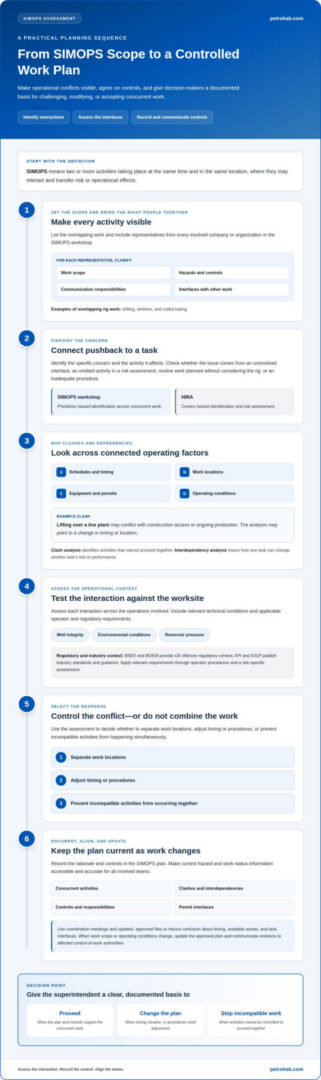
SIMOPS refers to activities occurring at the same time and place that could affect one another. Drilling, slickline and coiled tubing work on one rig are examples of overlapping activities. The workshop should include representatives from every involved company or organization. Each representative should clarify its work scope, hazards, controls and communication responsibilities.
A practical way to overcome drilling superintendent pushback during platform simultaneous operations is to identify the specific concern and the task it affects. Pushback may arise from unresolved interfaces, risk assessments that omit activities, routine work planned without considering the rig, or inadequate procedures. A SIMOPS workshop prioritizes hazard identification, while HIRA covers hazard identification and risk assessment.
Clash and Interdependency Analysis
Clash analysis identifies activities that cannot proceed together. Interdependency analysis traces how one task can change another task’s risk or performance. Review schedules, work locations, equipment, permits and operating conditions as connected factors. For example, lifting over a live plant may conflict with construction access or ongoing production, requiring a change to timing or location.
Assess each interaction across the operations involved, including well integrity, environmental conditions and reservoir pressure. Consider applicable operator and regulatory requirements. Then decide whether to separate work locations, adjust timing or procedures, or prevent incompatible activities from happening simultaneously. Record the rationale and controls in the SIMOPS plan. This provides a technical basis for overcoming drilling superintendent pushback during platform simultaneous operations.
Real-Time SIMOPS Communication
Real-time communication keeps control-of-work authorities aligned as scope, hazards or work status change. Make current hazard and status information accessible and accurate for all involved teams. Coordination meetings and updated, approved files help prevent confusion about timing, available assets and task interfaces.
BSEE and BOEM provide US offshore regulatory context, while API and IOGP publish industry standards and guidance. Apply relevant requirements through operator procedures and a site-specific assessment. Document concurrent activities, clashes, interdependencies, controls, responsibilities and permit interfaces. Update the approved plan when the work scope or operating conditions change, and communicate revisions to affected control-of-work authorities.
Coordination of maintenance and operational demands
Maintenance, production and construction can compete for the same people, equipment and work areas. A workable schedule accounts for each activity’s operational requirements before approving concurrent tasks.
The site’s procedures and permit-to-work process should assign authority to approve, suspend or stop SIMOPS. These documents identify the relevant control-of-work authority and escalation route instead of assuming one universal offshore role.
Start decision-making by comparing maintenance windows with production demands and planned work. For example, a maintenance task that restricts access may conflict with construction activity or an operational requirement. The responsible teams can assess whether to reschedule, adjust the work scope or proceed with coordinated controls. Preliminary inspections and approval help identify conflicts before concurrent activities begin.
Assign each task to a named work group and define its interfaces with other teams. A permit-to-work system can require a risk assessment before issuing a permit. It can also support shift handovers by requiring permits to be handed in at the end of each shift. This gives incoming personnel a defined opportunity to review current work status and outstanding controls.
For simultaneous operations, the JO Simultaneous Operations Checklist calls for 24-hour supervisory coverage. Supervisors can use that coverage to coordinate schedule changes, communicate task status and bring unresolved conflicts to the designated authority. This is especially important when maintenance alters equipment availability or affects another team’s planned work.
If a concern remains unresolved, pause the affected activity under the site’s applicable stop-work and escalation procedures. Notify the responsible supervisor or control-of-work authority, document the concern and its status, and follow the installation’s incident-reporting process if an event or near miss occurs. Site procedures should establish the reporting route and decision authority so personnel know where to escalate before work starts.
Combined-operations notification and interface documents
Combined-operations notifications give involved parties a formal view of concurrent work and its controls. Under the Offshore 2005 regulations, combined operations were notified to the HSE. The notification described the operations, safety-management arrangements, identified risks and mitigation measures. These details help decision-makers assess how production, drilling and other activities interact.
An interface document turns the operational picture into defined working boundaries. It can identify each activity, the responsible organization, interfaces with other work and the agreed communication route. For example, a drilling team and a platform production team need shared information about planned work that could affect both scopes. Clear boundaries reduce uncertainty about who coordinates each interface.
Build the document around actual work packages, not generic descriptions. Record the work location, sequence, operating conditions, hazards, controls and relevant permit references. Link each control to the team responsible for applying or communicating it. If a maintenance task changes equipment availability, the interface record should show which concurrent activities may require schedule or control changes.
Keep notification details consistent with the supporting SIMOPS plan and permit records. A mismatch between the stated work scope and an active permit can obscure which hazards and controls apply. Before work starts, compare the approved activity descriptions, safety-management arrangements and mitigation measures. Refer discrepancies to the designated control-of-work authority for resolution.
Document changes when operations, timing, equipment status or identified risks shift. Record what changed, who approved the revised arrangement and which involved teams received the update. For example, a delayed maintenance task may overlap with production work originally scheduled separately. The revised interface information should make the new overlap visible before affected tasks proceed.
A useful review follows the notification from scope to control: confirm the operations described, trace each identified risk to its mitigation, and verify that responsibilities and communication routes align. The Offshore 2005 notification elements provide a practical structure for this review, while site procedures govern document approval and distribution. That traceable record gives the drilling superintendent a concrete basis for assessing unresolved interfaces.
Hazards when a wellhead platform and drilling rig operate together
A wellhead platform can release gas near an attending jack-up rig. In one scenario, gas from a platform vent was cold-vented over the rig during routine work. The rig’s OIM smelled gas, alerted the control room and suspended hot work while systems were made safe. The gas did not find an ignition source, so the event caused no harm. The key hazard is an activity on one installation exposing personnel or equipment on another.
Review vent locations, gas movement, ignition sources and the rig’s active work before simultaneous activity begins. Hot work requires particular attention because an unexpected gas release can change the hazard conditions around the worksite. The JO Simultaneous Operations Checklist calls for vessels and equipment within 10 feet of hot work to be shut in and bled down. For wireline work, it calls for crown valves to be shut on all wells within 20 feet.
These controls make proximity and task type operational decision points rather than abstract concerns. A drilling superintendent can use the venting scenario to assess whether routine platform operations could affect rig hot work and whether the plan defines who communicates a change. If gas status or activity changes, pause affected work and reassess the overlap before resuming.
For US offshore work, SIMOPS planning should account for applicable national and operator rules alongside hazards specific to the activities. A practical review connects each identified hazard to controls, responsibilities and coordination between the platform and rig. This avoids treating the rig’s work scope as separate from nearby production operations.
Where hot work must take place near platform operations, consider whether a hot-work safety enclosure from PetroHab LLC fits the work plan. It does not replace SIMOPS assessment, gas monitoring or coordination. The decision still depends on the identified hazards and controls for both installations.
PetroHab
PetroHab provides equipment that can support hot work controls within a platform SIMOPS plan. Its PetroHab Hot Work Safety Enclosure (HWSE), pressurized welding enclosures, pressurized habitats and Petro-Habitats address the physical setup for hot work. The Safe-Stop Automatic Shutdown System monitors gas levels and pressure, while Quadra-Lock Panels form part of the available enclosure equipment.
These products are relevant when the assessment identifies hot work near concurrent platform or rig operations and the work plan calls for an enclosure or monitoring system. They do not replace the SIMOPS review, permit controls or coordination between operating teams. Match the equipment to the defined work scope and hazard controls.
Contact PetroHab to discuss equipment for your planned hot work scope.
Move the SIMOPS decision forward
The next planning step is to turn an unresolved concern into a clear decision point: which operating condition would change the plan, who has authority to act, and how affected teams will be informed. This makes overcoming drilling superintendent pushback during platform simultaneous operations a practical part of work planning, not a debate about competing priorities.
Use the next planning review to identify the remaining decision, assign an owner and establish how a change in conditions affects the work. Tie the decision to the actual scope and operating environment. This gives the superintendent and other responsible personnel a clear basis for proceeding, revising the plan or holding the affected activity.
Contact PetroHab about platform SIMOPS to discuss equipment considerations for your planned work. Clear decisions support disciplined operations and help teams move forward with confidence.
Frequently Asked Questions
What are SIMOPS?
SIMOPS are concurrent activities whose hazards or operational demands can affect one another. On an offshore installation, drilling may overlap with production, maintenance, construction or marine work. The key question is whether one task changes the conditions, access, equipment availability or response options for another. For example, a lift over an operating area may constrain nearby work even when crews have separate task permits.
What behaviours and steps could prevent this from occurring?
Clear scopes, early disclosure of changes and disciplined handovers help prevent avoidable SIMOPS conflicts. Before work starts, each team should state its active tasks, work area, equipment needs and interfaces. Supervisors can resolve schedule conflicts before crews mobilize instead of relying on informal assumptions. At handover, outgoing personnel should communicate permit status, incomplete work and changed conditions so incoming crews do not act on outdated information.
What types of interference might occur during a SIMOP?
Interference can involve physical access, simultaneous equipment use, process conditions or changing hazards. A crane lift can restrict access while production continues; maintenance can make equipment unavailable for another task; and platform gas venting can expose nearby rig hot work. Marine movements may also affect offshore work areas. Assess how each interaction changes personnel exposure, timing or controls for the other task.
How should a SIMOPS matrix identify conflicts between drilling, production, maintenance, and marine operations?
Organize the matrix by activity pairs, such as drilling and production or maintenance and marine operations. For each pair, record whether work is permitted, restricted or incompatible, then state the reason and required controls. Include location, timing, affected equipment and the role responsible for coordination. A matrix of permitted operations helps crews distinguish routine concurrent work from combinations that require separation or a schedule change.
What steps help resolve disagreement with a drilling superintendent about SIMOPS risks?
First, define the specific disputed activity and hazard instead of debating the entire schedule. Compare the relevant task scopes, operating conditions and existing controls, then identify what information or control could change the decision. Consider alternatives such as moving the work, changing its timing or removing the overlap. Record the rationale, agreed actions and decision authority. If the concern remains unresolved, use the installation’s escalation process before affected work proceeds.
What communication and daily coordination practices improve cooperation among platform departments during SIMOPS?
Use a shared daily review to communicate active tasks, work-area changes, equipment status and planned interfaces. Control-of-work authorities should exchange updates when permits or operating conditions change, and supervisors should carry unresolved items into shift handovers. The JO Simultaneous Operations Checklist asks whether the SIMOPS log is completed daily. A current log helps departments work from the same status picture and identify developing conflicts.