Blog Posts
ROI Guide for Hot Work Safety Enclosures
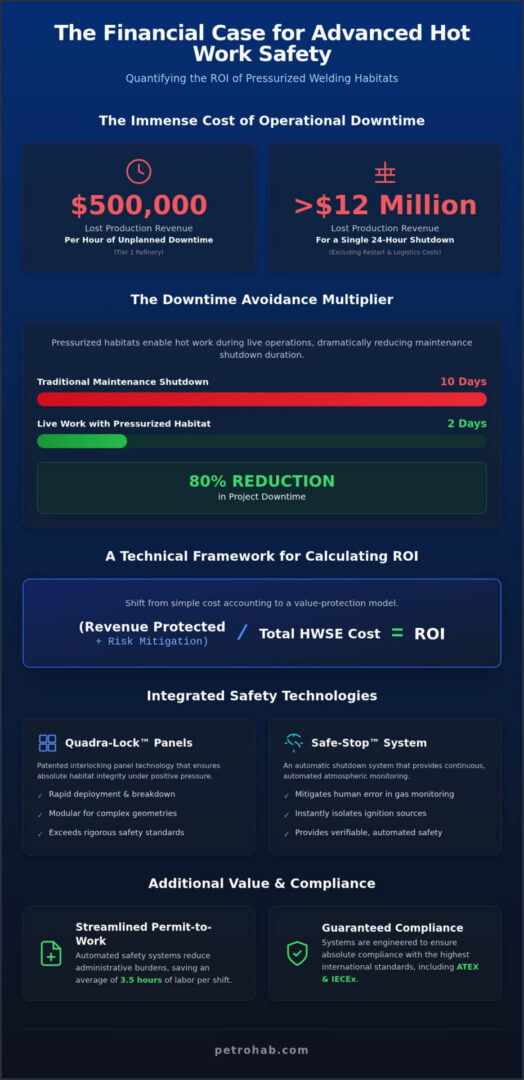
A single hour of unplanned downtime in a Tier 1 refinery can result in $500,000 of lost production revenue as of 2026. This stark reality forces safety managers and engineers to look beyond simple equipment costs when calculating ROI on a hot work safety enclosure. While traditional methods might focus on the initial lease or purchase price, a true financial assessment considers the protection of high-value assets and the preservation of operational continuity. You understand that every minute spent waiting on a permit-to-work or a full facility shutdown directly impacts the bottom line, especially with Brent crude prices hovering near $96.59 per barrel.
We recognize that justifying capital or operating expenditure requires more than just a commitment to safety; it demands a rigorous, data-driven defense of the investment. This guide provides the technical framework needed to quantify the financial benefits of implementing pressurized welding habitats like those featuring Quadra-Lock panels. You’ll learn how to evaluate the impact of the Safe-Stop automatic shutdown system on administrative labor and risk mitigation. We will provide a clear formula for ROI that accounts for downtime reduction during turnarounds and ensures regulatory compliance with ATEX and IECEx standards.
Key Takeaways
- Identify the “Total Cost of Risk” by analyzing the financial impact of potential ignition incidents and environmental remediation in hazardous environments.
- Apply a rigorous technical framework for calculating ROI on a hot work safety enclosure by balancing protected production revenue against total implementation costs.
- Utilize the Downtime Avoidance Multiplier to quantify how pressurized habitats can reduce a projected 10-day maintenance shutdown to just 2 days of live work.
- Compare the financial logic of leasing for short-term turnarounds versus capital expenditure to maximize long-term asset management and tax benefits.
- Learn how patented Quadra-Lock technology and Safe-Stop automatic shutdown systems ensure absolute compliance with ATEX and IECEx standards.
Quantifying the Financial Risk of Hot Work in Hazardous Zones
Operational managers in Tier 1 facilities face a constant conflict between essential maintenance and aggressive production targets. Delaying hot work compromises asset integrity, yet a full shutdown carries an immense fiscal burden. For a major refinery, the baseline cost of a 24-hour total facility shutdown can exceed $12 million in lost production revenue alone. This calculation doesn’t account for the logistical expenses of restarting complex systems or the potential for equipment failure during thermal cycling. When calculating ROI on a hot work safety enclosure, the primary variable is the value of the production revenue protected. By acting as a production bridge, a PetroHab HWSE allows welding and grinding to proceed during live operations, effectively decoupling maintenance schedules from production cycles.
The True Cost of Ignition Incidents
Safety failures in hazardous environments trigger long-tail costs that far exceed the immediate damage to equipment. A single ignition event can lead to multi-million dollar lawsuits, catastrophic reputation damage, and the permanent loss of a facility’s social license to operate. These risks are often exacerbated by the human error variable in manual gas monitoring. Integrating a Safe-Stop Automatic Shutdown System mitigates this uncertainty by providing continuous, automated surveillance of the internal atmosphere. It ensures that the welding power source is instantly isolated if gas is detected. Ignition source control acts as a definitive financial safeguard for high-value industrial assets.
Production Continuity vs. Maintenance Shutdowns
Hot work is frequently the primary bottleneck in refinery turnarounds because of the stringent permit-to-work (PTW) requirements. Traditional open-air welding requires massive exclusion zones that halt all surrounding activity. In contrast, using a positive pressure enclosure creates a localized environment where work continues without disrupting the rest of the site. Data from 2026 indicates that modular habitats can reduce a projected 10-day shutdown window to just 2 days of live work. This efficiency gain is central to calculating ROI on a hot work safety enclosure, as it directly preserves the facility’s output during high-profitability periods. Utilizing Quadra-Lock panels ensures the habitat maintains its integrity under pressure, allowing for customized configurations that fit complex site geometries without compromising safety standards.
A Technical Framework for Calculating HWSE ROI
A rigorous technical framework for calculating ROI on a hot work safety enclosure requires a shift from simple cost accounting to a value-protection model. The core equation is: (Production Revenue Protected + Risk Mitigation Value) / Total HWSE Cost. Direct benefits include the preservation of daily revenue, which can exceed $1,000,000 for mid-sized offshore assets. Indirect benefits involve long-term asset integrity and the reduction of liability exposure. Implementing a pressurized welding habitat transforms hot work from a high-risk bottleneck into a controlled, routine maintenance task.
Streamlining the Permit-to-Work (PTW) Process
The Permit-to-Work (PTW) process often consumes significant administrative resources, delaying the start of critical repairs. Standardized systems like the Safe-Stop Automatic Shutdown System streamline these approvals by providing verifiable, automated gas monitoring. Data from 2026 indicates that automated detection can save an average of 3.5 hours of administrative labor per shift. This efficiency is enhanced by the modularity of Quadra-Lock panels, which allow for rapid deployment even in confined spaces. Faster setup and breakdown cycles mean welders spend more time on the tools and less time navigating procedural delays, aligning with OSHA hot work regulations regarding site preparation.
Regulatory Compliance as a Profit Center
While annual ATEX and IECEx factory audits typically cost between $2,000 and $5,000 in 2026, these expenses are negligible compared to the potential for regulatory fines or the $5,000 to $40,000 cost of ISO 45001 certification. Regulatory compliance serves as a profit center by insulating the organization from punitive fines and excessive insurance premiums. Maintaining certified systems demonstrates a commitment to international safety standards, which insurers often reward with more favorable terms. This “Risk Transfer” benefit is a critical component when calculating ROI on a hot work safety enclosure. By utilizing certified third-party enclosures, operators move the burden of proof for ignition prevention from the facility to the equipment manufacturer. This strategy ensures that even as standards like IEC 60079-0 Edition 8.0 evolve, your site remains compliant without requiring constant internal hardware redesigns.
For managers looking to optimize their next turnaround, exploring a modular habitat solution is a logical step toward operational excellence.
The Downtime Avoidance Multiplier: Production Protection
The Downtime Avoidance Multiplier (DAM) serves as a critical metric for safety managers when calculating ROI on a hot work safety enclosure. While safety is the primary objective, the financial justification often rests on the ability to maintain production targets. In the current energy landscape, where the diesel “crack spread” reached $100 a barrel in September 2026, every minute of operational continuity carries significant weight. A PetroHab HWSE functions as a localized containment system, allowing hot work to proceed while the facility remains online. This prevents the massive revenue loss associated with total facility shutdowns, which can cost Tier 1 refineries $500,000 per hour.
Calculating Labor Efficiency Gains
Welders operating within a controlled environment demonstrate significantly higher productivity than those in open-air hazardous zones. A pressurized welding habitat eliminates the need for certain bulky personal protective equipment required for toxic gas exposure, which reduces worker fatigue and increases weld quality. Stable environmental conditions inside the enclosure, maintained by Quadra-Lock panels, ensure consistent results and drastically reduce rework costs. Additionally, the Safe-Stop Automatic Shutdown System provides continuous gas monitoring, saving an average of 3.5 hours of administrative labor per shift. This automation reduces the dependency on manual fire watch personnel, allowing human resources to be reallocated to other critical turnaround tasks.
Comparative Analysis: Shutdown vs. HWSE Implementation
Facility managers must weigh the costs of a total shutdown against the implementation of a live-work window. A total shutdown involves not only the loss of production but also significant restart costs and the generation of off-spec production during the ramp-up phase. By using a hot work safety enclosure, operators can often reduce a projected 10-day shutdown to just 2 days of live work. This comparison is the foundation for calculating ROI on a hot work safety enclosure. For offshore assets generating over $1,000,000 in gross daily revenue, the avoidance of even a 48-hour shutdown pays for the enclosure technology multiple times over. Weather protection also plays a vital role in offshore environments, as the habitat prevents rain and wind from disrupting maintenance schedules, ensuring turnarounds stay on track regardless of external conditions.
Strategic Procurement: Analyzing Leasing vs. Capital Expenditure (CAPEX)
Procurement strategy determines the final efficiency of any safety program. When calculating ROI on a hot work safety enclosure, the decision between leasing and capital expenditure depends on project duration, frequency, and the specific financial strategy of the organization. The Equipment Leasing & Finance Association (ELFA) forecasts that total equipment deal volume will reach $129 billion in 2026, reflecting a broader industrial trend toward financial flexibility. While leasing preserves cash reserves, purchasing offers long-term control over asset availability. Both paths require a detailed analysis of total cost of ownership, including training, supervision, and storage logistics.
Leasing: OPEX Flexibility and Technical Support
Leasing provides immediate access to specialized hardware without the burden of long-term storage or specialized maintenance. Rental agreements typically include on-site technical supervision, ensuring that the Safe-Stop Automatic Shutdown System is configured correctly for specific site conditions. This model turns unpredictable capital expenses into manageable operating costs. It also ensures access to the latest technological iterations and software updates for gas detection systems. Choosing OPEX reduces balance-sheet liability and allows safety managers to scale their response based on the specific requirements of a turnaround without the risk of equipment obsolescence.
Purchasing: Long-Term Asset Integrity and Availability
Purchasing remains the standard for facilities with high-frequency maintenance requirements or remote locations where mobilization times are prohibitive. Owning a system ensures immediate, on-site response capabilities for emergency repairs. For 2026, the Section 179 deduction limit for equipment purchases is $2,560,000, which can significantly offset the initial investment through tax advantages. Quadra-Lock Panels offer a distinct modular advantage in this scenario. Their patented design allows for flexible asset allocation, meaning the same hardware can be reconfigured for various site geometries across multiple facilities. This modularity extends the life of the asset and simplifies the training requirements for internal maintenance teams.
Effective asset management requires a partner that understands the technical nuances of your facility. You can optimize your procurement strategy by contacting our technical team to discuss the best implementation model for your site.
Enhancing Asset Integrity with PetroHab’s Integrated Safety Technologies
PetroHab stands as the industry benchmark for technical precision in hazardous environment containment. While previous sections detailed the financial formulas for calculating ROI on a hot work safety enclosure, the underlying driver of those returns is the engineering integrity of the hardware itself. Generic alternatives often fail to maintain the rigorous pressure gradients required for high-stakes welding operations. By integrating patented technologies, PetroHab ensures that safety managers don’t have to choose between production speed and personnel protection. Our role as an active guardian of industrial sites is defined by our commitment to risk mitigation and the protection of high-value assets.
The Quadra-Lock Advantage: Modular Integrity
The engineering behind Quadra-Lock panels focuses on maintaining absolute positive pressure within the habitat. This system utilizes a unique interlocking design that eliminates the gaps common in standard panel systems. Its modular nature allows for custom site configurations, which directly impacts labor ROI by reducing the time required for mobilization and setup. Faster installation means maintenance teams can initiate hot work sooner, preserving the facility’s operational continuity. Quadra-Lock technology is the definitive replacement for outdated panel systems that lack the structural resilience needed for industrial environments. It provides the durability required for long-term use in the harsh conditions of refineries and offshore platforms.
Safe-Stop: The Ultimate Risk Mitigation Tool
The Safe-Stop Automatic Shutdown System serves as the primary safeguard for high-value assets. It provides continuous gas detection and will automatically isolate the welding power source if hydrocarbons or oxygen levels deviate from set safety parameters. This capability serves as a definitive technological remedy for the inherent risks of hot work. It removes the uncertainty of human error, ensuring that an ignition source is never present when a hazardous atmosphere is detected. The system’s integration with international technical certifications, such as ATEX and IECEx, reinforces its reliability as an industry-standard safety component. It’s not just a monitoring tool; it’s an essential component of a broader mission to eliminate workplace accidents.
Choosing a partner with global operations and technical expertise ensures that your facility benefits from a safety architecture that is as resilient as the equipment it protects. PetroHab’s presence in Houston and our global reach allow us to support turnarounds with seasoned experts who understand the granular details of industrial hazards. We act as a trusted advisor and a critical safety partner, ensuring your site remains compliant and productive.
Request a Quote for Pressurized Welding Habitat Rental
Optimizing Your Next Turnaround Strategy
Effective asset management in hazardous environments requires a shift from viewing safety as a cost center to recognizing it as a production catalyst. By prioritizing the Downtime Avoidance Multiplier, facility managers can protect millions in daily revenue while maintaining absolute compliance with international standards. Calculating ROI on a hot work safety enclosure involves more than quantifying equipment fees; it’s a strategic assessment of risk transfer and labor efficiency. Utilizing patented Quadra-Lock technology ensures habitat integrity, while ATEX and IECEx certified Safe-Stop systems provide automated, fail-safe ignition control. PetroHab supports these implementations with global technical supervision and specialized training to ensure your team operates at peak efficiency. These systems provide a definitive technological remedy for the inherent risks of live-production welding. You now have the technical framework to justify these critical investments to management and stakeholders alike. Aligning your procurement strategy with the specific needs of your facility will ensure long-term asset integrity and regulatory peace of mind. Secure your operational continuity—request a technical consultation with PetroHab today. We are ready to help you protect your personnel and high-value assets during your next critical project.
Frequently Asked Questions
How do I calculate the ROI for a hot work safety enclosure?
ROI is determined by the formula (Production Revenue Protected + Risk Mitigation Value) / Total HWSE Cost. This involves quantifying the daily revenue of the asset and the potential cost of an ignition event. Technical managers must also factor in labor efficiency gains and the reduction in shutdown duration. This data-driven approach is essential when calculating ROI on a hot work safety enclosure to provide a definitive justification for the investment to corporate stakeholders.
What are the primary cost savings of using a welding habitat?
Primary savings are realized through production continuity and reduced labor overhead. By performing hot work during live operations, facilities avoid the $500,000 per hour loss typical of Tier 1 refinery shutdowns. Additionally, the Safe-Stop system’s automated monitoring reduces the need for manual fire watch personnel. These efficiencies directly lower the total cost of maintenance while maintaining high safety standards and protecting high-value assets from catastrophic ignition incidents during critical turnarounds.
Is it better to lease or purchase a hot work safety enclosure?
The choice depends on project frequency and your long-term maintenance strategy. Leasing offers OPEX flexibility, includes on-site technical supervision, and ensures access to the latest Safe-Stop technology updates. Purchasing is often more economical for facilities with high-frequency maintenance needs and offers tax advantages through Section 179 deductions. In 2026, the deduction limit is $2,560,000; this makes CAPEX an attractive option for permanent facility hardware like modular Quadra-Lock panels.
How does an HWSE impact insurance premiums in the oil and gas industry?
Implementing certified safety enclosures demonstrates a rigorous commitment to risk mitigation, which insurers often recognize through more favorable premium terms. Using ATEX and IECEx compliant systems like Safe-Stop acts as a definitive risk transfer mechanism. By moving the burden of proof for ignition prevention to a certified third-party system, operators reduce their liability profile. This proactive safety posture minimizes the likelihood of catastrophic claims and the immense costs associated with environmental remediation.
Can using a pressurized habitat reduce facility downtime during turnarounds?
Pressurized habitats allow for localized containment, enabling hot work to proceed without requiring a full facility shutdown. Current data indicates that modular enclosures can reduce a projected 10-day shutdown window to just 2 days of live work. This drastic reduction in downtime is a primary variable when calculating ROI on a hot work safety enclosure. It ensures that maintenance bottlenecks don’t interfere with aggressive production targets or high-profitability periods in the energy sector.
What regulatory standards (ATEX, IECEx) should I look for to ensure maximum ROI?
Ensure the hardware meets the latest IEC 60079-0 Edition 8.0 requirements and the ATEX Directives 2014/34/EU and 1999/92/EC. Compliance with these international standards ensures the equipment is suitable for use in explosive atmospheres. Using certified hardware protects the organization from regulatory fines and ensures the longevity of the investment. These certifications serve as essential anchors for quality, providing absolute confidence in the system’s operational capabilities and its role in protecting personnel.
How does the Permit-to-Work process change when using a PetroHab system?
The process becomes significantly more streamlined through the use of automated monitoring and standardized safety protocols. The Safe-Stop system provides continuous gas detection, which simplifies the inspection and approval phases of the Permit-to-Work. This automation saves an average of 3.5 hours of administrative labor per shift. Safety officers can issue permits with greater confidence, knowing that the Quadra-Lock panels provide a resilient, pressurized barrier against hazardous gases, ensuring a controlled work environment.
What is the ‘Downtime Avoidance Multiplier’ in industrial safety?
The Downtime Avoidance Multiplier (DAM) is a metric used to quantify the financial benefit of maintaining operational continuity during maintenance. It compares the revenue generated during live operations against the costs of a total shutdown. A higher DAM indicates a more efficient safety strategy. By using pressurized habitats, facilities can achieve a multiplier effect where the cost of the enclosure is offset multiple times by the value of the production revenue protected.