
Blog Posts
The Definitive Guide to Hot Work Safety Enclosures (HWSE) in 2026
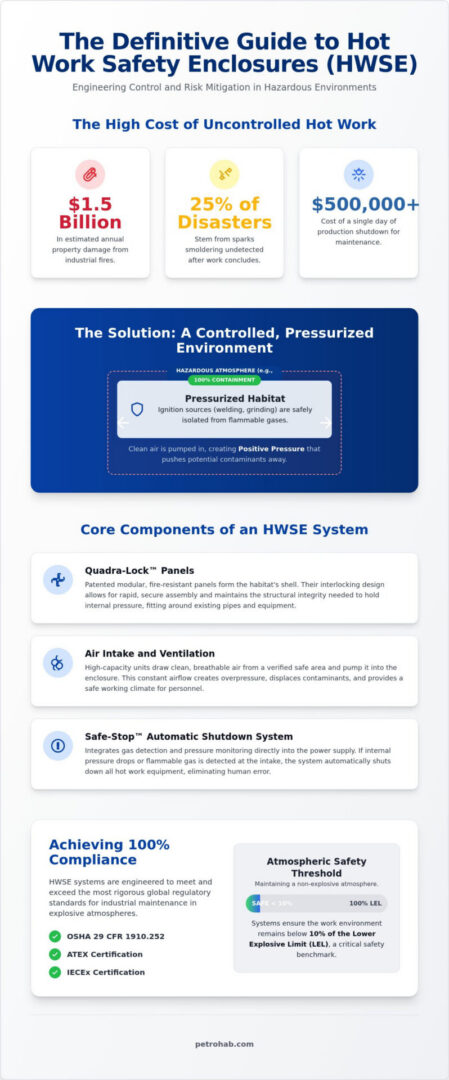
Industrial fires result in an estimated $1.5 billion in property damage annually, and 25 percent of these disasters stem from sparks that smolder undetected for hours after work concludes. For safety managers, these figures represent a constant struggle between maintaining production and preventing a catastrophic ignition event. You understand that a single day of shutdown can cost upwards of $500,000, yet performing maintenance without a certified Hot Work Safety Enclosure in a Zone 1 or Zone 2 hazardous area is an unacceptable risk.
This guide explains how these pressurized systems function as a definitive technological remedy to this dilemma. By creating a controlled, ignition-free environment, a Hot Work Safety Enclosure protects personnel and multi-million dollar assets while allowing live-site productivity to continue. You’ll discover the engineering behind modular Quadra-Lock panels and the Safe-Stop Automatic Shutdown System. We’ll also analyze the current 2026 regulatory landscape, including OSHA 29 CFR 1910.252 and atmospheric testing thresholds below 10% of the Lower Explosive Limit. This comprehensive overview provides the technical data needed to achieve 100% compliance and absolute operational control in explosive atmospheres.
Key Takeaways
- Understand how a Hot Work Safety Enclosure provides a modular, fire-resistant habitat to isolate ignition sources in hazardous zones.
- Learn the mechanics of positive pressure and how Quadra-Lock technology ensures structural integrity in high-pressure environments.
- Identify the critical ATEX and IECEx certifications required to validate safety and meet global regulatory standards for industrial maintenance.
- Discover how implementing pressurized habitats enables live welding on offshore platforms and during refinery turnarounds without costly production shutdowns.
- Evaluate the financial and technical factors involved in selecting between rental and purchase models for PetroHab HWSE systems.
Defining the Hot Work Safety Enclosure (HWSE)
A Hot Work Safety Enclosure is a modular, fire-resistant structure engineered to isolate ignition sources in hazardous industrial zones. It functions by creating a specialized “habitat” where welding, grinding, and cutting occur safely. The system’s primary role is to prevent sparks, slag, or heat from contacting flammable gases that may be present in the surrounding atmosphere. By establishing a localized environment of positive pressure, the enclosure ensures that no external gases can enter the workspace. This creates a definitive barrier between the ignition source and the explosive atmosphere, allowing for operational continuity in high-stakes environments like offshore platforms and refineries.
The Evolution of Pressurized Welding Habitats
Safety protocols have transitioned from passive administrative controls to active engineered solutions. In the past, facilities relied on basic fire-retardant tarps that provided limited protection against gas ingress. The modern Petro-Habitat represents a significant advancement in this field. These high-tech enclosures are designed to meet rigorous 2026 safety benchmarks, incorporating materials and sensors that weren’t available a decade ago. This evolution reflects an industry-wide shift toward total risk mitigation. By moving away from temporary fixes and toward permanent safety engineering, operators can now perform critical maintenance without the need for costly facility-wide shutdowns.
Core Components of an HWSE System
The effectiveness of a Hot Work Safety Enclosure relies on the synergy between its structural elements and its automated monitoring systems. Each component is a calculated remedy for a specific industrial hazard.
- Quadra-Lock Panels: These modular, fire-resistant panels form the habitat’s shell. Their patented design allows for rapid assembly while maintaining the structural integrity needed to hold internal pressure. The modular nature of these panels means they can be configured to fit around existing piping and equipment.
- Air Intake and Ventilation: To maintain positive pressure, the system utilizes air intake units and flexible ducting. These components draw clean, breathable air from a verified safe zone and pump it into the enclosure. This constant airflow displaces any potential contaminants and provides a safe working climate for personnel.
- Safe-Stop Automatic Shutdown System: This is the hardware signature of a modern HWSE. It integrates gas detection and pressure monitoring directly into the power supply. If internal pressure drops or flammable gas is detected at the intake, the system automatically shuts down all hot work equipment. This removes the risk of human error and ensures that the enclosure remains a safe zone at all times.
The Science of Containment: Positive Pressure and Quadra-Lock Panels
Positive pressure is the cornerstone of hazardous area isolation. It creates a physical barrier using air density rather than relying solely on material thickness. By maintaining a constant differential pressure, the system prevents the ingress of hydrocarbons into the workspace. This ensures that even if a gas leak occurs in the surrounding facility, the flammable vapors cannot penetrate the enclosure’s perimeter. This principle of physics transforms a standard workspace into a controlled environment where ignition sources are safely contained.
How Positive Pressure Habitats Ensure Worker Safety
The physics of air pressure dictate that fluids and gases move from areas of high pressure to low pressure. Within a habitat, high-capacity air intake units pump clean, breathable air into the structure to create an overpressure environment. Safety engineers monitor these pressure differentials using calibrated manometers and digital sensors to verify that the habitat remains “sweet” relative to the “sour” external atmosphere. You can learn more about how Positive Pressure Habitats Ensure Worker Safety by reviewing the technical specifications of these containment systems. This constant monitoring is vital because any drop in pressure could allow explosive gases to seep in, compromising the entire work site.
Engineering Superiority with Quadra-Lock Technology
Structural integrity is the second pillar of reliable containment. While traditional systems often rely on velcro or zipper attachments, these methods introduce significant weak points and potential leak paths. Quadra-Lock technology provides the structural integrity needed for high-pressure environments by utilizing a patented mechanical interlocking system. This design eliminates gaps where pressure could escape or gases could enter. Specifically, Quadra-Lock panels prevent chimney effects in habitats by ensuring a tight, seamless seal that stops vertical drafts from pulling external air through the base of the structure.
The durability of the materials used in these patented panels is engineered for the high-stakes environment of heavy industry. They are designed to withstand the rigors of daily use in offshore and onshore facilities while maintaining the necessary seal for pressurization. For engineers seeking to eliminate the vulnerabilities of traditional systems, integrating Quadra-Lock Panels into your safety protocol is a definitive technological remedy. This modular approach allows for rapid assembly without sacrificing the uncompromising safety standards required in 2026.
- Differential Pressure: Maintains a higher internal pressure to repel external gases.
- Mechanical Interlocking: Replaces inferior velcro with high-strength Quadra-Lock seals.
- Automated Monitoring: Links pressure sensors directly to the Safe-Stop system for immediate response.
Regulatory Compliance: Meeting ATEX, IECEx, and OSHA Standards
Compliance with international standards is non-negotiable for industrial hot work. In the high-stakes environment of energy production, adherence to regulatory frameworks isn’t a suggestion; it’s a legal and moral mandate. ATEX and IECEx certifications validate the safety of electrical components within explosive atmospheres, ensuring that hardware like gas detectors and shutdown systems don’t become ignition sources themselves. Beyond electrical safety, OSHA 29 CFR 1910.252 and NFPA 51B guidelines dictate the operational requirements for fire prevention. These standards require rigorous risk mitigation, such as the 35-foot rule for combustible materials. To maintain safety, a certified Hot Work Safety Enclosure must be audited regularly to verify that every panel and sensor performs to the original engineered specification.
Navigating Hazardous Environment Standards
Engineers must distinguish between Zone 1 and Zone 2 classifications to deploy the correct safety remedy. Zone 1 defines areas where an explosive atmosphere is likely to occur during normal operations. Zone 2 covers areas where such an atmosphere is unlikely or infrequent. A Hot Work Safety Enclosure allows for Safe Work in these otherwise restricted areas by isolating the ignition source from the surrounding environment. For a deeper analysis of these requirements, safety managers should consult the 2026 Guide to Global Compliance. This documentation serves as a linguistic anchor for quality, ensuring every deployment meets the most recent international benchmarks.
The Role of HWSE in the Permit-to-Work (PTW) System
Integrating habitat deployment into the standard Permit-to-Work (PTW) workflow is essential for operational excellence. The permit process must document specific hazards, required precautions, and authorized personnel for the task. It’s vital that all fire watch personnel receive training on habitat-specific protocols, including the mandatory 30-minute monitoring period after work concludes. Documentation and logging requirements for pressurized work environments are extensive. Operators must record pressure levels and gas detector readings to prove the enclosure maintained its integrity throughout the operation. This methodical approach provides a clear audit trail for regulatory bodies, confirming that risk was managed with technical precision.
Strategic Applications: Offshore Platforms and Refinery Turnarounds
The strategic deployment of a Hot Work Safety Enclosure is a critical factor in maintaining operational continuity during essential maintenance. In the energy sector, the ability to perform live welding on offshore platforms eliminates the need for total facility shutdowns, which can otherwise result in millions of dollars in lost production. Similarly, refinery turnarounds utilize these systems to isolate ignition sources, allowing technicians to perform repairs while adjacent process units remain fully active. The modular design of these enclosures is specifically engineered to accommodate custom configurations around complex piping, valves, and structural beams that are common in industrial sites. Integrating a Hot Work Safety Enclosure into a refinery turnaround schedule delivers immediate ROI by preventing the massive costs associated with de-energizing entire units for minor hot work tasks.
Offshore Welding Habitat Success Factors
Working in maritime environments presents unique challenges that require a robust technological remedy. High-wind conditions and corrosive salt-spray can compromise inferior containment systems, making the durability of the enclosure materials a primary safety concern. Space optimization is equally vital; modular habitats must fit into tight platform footprints without obstructing emergency egress routes or essential operations. For detailed engineering data on these systems, review our guide to Pressurized Welding Habitats. These specialized units are designed to maintain internal pressure even when subjected to the turbulent conditions of the open sea.
Onshore Industrial and Refinery Maintenance
Onshore facilities face the risk of catastrophic ignition when emergency repairs are required near live hydrocarbon streams. A pressurized habitat minimizes the “hot work zone” to a manageable, isolated area, protecting high-value assets from accidental fire or explosion. During a turnaround, the speed of deployment and breakdown is paramount to staying on schedule. Systems that feature rapid assembly components, such as Quadra-Lock panels, allow maintenance teams to move from one task to the next without the delays associated with traditional scaffolding and tarping. This efficiency ensures that critical path items are completed on time while maintaining an unwavering commitment to safety. To secure your facility during the next maintenance cycle, contact PetroHab for deployment specifications tailored to your site’s unique layout.
Procurement and Implementation of PetroHab HWSE Systems
Procuring a Hot Work Safety Enclosure is a decision that carries significant weight for site safety and operational continuity. Precision is mandatory. Selecting a supplier with operations in the US, UK, and Brazil ensures that technical support is available regardless of the facility’s location. Engineers must evaluate suppliers based on their technical certifications and their ability to provide engineering support for complex configurations. Establishing a relationship with a dedicated safety partner like PetroHab ensures long-term compliance with evolving 2026 standards. This collaborative approach transforms a simple equipment purchase into a comprehensive risk mitigation strategy.
Choosing the Right Hot Work Safety Enclosure Suppliers
Technical capability is the primary benchmark when vetting providers. A supplier’s track record in high-stakes environments like offshore platforms provides the necessary confidence for safety managers. You should prioritize suppliers that offer on-site supervision and rigorous technician training during the initial setup. This ensures that the habitat is assembled correctly and that the crew understands the operational parameters of the pressurized environment. For a detailed breakdown of selection criteria, consult the PetroHab Procurement Guide. This resource outlines the essential engineering support required for successful deployment.
The financial model for implementation typically falls into two categories: rental or purchase. Rental models are often ideal for short-term refinery turnarounds where specific maintenance windows are defined. Purchasing a Hot Work Safety Enclosure is a strategic move for facilities with high-frequency maintenance requirements. This model allows for immediate deployment by internal teams who’ve been trained in the system’s modular assembly. Both options provide a definitive technological remedy to the high costs of production shutdowns.
Integrating the Safe-Stop Automatic Shutdown System
The Safe-Stop Automatic Shutdown System is the central nervous system of a modern HWSE implementation. It doesn’t just monitor gas levels; it actively protects the site by triggering immediate power isolation if hazardous conditions arise. This system monitors internal pressure and external gas concentrations, ensuring that hot work equipment only functions when the environment is verified as safe. There’s a clear synergy between the structural integrity of Quadra-Lock panels and this automated hardware. While the panels provide the physical barrier, the Safe-Stop system provides the fail-safe logic needed for high-pressure scenarios. This integration removes the variable of human error from the safety equation, maintaining an uncompromising standard of protection for both personnel and multi-million dollar assets.
Securing the Future of Industrial Hot Work
Maintaining operational continuity in hazardous environments requires moving beyond basic administrative permits. The adoption of a Hot Work Safety Enclosure represents a transition to engineered safety excellence. By utilizing positive pressure and mechanical interlocking systems, operators can effectively isolate ignition sources from explosive atmospheres. This approach ensures that critical maintenance doesn’t necessitate costly production shutdowns. You’ve seen how modular containment and automated monitoring create a definitive barrier against catastrophic risk.
The integration of patented Quadra-Lock integrity and global ATEX/IECEx compliance establishes a new benchmark for risk mitigation. These technologies, combined with proven offshore reliability, provide the technical remedy needed to protect both personnel and multi-million dollar assets. Every deployment is a calculated step toward eliminating workplace accidents in high-stakes industrial zones. It’s about more than just equipment; it’s about a rigorous commitment to safety and precision.
To implement these industry leading standards at your facility, Request a Quote for PetroHab HWSE Solutions. We remain your dedicated partner in achieving absolute safety and operational excellence. Your commitment to safety is the foundation of a resilient and productive worksite.
Frequently Asked Questions
What is the difference between a welding habitat and an HWSE?
They’re largely synonymous, but “Hot Work Safety Enclosure” is the technically precise term for a pressurized, fire-resistant habitat. While “welding habitat” is a common industry term, HWSE highlights the broader application of containing any ignition source, including grinding or cutting. Modern HWSE systems incorporate advanced modularity and automated safety logic that exceeds the capabilities of basic, traditional habitats.
How does positive pressure prevent explosions during hot work?
Positive pressure creates a physical barrier by maintaining internal air density higher than the surrounding atmosphere. This overpressure ensures that air only moves outward through any potential gaps, effectively repelling flammable hydrocarbons or explosive gases. By keeping the external environment “sour” and the internal workspace “sweet”, the system prevents hazardous vapors from reaching the ignition source.
What are the ATEX requirements for hot work safety enclosures?
ATEX requirements mandate that all electrical components used within or near the enclosure are certified for use in explosive atmospheres. This includes gas detectors, lighting, and the automatic shutdown hardware. Compliance ensures that the safety equipment itself doesn’t become a source of ignition. Every Hot Work Safety Enclosure must undergo rigorous testing to meet these European Union safety directives for Zone 1 and Zone 2 environments.
Can HWSE be used on live offshore oil platforms?
Yes, HWSE systems are specifically engineered for use on live offshore platforms to enable maintenance without production shutdowns. These enclosures protect personnel and high-value assets from the risks associated with welding near active hydrocarbon streams. Their modular design allows them to fit within restricted platform footprints while withstanding harsh maritime conditions, including high winds and salt spray.
What is Quadra-Lock technology and why is it used in habitats?
Quadra-Lock is a patented mechanical interlocking system used to join modular fire-resistant panels. It provides superior structural integrity compared to traditional velcro or zipper systems, which often introduce leak paths. By creating a seamless, high-strength seal, Quadra-Lock technology ensures the habitat maintains the necessary internal pressure and prevents chimney effects that could pull external gases into the workspace.
How does the Safe-Stop automatic shutdown system work?
The Safe-Stop system functions as an automated safety watchdog for the Hot Work Safety Enclosure by monitoring gas levels and internal pressure in real-time. If the system detects flammable gas at the air intake or a loss of positive pressure, it immediately de-energizes all hot work equipment. This rapid power isolation removes the ignition source before a hazardous atmosphere can penetrate the workspace.
Is it more cost-effective to rent or buy an HWSE?
The choice depends on the frequency and duration of your maintenance cycles. Renting is typically more cost-effective for short-term projects or annual refinery turnarounds where equipment is only needed for a few weeks. Conversely, purchasing a system is a strategic investment for facilities with continuous maintenance requirements, as it allows for immediate deployment by internally trained teams without recurring rental fees.
What training is required for personnel working inside a pressurized habitat?
Personnel must receive specialized training covering habitat assembly, pressure monitoring, and emergency response protocols. This includes understanding how to interpret manometer readings and the function of the Safe-Stop system. Training ensures that every worker can maintain the enclosure’s integrity and respond correctly if the automatic shutdown is triggered, which is essential for meeting 2026 safety benchmarks.