Blog Posts
Welding Habitat Specifications for Hazardous Oil and Gas Sites
A welding habitat’s enclosure is only one part of its specification. For a pressurized habitat, maintain minimum positive pressure of 0.1 inch of water inside the enclosure. Effective welding habitat specifications also address airflow, gas monitoring, enclosure integrity, and controls that respond to hazardous conditions.
A welding habitat cannot be assessed by its panels alone. The work area, hazard zone, ventilation requirements, and pressure controls all affect how the enclosure should be configured and operated.
This guide covers the key requirements to consider, from installation preparation and ventilation to sealing, access, and operating pressure. It explains how these elements work together to support hot-work controls at hazardous oil and gas sites.
Key Takeaways
- Plan installation around enclosure size, site preparation, and competent installation. The European Union’s ATEX Directive 2014/34/EU requires equipment to have a proper manufacturer’s EU Declaration of Conformity.
- Set ventilation to remove fumes, sustain continuous airflow, and limit gas accumulation; airflow requirements depend on the work conditions.
- Ensure fabric panels fully cover the frame, with edges secured and no gaps, then assess enclosure integrity and ventilation before welding.
- Maintain positive pressure above atmospheric pressure, with the specified minimum inside the habitat set at 0.1 inch of water.
Installation time and labor requirements
Installation duration is the time required to assemble and prepare a habitat for hot work. A small system takes 2-4 hours, a medium system takes 1 day, and a large offshore system takes 2-3 days. Before installation, remove flammable materials, clean the work surface, and make enough room for the enclosure.
ATEX documentation records equipment conformity for the European market. The ATEX Directive 2014/34/EU requires equipment to have a proper manufacturer’s EU Declaration of Conformity, according to the European Union. For U.S. projects, establish requirements from applicable site hot-work controls and hazardous-area classification; an EU declaration does not replace U.S. requirements.
Installer competence means having documented capability to construct a habitat. A competent habitat installer should manage construction. Until a competence norm is in place, each supplier must set and document its internal competence requirements for operator approval.
For welding habitat specifications in the United States, start with the site’s governing hot-work controls and hazardous-area classification. These determine which equipment documentation and operating controls apply to the environment.
Fire-resistant panels form the habitat walls and roof, enclosing the hot-work area. Choose an enclosure configuration suited to the work and site hazards. There is no universal wall or roof rating for every application.
Gas and oxygen monitoring detects changes that can affect hot-work controls. A Zone 1 arrangement monitors oxygen, hydrogen sulfide, and methane in the airflow and habitat, alongside differential pressure.
Electrical, lighting, and grounding specifications must suit the equipment and hazardous-area classification. Before bringing the system into service, coordinate these components with the site’s electrical controls and equipment documentation.
Offshore and confined-space installation depends on access, work area, and enclosure size. A large offshore habitat takes 2-3 days to install; prepare the surface and clear space before construction begins.
Habitat dimensions and clearance determine the space needed for the enclosure and planned work. Confirm that the work surface is clean and that the installation area has enough room for the frame and access.
Before welding, inspect the enclosure’s integrity and ventilation performance. Remove flammable materials, clean the work surface, secure the installation area, and assess the enclosure and airflow before work begins.
Airflow direction and ventilation rate
Airflow direction describes how clean supply air moves through a habitat. Ventilation rate describes how much air moves through the enclosure or how often it is replaced. Together, these controls help remove fumes, maintain air quality, sustain continuous airflow, and prevent gas accumulation during hot work.
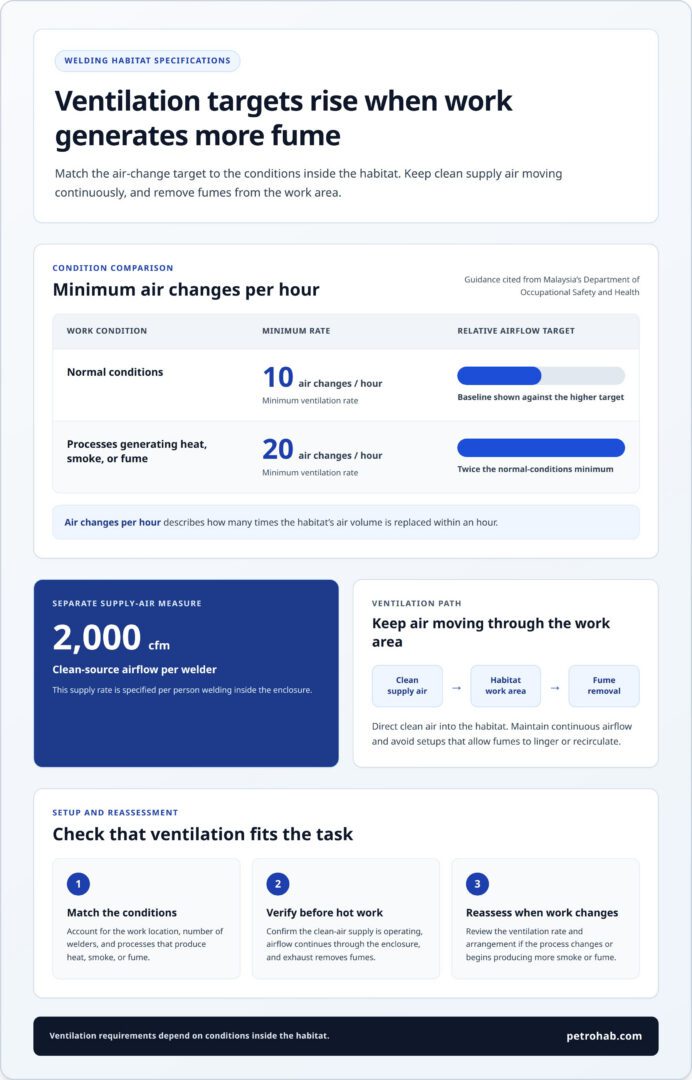
Ventilation requirements change with the work environment. Malaysia’s Department of Occupational Safety and Health considers ventilation adequate at a minimum of 10 air changes per hour under normal conditions. When processes generate heat, smoke, or fume, its minimum is twenty air changes per hour. These rates distinguish routine conditions from work that produces additional airborne contaminants.
Air changes per hour describe how many times the habitat’s air volume is replaced within an hour. A separate airflow measure is also specified: 2,000 cubic feet per minute from a clean source per welder. This per-welder rate ties required supply airflow to the number of people welding inside the enclosure.
Direct clean supply air into the habitat and maintain a continuous path that carries contaminants away from the work area. Avoid setups that interrupt airflow or let fumes linger around the welder. Ventilation design should account for the work location, fume-producing processes, and number of welders.
Assess ventilation as part of habitat setup, before hot work begins. Confirm that the clean-air supply is operating, airflow continues through the enclosure, and exhaust removes fumes rather than recirculating them. Reassess when the process changes, such as when a task starts producing more smoke or fume. The ventilation rate and airflow arrangement must suit conditions inside the habitat, not just its dimensions.
Enclosure sealing and access points
An enclosure seal is the secured boundary that limits openings around habitat panels. Panels should fully cover the frame, with edges tightly secured and no gaps or loose areas. Inspect seams, corners, and panel connections, where movement can create openings. Check doors, cable passages, and ventilation interfaces closely. Even a correctly positioned panel can leave a gap if its edge shifts during setup or work.
Access points are openings for workers, equipment, or services to enter or pass through the habitat. Keep each entry clear, operable, and compatible with the enclosure’s sealed configuration. Route cables and service lines without pulling panels away from the frame. After anything passes through, inspect the affected edge and restore the panel seal. This helps preserve enclosure integrity while keeping access practical.
Fire-prevention controls reduce the chance that hot-work sparks or heat will ignite nearby materials. Before welding, clear flammable materials from the work area and inspect the enclosure for damage, loose panels, or openings. Follow the site hot-work permit and emergency plan for fire-watch arrangements and emergency egress. Keep exits accessible, and ensure the response plan accounts for the habitat’s entrances and surrounding work area.
A pre-weld inspection assesses enclosure integrity, ventilation performance, and compliance with applicable safety standards. Check panel coverage, secured edges, access points, and connection condition. Confirm that ventilation works as intended and does not leave gaps around panel interfaces. Record and correct defects before hot work begins. Repeat the inspection if access, panel position, or site conditions change during the task.
During operation, watch for displaced fabric, damaged edges, or blocked access. If a condition compromises the enclosure boundary or obstructs exit routes, stop and address it according to site procedures. When the task is complete, inspect the habitat and surrounding area for damage or residual ignition hazards. These checks coordinate enclosure sealing, worker access, fire prevention, and emergency egress.
Operating pressure above atmospheric pressure
Positive pressure means habitat air pressure exceeds the surrounding atmospheric pressure. IEC60079-13 covers pressurized habitats, which the International Electrotechnical Commission calls pressurized rooms. The pressure difference helps maintain the intended separation between the enclosure interior and the surrounding environment.
The specified minimum positive pressure inside a habitat enclosure is 0.1 inch of water. A typical positive-pressure isolation chamber operates approximately 0.05 kilopascals above local atmospheric pressure. These figures use different units and describe separate specifications; don’t treat them as interchangeable targets.
Differential pressure is the measured difference between pressure inside the habitat and pressure outside it. Monitoring this difference shows whether the enclosure is maintaining its intended pressure relationship. A changing reading can indicate a pressure-control issue or a change in enclosure conditions, such as an access point left open.
During setup, measure pressure across the habitat boundary and confirm that the monitoring system reads the interior-to-exterior differential. Monitor pressure throughout hot work. If a reading falls below the project’s required operating point, follow the site’s response procedure before continuing. An initial reading alone does not confirm conditions for the full task.
Changes to access can affect pressure balance. Opening an entry, shifting a panel, or changing the enclosure configuration can alter the pressure relationship. After a change, restore the enclosure arrangement and reassess the differential before resuming work. Consider the pressure target alongside ventilation and enclosure integrity, since each affects the operating environment.
For hazardous-area applications, IEC60079-13 provides the named standard relevant to pressurized habitats. The required operating point and monitoring response depend on the habitat design and site controls. Clear operating criteria help personnel recognize when pressure conditions have changed and act according to established procedures.
Discuss welding habitat specifications and pressure requirements with PetroHab LLC for your hot-work environment.
For hazardous-area applications, IEC 60079-13 is the named standard relevant to pressurized habitats, which the IEC calls pressurized rooms.
PetroHab: Pressurized welding enclosures
PetroHab provides pressurized welding enclosures for hot work in hazardous oil and gas environments. After defining the required airflow, enclosure integrity, and pressure controls, consider a PetroHab Hot Work Safety Enclosure (HWSE) as an integrated habitat option.
PetroHab’s Safe-Stop Safety Shutdown System monitors differential pressure and gas levels. Quadra-Lock® panels join without zippers and form part of PetroHab’s habitat configurations. These components address key aspects of the enclosure system, while project requirements guide the configuration.
Contact PetroHab to discuss pressurized welding enclosures for your work environment.
Make the Next Step Project-Specific
Use welding habitat specifications as the starting point for a project-specific execution plan. Align the habitat configuration with the work scope, hazardous-area classification, site layout, and operating procedures. This gives engineering, safety, and field teams a shared basis for planning before setup begins. It also helps identify where project conditions call for coordination between the enclosure, surrounding operations, and hot-work controls.
Keep the decision process practical: define the work environment, document operating criteria, and coordinate responsibilities among the teams involved. Clear requirements help align equipment selection and field execution as conditions change. PetroHab manufactures, leases, and sells pressurized hot-work safety enclosures for hazardous environments, supporting projects where the habitat must work alongside site safety controls.
Contact PetroHab to discuss your habitat requirements and take the next planning step with a clear project basis.
Frequently Asked Questions
What is a welding habitat, and when is one required?
A welding habitat is a fire-resistant enclosure used to isolate hot work in hazardous environments. It helps contain sparks and heat where they could create fire or explosion risks. A habitat may be needed when site hot-work controls call for containment around welding, grinding, or cutting. For example, a maintenance weld near process equipment may need a different setup from work in an open, non-hazardous area.
What ventilation and air-quality requirements apply inside a welding habitat?
Ventilation must manage fumes and maintain air quality during work. The required arrangement depends on the process, the contaminants it generates, and the habitat’s operating controls. Gas and pressure monitoring can also support hazard response. PetroHab’s Safe-Stop system monitors differential pressure and gas levels, and can be equipped with oxygen and/or carbon-dioxide detectors. Configure monitoring to reflect the hazards identified for the specific work environment.
How do welding habitat specifications differ by industry, project, or jurisdiction?
Requirements vary by work scope, hazardous-area classification, and the jurisdiction governing the site. A refinery task and an offshore repair may have different access, environmental, and operational constraints, so one configuration may not suit both. Align equipment documentation and operating controls with the location and work scope. For international projects, applicable certification frameworks may also vary between jurisdictions.
What materials and fire-resistant ratings are required for welding habitat walls and roofs?
Fire-resistant panels should form the walls and roof, fully cover the frame, and have tightly secured edges without gaps or loose areas. Choose an enclosure configuration suited to the work and site hazards; there is no universal wall or roof rating.
What shielding-gas and oxygen-monitoring requirements apply to welding habitats?
For a Zone 1 arrangement, monitor oxygen, hydrogen sulfide, and methane in the airflow and inside the habitat, alongside differential pressure.