Blog Posts
Getting Budget Approval for Safety Equipment: The 2026 Strategic Guide for HSE Managers
In 2026, a single willful OSHA violation can cost your organization up to $165,514, yet many executive boards still view high-integrity hot work protection as a discretionary expense. You know that getting budget approval for safety equipment requires more than just technical data; it demands a rigorous business case that highlights risk mitigation and asset protection. It’s frustrating when management prioritizes short term savings over the technical precision of a pressurized welding habitat, often pushing for cheaper, less effective fire blankets that fail to meet modern safety benchmarks.
This strategic guide provides the framework to translate the engineering advantages of Quadra-Lock panels and Safe-Stop technology into a compelling financial narrative that secures executive buy-in. We’ll outline the exact methods to quantify the ROI of a PetroHab Hot Work Safety Enclosure, demonstrating how every dollar invested in safety can save up to six dollars in avoided costs. By aligning safety excellence with fiscal responsibility, you can protect your personnel and your bottom line simultaneously.
Key Takeaways
- Apply the ‘Cost of Incident’ formula to quantify the financial impact of avoided downtime and asset protection during refinery turnarounds.
- Master a structured framework for getting budget approval for safety equipment by aligning technical requirements with 2026 fiscal priorities.
- Dismantle the ‘good enough’ fallacy by identifying the operational risks of using traditional fire blankets in pressurized hazardous zones.
- Leverage the engineering advantages of Quadra-Lock panels to demonstrate how modular safety systems reduce shipping costs and setup time.
- Position hot work safety enclosures as essential profit protection tools rather than discretionary operational expenses to secure executive buy-in.
The Financial Reality of Safety Budget Approval in 2026
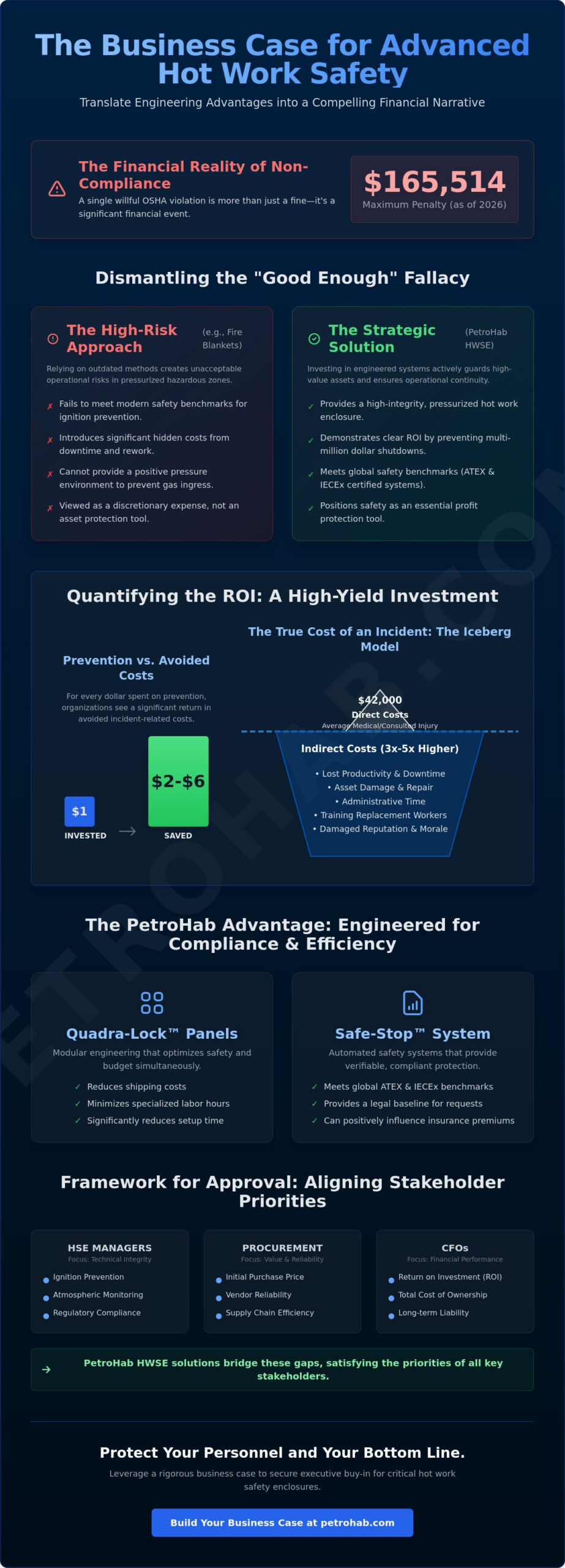
Securing safety budget approval in 2026 requires a departure from traditional procurement methods. In high-hazard industrial sectors, this process is no longer just about purchasing gear; it’s about validating the technical integrity of life-critical systems. Fiscal cycles are tighter now. CFOs require empirical evidence that every dollar protects an asset or prevents a catastrophic shutdown. This shift requires a move from compliance-only spending to risk-mitigation investment. You aren’t just meeting a minimum standard. You’re actively guarding high-value assets against failure.
The stakeholder map has evolved. Success requires addressing the specific priorities of three primary groups:
- HSE Managers: Focus on technical integrity, ignition prevention, and atmospheric monitoring.
- Procurement: Prioritizes initial purchase price and vendor reliability.
- CFOs: Look at long-term liability, ROI, and the total cost of ownership.
Bridging these gaps is the only way of getting budget approval for safety equipment when competing against other capital projects.
To better understand the financial dynamics of industrial safety, watch this evaluation of safety budgeting:
Moving Beyond the ‘Cost Center’ Stigma
Safety isn’t a drain on resources. It’s a guardian of productivity. The total cost of workplace injuries in the U.S. reached $167 billion according to recent safety data. For every $1 spent on prevention, organizations typically see a return of $2 to $6 in avoided costs. When you frame a PetroHab Hot Work Safety Enclosure (HWSE) as a tool for operational continuity, the conversation changes. It’s no longer a discretionary expense. It becomes a critical infrastructure component that prevents multi-million dollar refinery shutdowns. Using historical data to show the rising cost of non-compliance proves that the cheapest option is often the most expensive in the long run.
Regulatory Mandates as Budget Drivers
Compliance isn’t optional. As of January 15, 2026, willful OSHA violations carry penalties up to $165,514 per violation. This figure doesn’t include the indirect costs of an incident, which are often three to five times higher than direct medical expenses. Using Occupational safety and health standards like NFPA 51B provides a legal baseline for your request. Beyond basic compliance, ATEX and IECEx certifications for equipment like the Safe-Stop system can influence insurance premiums. These technical anchors prove that your chosen solution meets global safety benchmarks. Integrating these requirements into the Permit-to-Work (PTW) system ensures that safety remains a non-negotiable line item in every turnaround budget.
Quantifying the ROI: The Business Case for HWSE
Securing executive buy-in requires a shift from emotional safety appeals to rigorous financial modeling. The most effective framework for getting budget approval for safety equipment is the ‘Cost of Incident’ versus ‘Cost of Prevention’ formula. While the average medically consulted workplace injury costs $42,000, the indirect costs typically amplify this figure by three to five times. These indirect expenses include administrative time, training replacement workers, and lost productivity. By demonstrating the positive Return-on-Investment (ROI) through these metrics, HSE managers can present safety as a high-yield investment rather than an operational burden.
Risk must be quantified. Modular engineering plays a critical role in this business case because traditional containment methods often require extensive custom fabrication and long assembly times. In contrast, Quadra-Lock panels utilize a standardized interlocking design that significantly reduces specialized labor hours. This efficiency minimizes the footprint of safety personnel during critical turnaround windows. When labor costs are optimized, the total cost of ownership for a PetroHab Hot Work Safety Enclosure (HWSE) becomes a clear advantage for procurement departments focused on budget efficiency. You can review the technical specifications of these modular systems to assist in your procurement documentation.
The Cost of a Single Day of Downtime
Production continuity is the primary driver for executive decision makers. In offshore environments, the financial impact of a full facility shutdown is staggering, often reaching millions of dollars in lost revenue per day. Pressurized habitats allow welding and grinding to proceed in close proximity to live hydrocarbon lines without requiring a total plant blow-down. This capability transforms the HWSE from a safety tool into a production-enabling asset. The daily rental and operation of a PetroHab HWSE is a minor fraction of the hourly revenue loss incurred during a platform flare-tip shutdown.
Insurance and Liability Mitigation
Liability management is a core component of the corporate financial strategy. Deploying certified hot work safety systems allows the organization to maintain a defensible position against claims of gross negligence. This technical due diligence is often reflected in lower corporate insurance deductibles and improved liability profiles. The durability of high-quality, fire-resistant materials used in Petro-Habitats ensures that the equipment maintains its integrity over multiple deployments. This longevity provides long-term savings by reducing the frequency of equipment replacement and ensuring consistent protection of personnel and high-value assets.
Overcoming Management Objections: The ‘Good Enough’ Fallacy
Management often relies on the “we’ve always done it this way” defense to justify stagnant safety budgets. It’s a dangerous bias. In high-hazard industrial environments, legacy methods like basic fire blankets are insufficient for Zone 1 and 2 risks. These barriers don’t account for the volatile nature of 2026 operational environments. Successfully getting budget approval for safety equipment requires dismantling the ‘good enough’ fallacy by highlighting the technical gaps in traditional containment. You must demonstrate that what worked a decade ago is now a liability.
The myth that safety slows down production is another hurdle. In reality, high-integrity systems protect the production schedule. When a habitat fails or an ignition event occurs, the resulting shutdown is catastrophic for the bottom line. High-integrity systems like the PetroHab Hot Work Safety Enclosure (HWSE) allow operations to continue safely. They ensure that technical compliance and productivity exist in tandem. You aren’t just buying gear; you’re buying the certainty that work won’t be interrupted by an avoidable incident.
Technical Integrity vs. Basic Barriers
Positive pressure functions as a relentless physical force. It pushes clean air out, preventing hazardous gases from entering the workspace where ignition sources are present. Traditional fire blankets offer localized spark protection but fail to address the fundamental risk of gas ingress. Quadra-Lock technology is a prerequisite for high-stakes welding because it provides a 100% seal that lower-cost alternatives cannot match. In offshore wind or volatile gas zones, cheap barriers often sag, leak, or fail under pressure. These failure points compromise the entire site. Using proprietary Quadra-Lock panels ensures the structural integrity of the pressurized habitat remains absolute.
Risk Transfer and Executive Responsibility
Choosing superior equipment transfers risk from the individual worker to the engineered system. The Safe-Stop Automatic Shutdown System removes human error from the equation by monitoring the environment constantly. It’s a definitive technological remedy for a logical problem. If gas is detected or pressure is lost, the system acts instantly. Beyond the technical benefits, providing the industry benchmark in protection significantly improves worker retention. Personnel feel valued when they see the brand’s commitment to safety excellence through the deployment of Petro-Habitats. This investment is an investment in human capital and long-term operational stability.
Building the Pitch Deck: A Step-by-Step Approval Framework
Transforming technical safety requirements into a boardroom-ready presentation is a critical skill for the modern HSE manager. Executive leaders often prioritize data over intuition. Therefore, getting budget approval for safety equipment requires a methodical approach that highlights risk mitigation and operational continuity. Your pitch deck should serve as a logical roadmap that leads the CFO to a single, inevitable conclusion: high-integrity protection is a financial necessity.
Follow this five-step framework to structure your request:
- Step 1: Identify the High-Consequence Risk. Clearly define the hazard, such as ignition in a pressurized hydrocarbon zone, and the potential for catastrophic asset loss.
- Step 2: Present the Technological Remedy. Introduce the PetroHab HWSE. Highlight its technical certifications and the role of the Safe-Stop Automatic Shutdown System in removing human error.
- Step 3: Quantify the Financial Delta. Contrast the cost of the proposed investment against the cost of inaction. Use the ‘Cost of Incident’ formula to show the potential for $165,514 in daily OSHA penalties and millions in lost production.
- Step 4: Demonstrate Financial Flexibility. Outline the advantages of modularity. Explain how Quadra-Lock panels allow for scalable configurations that fit specific site needs without over-purchasing.
- Step 5: Define the Implementation Timeline. Provide a structured plan for deployment and personnel training to show that the system will be operational without delaying the project schedule.
The Power of Visual Evidence and Case Studies
Technical data is more persuasive when paired with visual proof of performance. Use thermal imaging to show how the pressurized habitat maintains a thermal barrier against external ignition sources. You can find documented evidence of successful deployments in these offshore welding safety case studies, which provide the real-world validation executives require. A visual ‘Permit-to-Work’ map justifies habitat placement by overlaying the enclosure’s footprint directly onto identified high-risk zones. This clarity reduces friction during the review process. You can contact our technical team to secure specific data sheets for your presentation.
Leasing as a Strategic Financial Move
Leasing equipment often provides a faster path to approval by moving the expense from Capital Expenditure (CAPEX) to Operational Expenditure (OPEX). This shift bypasses the rigid cycles associated with major asset purchases. On-demand safety means paying only for the duration of the hot work, which optimizes the project budget. The PetroHab rental model also eliminates the long-term burden of storage and maintenance costs. These responsibilities remain with the provider, ensuring that every enclosure deployed is inspected, certified, and ready for immediate service in hazardous environments.
PetroHab Solutions: Engineering Compliance and Budget Efficiency
PetroHab addresses the core friction in getting budget approval for safety equipment by merging technical excellence with logistical efficiency. The modular design of our systems minimizes shipping volumes and simplifies on-site assembly. This reduction in footprint directly lowers the operational costs associated with mobilization and demobilization. It’s a pragmatic solution for sites with limited deck space or complex structural layouts. By reducing the number of shipping containers required for a project, we help HSE managers present a leaner, more efficient budget to procurement departments without sacrificing the technical integrity of the habitat.
Technical anchors like the Safe-Stop automatic shutdown system provide the multi-layered protection that modern safety protocols demand. This system doesn’t just monitor; it actively controls the environment by isolating ignition sources the moment a hazard is detected. Integrating this technology into your site’s Permit-to-Work system ensures that every hot work operation is backed by a definitive technological remedy. This level of automation reduces the reliance on manual monitoring, which often fluctuates in reliability. It’s a calculated move to enhance safety while optimizing the allocation of personnel during high-stakes turnarounds.
Why Quadra-Lock is the Industry Benchmark
Patented Quadra-Lock panels provide a 100% seal, creating a superior pressure-retaining boundary that traditional zip-up habitats can’t replicate. This structural integrity is critical for ensuring compliance with hazardous environment standards. Unlike disposable or low-cost alternatives, these panels are engineered for durability and resilience in the harshest heavy industry environments. The interlocking mechanism ensures that the enclosure remains pressurized even in high-wind conditions typical of offshore platforms. Linking this product durability to long-term budget sustainability proves that the PetroHab HWSE is a superior asset compared to temporary, less reliable barriers.
Partnering for Long-Term Safety Excellence
Professional oversight is a key component of risk mitigation. Utilizing PetroHab’s on-site supervision and training ensures that the equipment is installed to exact engineering specifications, maximizing your ROI. This expert setup prevents costly habitat failures that can lead to project delays or safety incidents. Our supervisors act as technical advisors, ensuring that the Safe-Stop system is correctly calibrated to the specific atmospheric conditions of your site. This proactive approach ensures that your safety investment performs as intended from the first day of operation.
Global availability ensures that logistical hurdles don’t delay critical maintenance schedules. With standardized components available worldwide, your procurement team can source high-integrity pressurized welding enclosures without the lead times typical of custom solutions. This reliability makes PetroHab an essential partner for global energy operations. Contact PetroHab today for a customized budget-justification proposal tailored to your specific operational risks and compliance requirements.
Securing Your Operational Integrity
Successful safety leadership in 2026 relies on the ability to bridge the gap between engineering requirements and fiscal responsibility. You now possess the framework to dismantle the ‘good enough’ fallacy by prioritizing technical integrity over basic barriers. By utilizing the structured pitch deck strategy, you can present a data-driven business case that CFOs cannot ignore. Getting budget approval for safety equipment is ultimately about protecting your most valuable assets and ensuring production continuity through rigorous risk mitigation.
Our ATEX and IECEx certified systems provide the technical anchors needed for global compliance. The patented Quadra-Lock technology ensures a 100% seal, maintaining pressurized integrity in the most volatile environments. With global technical support and training, your team has a critical safety partner ready to support complex deployments.
Request a Customized ROI Analysis and Quote for Your Next Project
You’re now equipped to lead your organization toward a future defined by operational excellence and unwavering safety standards.
Frequently Asked Questions
Is safety equipment considered a capital expenditure (CAPEX) or an operating expense (OPEX)?
Safety equipment acquisition is classified based on the ownership model. Purchasing a PetroHab HWSE represents a capital expenditure (CAPEX) because it’s a long-term asset. Conversely, leasing or renting a pressurized habitat falls under operating expenses (OPEX). This distinction is critical for HSE managers because OPEX approvals often bypass the rigorous, multi-year scrutiny typically associated with CAPEX investments.
How do I calculate the ROI on a hot work safety enclosure?
Calculate ROI by comparing the cost of the enclosure against the total value of avoided incidents and downtime. Research indicates organizations save between $2 and $6 for every $1 invested in safety. When you factor in the average $42,000 cost of a medically consulted injury, the financial return is clear. Include the revenue protected by avoiding a full facility shutdown during hot work to complete the business case.
What are the most common reasons safety budgets get rejected?
Budgets are most frequently rejected due to a failure to quantify risk or a lack of alignment with fiscal goals. Management often views safety as a cost center rather than a profit protection tool. Rejections also stem from the ‘good enough’ fallacy, where cheaper alternatives like fire blankets are mistakenly viewed as sufficient. Addressing these objections requires shifting the narrative from spending to risk mitigation.
Can I use industry standards like NFPA 51B to force budget approval?
Regulatory standards like NFPA 51B and OSHA mandates serve as non-negotiable budget drivers. They establish the legal minimum for fire prevention during welding and grinding. Using these standards simplifies getting budget approval for safety equipment by framing the request as a compliance necessity. Failure to meet these requirements exposes the organization to willful violation penalties that can reach $165,514 per instance.
Is it more cost-effective to rent or buy a pressurized welding habitat?
Renting a pressurized welding habitat is typically more cost-effective for specific, short-term turnaround projects. This model eliminates long-term storage, maintenance, and certification costs. Purchasing is preferred for facilities with continuous, high-frequency hot work requirements where the asset can be depreciated over time. Most industrial sites favor the rental model to keep costs within a single project’s operating budget.
How does an automatic shutdown system impact insurance liability?
Automatic shutdown systems like Safe-Stop drastically reduce the probability of human error in hazardous zones. Insurance providers often recognize these engineered controls as a superior form of risk mitigation. By deploying multi-layered protection, an organization establishes a defensible position against gross negligence claims. This technical due diligence can lead to improved liability profiles and potential reductions in corporate insurance deductibles.
What data points do CFOs care about most when reviewing safety equipment requests?
CFOs prioritize data that demonstrates long-term liability reduction and production continuity. They care about the total cost of ownership and the impact of the investment on the company’s risk profile. During the review of getting budget approval for safety equipment, they look for evidence that the equipment prevents downtime. Highlighting the ROI of a $167 billion annual workplace injury cost provides the financial gravity they require.
How can modular equipment like Quadra-Lock reduce overall project costs?
Modular equipment like Quadra-Lock panels reduces project costs by optimizing logistics and labor. The interlocking design allows for faster assembly compared to traditional custom-fabricated enclosures. This efficiency reduces the number of specialized technicians required on-site. Additionally, the modular nature of the panels allows them to be packed into smaller shipping volumes, significantly lowering transportation and mobilization expenses for global operations.