Blog Posts
Hot Work Enclosure Rental Agreement Terms: A Guide for Safety Managers
A hot work safety enclosure rental isn’t a standard equipment lease; it’s a high-stakes transfer of operational risk where technical failure leads directly to catastrophic liability. Safety managers often find that the difference between a seamless project and an expensive, gas-triggered shutdown lies within the granular details of the contract. You recognize that in heavy industry, ambiguity is a hazard your site can’t afford. Any lack of clarity regarding equipment performance or technician oversight creates unnecessary exposure during high-value operations.
Mastering specific hot work enclosure rental agreement terms is essential to ensure your operations remain compliant with NFPA 51B (2024 edition) and OSHA standards. This article provides the technical and legal clarity you need to establish firm maintenance responsibilities and secure robust indemnification for hazardous work. We’ll examine how to structure agreements for pressurized systems, such as the PetroHab HWSE featuring Quadra-Lock panels, to eliminate unexpected technician costs and minimize project downtime. You’ll gain a calculated framework for evaluating rental providers, moving beyond basic logistics to a strategy defined by operational excellence and the uncompromising protection of your personnel and assets.
Key Takeaways
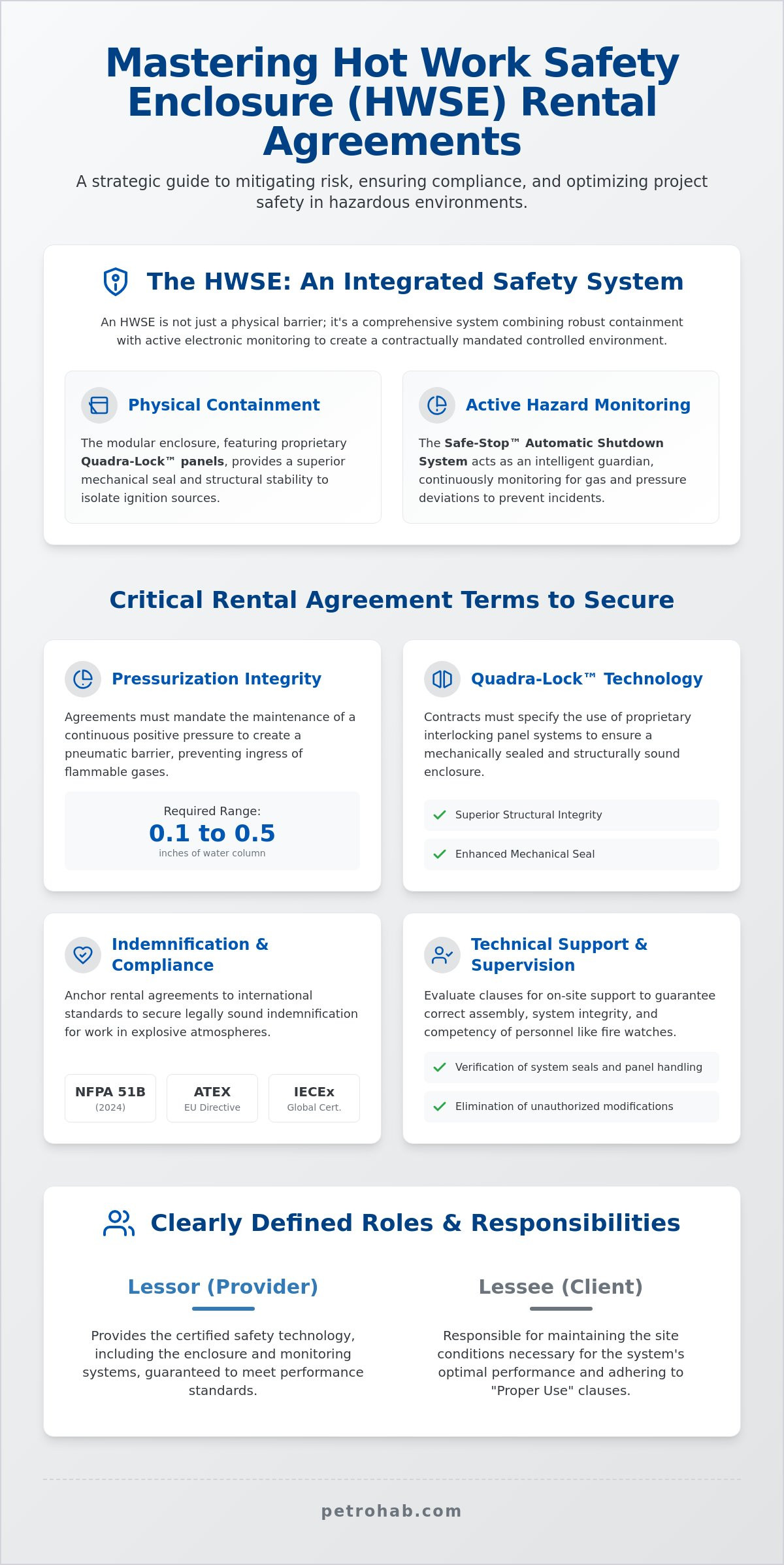
- Define the Hot Work Safety Enclosure (HWSE) as an integrated safety system that pairs physical containment with the Safe-Stop Automatic Shutdown System for active hazard monitoring.
- Identify the critical hot work enclosure rental agreement terms that mandate the maintenance of positive pressure between 0.1 and 0.5 inches of water column to ensure environmental integrity.
- Secure legally sound indemnification by anchoring rental agreements to international standards like NFPA 51B, ATEX, and IECEx for hot work in explosive atmospheres.
- Evaluate technical support and on-site supervision clauses to guarantee the structural integrity of Quadra-Lock panels and the competency of site-specific fire watches.
Understanding the Hot Work Safety Enclosure (HWSE) Rental Framework
The PetroHab Hot Work Safety Enclosure (HWSE) is a sophisticated engineering control designed to isolate ignition sources from flammable atmospheres. Negotiating hot work enclosure rental agreement terms requires understanding that the asset is an integrated safety system, not a simple physical structure. A comprehensive hot work safety overview reveals that fire prevention relies on strict environmental containment. This system combines modular physical barriers with active electronic monitoring to provide a definitive technological remedy for hazardous site conditions.
Safety managers must distinguish between the modular enclosure and the Safe-Stop Automatic Shutdown System. The enclosure provides the physical containment, while the Safe-Stop system acts as the intelligent guardian of the site, monitoring gas levels and internal pressure. The primary purpose of the rental agreement is to establish a contractually mandated controlled environment in Zone 1 or Zone 2 areas. In industrial leasing, these systems fall under the distinct legal category of pressurized habitats, which carries specific compliance obligations beyond standard tool rentals.
To analyze the standard structures of industrial leases, review this template overview:
The Scope of HWSE Leasing in 2026
A PetroHab rental package typically includes modular panels, spark-arresting intake fans, and the Safe-Stop monitoring unit. These components work together to ensure ignition prevention in volatile environments. Most global deployments utilize a duration-based fee structure, offering daily or monthly rates to accommodate varying project timelines. For deeper technical context on these systems, safety managers should consult the Definitive Guide to Hot Work Safety Enclosures (HWSE) in 2026. This resource outlines the operational capabilities required for modern industrial compliance.
Critical Definitions for Procurement Teams
Procurement teams must recognize specific hot work enclosure rental agreement terms to avoid operational gaps. Pressurization Integrity is defined as the system’s ability to maintain a positive pressure differential, preventing the ingress of flammable gases. The agreement also differentiates between general equipment and proprietary technology. For example, Quadra-Lock panels are proprietary interlocking components that provide superior structural integrity compared to generic welding blankets. Finally, the contract clearly defines the roles: the Lessor (PetroHab) provides the certified safety technology, while the Lessee (the client) is responsible for maintaining the site conditions necessary for the system’s optimal performance.
Operational Integrity and Maintenance Requirements in HWSE Agreements
Operational integrity is the cornerstone of industrial risk mitigation. Standard hot work enclosure rental agreement terms must explicitly specify the maintenance of positive pressure. This pneumatic barrier, typically maintained between 0.1 and 0.5 inches of water column, ensures that flammable vapors cannot ingress into the work area. Quadra-Lock technology is frequently specified in these agreements because its interlocking panel design provides a mechanical seal and structural stability that generic alternatives fail to match. Reliability is not accidental. It is engineered through precise technical requirements.
Defining “Proper Use” within the contract is critical for legal protection and personnel safety. This definition must encompass fire-resistant panel handling, the exclusion of unauthorized modifications, and the continuous verification of all system seals. To maintain the structural and safety certification of the HWSE, agreements must mandate the exclusive use of PetroHab-certified spare parts. Substituting components with non-certified alternatives compromises the entire safety barrier and often voids the liability protections outlined in the lease. If your site requires a specialized assessment of these requirements, consult with our technical team to align your safety protocols with industry benchmarks.
Maintaining the Pressurized Welding Habitat
Daily inspections are non-negotiable for high-stakes operations. A certified fire watch or designated technician must verify the physical and pneumatic integrity of the system before every shift. While the client is often permitted to perform basic seal adjustments, any significant modifications to the core structure or the Safe-Stop system require direct PetroHab supervision. This oversight ensures the habitat remains a definitive technological remedy for hazardous conditions. For a deeper look at these operational standards, refer to our guide on Pressurized Welding Habitats. Adhering to these rigorous protocols ensures compliance with OSHA hot work regulations regarding fire prevention and hazard assessment.
Sensor Calibration and Automatic Shutdown Compliance
The Safe-Stop system acts as the site’s primary active guardian. Rental terms define specific intervals for gas detection sensor calibration to ensure the automatic shutdown remains responsive to environmental changes. Agreements also clarify the liability distinction between a “False Trip” and an “Actual Alarm.” A false trip caused by client-side maintenance neglect is handled as an operational cost, whereas an actual alarm triggered by a genuine hazard demonstrates the system’s successful risk mitigation. Maintaining a meticulous, time-stamped log of these calibrations and system tests is the only way to prove regulatory compliance during an audit. This documentation serves as a linguistic anchor for quality and safety excellence.
Liability, Indemnification, and Compliance in Hazardous Zone Rentals
In explosive atmospheres, risk is absolute. Negotiating hot work enclosure rental agreement terms requires a move away from the broad, one-sided indemnification clauses found in general equipment leases. Standard leases often place the entire burden of liability on the customer, regardless of the equipment’s technical performance. In contrast, a safety-critical agreement for a pressurized habitat must account for the shared responsibility of maintaining a safe working environment. PetroHab adopts the role of a trusted advisor, ensuring that the indemnification structure reflects the high-stakes reality of Zone 1 and Zone 2 operations.
International standards serve as the linguistic anchors for these contracts. When agreements are anchored to the NFPA 51B Standard, they provide a rigorous framework for fire prevention that satisfies both regulatory inspectors and internal safety auditors. This technical precision does more than ensure compliance; it actively reduces the client’s risk profile. Insurance underwriters frequently recognize the deployment of certified systems like the Safe-Stop Automatic Shutdown System as a definitive risk-mitigation factor, which can lead to a reduction in project-specific insurance premiums.
The “Force Majeure” clause in these industrial agreements also requires a specialized definition. Unlike standard commercial leases, these terms must account for platform-wide shutdowns, emergency evacuations, or extreme offshore weather that mandates a cessation of all hot work. These provisions protect the lessee from rental costs during periods when the hazardous environment makes the use of the enclosure technically impossible or unsafe.
Compliance with Hazardous Environment Standards
Every component of the rented system must meet stringent zone certifications to ensure operational integrity. The legal weight of using patented technology like Quadra-Lock panels is significant during safety audits, as it demonstrates an unwavering commitment to engineering excellence. For a detailed analysis of how these systems align with international regulations, safety managers should consult the 2026 Guide to Global Compliance. This documentation ensures that your site meets ATEX and IECEx requirements for ignition prevention.
Risk Allocation and Insurance Requirements
Agreements specify minimum insurance coverage to protect both parties during high-value operations. While PetroHab provides the technological remedy, the lessee typically remains liable for equipment damage resulting from improper operational practices, such as poor welding slag management or unauthorized structural modifications. The Safe-Stop system serves as a primary risk-mitigation clause within the contract. By providing an objective, automated record of environmental monitoring, it eliminates the ambiguity often associated with manual fire watches and provides a clear audit trail for incident investigation.
Key Provisions to Evaluate in a Pressurized Habitat Lease Agreement
A thorough evaluation of hot work enclosure rental agreement terms moves beyond financial default conditions to address safety-critical operational defaults. While standard commercial leases focus on payment schedules, a pressurized habitat agreement must prioritize the structural and functional integrity of the system. Operating a habitat with a compromised seal or bypassed sensor constitutes a safety default that carries immediate legal and operational consequences. Safety managers should ensure the contract explicitly integrates with the site’s Permit-to-Work (PTW) system, mandating that the enclosure’s status is verified before any ignition source is introduced.
Technical support is another vital provision. You must determine if the agreement includes 24/7 remote diagnostic support or requires on-site PetroHab technicians for system re-certification after a shutdown. Training and certification requirements for client personnel are equally important. The lease should stipulate that only trained fire watches and welders are authorized to operate near the enclosure. To maintain the highest standards of site safety, review our technical specifications for rental systems to ensure your team is fully prepared for deployment.
Mobilization and Global Logistics
Shipping modular HWSE units to remote offshore platforms involves complex logistics that must be detailed in the rental agreement. The contract should clarify who bears the financial and administrative burden for customs clearance and hazardous material documentation for the Safe-Stop system’s batteries or sensors. For a comprehensive framework on evaluating these logistics, refer to our Procurement Guide. This resource helps safety managers identify suppliers capable of meeting the rigorous demands of global industrial shipping.
Termination and Equipment Return
The off-hiring process requires strict adherence to cleaning and decontamination standards. Fire-resistant panels must be returned free of excessive welding slag or chemical residues. Rental agreements typically include a “Replacement Cost” schedule for proprietary Quadra-Lock components that are damaged beyond normal wear. “Hot Work Contamination,” such as deep burns or structural warping of the panels, often triggers repair or replacement penalties. Defining these standards upfront prevents unexpected costs at the conclusion of a project turnaround and ensures the equipment remains ready for its next safety-critical mission.
Optimizing Project Safety with PetroHab Rental and Supervision Services
The distinction between an equipment vendor and a safety partner is defined by the level of operational support provided during high-stakes turnarounds. In hazardous environments, professional supervision is a necessity rather than an optional service. Including on-site technical oversight in your hot work enclosure rental agreement terms ensures that the system functions as a definitive technological remedy rather than a passive barrier. PetroHab acts as an active guardian, providing the expertise required to manage the granular details of industrial hazards that general rental companies often overlook.
Training protocols form the second pillar of this safety partnership. PetroHab provides rigorous instruction for client-side fire watches and welders, ensuring they understand the operational limits and safety features of the PetroHab Hot Work Safety Enclosure (HWSE). This training covers emergency response procedures and the correct interaction with the Safe-Stop system. By certifying site personnel, we eliminate the human error that often leads to avoidable project downtime or safety breaches. Our commitment to safety excellence ensures that every individual on the site is equipped to maintain the highest standards of ignition prevention.
The Value of Certified On-site Supervision
Certified PetroHab technicians ensure the structural and pneumatic integrity of Quadra-Lock enclosures through every phase of the project. These experts manage the initial setup, ensuring that the interlocking panels provide a robust mechanical seal against flammable vapors. Beyond the assembly, technicians perform real-time gas monitoring and continuous pressure adjustments to keep the habitat within the required 0.1 to 0.5 inches of water column. This specialized oversight significantly reduces the client’s liability, as an expert is always present to verify that the system meets its technical certifications. It’s a proactive approach to risk mitigation that safeguards both personnel and high-value assets.
Advanced Safety Systems: Safe-Stop Integration
The Safe-Stop Automatic Shutdown System is the industry benchmark for active environmental monitoring. This system provides a technical advantage by automatically isolating ignition sources the moment a hazard is detected, such as a loss of pressure or the presence of hydrocarbons. For a detailed analysis of these capabilities, safety managers should consult the Advanced Hot Work Safety Systems Guide. Integrating Safe-Stop into your rental agreement ensures that your site utilizes the most reliable technology available for environmental containment. This system doesn’t just monitor hazards; it actively controls them.
Contact PetroHab today to discuss your specific HWSE rental terms and project requirements.
Securing Your Industrial Site for High-Stakes Operations
Achieving total site safety requires moving beyond basic containment toward an integrated engineering control. The most effective hot work enclosure rental agreement terms prioritize active monitoring and clear maintenance protocols. By specifying the maintenance of positive pressure and utilizing the Safe-Stop Automatic Shutdown System, you eliminate the ambiguity that leads to costly shutdowns. A calculated approach to these contracts transforms a standard lease into a critical safety partnership.
PetroHab provides the technical precision required for Zone 1 and Zone 2 environments. Our patented Quadra-Lock technology and ATEX & IECEx certified systems offer a definitive technological remedy for hazardous conditions. With global operations in Houston, Brazil, and the UK, we’re prepared to support your most complex deployments. To ensure your next turnaround is defined by operational excellence and uncompromising protection, Request a Quote for HWSE Rental and Supervision. Your commitment to safety excellence starts with a partner who understands the granular details of industrial hazards better than anyone else.
Frequently Asked Questions
What is the typical duration for a hot work safety enclosure rental?
Duration is strictly determined by the project’s operational scope. Rental options typically include daily, weekly, or monthly structures to accommodate both emergency repairs and planned facility turnarounds. This flexibility ensures that the PetroHab Hot Work Safety Enclosure (HWSE) remains on-site only for the necessary duration of the hazardous work. It minimizes unnecessary costs while maintaining a definitive technological remedy for the site.
Does the rental agreement include the Safe-Stop automatic shutdown system?
Yes, the Safe-Stop Automatic Shutdown System is included as an integrated component of the HWSE package. This active guardian monitors gas levels and internal pressure to ensure immediate ignition prevention. Including this proprietary technology in the rental agreement is a non-negotiable benchmark for safety. It provides the automated protection required for operations in Zone 1 and Zone 2 environments.
Who is responsible for the maintenance of the pressurized habitat during the lease?
Maintenance responsibilities are clearly delineated within the hot work enclosure rental agreement terms. The client is responsible for daily fire watch inspections and basic seal maintenance. PetroHab technicians manage the technical integrity of the pneumatic systems and electronic monitoring units. This shared approach ensures that the habitat maintains a positive pressure differential between 0.1 and 0.5 inches of water column throughout the project.
Are PetroHab technicians required for the setup of the Quadra-Lock panels?
Yes, certified technicians are required to oversee the setup and decommissioning of Quadra-Lock panels. This requirement ensures that the modular enclosure is assembled according to technical certifications and international standards. Professional supervision guarantees the structural integrity of the habitat in volatile atmospheres. It eliminates the risks associated with improper assembly by untrained personnel, providing absolute confidence to safety managers.
What insurance coverage is needed for hot work safety enclosure rentals?
Clients must typically provide proof of general liability and specific equipment insurance. These policies must cover the replacement value of the HWSE and Safe-Stop components. Because hot work occurs in high-stakes environments, additional coverage for industrial accidents or environmental hazards is often mandated. This insurance structure ensures that both the lessor and lessee are protected against the financial consequences of catastrophic site failures.
How does the agreement handle equipment damaged by welding sparks or heat?
The agreement handles damage through a defined replacement cost schedule for proprietary components. While normal wear is expected, damage such as “Hot Work Contamination” from excessive welding slag or direct heat exposure is the client’s responsibility. Technicians inspect the Quadra-Lock panels upon return to verify their condition. This process ensures the equipment remains durable and resilient for future safety-critical missions.
Is training for my offshore crew included in the rental agreement terms?
Yes, comprehensive training for the client’s offshore or facility crew is a standard provision in our hot work enclosure rental agreement terms. This training ensures that fire watches and welders understand the operational capabilities and safety protocols of the pressurized habitat. Proper instruction reduces the likelihood of false trips or safety defaults. It empowers your personnel to act as competent partners in maintaining a controlled work environment.
Does PetroHab offer global mobilization for HWSE rentals?
Yes, PetroHab offers global mobilization from strategically located hubs in Houston, Brazil, and the United Kingdom. Our logistics experts manage the complex documentation and shipping requirements for modular HWSE units. Whether your project is on a remote offshore platform or a major inland refinery, we provide the global reach required for rapid deployment. This ensures that our safety technology is available wherever hazardous work is performed.