
Blog Posts
Hot Work Habitat Gas Detection: The 2026 Technical Safety and Calibration Guide
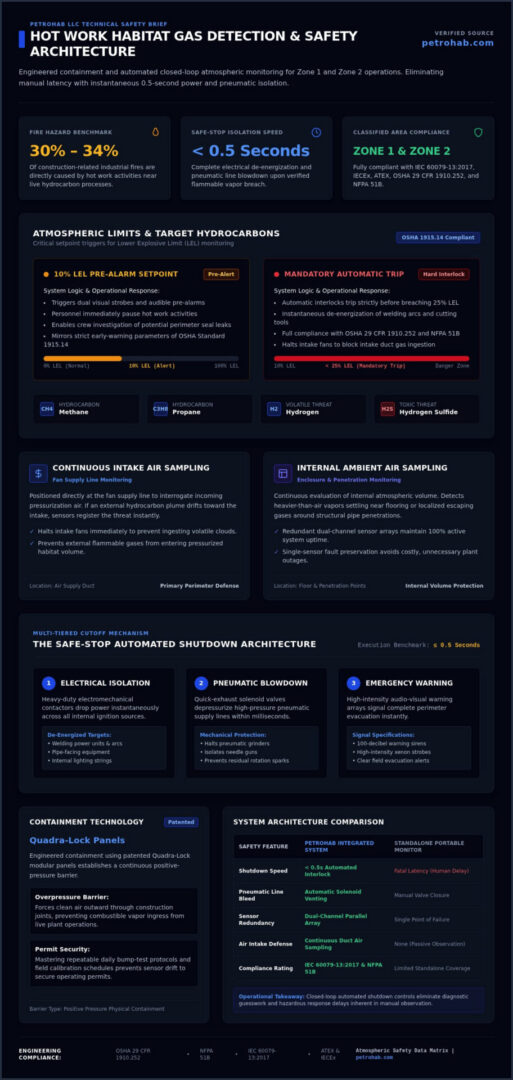
Hot work causes roughly 30% to 34% of construction-related industrial fires, yet many facilities still treat atmospheric monitoring as a passive observation exercise. When you’re managing repairs near live hydrocarbon processes, delayed detection can prove fatal. Reliable hot work habitat gas detection demands an automated, closed-loop architecture that isolates ignition sources before flammable vapors reach dangerous concentrations.
Every safety engineer knows the high stakes of live plant maintenance. A single vapor breach risks catastrophic ignition, while sensor drift can trigger false trips that idle production and drive up unplanned downtime costs. Balancing IECEx and ATEX compliance with tight turnaround schedules leaves zero margin for diagnostic guesswork.
This technical guide shows you how to master the mechanics, calibration intervals, and automatic shutdown integration of detection systems inside pressurized habitats. We’ll examine standard bump-testing routines, critical LEL setpoints, and the protocols required to achieve zero ignition incidents across Zone 1 and Zone 2 operations.
Key Takeaways
- Understand how continuous hot work habitat gas detection integrates with control systems to enforce mandatory shutdowns at 10% LEL per OSHA 29 CFR 1910.252 and NFPA 51B standards.
- Discover why closed-loop automated shutdown controls eliminate the hazardous response delays inherent in standalone portable gas monitors.
- Master repeatable daily bump-test protocols and field calibration schedules to prevent sensor drift and secure habitat operating permits.
- Learn how engineered containment using patented Quadra-Lock panels maintains overpressure to shield hot work activities from external vapor ingress.
- Explore how the Safe-Stop system achieves complete electrical and pneumatic isolation within 0.5 seconds to guarantee compliance with IEC 60079-13:2017.
The Critical Role of Hot Work Habitat Gas Detection in Hazardous Zones
Executing grinding, cutting, or welding inside operational oil and gas facilities introduces severe ignition risks. In classified Zone 1 environments where explosive atmospheres occur during normal operations, and Zone 2 areas where they can arise unexpectedly, manual fire watching is insufficient. Reliable hot work habitat gas detection continuously interrogates the local atmosphere, establishing a monitored barrier that prevents flammable vapor from contacting active ignition sources.
Positive pressure containment physically forces clean air outward through construction joints, preventing external gas entry. However, pressurization alone cannot counter an undetected vapor pocket entering through the intake duct or localized leaks occurring around penetration seals. Modern industrial safety pairs mechanical containment with advanced gas detection technology. This combination transforms passive enclosures into proactive, fail-safe environments that identify hazards before combustible concentrations form.
Lower Explosive Limit (LEL) Thresholds and Target Gases
Methane, propane, and hydrogen represent the primary combustible volatile threats across processing facilities. Hot work habitat gas detection platforms continuously track these hydrocarbon concentrations relative to their Lower Explosive Limit (LEL). Industry safety mandates enforce precise operational boundaries:
- 10% LEL Alert: System logic triggers visual and audible pre-alarms, signaling personnel to pause work and investigate potential perimeter leaks.
- Mandatory Shutdown: Automatic interlocks de-energize habitat power and welding tools strictly before gas concentrations breach 25% LEL, complying directly with OSHA 29 CFR 1910.252 and NFPA 51B parameters.
- Toxic Gas Interception: Integrated electrochemical sensors sample for hydrogen sulfide (H2S), protecting internal welding crews against rapid asphyxiation in sour gas environments.
Continuous Intake vs. Internal Ambient Air Sampling
Reliable gas mitigation requires dual-zone monitoring. Intake duct sensors sample incoming pressurization air directly at the fan supply line. If an external hydrocarbon release drifts near the air intake point, these sensors catch the plume immediately. The system halts intake fans and trips hot work power before explosive clouds get drawn into the pressurized welding enclosure.
Simultaneously, internal ambient sensors evaluate the enclosure volume. These units detect heavier-than-air vapors settling near flooring or gas escaping through structural pipe penetrations. Redundant dual-channel sensor arrays maintain full system uptime. If one sensor faults, its parallel counterpart preserves site monitoring without forcing an unnecessary plant outage.
System Architecture: How Gas Sensing Triggers Automatic Hot Work Shutdown
Relying on manual human intervention during an atmospheric breach introduces fatal latency. True site integrity requires hot work habitat gas detection to operate as an integrated, closed-loop safety shutdown network. Field logic controllers evaluate continuous telemetry from intake and ambient sensors. When flammable gas concentrations reach 10% LEL, mirroring the strict thresholds enforced by OSHA Standard 1915.14, the system executes an automated, multi-tiered cutoff sequence. Interfacing specialized sensors directly with advanced hot work safety systems strips operational lag out of emergency workflows.
The Safe-Stop Automatic Shutdown Mechanism
The core execution layer must sever all potential ignition sources instantaneously. PetroHab’s certified Safe-Stop system executes complete electrical and pneumatic isolation within 0.5 seconds of a verified gas detection event. Heavy-duty electromechanical contactors drop power to welding machines, pipe-facing equipment, and internal lighting strings before flammable vapor clouds can enter the active arc perimeter.
Simultaneously, quick-exhaust solenoid valves depressurize air lines serving pneumatic grinders and needle guns. This prevents residual rotation from striking mechanical sparks. Integrated control stations emit 100-decibel sirens paired with high-intensity xenon strobes, giving craft personnel immediate, unmistakable evacuation commands.
Intake Air Dampers and Pressurization Interlocks
Protecting the habitat interior requires rapid mechanical air handling alongside electrical cutoffs. The system manages environmental stability across two main physical defenses:
- Intake Dampers: Spring-return pneumatic dampers snap shut the microsecond intake sensors detect hydrocarbon traces. This blocks external vapor clouds from traveling down ducting lines into the habitat envelope.
- Differential Pressure Sensors: Calibrated differential pressure transducers monitor the positive pressure boundary, typically set at 25 Pascals. If interior pressure drops below baseline thresholds, the system flags a pressure failure and trips the hot work interlock.
Positive pressure maintenance ensures external hydrocarbons cannot penetrate interlocking panel seams. To safeguard critical operations and guarantee strict ATEX Directive 2014/34/EU and IEC 60079-13:2017 compliance, facilities routinely consult PetroHab to implement engineered pressurized habitats across high-risk assets.
Evaluating Integrated Detection Systems vs. Standalone Portable Monitors
Relying exclusively on personal gas badges to govern hot work inside classified process units introduces severe operational vulnerability. Portable monitors alert individual workers, but they cannot interface with plant power distribution or welding machinery. In contrast, purpose-engineered hot work habitat gas detection integrates sensing elements directly with main control logic, transforming passive personal warnings into automated ignition isolation.
The differences between standalone personal devices and centralized habitat safety networks come down to control. Handheld detectors function strictly as local alert systems. They lack the hardwired relays, logic boards, and pneumatic exhaust solenoids required to de-energize equipment when explosive vapors breach baseline limits. Effective risk reduction demands automated systems that execute commands independent of worker behavior.
Response Latency and Ignition Source Isolation
Human delay during a hazardous release frequently causes incident escalation. When a wearable gas badge alarms in a loud habitat, the operator must recognize the alert, put down their torch, and manually de-energize the power pack. That sequence often takes anywhere from 10 to 30 seconds.
Integrated habitat systems eliminate that procedural lag entirely. When combustible gases cross set limits, electromechanical controls isolate all electrical and pneumatic power lines within 0.5 seconds. Removing human hesitation from the critical shutdown loop ensures that hot grinding discs stop and welding arcs extinguish before flammable gas concentrations reach lower explosive thresholds.
Atmospheric Blind Spots and Sensor Positioning
Spatial coverage reveals another critical limitation of handheld detection. Wearable monitors clip to a technician’s collar, sampling only the personal breathing zone while ignoring the wider habitat volume. This creates dangerous atmospheric blind spots across several high-risk sections:
- Intake Air Ducts: Portable units cannot sample fresh air supplies upstream before external vapor plumes are drawn inside.
- Penetration Seals: Handheld monitors miss volatile gas seeping across complex pipe penetrations or structural steel beams.
- Floor and Ceiling Traps: Stratified gases, like heavy propane near the decking or light methane near the roof, remain undetected until they reach the worker.
Fixed multi-point sensor arrays remove these blind spots by continuously sampling both the intake airflow and internal containment zones. Deploying airtight modular systems like pressurized welding habitats ensures predictable, directional air migration directly toward these fixed sensors. This disciplined airflow allows control hardware to register minor containment breaches long before vapor volumes can threaten habitat integrity.
Step-by-Step Gas Detection System Calibration and Field Verification
Sensor drift compromises safety faster than almost any other hardware failure. Harsh offshore salt spray, airborne drilling muds, and ambient moisture degrade sensing chemistry over time. Reliable hot work habitat gas detection demands disciplined, repeatable calibration regimens before issuing permits to work. Following structured field verification protocols protects operations against undetected gas releases and the costly downtime triggered by false trips.
Field verification splits into two primary tiers: daily functional challenges and periodic full-span adjustments. Adhering to manufacturer guidelines ensures uninterrupted compliance with international safety protocols across high-consequence operating environments.
Pre-Operational Bump Testing Procedures
Technicians must complete a qualitative bump test before every work shift. This challenge exposes the sensing array directly to a certified test gas mixture without altering baseline settings:
- Challenge Sensors: Apply a certified blend (typically 50% LEL methane in air) to both intake duct and internal sampling heads.
- Confirm Setpoint Logic: Verify that local beacon strobes trigger at 10% LEL and verify that control relays initiate equipment trip logic before 25% LEL.
- Measure Response Times: Ensure the sensor reaches 90% of final target values (T90) within the manufacturer’s operational window.
- Enforce Pass/Fail Limits: Abort work immediately if the monitored reading drifts more than +/- 10% from the applied cylinder concentration.
Full Span Calibration and Zero-Point Adjustment
Every 90 to 180 days, technicians perform a quantitative span calibration. The sequence begins by bathing the sensor in certified zero-grade synthetic air, stripped of ambient hydrocarbons, to anchor a clean zero-volt baseline.
Next, technicians deliver target span gas matching site-specific process risks, adjusting internal amplifier potentiometers until telemetry outputs align perfectly with the test cylinder. Before completing the cycle, crews inspect sintered stainless steel flame arrestors and hydrophobic membrane filters, replacing clogged elements that slow gas diffusion rates.
Permit-to-Work Documentation and Logged Verification
Regulatory bodies reject unverified calibration claims. Site technicians must maintain comprehensive, defensible safety logs documenting test gas bottle batch numbers, certificate expiration dates, and ambient conditions during testing. Every field check must record individual sensor serial numbers, physical installation locations, and final verification timestamps.
Maintaining clear records confirms continuous compliance aligned with global hazardous environment standards across every shift. Safety superintendents require signed, dated calibration certificates before energizing pressurized habitats. To establish verified safety controls for your next turnaround, contact PetroHab to deploy certified technicians and compliant detection hardware.
Deploying Certified Hot Work Safety Enclosures with PetroHab Systems
Engineering a dependable barrier against volatile hydrocarbons requires physical containment and electronic intelligence to function as a singular unit. PetroHab manufactures engineered modular habitats built specifically around this balance. Rather than treating atmospheric sampling as an aftermarket accessory, PetroHab’s architecture integrates specialized hot work habitat gas detection straight into the enclosure control matrix, giving operators verified protection across classified zones.
At the center of this ecosystem sits the certified Safe-Stop system, establishing an industry benchmark for fail-safe automatic isolation. Paired directly with positive-pressure blowers and quick-acting shutoff dampers, the system prevents dangerous atmospheric mixtures from ever reaching active welding tools or piping joints.
Engineered Enclosure Integrity with Quadra-Lock Panels
Physical isolation fails if structural seams allow pressure leakage. PetroHab’s modular habitats utilize patented Quadra-Lock panels to establish an airtight mechanical seal without requiring uncertified fasteners or zipper tracks. The interlocking joinery keeps overpressure stable at required operating levels while eliminating fugitive vapor entry points.
Every panel uses high-temperature, silicone-coated fiberglass fabric designed to repel continuous hot metal slag and welding sparks. Exploring the engineering details behind hot work safety enclosures demonstrates how rugged structural boundaries make positive pressure containment repeatable under difficult environmental conditions.
On-Site Supervision and Operational Equipment Leasing
Hardware performance depends on precise installation and rigorous field calibration. PetroHab provides certified on-site technicians who manage system rigging, calibrate sensing instruments, and oversee continuous atmospheric checks across active shifts. These specialists eliminate operator error during critical turnarounds:
- Deployment Oversight: Supervise physical assembly of the PetroHab Hot Work Safety Enclosure (HWSE) to confirm proper sealing around complex pipe penetrations.
- Atmospheric Verification: Conduct mandatory pre-shift bump tests and multi-gas sensor challenges to satisfy local operating permits.
- Operator Instruction: Train facility safety teams on Safe-Stop alarm responses, air damper resets, and emergency ventilation controls.
Through global hubs operating across the United States, Brazil, and the United Kingdom, PetroHab leases modular pressurized enclosures and detection equipment for rapid deployment worldwide. Plant managers can consult directly with PetroHab safety engineers to specify customized habitat layouts and multi-point sensing arrays tailored for demanding offshore or refinery turnarounds.
Securing Operational Integrity with Closed-Loop Containment
Operating safely near active hydrocarbon systems requires moving beyond passive atmospheric monitoring. Reliable site protection relies on advanced hot work habitat gas detection coupled directly with automated plant interlocks. When deployed alongside patented Quadra-Lock panels that deliver certified airtight modular structural containment, pressurized enclosures prevent external vapors from infiltrating the active work area. If combustible mixtures ever breach safety setpoints, the Safe-Stop system executes total ignition source isolation within 0.5 seconds, protecting crews and preventing catastrophic facility damage.
Turnaround schedules demand precision, and safety margins cannot be compromised. Backed by global deployment hubs in Houston, the United United Kingdom, and Brazil for rapid mobilization, engineered habitats ensure your maintenance operations remain fully compliant with ATEX and IECEx standards. Take complete control over your atmospheric safety before striking the next arc. Request a Technical Consultation for Your Hot Work Project to partner with experienced safety specialists and safeguard your critical assets.
Frequently Asked Questions
What is the primary function of gas detection in a hot work habitat?
The primary function of gas detection in a hot work habitat is to continuously monitor for combustible and toxic gases, automatically isolating ignition sources before vapors reach flammable thresholds. It acts as an active safety barrier, sampling air at the intake duct and inside the work envelope. When tied into control networks like the Safe-Stop system, it eliminates ignition risks during live plant maintenance by severing tool power and closing intake dampers instantly.
How quickly must a hot work habitat shutdown system isolate equipment?
A compliant hot work habitat shutdown system must isolate equipment in under one second, with top-tier systems achieving isolation within 0.5 seconds. Rapid response is critical to extinguish welding arcs and de-energize rotating abrasive equipment before moving vapor clouds ignite. PetroHab’s Safe-Stop system achieves complete electrical and pneumatic isolation within 0.5 seconds of detecting flammable gas, satisfying strict IEC 60079-13:2017 functional safety requirements across hazardous locations.
What is the difference between a bump test and a span calibration?
A bump test is a daily qualitative check confirming sensor response and alarm trip triggers using a known gas concentration without adjusting baseline parameters. A span calibration is a comprehensive, quantitative adjustment performed every 90 to 180 days. Technicians zero the instrument with pure air, challenge it with certified calibration gases, and tune amplifier settings to guarantee reading accuracy across operational ranges under demanding field conditions.
Where should gas detection sensors be positioned within and around the habitat?
Sensors must be placed at the intake air duct, inside the habitat envelope, and near high-risk structural penetrations. Intake sensors ensure fresh pressurization air remains clean before entering the enclosure. Internal sensors should be positioned based on target gas vapor density, placing methane detectors near the ceiling and propane or hydrogen sulfide sensors near the floor. This dual-zone layout eliminates blind spots and verifies overall containment integrity.
What gases must be monitored during offshore hot work operations?
Offshore operations primarily require monitoring for combustible hydrocarbons such as methane and propane, along with toxic hydrogen sulfide (H2S) and ambient oxygen levels. Methane represents the standard explosive threat on oil and gas platforms, while heavy hydrocarbons settle along decks. Monitoring oxygen ensures levels stay between 19.5% and 23.5%, preventing both oxygen enrichment fire hazards and worker asphyxiation risks inside enclosed modular work structures.
Can hot work proceed if a habitat gas detection sensor faults or fails calibration?
Hot work must stop immediately if a sensor faults, drifts outside calibration tolerances, or fails a daily challenge test. Safety permits require active, certified atmospheric monitoring before striking an arc. If a sensor fails, the automated interlock holds equipment in a de-energized fail-safe state. Work can only resume once qualified technicians recalibrate or replace the faulty sensing head and verify complete shutdown functionality in site logs.
How does positive pressurization interact with the gas detection system?
Positive pressurization and hot work habitat gas detection function together as a coordinated defense mechanism. Differential pressure sensors monitor the enclosure to maintain an overpressure of 25 Pascals, physically forcing clean air out and keeping external vapors away. If pressure drops or intake sensors register gas, the logic controller instantly shuts intake dampers and isolates welding power, ensuring combustible vapors never breach the interlocking Quadra-Lock panels.