
Blog Posts
Integrating Automatic Shutdown System with Habitat: A 2026 Technical Guide
A single hour of unplanned downtime in the offshore energy sector costs an average of $416,000, while onshore refineries can lose up to $1.2 million per day. For safety managers, the pressure to maintain production while conducting hot work is constant, yet manual gas monitoring remains a significant liability for human error. You know that relying on manual intervention isn’t just risky; it’s a threat to your Tier 1 safety status and your bottom line. Relying on outdated protocols often leads to production delays that eat into your operational budget.
By integrating automatic shutdown system with habitat, you move beyond basic containment into a proactive, automated safety loop. This guide provides the technical expertise you need to master this synchronization, ensuring your site meets the rigorous IEC 60079-13:2017 standards. We’ll examine how the Safe-Stop system interacts with Quadra-Lock panels to create a zero-incident environment. You’ll learn the specific triggers for automated logic, the requirements for ATEX and IECEx compliance, and how to satisfy auditors with seamless hardware integration. This is the definitive path to achieving absolute control over hazardous ignition sources.
- Understand why automated ignition control is mandatory for 2026 Tier 1 safety compliance in Zone 1 and Zone 2 environments.
- Master the technical requirements for integrating automatic shutdown system with habitat to create a synchronized safety loop that isolates power upon detecting hazards.
- Learn how Quadra-Lock panels provide the structural rigidity needed for sensors to maintain a consistent positive pressure of at least 25 Pascals.
- Follow a structured five-step protocol for the physical assembly, atmospheric calibration, and logic synchronization of a pressurized welding habitat.
- Evaluate the operational benefits of the PetroHab LLC Safe-Stop system, specifically its role in reducing downtime and satisfying safety auditors.
The Critical Role of Integrated Shutdown Systems in Hazardous Hot Work
Passive containment is no longer sufficient for Tier 1 industrial facilities. Traditional habitats rely heavily on human vigilance, which is inherently prone to error and fatigue. By integrating automatic shutdown system with habitat, operators implement a definitive technological remedy for ignition risks. This shift transforms the enclosure from a simple physical barrier into an active guardian of the site. Modern safety protocols demand that ignition source control is immediate and autonomous, leaving no room for the delays associated with manual intervention.
To better understand the mechanics of automated safety in hazardous environments, watch this technical overview:
The transition from passive to active safety is driven by the need for absolute reliability. In Zone 1 and Zone 2 environments, the presence of flammable gases is a constant threat. An integrated hot work safety enclosure functions as a comprehensive safety loop. It doesn’t just contain the work; it monitors the atmosphere and reacts to threats in real-time. This level of synchronization is the benchmark for safety excellence in 2026.
The Limitations of Manual Safety Monitoring
Manual gas monitoring in hazardous zones presents unacceptable reaction time delays. A human fire watch must detect an alarm, process the threat, and manually cut power or signal the welder to stop. This chain of events can take several seconds, which is too slow when gas concentrations rise rapidly. Dedicated fire watch personnel also represent a significant recurring cost and increase the number of people exposed to potential hazards. Non-integrated setups often fail because the gas detection equipment is decoupled from the ignition source. If the detector triggers but the welding equipment remains energized, the risk of ignition remains critical.
Regulatory Drivers for System Integration
Evolving ATEX and IECEx requirements now emphasize autonomous protection for pressurized rooms. Integrating these systems functions as a Safety Instrumented System (SIS), where the logic solver automatically isolates power to welding equipment without human input. This automation significantly simplifies the Permit-to-Work (PTW) approval process. Facility managers find that automated protocols satisfy the most stringent insurance benchmarks for offshore and refinery operations. By integrating automatic shutdown system with habitat, you provide auditors with verifiable, logic-driven proof of risk mitigation that manual logs cannot match. Using Quadra-Lock panels ensures the structural integrity needed to maintain the pressure required for these sensors to function accurately.
How Automatic Shutdown Systems Synergize with Pressurized Habitats
The core of this synergy lies in the electronic handshake between the environmental sensors and the power distribution unit. Integrating automatic shutdown system with habitat ensures that any breach in containment leads to an immediate cessation of potential ignition sources. This integrated safety loop consists of high-precision sensors, a central logic controller, and a fail-safe power isolation switch. Unlike manual fire watches, these advanced hot work safety systems operate with microsecond response times to eliminate the human element of risk.
Compliance with OSHA hot work regulations requires rigorous control over sparks and heat in the presence of combustibles. The Safe-Stop system accomplishes this by acting as a master kill-switch for all welding equipment. When the logic controller receives a signal that exceeds safety thresholds, it triggers a mechanical relay that physically disconnects the power supply. This process is not merely an alert; it is a definitive operational override that prioritizes site integrity over production speed.
The Pressure-Loss Trigger Mechanism
Positive pressure maintenance is the primary defense against gas ingress. Digital manometers continuously measure the differential pressure between the habitat interior and the external environment. If the pressure drops below 25 Pascals (0.05 inches of water gauge), the manometer sends an immediate signal to the central control unit. This communication occurs via a hardwired, intrinsically safe connection to ensure signal reliability. The loss of habitat integrity, whether from a torn panel or a blower failure, results in an automated power isolation within seconds. This rapid response prevents hazardous atmospheres from reaching active ignition sources.
Gas Detection and Atmospheric Monitoring
Atmospheric monitoring utilizes ATEX-certified gas detectors positioned strategically at the air intake and inside the work area. The system employs a specific logic threshold; if flammable gas concentrations reach 10% of the Lower Explosive Limit (LEL), the Safe-Stop shutdown sequence initiates. This set-point provides a critical buffer before the environment becomes combustible. Managing false positives is achieved through voting logic, where multiple sensors confirm the presence of a hazard before a full shutdown occurs, preventing unnecessary downtime. For optimal reliability, ensure your setup utilizes Quadra-Lock panels to maintain the required environmental seal.
Evaluating Integration Features: Safe-Stop vs. Manual Safety Protocols
The efficacy of any hot work safety enclosure depends on the speed and reliability of its response to environmental changes. Integrating automatic shutdown system with habitat represents a significant advancement over legacy manual fire watch protocols. While a human observer might take several seconds to process a gas alarm and react, the Safe-Stop system isolates power in milliseconds. This difference in response time is often the deciding factor in preventing an ignition event in high-risk areas. Relying on manual intervention introduces a variable level of risk that’s unacceptable in modern Tier 1 facilities.
Proprietary logic controllers within the Safe-Stop system are specifically engineered to withstand the extreme vibration and corrosive salt spray found in offshore environments. These units offer a level of reliability that manual systems simply can’t replicate. By removing the risk of human distraction or fatigue, facility managers can achieve a higher degree of refinery turnaround safety. This automation ensures that safety remains a constant, rather than a variable dependent on personnel performance. It’s about replacing human uncertainty with technical precision.
Structural Integrity and Sensor Accuracy
The accuracy of environmental sensors is directly linked to the structural stability of the habitat. Quadra-Lock panels are engineered to prevent the “bellows effect,” where loose-fitting walls flex and cause internal pressure fluctuations. These fluctuations often trigger false alarms, leading to unnecessary production downtime. A rigid structure is essential for maintaining the precise overpressure required by the NFPA 51B standard. Additionally, the habitat must utilize flame-retardant materials that don’t interfere with sensor readings in sensor-heavy environments. Ensuring the habitat structure supports the weight of integrated ducting and ATEX-certified sensors is critical for maintaining long-term environmental integrity.
Data Logging and Post-Work Analysis
One of the most significant advantages of integrating automatic shutdown system with habitat is the creation of a digital audit trail. Unlike manual logs, which are subject to interpretation and error, integrated systems provide an objective, time-stamped record of atmospheric conditions. This data is invaluable for post-work analysis and optimizing future hot work procedures. Compliance reporting is simplified through automated event logging, allowing safety managers to provide auditors with precise data for every pressure variation or gas detection event. This transparency reinforces a culture of safety excellence and accountability across the industrial site, making it easier to satisfy rigorous safety audits.
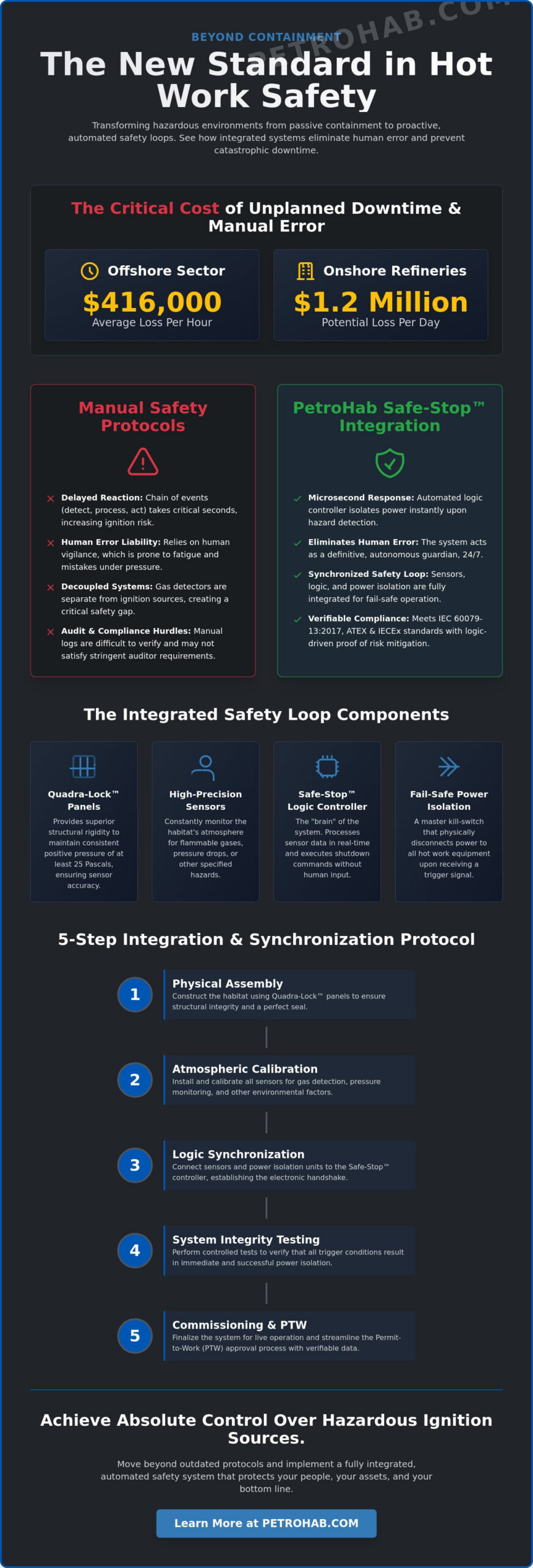
5 Steps to Integrating Automatic Shutdown Systems with HWSE
Technical precision during field installation determines the ultimate reliability of your safety loop. Integrating automatic shutdown system with habitat follows a rigid five-step protocol designed to eliminate human error and ensure Tier 1 compliance. This process synchronizes the physical enclosure with automated logic, transforming the workspace into a fail-safe environment. Each step must be executed with meticulous attention to detail to satisfy the requirements of IEC 60079-13:2017.
Step 1 & 2: Preparation and Structural Setup
Technicians must first conduct a comprehensive baseline atmospheric assessment to confirm the hazardous zone is below detectable gas limits before assembly. Once the site is cleared, the physical construction of the pressurized welding habitat begins. The structural integrity of the enclosure is paramount; it must withstand internal overpressure without significant wall deflection. Quadra-Lock panels are the mandated alternative to outdated panel systems for all high-pressure containment applications. Technicians must secure all penetrations, including pipework and structural beams, using specialized sleeves to ensure zero leakage. A secure enclosure prevents the pressure fluctuations that lead to false alarms and unnecessary production downtime.
Step 3 & 4: Logic Integration and Validation
Logic integration involves establishing a hardwired signal connection between the Safe-Stop control unit and the main power distribution board. This connection allows the system to act as a master circuit breaker for all hot work equipment. Technicians then perform a functional test to validate the fail-safe triggers. By simulating a pressure loss below 25 Pascals or introducing a test gas exceeding 10% LEL, the system must demonstrate power isolation within milliseconds. This test confirms the signal chain is intact from the sensor to the power isolation relay. Verifying that audible and visual alarms are synchronized across the site ensures that all personnel are immediately aware of a safety trip.
The final stage is the formal verification and Permit-to-Work (PTW) activation. The safety manager reviews the digital logs from the functional test to confirm the system meets all operational parameters. Once verified, the habitat is cleared for hot work, providing an active guardian for your personnel and assets. This structured approach moves your facility toward a zero-incident environment. To ensure your site meets these rigorous 2026 standards, consult with our engineers regarding your specific habitat requirements.
PetroHab Safe-Stop: The Benchmark for Integrated Habitat Safety
The Safe-Stop Automatic Shutdown System by PetroHab LLC represents the industry benchmark for ignition source control. Integrating automatic shutdown system with habitat environments requires more than just a power-cut relay; it requires a sophisticated logic controller capable of processing multiple environmental variables simultaneously. This system acts as the primary guardian of high-value assets, ensuring that hot work only proceeds when the atmosphere is verified as inert. The structural durability of Quadra-Lock panels provides the stable environment necessary for the Safe-Stop sensors to operate without the interference of external pressure fluctuations.
PetroHab LLC focuses on reducing operational downtime through seamless hardware synchronization. By utilizing a system where the enclosure and the shutdown logic are engineered to work in tandem, facility managers eliminate the compatibility issues that plague piecemeal safety setups. This integrated approach is supported by a global network of technicians who provide specialized training for rapid system deployment. Every component is designed to withstand the rigors of heavy industry, ensuring that safety protocols remain as durable as the habitats themselves.
Technical Superiority of the Safe-Stop Unit
The Safe-Stop unit features a modular design that facilitates rapid deployment even in the most restricted confined spaces. It provides comprehensive multi-gas detection, monitoring for H2S, LEL, O2, and CO to ensure a 360-degree safety profile. Unlike standard detection units, this system includes an independent power backup to maintain critical monitoring during site-wide outages. PetroHab LLC ensures that every unit is certified to the highest ATEX and IECEx standards, providing safety managers with a reliable, logic-driven solution for hazardous area work.
The Future of Integrated Hot Work Safety
Looking ahead, PetroHab LLC is incorporating AI-assisted safety monitoring and predictive maintenance into its 2026 product line. These advancements allow for the identification of potential sensor drift or environmental trends before they trigger a full shutdown. This proactive approach minimizes unnecessary downtime while maintaining an unwavering commitment to personnel protection. Our global support teams provide specialized training and deployment assistance to ensure your site adopts these technologies seamlessly. Contact PetroHab LLC today for a specialized integration consultation to evaluate your facility’s specific hot work requirements.
Advancing Ignition Source Control in Hazardous Zones
Transitioning from manual oversight to automated safety logic is the definitive step toward achieving absolute site integrity. By integrating automatic shutdown system with habitat, you eliminate the variability of human response and replace it with technical precision. This guide has demonstrated how the structural rigidity of Quadra-Lock technology supports the high-precision logic of the Safe-Stop system to prevent ignition events. These integrated solutions are no longer optional; they’re essential for meeting the rigorous 2026 safety cases required by Tier 1 oil and gas operators worldwide.
PetroHab LLC remains a seasoned veteran in the field, delivering equipment that meets global ATEX and IECEx standards for high-stakes environments. Our commitment to safety advocacy ensures that your personnel and high-value assets remain protected under the most hazardous conditions. It’s time to move beyond passive containment and adopt a system that actively guards your operations. We invite you to Request a Technical Quote for an Integrated Safe-Stop System and see how our engineering excellence can secure your site. PetroHab LLC is ready to partner with you to achieve a zero-incident future.
Frequently Asked Questions
How does an automatic shutdown system detect a loss of pressure in a habitat?
The system utilizes high-precision digital manometers to continuously monitor the differential pressure between the internal workspace and the external atmosphere. If the internal pressure drops below the mandatory threshold of 25 Pascals, the manometers send an immediate signal to the central logic controller. This trigger occurs because any loss of positive pressure indicates a breach in environmental integrity, which could allow flammable gases to bypass the enclosure’s physical barriers.
Can the Safe-Stop system be used with habitats from other manufacturers?
The Safe-Stop Automatic Shutdown System is designed for maximum compatibility with various pressurized welding enclosures, but it delivers optimal performance when used with PetroHab LLC HWSE. Integrating automatic shutdown system with habitat structures requires precise sensor placement and secure ducting connections. Using standardized hardware ensures that the logic controllers accurately interpret data without the interference of structural wall deflection common in lower-quality enclosures.
What happens to the welding equipment when the automatic shutdown system is triggered?
Upon reaching a safety threshold, the Safe-Stop system acts as a master circuit breaker by immediately isolating all power to the welding equipment. This is achieved through a heavy-duty mechanical relay that physically disconnects the energized source from the tools. By cutting power at the distribution level, the system eliminates the ignition source within milliseconds, preventing a fire if flammable gas is detected at 10% LEL.
How often do gas detectors in an integrated habitat system need to be calibrated?
Gas detectors must undergo a bump test before every shift to verify sensor responsiveness and alarm functionality. Full calibration should occur according to the manufacturer’s specifications, typically every three to six months, or as dictated by site-specific safety protocols. In harsh offshore environments, more frequent verification is necessary to ensure that the sensors remain accurate despite exposure to corrosive salt spray and extreme temperature fluctuations.
Does integrating a shutdown system increase the time required for habitat setup?
Integrating automatic shutdown system with habitat adds a negligible amount of time for sensor placement and logic validation, but it doesn’t delay the overall project schedule. The automated testing phase replaces the need for extensive manual monitoring setup. Once the hardware is physically assembled, the functional test takes only minutes, providing a verifiable safety baseline that satisfies permit-to-work requirements more efficiently than manual fire watch protocols.
What is the response time of the Safe-Stop system in a real-world gas ingress event?
The Safe-Stop system is engineered to isolate power within milliseconds of detecting a safety breach. This rapid response is critical in hazardous zones where gas concentrations can rise to combustible levels in seconds. While a manual fire watch relies on human perception and reaction, the automated logic controller processes signals and triggers the kill-switch almost instantaneously, ensuring that ignition sources are eliminated before a hazard escalates.
Are integrated shutdown systems required by law for offshore hot work?
The Bureau of Safety and Environmental Enforcement (BSEE) typically requires a Pressurized Welding Enclosure (PWE) for hot work within 10 feet of pressurized equipment. Most Tier 1 operators mandate integrated shutdown systems to comply with IEC 60079-13:2017 standards for pressurized rooms. Automation is increasingly viewed as a legal necessity for risk mitigation, as manual monitoring often fails to meet the stringent safety cases required for modern offshore production.
How does Quadra-Lock technology improve the reliability of the shutdown system?
Quadra-Lock technology provides the structural rigidity necessary to maintain a consistent internal atmosphere without the bellows effect found in inferior panel systems. These panels ensure a tight seal that prevents wall deflection, which can cause erratic pressure readings and false alarms. This structural stability allows the shutdown system’s sensors to provide accurate data, ensuring that the safety loop remains reliable and that production downtime is minimized during critical hot work.