
Blog Posts
LNG Habitat Gas Alarm: Hot Work Response Guide
A habitat gas alarm is a trigger for action, not a reason to diagnose a hazard from a single reading. During LNG hot work, the crew’s first response should follow the approved site procedure, not improvisation. A clear LNG habitat gas alarm response starts with knowing who stops work, who contacts site control, and how personnel follow the site’s instructions for the event.
When an alarm activates, gas and pressure indications can help inform the response, but they don’t replace site procedures or authorize a restart. Treat the alarm seriously, follow the assigned response sequence, and leave the decision to resume hot work to the designated site authority.
This guide covers how to prepare for an alarm, coordinate crew actions and communication, and maintain accountability throughout the response. It also explains how systems such as PetroHab’s Safe-Stop Automatic Shutdown System, which monitors gas levels and pressure, can support operational readiness without replacing site-specific procedures. The goal is a disciplined response with no premature restart.
Key Takeaways
- Before hot work, locate the facility’s alarm instructions and assign responsibility for stopping work and contacting site control.
- Use a clear LNG habitat gas alarm response: stop hot work and follow site instructions for personnel movement.
- Separate immediate crew actions from later technical assessment by authorized site personnel.
- Resume hot work only through the site’s approved assessment and restart process.
- Know the distinct roles of monitoring, alarm notification, automatic shutdown, and personnel response.
What an LNG Habitat Gas Alarm Means During Hot Work
A habitat gas alarm indicates that a monitored condition requires action under the facility’s approved procedures. It does not, by itself, identify the source, location, or cause. During hot work, treat the alarm as a procedural trigger. Don’t try to explain it through assumptions or an isolated reading.
The LNG habitat gas alarm response should be established before work begins through site instructions and permit controls. These account for the operating environment, scope of work, and crew responsibilities. This guide outlines general response principles, but it does not replace facility emergency instructions or the conditions of an active hot-work permit.
A short video can serve as a visual prompt for discussing alarm readiness. Site procedures remain the operational authority.
What information can a habitat alarm communicate?
Habitat systems may monitor conditions such as gas levels and pressure. An alarm can indicate that a monitored value or system condition requires attention. Its precise meaning depends on the configured indications and the facility’s response instructions. Interpret a display, tone, or other signal using system documentation and site procedures, not assumptions about a universal alarm code.
For example, don’t infer a specific hazard or its severity from an alarm color alone. A pressure indication is not proof that the atmosphere is clear. The alarm identifies a condition requiring action; authorized site processes determine what it means and what happens next.
Why LNG hot work requires a controlled response
Hot work introduces ignition sources into an environment where operating conditions can change. Tasks may include welding, cutting, or other work that produces heat or sparks. The broader Hot Work overview describes common activities and safety considerations, including permits and confined-space contexts. At an LNG facility, the applicable controls must come from the site’s hazard assessment and permit process.
Coordination prevents conflicting assumptions and actions. Workers shouldn’t investigate an alarm on their own, decide it is a fault, or continue working because a local indication appears normal. A designated response keeps the crew aligned with site control and maintains clear accountability while the condition is assessed.
Purpose-built pressurized habitats and monitoring or shutdown systems can support operational readiness, but they don’t replace emergency instructions. When evaluating advanced hot-work safety systems, keep the roles distinct: equipment supports control, while site procedures define the response and who has authority to make decisions.
How to Prepare Before an LNG Habitat Gas Alarm Occurs
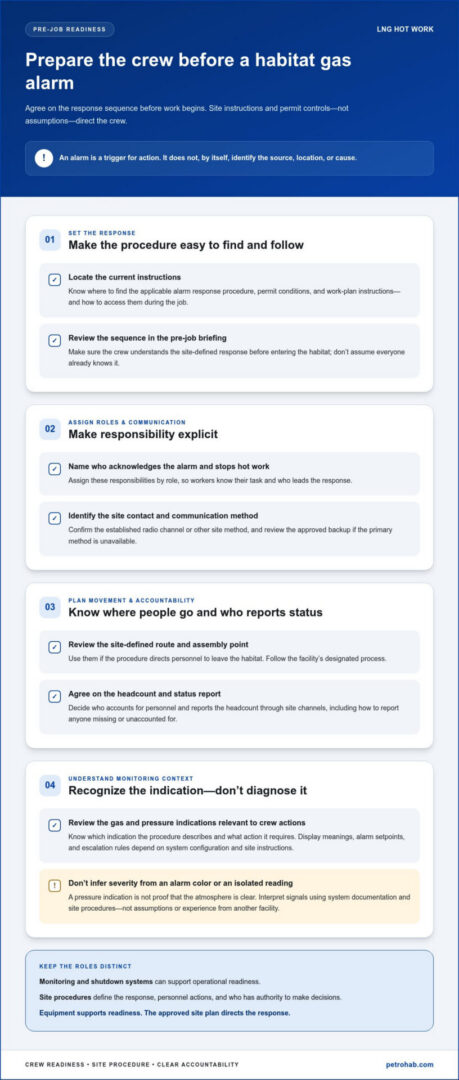
Preparation begins before hot work. The crew should know where to find the applicable alarm response instructions and permit controls, how to access them during the job, and which site authority directs the response. Workers who haven’t reviewed a procedure may struggle to apply it under pressure. Include the LNG habitat gas alarm response in the pre-job briefing instead of assuming everyone knows it.
Use the approved work plan to establish a shared sequence before the crew enters the habitat:
- Identify who receives or acknowledges the alarm and who is responsible for stopping hot work.
- Name the person who communicates with site control and confirm the designated communication method.
- Review the site-defined route and assembly point to use if the procedure directs personnel to leave the habitat.
- Confirm how personnel will be accounted for after a stop-work or evacuation event, including who reports the headcount.
Brief the crew on roles and communication
Assign responsibilities by role, not assumption. Each worker should understand their task and who leads the response. Identify the site contact according to site practice, and confirm the radio channel or other established communication method. Discuss the approved backup method if the primary one is unavailable. Clear roles reduce conflicting messages and help site control coordinate the response.
Make accountability explicit. The crew should know where to assemble if directed, who reports personnel status, and how to report a missing or unaccounted-for person through site channels. Use the facility’s designated process rather than creating a new muster process at the worksite.
Review alarm instructions and monitoring context
Before work, locate the current alarm response procedure, permit conditions, and work-plan instructions that apply to the habitat. Review the gas and pressure indications relevant to the crew’s assigned actions. The goal isn’t to train workers to diagnose system faults or infer alarm severity from a display. It’s to ensure they can recognize the indication described in the procedure and take the required action.
Alarm setpoints, escalation rules, and display meanings are specific to the system configuration and site. Don’t carry assumptions over from another facility or job. Review the site’s habitat pressure monitoring plan and clarify which instructions govern if gas and pressure indications appear together. The federal LNG facility safety regulations provide regulatory context; facility procedures and permit controls direct the worksite response.
For project planning, consider PetroHab’s pressurized habitat solutions alongside the site’s monitoring and work-control arrangements. Equipment supports readiness; the approved site plan defines responsibilities and actions.
What to Do When an LNG Habitat Gas Alarm Activates
Follow the facility’s alarm procedure immediately. The steps below offer a general structure, not a replacement for the instructions that govern the specific habitat, permit, and worksite. If this guidance differs from those instructions, follow the approved site procedure and direction from the designated authority.
- Stop hot work. Cease the task as directed by the site’s alarm instructions. Don’t continue working while deciding whether the indication is serious.
- Follow the alarm-specific direction. Take the protective action required by the facility procedure. If it directs personnel to leave the habitat, use the designated route and proceed to the stated assembly location. If it specifies another action, follow that instruction.
- Do not troubleshoot or dismiss the alarm. Don’t silence, reset, or investigate the system while exposed unless the approved procedure assigns that action to an authorized person under defined conditions.
- Notify the designated site contact. The assigned lead should use the established channel, report the alarm and work location, and follow site control’s instructions.
- Account for personnel. At the site-designated location, follow the facility’s accountability process. Report the crew’s status and anyone not accounted for through the established channel.
- Keep work stopped. Do not resume hot work until the authorized site process has assessed the situation and permits work to restart.
Immediate actions for personnel inside the habitat
Workers should know in advance how the procedure directs them to respond. If instructed to evacuate, use the designated route and go to the stated location rather than choosing another route based on personal judgment. Avoid unnecessary stops to inspect equipment or collect items. If a worker cannot follow the specified action, communicate that through the established site method when practicable and follow the designated authority’s directions.
Escalation, accountability, and work control
The lead’s report should be concise and factual: identify the worksite, state that the habitat alarm activated, and provide any information requested by the site procedure. Don’t speculate about the cause or say an indication has cleared unless the approved process establishes that status. At the assembly location, report personnel accountability as required, including any discrepancy. Site control and authorized personnel manage the assessment that follows.
A pressure indication, gas indication, or display change doesn’t independently authorize a return to work. Maintain the stop-work condition while the site follows its assessment and restart process. Don’t restart because the alarm is quiet, a sensor fault is assumed, or someone interprets the readings as normal. The LNG habitat gas alarm response remains under facility procedures, assigned roles, and the authority designated to release the work.
How to Manage Alarm Assessment, Communication, and Restart Decisions
After the crew follows the immediate alarm procedure, the facility’s designated personnel take responsibility for technical assessment and work control. Keep the phases distinct. Workers carry out their assigned protective actions. Authorized site personnel assess the alarm through approved processes and determine what must happen before the permit can be considered for release.
This separation prevents an early assumption from turning into a restart decision. A quiet alarm, a normal-looking display, or the absence of visible gas does not prove that the cause has been identified or the work area is acceptable. The LNG habitat gas alarm response remains governed by the facility’s emergency and permit systems until the authorized process establishes otherwise.
What to communicate and record after the event
Use the facility’s established reporting process to preserve a factual account. Depending on that process, useful event details may include:
- The alarm indication as reported or displayed, without interpreting its cause.
- Work status and the sequence of actions taken after the alarm.
- Who was notified, how the notification was made, and any directions received.
- Personnel accountability at the site-designated location, including any reported discrepancy.
- Relevant observations or changes in system indications communicated to authorized personnel.
Record observations as observations. For example, note that an indication changed or that a worker heard an alarm, but don’t turn that description into a conclusion that the atmosphere is acceptable. Reporting supports the assessment; it doesn’t replace it or establish a separate clearance standard.
What must happen before hot work resumes
Work remains stopped until the facility’s authorized process permits a restart. That process may require a site-directed assessment, review of the event, and atmospheric checks specified by the facility. Follow the applicable permit controls and acceptance criteria. Don’t substitute a worker’s interpretation of a reading, an apparent return to normal, or an automatic system status for formal authorization.
Restart authority belongs to the people and processes designated by the facility, not to the crew member who first noticed the alarm or the person operating a monitoring system. If the cause or status remains unresolved, keep the work on hold under site direction. A hazardous-environment standards guide can provide broader context on standards, equipment, and operating controls, but the facility’s applicable requirements govern the specific job.
Clear assessment boundaries are part of operational readiness. PetroHab manufactures pressurized habitats for hot-work applications that are used within project controls, not as a replacement for them. Explore PetroHab pressurized habitats as part of planning a controlled hot-work environment.
How Habitat Monitoring and Shutdown Systems Support LNG Alarm Readiness
Habitat monitoring and shutdown equipment can support hot-work readiness by helping crews and site personnel monitor conditions and apply controls. Each function has a distinct role: monitoring provides information, alarm notification draws attention to an indication, an automatic shutdown system performs its configured control function, and personnel follow the site-approved response. Keeping these roles clear helps prevent an equipment indication from being mistaken for permission to diagnose or restart work.
Monitoring and automatic shutdown have different operational roles
PetroHab’s Safe-Stop Automatic Shutdown System monitors gas levels and pressure. Monitoring provides information for the operating system and site personnel to use under established procedures. Alarm notification communicates an indication according to the system configuration, while automatic shutdown is a separate control function. The specific indications, shutdown behavior, settings, and reset method depend on the system and its approved product documentation.
Don’t infer an alarm’s meaning from a general description of monitoring or assume an automatic function has resolved the hazard. A shutdown indication does not establish the atmosphere’s condition or clear a permit. Personnel should follow the facility’s alarm instructions, and authorized site staff should use approved processes to assess the event and determine next steps.
This distinction supports a disciplined LNG habitat gas alarm response: monitoring informs, notification alerts, shutdown equipment supports control, and the crew responds under site direction. Equipment does not replace communication with site control or the authority assigned by the facility’s emergency and work-control procedures.
Build readiness around people, procedures, and equipment
Readiness starts with integrating equipment into the work plan, not treating it as a substitute for one. Before work begins, the crew should know which indications matter to their assigned actions, how to communicate an alarm, and who directs personnel movement and accounting. The facility’s approved instructions govern the response, including requirements for stopping work, leaving the habitat, technical assessment, and restart authorization.
PetroHab’s pressurized welding habitats and Hot Work Safety Enclosures are designed for hot-work applications in oil and gas environments. Consider their role in operational readiness alongside crew briefings, permit controls, and site emergency arrangements. A complete system picture includes both the equipment and the people responsible for applying its indications through established procedures.
For project planning, explore PetroHab habitat and shutdown-system solutions as part of a coordinated approach to hot-work readiness. Prepared crews, clear site authority, and purpose-built equipment work together; none replaces the others.
Make Alarm Readiness Part of the Work Plan
Use the next planning review to check that every person assigned to the job understands the response. Can each worker identify the instruction that governs their actions, the communication path, and who controls any restart decision? Resolve uncertainty before work begins by reviewing the facility’s approved procedures and permit controls.
This practical check turns the LNG habitat gas alarm response from a document into shared understanding. Keep equipment information aligned with the system configuration, and ensure crew briefings reflect current site instructions. Readiness comes from deliberate coordination, not assumptions made during an alarm.
PetroHab’s habitat and shutdown-system offerings can be part of project-level planning. With clear roles and procedure-led preparation, crews can approach hot work with greater confidence.
Frequently Asked Questions
Does every LNG habitat gas alarm require evacuation?
Not necessarily. The required action depends on the alarm instructions for that facility and work area. One alarm condition may require personnel to leave, while another procedure may specify a different protective action. Don’t apply a general rule or another site’s practice. Before hot work, confirm which instruction applies to the habitat and where the crew should go if directed to move.
Can workers use smell to confirm whether an LNG habitat gas alarm is real?
No. Smell can’t verify an alarm, identify a gas concentration, or establish that the atmosphere is acceptable. Odor may be absent or difficult to detect, and people can perceive it differently. Follow site instructions rather than waiting for a smell or using one to dismiss an indication. Report observations through the established process, without approaching a suspected source to investigate.
Are gas alarm setpoints the same at every LNG facility?
No. Alarm setpoints and escalation actions can vary with the facility’s system configuration and approved operating procedures. Don’t apply a threshold remembered from another site or assume a display value means the same thing everywhere. For an LNG habitat gas alarm response, use the applicable site instructions and system documentation to understand configured indications. The crew’s immediate actions should follow its procedure, not a self-selected threshold.
Should a hot-work crew investigate the source of an alarm before leaving the habitat?
No, unless the facility procedure specifically assigns an investigation to an authorized person under defined conditions. The crew should prioritize the protective actions specified for the alarm rather than searching for a leak, checking equipment, or trying to prove the indication is false. After personnel follow the site-directed action, they can pass relevant observations to the designated contact for assessment.
Who can authorize hot work to restart after a habitat gas alarm?
Only the person or authority designated by the facility’s permit and emergency processes can release the work to restart. That authority may require the event to be assessed and specified conditions to be met before the permit status changes. Crew members shouldn’t interpret an alarm clearing, a reset, or a normal-looking display as permission to restart. Follow the site’s authorization process and wait for explicit direction.
How often should LNG habitat gas detection equipment be tested?
Follow the testing and maintenance interval specified by the equipment documentation and the facility’s applicable program. There isn’t a universal interval that applies to every detector and site. Confirm the current schedule, responsible role, and recordkeeping process before work begins. An alarm-free period doesn’t demonstrate that detection equipment has been tested or is ready for service.
Can a habitat gas alarm be reset remotely?
That depends on the specific system and its approved operating instructions; don’t assume remote reset capability. A reset, if permitted, also doesn’t establish that the alarm cause has been resolved or that hot work may resume. Don’t attempt a remote reset to silence an indication or bypass site controls. Follow the documented process and leave reset actions to personnel authorized by the facility.