Blog Posts
LNG Habitat Panel Inspection: A Practical Field Checklist
A panel’s most important warning sign may be the one a rushed walk-around misses. Holes, tears, frayed material, or attached slag can compromise a habitat panel’s ability to contain sparks and resist heat. In LNG hot work environments, visible damage needs to be documented and reviewed before work proceeds.
A consistent LNG habitat panel inspection helps crews check the same areas, record observations clearly, and pass findings reliably between shifts. PetroHab habitats use patented Quadra-Lock® panel interlocking technology, so the check should cover both the panel material and the visible connections between panels.
This checklist lays out a repeatable visual inspection sequence, what to record, and when to route a concern through site procedures. It also explains how PetroHab’s ANSI/FM 4950-certified panels fit into the broader inspection process. The aim is practical: make observations clear, follow-up traceable, and decisions based on the habitat’s condition and the site’s authorized procedures.
Key Takeaways
- Follow a consistent LNG habitat panel inspection sequence so checks are repeatable across crews and shifts.
- Record each observation with its location, supporting evidence, and follow-up owner so it can be reviewed and tracked.
- Route concerns through site procedures, and pause the work decision when a condition needs escalation.
- Keep panel checks focused on visible panel condition. Follow site procedures for habitat readiness, gas monitoring, and pressure monitoring.
- Know the panel specifications: U.S.-made premium silver/gray silicone-coated fiberglass cloth, ANSI/FM 4950 certification, and a continuous-temperature rating of 1,000 °F (over 500 °C). PetroHab also provides habitat assembly, disassembly, and maintenance training and certification programs.
Why LNG Habitat Panel Inspection Matters Before Hot Work
Before hot work proceeds, crews need a clear record of visible habitat panel conditions, not an assumption based on a quick glance. An LNG habitat panel inspection focuses on panel surfaces, edges, interlocking areas, and visible attachment points. It helps identify conditions for site review and gives the next crew a documented starting point if the setup or personnel change.
That distinction matters in LNG environments. The properties and hazards of Liquefied natural gas (LNG) make a panel check just one part of a broader worksite safety process. It does not replace site procedures, operational monitoring, or a full habitat readiness assessment. Appearance alone cannot establish that a habitat is ready for work.
The video below provides broader context on LNG inspection practices. It does not replace site-specific panel checks or procedures.
What a panel inspection can, and cannot, establish
A visual check records what can be seen at the time of inspection. It can document a tear, frayed edge, residue, or visible concern where panels interlock or attach. It cannot determine on its own whether a condition meets the site’s acceptance criteria or whether the complete habitat is operationally ready.
A panel observation describes a visible condition; an operational acceptance decision belongs to the site’s authorized process. Site procedures set the criteria for review and any approvals required before hot work. If a condition raises concern, record it and route it through that process rather than deciding from appearance alone.
When to include panel checks in LNG work planning
Set inspection points according to site procedures instead of relying on an assumed fixed interval. A check may be required during work planning, before hot work, after a setup change, or when responsibility passes to another crew. Follow the site’s direction, and record when and where each observation was made.
At handover, pass along open concerns and their follow-up status. If the habitat configuration or surrounding work conditions change, make sure the site review process accounts for the change and determines whether another check is needed. This keeps observations tied to current conditions rather than treating an earlier record as ongoing approval.
Panel condition is one part of the system-level picture. For context on how an enclosure fits into a broader hot work safety approach, consult the hot work safety enclosure guide. Keep the panel record separate from other readiness checks so each finding reaches the appropriate site review process.
Understand LNG Habitat Panels Before Inspecting Their Condition
A useful visual check starts with knowing what the panels are made from and how they connect. PetroHab panels are made from U.S.-made premium silver/gray silicone-coated fiberglass cloth. They are ANSI/FM 4950 certified and have a continuous-temperature rating of 1,000 °F (over 500 °C). These are panel specifications, not a substitute for evaluating the complete habitat against site requirements.
PetroHab panels are made from U.S.-made premium silver/gray silicone-coated fiberglass cloth, are ANSI/FM 4950 certified, and have a continuous-temperature rating of 1,000 °F (over 500 °C). Keep these facts together when describing the panels. Do not extend them into claims about suitability for every LNG worksite condition. Certification and a temperature rating provide specific product information; site procedures still govern operational decisions.
Which panel areas belong in the visual check
During an LNG habitat panel inspection, describe what is visible rather than assigning an unapproved defect threshold. Review the panel faces, edges, joins, and visible attachment areas. At joins, observe how the panels meet and whether the interlocking areas appear engaged in the assembled configuration. Record the location and appearance of any concern for review under site procedures.
PetroHab habitats use patented Quadra-Lock® panel interlocking technology, making the connection areas a relevant part of a visual review. The technology does not establish a field acceptance tolerance. A record might describe an edge that appears lifted, a visible gap, or an attachment area that needs review. These descriptions communicate observations; they do not diagnose a cause or authorize a repair. For more detail on the system context, see Quadra-Lock panel connections.
How to describe panel materials and certification accurately
Use the complete material description when the detail matters: U.S.-made premium silver/gray silicone-coated fiberglass cloth. Avoid shortening it in a way that changes the material claim or suggests that the cloth alone determines habitat readiness. Likewise, attach ANSI/FM 4950 certification and the 1,000 °F (over 500 °C) continuous-temperature rating to the panels, not to an unsupported claim about the entire enclosure or a particular site condition.
This distinction makes inspection records more precise. A crew can document the panel type, identify the area observed, and state what was seen without turning a specification into an acceptance decision. For personnel responsible for habitat assembly, disassembly, or maintenance, PetroHab’s training and certification programs support consistent equipment knowledge. Learn about PetroHab habitat systems as part of that broader understanding.
How to Assess Panel Observations Without Guessing at Acceptance
A useful inspection record separates what the observer sees from what the site decides. In an LNG habitat panel inspection, write down the condition in plain, neutral language, identify its location, and assign follow-up to a role or person according to site documentation practices. Avoid labels such as “pass,” “fail,” or “serviceable” unless the site’s approved criteria and process authorize those decisions.
Inspection records describe evidence; authorized site processes determine disposition. This distinction keeps observations useful without turning an individual visual check into an unsupported acceptance decision.
Record visible changes consistently
Use a consistent location reference, such as a panel identifier or a clear description of where the panel sits in the habitat. Describe the visible condition rather than guessing at its cause. For example, record “frayed material at the lower edge” instead of assuming how the damage occurred. Note who made the observation and when, following site recordkeeping practices. Take photographs only if site rules permit, and store them through approved records channels.
The table provides a documentation framework. “Routine observation” means the condition is recorded without an immediate integrity concern identified by the observer. It does not mean the panel has been approved for use. Route a concern that needs review through site procedures, which determine the appropriate next step.
| Observation | Location | Evidence recorded | Follow-up owner |
|---|---|---|---|
| No visible change noted during the check | Panel identifier or area examined | Inspection note, date, and observer | Role assigned by site practice |
| Visible residue or attached material observed | Panel face, edge, or join | Plain description; photograph only if permitted | Person or role designated for review |
| Hole, tear, fraying, or other condition that raises an integrity concern | Exact panel area and nearby connection, if relevant | Description, date, observer, and controlled image if allowed | Site-designated authority for disposition |
| Visible concern at an interlocking or attachment area | Specific join or attachment point | What appears different or needs review, without assigning a cause | Site-designated reviewer |
Recognize when a concern needs escalation
If a condition raises doubt about panel integrity, pause the work decision and follow site procedures for review. Do not attempt a field repair or make an improvised acceptance call. Record the condition, notify the designated follow-up owner, and state clearly that the observation has been documented while its disposition remains subject to the authorized site process.
Carry that status through handovers. The next crew needs to know what was observed, where it was found, who owns follow-up, and whether a decision has been recorded under site procedures. Clear, factual notes reduce ambiguity without setting inspection limits that have not been supplied.
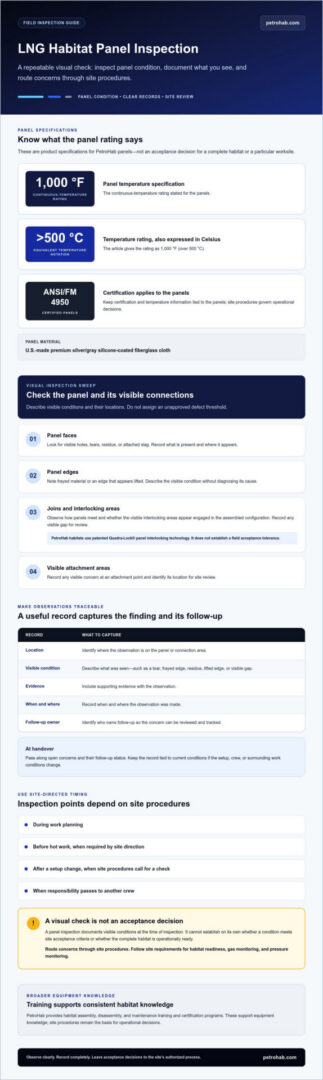
Use This LNG Habitat Panel Inspection Checklist in the Field
A field checklist works best when it follows a clear sequence and stays within its scope. This LNG habitat panel inspection covers the panels, not every system or condition needed for work readiness. Use site processes to determine inspection timing, acceptance criteria, and approvals. Gas and pressure monitoring belong to the applicable system procedures, not this panel checklist.
Before, during, and after the panel check
Adapt the sequence below to site documentation practices. Identify the habitat and panels in scope before starting. Examine visible areas without dismantling components, then record findings and route concerns through the established process.
- Confirm scope: Use site records to identify the habitat, its model, and the panels included in the check. Refer to site procedures for timing and required approvals.
- Examine visible areas: Review accessible panel faces, edges, joins, and attachment areas. Observe and describe conditions. Do not dismantle the habitat or infer readiness from appearance alone.
- Record observations: Note the panel location, what was observed, who performed the check, and when, following site documentation practices. Include photographs only if site rules permit and the records can be controlled.
- Route concerns: Communicate any condition that raises concern through the site’s established process. Leave disposition and approval to the roles designated by that process.
Keep this record focused on panel condition. It does not verify gas readings, pressure, or other operational requirements. Those checks remain governed by the relevant system procedures and full habitat readiness process.
Keep the checklist specific to the habitat model
A checklist should identify the equipment it applies to rather than assume every habitat has the same layout. Petro-Habitat™, Petro-Shield™, and Petro-Lite™ are PetroHab HWSE product names. Use site records to identify the model under inspection, and do not assume its panel arrangement or components are identical to another model or interchangeable. For wider system context, advanced hot work safety systems help place panel checks within the larger safety approach.
At handover, carry forward the habitat identifier, areas checked, recorded observations, and any open follow-up. This makes the next review easier to connect to the same equipment and site process without treating an earlier check as current approval. Maintain controlled records according to site practice.
Build a panel checklist around the habitat model and inspection sequence your crews use. Explore PetroHab habitat systems for model-specific planning context.
Connect Panel Inspection to PetroHab Habitat Training and Support
A consistent panel record has value beyond the individual inspection. Over time, location-specific observations can help teams identify recurring concerns, plan maintenance reviews, and give incoming crews a clearer picture of equipment history. A single entry describes one visible condition; records linked by habitat and panel location can help qualified personnel assess whether similar observations have appeared before.
Keep records factual. Note what was observed, where it was found, and what follow-up occurred under site procedures. Do not treat a series of notes as an independent acceptance standard or use the checklist to replace maintenance instructions, system procedures, or personnel training. Decisions about inspection findings remain with the roles and processes designated by the site.
Make inspection findings useful for maintenance planning
Consistent identifiers make handovers more reliable. When one crew records an observation by habitat and panel location, the next crew can relate later notes to the same area instead of relying on memory or vague descriptions. That history can inform maintenance planning and review, while qualified personnel determine the appropriate action under site procedures.
PetroHab provides training and certification programs for habitat assembly, disassembly, and maintenance. This training supports personnel who handle habitat systems and need to understand their responsibilities within established work practices. It complements, but does not replace, site-specific procedures or approvals required for an operation.
Choose a clear next step for an LNG project
When discussing a habitat requirement, sharing the work scope and inspection context can make the conversation more focused. Useful project information may include the planned hot work, the habitat model or configuration under consideration, the worksite environment, and inspection or maintenance concerns the team needs to address. Keep observations distinct from decisions, and describe project constraints through the site’s established process.
PetroHab offers habitat options for lease and sale. The right path depends on project requirements and planning. Personnel responsible for ongoing assembly, disassembly, or maintenance can also consider PetroHab’s training and certification programs as part of crew preparation. These resources support a disciplined approach to habitat use without replacing operational controls or site approval processes.
Clear records, capable personnel, and project-specific planning help connect habitat requirements to the work. To discuss your LNG habitat requirements, contact PetroHab.
Put a Consistent Inspection Practice to Work
A checklist is more useful when it fits the way your site records equipment condition and routes follow-up. Use this LNG habitat panel inspection approach to align location references, record ownership, and handover practices with site procedures. The goal is a dependable history that helps crews carry observations forward without turning notes into an acceptance decision.
As project requirements evolve, review whether the inspection record still reflects the habitat configuration, work scope, and roles involved. Keep the process practical for field crews, and make sure changes follow the site’s established review and approval channels. Consistency across shifts supports clearer communication and deliberate follow-up.
For a project-specific discussion of habitat requirements, discuss your LNG habitat requirements with PetroHab. A clear scope is a practical starting point for planning next steps.
Frequently Asked Questions
How often should LNG habitat panels be inspected?
There is no universal inspection interval specified here. Follow project site procedures and applicable manufacturer guidance for timing, responsible personnel, and documentation. Use the LNG habitat panel inspection checklist at the stages your procedures require, such as after a setup change or before a designated work phase. Record the date and panel location so reviewers can distinguish a new finding from an earlier entry. An informal check does not replace required inspections or approvals.
What should I do if I notice damage on a habitat panel?
Pause work when panel integrity is in question, as required by the site process. Identify the panel and location, describe the visible damage without diagnosing its cause, and route the observation to the designated reviewer. For example, write “tear at upper edge of panel by east access” rather than assigning a pass or fail. Do not improvise a repair or return the panel to service based on appearance alone. Follow authorized guidance for disposition.
Does ANSI/FM 4950 certification mean a habitat is suitable for every LNG worksite?
No. PetroHab panels are ANSI/FM 4950 certified and have a continuous-temperature rating of 1,000 °F (over 500 °C). Those panel specifications do not establish that every habitat configuration suits every LNG worksite, task, or operating condition. For example, the stated temperature rating alone does not determine whether a particular setup meets project requirements. Apply the site-specific assessment and procedures to the intended work, conditions, and required approvals.
Can a visual panel check replace a full habitat readiness review?
No. A visual check records panel conditions that can be observed; it does not verify every habitat component or operating system. Keep readiness review, system monitoring, and work authorization within their separate site processes. For example, a panel record cannot substitute for required gas or pressure monitoring. Treat panel findings as one part of the broader review, and follow project procedures to establish overall readiness before work proceeds.
What information should an LNG habitat panel inspection record include?
Follow site documentation requirements and include enough detail for another crew to identify the same area. A useful entry names the habitat, panel location, inspection date, observer, and visible condition in plain language. If a photograph is permitted, link it to the corresponding record and use approved storage. Also note who received any escalation and where follow-up was routed. Leave acceptance limits and approval decisions to authorized site personnel.
Can habitat panels be repaired in the field?
Do not assume a panel can be repaired in the field or use a repair method without authorized instructions. Document the condition and follow the site’s escalation process for disposition. An improvised repair can leave uncertainty about panel integrity, so maintenance should follow applicable approved procedures. PetroHab provides training and certification programs that include habitat maintenance for personnel responsible for maintaining habitat systems.