Blog Posts
Modular Safety Enclosures: 2026 Engineering Guide
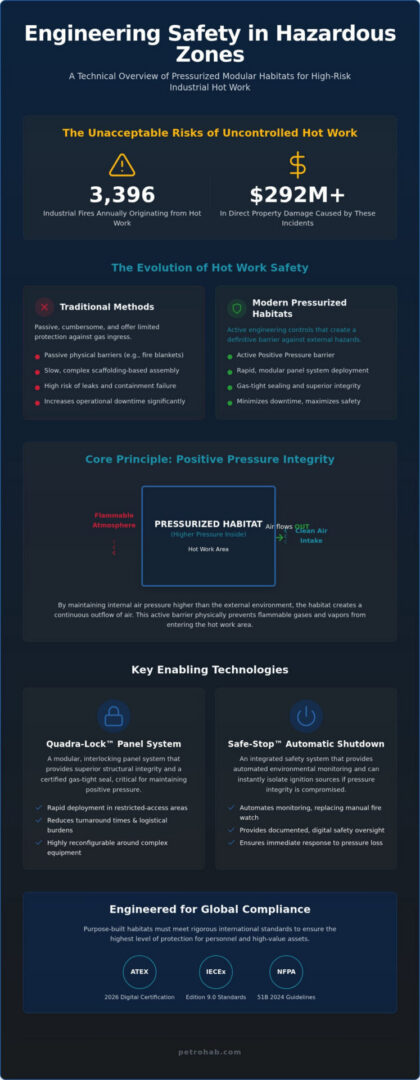
In high-stakes industrial environments, a modular safety enclosure must function as an active pressurized barrier rather than a passive shield. When you’re managing hot work in Zone 1 or Zone 2 areas, the margin for error is nonexistent. You’ve likely seen how traditional scaffolding-based containment slows down operations and introduces unnecessary complexity. With an average of 3,396 industrial fires originating from hot work annually, resulting in over $292 million in direct property damage, the stakes for your facility couldn’t be higher.
We recognize that safety managers face immense pressure to maintain regulatory compliance while minimizing production downtime. This guide promises to help you master the technical requirements for deploying pressurized habitats that ensure zero-incident execution. We’ll analyze the operational benefits of the Quadra-Lock interlocking system and the Safe-Stop automatic shutdown system. By the end of this article, you’ll understand how to align your site with the 2026 ATEX digital certification mandates and IECEx Edition 9.0 standards to protect both your personnel and your high-value assets.
Key Takeaways
- Understand the engineering principles of positive pressure and how active habitats function as a definitive barrier against flammable atmosphere ingress.
- Master the technical selection criteria for a modular safety enclosure by evaluating fire-resistance ratings and aligning with 2026 ATEX digital certification mandates.
- Explore the logistics of on-site assembly for Quadra-Lock systems within restricted-access areas to reduce turnaround times and logistical burdens.
- Learn to integrate Safe-Stop technology for automated environmental monitoring, shifting from manual fire watches to documented, digital oversight.
- Acquire the engineering protocols necessary to maintain regulatory compliance under the latest 2024 NFPA 51B and 2026 international safety guidelines.
Understanding the Role of Modular Safety Enclosures in Industrial Operations
In the high-stakes environment of oil and gas production, a modular safety enclosure serves as a critical engineering control. It’s not merely a physical barrier. It’s a sophisticated system designed to isolate hot work activities, such as welding and grinding, from potentially explosive atmospheres. These enclosures provide a controlled environment where ignition sources are managed with technical precision, ensuring that maintenance doesn’t compromise site-wide safety.
The industry has moved beyond passive containment. While fire blankets and simple partitions once sufficed, modern safety protocols demand active pressurized habitats. These systems use a Positive pressure enclosure methodology to maintain internal air pressure higher than the external environment. This pressure differential prevents the ingress of flammable gases, transforming a high-risk work area into a manageable operational zone. This transition is essential for refineries and offshore platforms where production downtime must be minimized without increasing the risk of ignition in Zone 1 or Zone 2 environments.
The Evolution of Hot Work Safety Enclosures (HWSE)
The journey from basic fire-retardant materials to the modern PetroHab Hot Work Safety Enclosure (HWSE) reflects a commitment to operational excellence. Early methods were often cumbersome and offered limited protection. Today’s modular systems utilize Quadra-Lock panels to provide superior structural integrity and gas-tight sealing. This modularity is vital for offshore maintenance where deck space is restricted. It allows for rapid deployment and reconfiguration around complex site geometries, directly improving Permit-to-Work (PTW) efficiency. Engineers can now authorize hot work in areas previously deemed too hazardous, reducing turnaround times significantly.
Distinguishing General Enclosures from Hazardous Zone Habitats
It’s vital to distinguish between general industrial enclosures and those engineered for hazardous zones. General enclosures often focus on noise reduction or debris containment. However, they lack the specialized fire ratings and structural resilience required for hydrocarbon-rich environments. A true modular safety enclosure must meet rigorous international standards such as ATEX and IECEx. These regulations mandate specific performance criteria:
- Fire Resistance: Materials must withstand intense heat and prevent flame spread.
- Positive Pressure: The system must maintain a constant barrier against external gases.
- Automatic Integration: The enclosure should interface with systems like the Safe-Stop Automatic Shutdown System to isolate ignition sources if pressure is lost.
Standard machine enclosures don’t provide the level of protection necessary for oil and gas operations. Relying on inadequate containment risks catastrophic failure and regulatory penalties. Using a purpose-built system ensures that every component is calculated to protect personnel and high-value assets.
The Engineering Behind Pressurized Modular Habitats
Designing a modular safety enclosure requires a deep understanding of fluid dynamics and thermodynamics. It’s not enough to simply enclose a workspace. You must create a controlled environment that actively rejects external hazards. The structural integrity of the system must withstand the internal forces of pressurization while maintaining a gas-tight seal against the surrounding atmosphere. Every component must be calculated to resist heat and prevent the entry of hydrocarbons.
Maintaining Positive Pressure Integrity
The core safety mechanism relies on maintaining a precise pressure differential. Positive pressure serves as the primary defense against gas ingress by ensuring air only flows outward from the enclosure. This is achieved by drawing air from a confirmed clean source through specialized ducting. These air intake systems must be strategically positioned to avoid cross-contamination from local exhaust. Systems must maintain a minimum overpressure, typically monitored by high-precision manometers that provide real-time feedback to safety supervisors. Continuous air monitoring ensures that air exchange rates are sufficient to remove welding fumes while preventing the buildup of combustible gases. Compliance with OSHA 1910.252 demands these rigorous fire prevention measures during all hot work operations.
Panel Technology and Structural Sealing
Sealing modular joints presents a significant engineering challenge in temporary structures. While some systems rely on fire-resistant fabrics, rigid panel systems offer superior durability in high-pressure environments. Standard fasteners often fail to provide the necessary gas-tight seal under constant vibration or mechanical stress. This is where specialized locking mechanisms become essential. The Quadra-Lock system utilizes a patented interlocking design that creates a seamless barrier without the need for tools. These panels are engineered to accommodate complex pipe penetrations and irregular geometries common on offshore rigs.
Structural stability is non-negotiable. The enclosure must remain rigid even when subjected to significant internal pressure or external wind loads. Every component, from the flame-retardant panels to the reinforced ducting, is a link in a safety chain. If you’re evaluating systems for an upcoming turnaround, you can review technical specifications for high-performance pressurized habitats to ensure your site meets the highest safety benchmarks. A properly engineered modular safety enclosure doesn’t just meet standards; it provides the stoic reliability required for life-critical operations.
Key Selection Criteria for High-Risk Modular Safety Enclosures
The selection of a modular safety enclosure is a life-critical decision that requires technical rigor. You can’t rely on generic fire-rated labels. High-hazard operations demand materials that resist ignition while maintaining structural integrity under the extreme thermal stress of welding or grinding. You must ensure the system provides a definitive barrier that aligns with your facility’s specific risk profile. Evaluating fire resistance means looking beyond basic Class A ratings; you need documented performance data under hydrocarbon-fire conditions.
Compliance and Certification Standards
Compliance isn’t static. It’s a moving target defined by evolving global regulations. You must understand the latest hazardous environment standards, including the 2026 ATEX 2014/34/EU Guidelines and the IECEx System Edition 9.0. These updates emphasize digital certification and verifiable documentation for explosion-proof equipment. Specifically, equipment placed in the EU after July 21, 2026, must include a digital e-Certificate accessible through the EU-CE-Portal. When evaluating a supplier, verify their ATEX Zone 1 and Zone 2 certifications against third-party testing data. A manufacturer’s internal claims aren’t a substitute for international validation. If a system doesn’t meet the 2024 NFPA 51B standards for documented digital permits and fire prevention, it’s an operational liability.
Operational Flexibility and Portability
Technical specs mean little if the system can’t be deployed where it’s needed. For offshore assets, weight is a primary constraint. You must consider deck loading limits and the logistical burden of transporting heavy components. A modular safety enclosure should offer a tool-free assembly process to reduce turnaround times. The Quadra-Lock interlocking mechanism facilitates rapid setup without the need for specialized fasteners that can be lost or compromised. This modularity allows the enclosure to adapt to complex pipe geometries and restricted-access areas. Partnering with hot work safety enclosure suppliers who offer global logistics support ensures that certified technicians and equipment are available in major energy hubs like Houston, Brazil, or the UK.
Finally, assess integration capabilities. The enclosure shouldn’t operate in isolation. It must interface with active safety systems like the Safe-Stop Automatic Shutdown System. This integration moves your site from passive containment to a proactive safety posture where ignition sources are automatically isolated if environmental conditions deteriorate. This level of control is what distinguishes a professional habitat from a simple fire blanket.
Deploying Modular Safety Enclosures in Zone 1 and Zone 2 Areas
Deployment in high-hazard zones is a procedural exercise in risk mitigation. Engineers must conduct a site-specific risk assessment before any equipment arrives on-site. This includes identifying potential gas release points and ensuring the substrate can support the habitat. A modular safety enclosure must be positioned to avoid blocking emergency egress routes or critical safety equipment. Site preparation involves clearing debris and confirming the availability of a clean air source for the pressurization system. This phase ensures that the technical remedy aligns perfectly with the hazardous conditions present.
The Assembly and Setup Process
Assembly begins by establishing a secure footprint around the work area. Technicians use Quadra-Lock panels to navigate existing infrastructure like pipe racks and valves. Sealing these penetrations is the most technical phase. Every gap must be closed to maintain the pressure differential. Once the structure is rigid, technicians connect the air intake systems and gas detection sensors. A final pressure test is mandatory. This test verifies that the habitat can maintain the required overpressure before the safety lead issues a hot work permit. It’s a calculated process that leaves nothing to chance.
Monitoring and Maintenance During Operations
Operational safety doesn’t end with assembly. A certified habitat technician must provide continuous oversight. They monitor internal air quality to manage heat stress and ensure oxygen levels remain within safety limits. This oversight is critical in high-ambient-temperature environments where worker fatigue can lead to errors. The technician also manages the interface with the Safe-Stop Automatic Shutdown System. If sensors detect hazardous gases at the air intake or if internal pressure drops, the system immediately isolates the welding power source. This automated response eliminates human error during an emergency, acting as a stoic guardian of the site.
Effective deployment requires a blend of advanced hardware and seasoned expertise. You can request on-site supervision from PetroHab technicians to ensure your next turnaround meets these rigorous standards. Proper training for all personnel involved ensures that emergency protocols are executed without hesitation. This disciplined approach protects your high-value assets and ensures that hot work remains a controlled activity rather than a variable risk. Maintaining this level of operational excellence is the only way to achieve zero-incident performance in Zone 1 or Zone 2 environments.
PetroHab Modular Solutions: Engineering Safety with Quadra-Lock Technology
PetroHab provides the definitive technological remedy for hot work hazards in high-risk industrial zones. The PetroHab Hot Work Safety Enclosure (HWSE) is an engineered solution that transforms hazardous areas into controlled environments. It’s a system built on decades of field experience and technical rigor. By deploying this modular safety enclosure, operators can execute critical maintenance without halting production or compromising the safety of personnel and high-value assets. This disciplined approach to risk mitigation ensures that your facility remains operational while adhering to the most stringent safety protocols.
Why Quadra-Lock is the Industry Benchmark
The Quadra-Lock panel technology serves as the foundation of every PetroHab habitat. Quadra-Lock panels utilize a patented interlocking mechanism that creates a seamless, gas-tight barrier without the need for tools or complex fasteners. These panels are manufactured from high-performance, fire-resistant materials designed to withstand the extreme thermal stress of welding and grinding. Their durability is proven in harsh offshore and desert environments where corrosive salt air and intense heat degrade inferior containment systems. This modular architecture allows the system to scale and adapt to diverse hot work safety systems, providing structural integrity even when navigating complex site geometries and restricted-access areas.
Total Safety Integration
A physical barrier is only one component of a modern safety strategy. PetroHab bridges the gap between passive containment and active protection by integrating the Safe-Stop Automatic Shutdown System. This electronic control unit provides 24/7 environmental monitoring, interfacing directly with the facility’s existing emergency systems. If internal gas detectors identify a breach or if the pressure differential fails, Safe-Stop immediately isolates all ignition sources. This proprietary gas monitoring is essential for ignition prevention in Zone 1 and Zone 2 areas. PetroHab supports these technologies with a global service network, offering leasing, sales, and certified on-site supervision in major energy hubs like Houston and the UK. You should Request a technical consultation for your next project to ensure your site adheres to the highest engineering standards for pressurized habitats.
Securing Operational Excellence Through Advanced Pressure Containment
Deploying a high-performance modular safety enclosure is a strategic investment in risk mitigation and asset protection. This guide has detailed the technical shift from passive fire blankets to active pressurized habitats that utilize a calculated pressure differential to reject flammable gases. You’ve seen how structural integrity depends on specialized interlocking mechanisms rather than standard fasteners. Maintaining compliance with 2026 ATEX and IECEx standards ensures your site meets the most rigorous international safety benchmarks.
PetroHab remains the industry guardian, offering patented Quadra-Lock panel technology and the Safe-Stop Automatic Shutdown System to provide 24/7 protection. Our global technical support and on-site supervision teams ensure that every deployment adheres to precise engineering protocols, even in the most restricted-access environments. By prioritizing these advanced containment solutions, you protect your personnel and eliminate the variables that lead to catastrophic failures.
Contact PetroHab for a Modular Safety Enclosure Quote to secure your next turnaround with the industry’s most reliable technology. We’re ready to partner with you to achieve zero-incident hot work execution.
Frequently Asked Questions
What is the difference between a standard enclosure and a modular safety enclosure for hot work?
Standard industrial enclosures typically serve as passive barriers for noise reduction or debris containment. In contrast, a modular safety enclosure is an active engineering control designed for hazardous zones. These systems utilize fire-resistant materials and maintain positive pressure to prevent the ingress of flammable gases. Unlike general partitions, these enclosures meet rigorous international standards like ATEX and IECEx, ensuring they can safely isolate ignition sources in explosive atmospheres.
Can modular safety enclosures be used in Zone 1 hazardous areas?
Yes, certified modular safety enclosures are specifically engineered for deployment in both Zone 1 and Zone 2 hazardous areas. These environments require specialized equipment that prevents ignition in the presence of explosive gases. By maintaining a constant positive pressure differential, the enclosure ensures that flammable vapors cannot enter the workspace. This technical capability allows critical hot work to proceed safely in areas where it would otherwise be prohibited by traditional safety protocols.
How does a pressurized habitat prevent explosions during welding?
A pressurized habitat prevents explosions by maintaining internal air pressure at a higher level than the surrounding atmosphere. This pressure differential creates a continuous outward airflow at any seal or opening. If a gas leak occurs externally, the positive pressure physically blocks the gas from entering the enclosure. When integrated with the Safe-Stop system, the habitat provides an active defense by monitoring environmental conditions and automatically isolating ignition sources if pressure integrity is lost.
What certifications should I look for in a modular safety enclosure?
You should prioritize systems that hold current ATEX and IECEx certifications for use in explosive atmospheres. These international standards verify that the equipment meets specific safety performance criteria. Additionally, compliance with the 2024 edition of NFPA 51B is essential for fire prevention during hot work operations. For EU operations, ensure the system includes the 2026 digital e-Certificate. These certifications serve as technical anchors for quality and regulatory compliance in high-risk industrial sectors.
Are these enclosures suitable for both onshore and offshore applications?
These systems are versatile and engineered for both onshore refineries and offshore oil platforms. Onshore applications often focus on maintaining production during plant turnarounds. Offshore, the modularity of the Quadra-Lock system is critical due to deck loading constraints and restricted deck space. The fire-resistant materials are also designed to withstand the corrosive salt-air environments typical of maritime operations, ensuring durable protection regardless of the facility’s geographic location or environmental challenges.
What happens if the automatic shutdown system detects gas?
If the Safe-Stop Automatic Shutdown System detects hazardous gas at the air intake or a loss of internal pressure, it immediately isolates all ignition sources. This includes cutting power to welding machines, grinders, and other electrical equipment within the habitat. The system acts as an uncompromising guardian, removing the factor of human error during an emergency. This automated response ensures that hot work cannot continue if the environment becomes unsafe, protecting both the personnel and the facility.
How long does it take to assemble a PetroHab HWSE on-site?
Assembly time varies based on the complexity of the site geometry and the enclosure size. However, the tool-free Quadra-Lock panel system is designed for rapid deployment compared to traditional containment methods. Most standard configurations can be assembled and pressure-tested within a single shift. This efficiency reduces logistical burdens and minimizes turnaround downtime, allowing maintenance teams to begin hot work activities sooner while maintaining a rigorous commitment to site-wide safety and operational excellence.
Is on-site training required for operating modular safety enclosures?
Professional training is highly recommended to ensure the system is operated according to precise engineering specifications. PetroHab offers certified on-site supervision and comprehensive training programs for client personnel. These programs cover the proper setup of Quadra-Lock panels, the calibration of gas detection sensors, and emergency shutdown procedures. Having trained technicians on-site ensures that the habitat maintains its integrity throughout the project, mitigating operational risks and ensuring the protection of high-value assets.