
Blog Posts
Remote LNG Habitat Logistics: A Safety-First Planning Checklist
A habitat shipment is only one part of the job. At a remote LNG site, access constraints, site readiness, work sequencing, and removal all affect how hot-work preparation proceeds. Treat remote LNG habitat logistics as safety-critical project scope, with responsibilities and interfaces defined before equipment moves.
Transport plans need to align with the work area, permit controls, and the people preparing and assembling the enclosure. A gap in any handoff can delay deployment or leave safety checks unresolved. This checklist helps you identify logistics tasks early, assign project owners, and coordinate mobilization, site readiness, setup, and demobilization.
It also explains how modular, pressurized habitats built with Quadra-Lock® panels and the Safe-Stop Safety Shutdown System (SSS) can support project planning, alongside training for assembly and disassembly. Use the sequence to align habitat delivery and removal with site conditions, project requirements, and the controls that protect personnel and assets throughout the work.
Key Takeaways
- Treat remote LNG habitat logistics as safety-critical project scope, separate from LNG cargo movement and its procedures.
- Sequence the work from scope definition and equipment movement through site preparation, deployment, work support, and demobilization.
- Assess access, staging, assembly space, work scope, and operating conditions as planning inputs. Resolve project-specific requirements with the responsible teams.
- Assign an accountable role and resolution point to each checklist item so open tasks are visible before they affect deployment.
- Include habitat configuration, Safe-Stop system needs, and training for assembly, disassembly, and maintenance in the deployment plan.
What Remote LNG Habitat Logistics Must Cover Before Hot Work Begins
Remote LNG habitat logistics is the coordinated planning of equipment movement, site readiness, habitat deployment, work support, and removal for a defined hot-work scope at a remote LNG facility.
This scope is distinct from the movement of LNG itself. Remote access, work location, site layout, and the planned activity sequence all shape how an enclosure and its associated systems reach the work area and are prepared for use. A delivery that arrives before access or staging is ready can disrupt the sequence. A change in work scope can affect the habitat configuration and support required. Treat these as connected project interfaces, not assumptions to resolve after mobilization begins.
Build the site-specific plan with the project safety team and align it with applicable site procedures. The habitat plan supports the project’s controls, but does not replace them. LNG cargo handling and hot-work enclosure deployment involve different equipment, tasks, and safety processes. An overview of Liquefied natural gas (LNG) explains the fuel’s production and transportation context. Habitat logistics, by contrast, must be planned around the work area and project scope.
Which project details should shape the logistics plan?
Start with the details that determine where the habitat must go and what the job requires. Record the work location, hot-work scope, expected work sequence, and required habitat configuration. Then identify access constraints, staging space, and project-defined movement arrangements. This information helps the responsible teams coordinate equipment movement and site preparation without assuming that one route, staging method, or schedule suits every site.
Assign clear owners for logistics coordination, site readiness, safety review, and habitat support. Each owner should know which decisions they control and when those decisions are needed. For example, the site-readiness owner should resolve access and staging interfaces early enough to inform deployment planning. The safety review should align the habitat plan with applicable procedures before hot-work preparation begins.
How does habitat logistics differ from LNG supply logistics?
LNG supply logistics move fuel through production, transportation, storage, and delivery stages. Habitat logistics coordinate a hot-work enclosure and associated systems for a defined work scope at a facility. The cargo chain and habitat deployment plan may intersect at a remote site, but they are not interchangeable. Keep their planning inputs and safety procedures distinct, then coordinate site interfaces through the responsible project teams.
This distinction helps prevent a common planning gap: assuming a well-coordinated fuel delivery also accounts for enclosure access, staging, assembly readiness, or removal. The habitat plan must address these work-specific interfaces directly. Before mobilization, align the scope, configuration, movement arrangements, site readiness, and accountable owners with the project sequence and procedures.
How to Sequence Remote LNG Habitat Mobilization and Deployment
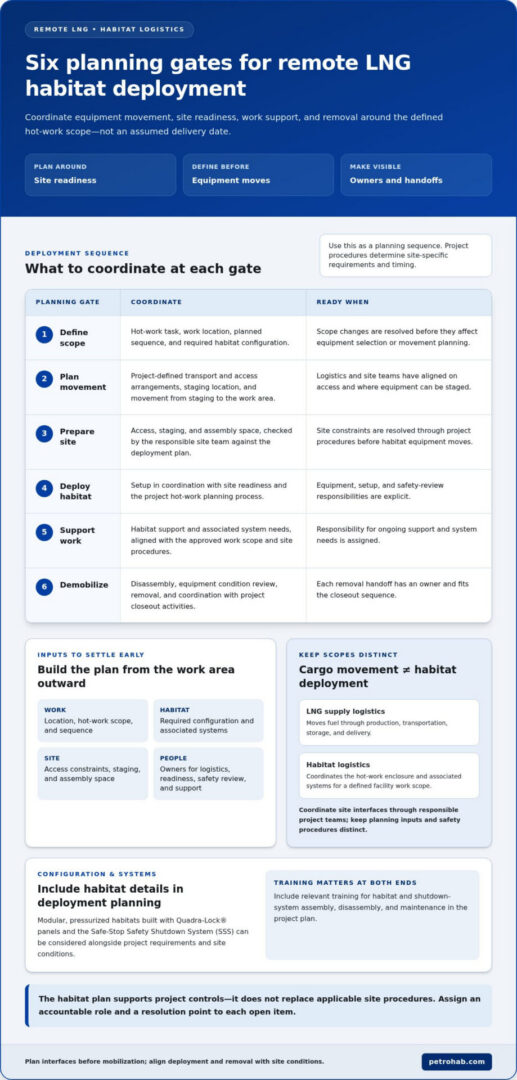
Sequence habitat work around readiness, not an assumed delivery date. Remote LNG habitat logistics depend on several handoffs: define the task and configuration, coordinate movement arrangements, prepare the work area, and clarify responsibilities before deployment. The project team sets site-specific requirements and timing through its procedures. Use this sequence as a set of planning gates, not a universal schedule.
- Define the work scope. Record the hot-work task, planned sequence, work location, and required habitat configuration. Resolve scope changes before they affect equipment selection or movement planning.
- Plan movement and staging. Coordinate project-defined transport and access arrangements with the logistics and site teams. Identify where equipment can be staged and how it will move from that location to the work area.
- Prepare the site. Have the responsible site team confirm that access, staging, and assembly space align with the deployment plan. Resolve constraints through project procedures before habitat equipment moves.
- Deploy the habitat. Coordinate setup with site readiness and the project hot-work planning process. Make equipment, setup, and safety-review responsibilities explicit.
- Support the work. Assign responsibility for habitat support and associated system needs in line with the approved work scope and site procedures.
- Demobilize and close out. Coordinate disassembly, equipment condition review, and removal with the project closeout sequence. Define who completes each handoff and how removal fits with other site activities.
What should be coordinated before the habitat moves?
Configuration comes first. Match the habitat to the hot-work task and available work area, then align movement and staging arrangements with the teams responsible for site access and logistics. If the planned assembly area is obstructed or inaccessible, equipment mobilization may not lead to timely setup. Resolve those interfaces during planning rather than leaving them to the deployment crew on arrival.
Plan for people and support as well as equipment. PetroHab provides training and certification programs for habitat and shutdown-system assembly, disassembly, and maintenance. Include relevant training in the project plan so the teams responsible for setup and removal understand their roles. The project’s responsible personnel determine applicable procedures and readiness criteria.
What are the deployment and demobilization handoffs?
Deployment should connect site readiness to the project’s hot-work planning process. Identify who controls equipment receipt, who performs or oversees setup, who completes the safety review, and who authorizes the next work phase under site procedures. Keep these assignments visible. An unclear handoff can leave a task unresolved even when equipment is in place.
Closeout needs the same discipline. Assign responsibility for disassembly, equipment condition review, and removal, and coordinate those tasks with the project sequence. For planning support on PetroHab habitat deployment, align the habitat configuration and training needs with the work scope before movement begins.
How Remote LNG Site Conditions Affect Habitat Logistics
Remote LNG habitat logistics must account for the actual work area, not just the distance equipment travels. Access, staging, assembly space, work scope, and operating environment each raise distinct planning questions. Treat them as project inputs. The project safety plan and site procedures determine the appropriate habitat configuration and controls; site conditions alone do not dictate a universal solution.
Use a planning table to identify what must be resolved before mobilization. Record the answer and responsible project role in the project plan, especially when access or layout depends on site decisions.
| Project condition | Planning question |
|---|---|
| Access | What route connects the designated receiving point to the planned work area, and what access limits apply? |
| Staging | Where can habitat equipment be held before deployment, and what project-defined handling arrangements apply? |
| Assembly space | Does the planned location provide space for the selected habitat configuration and its assembly? |
| Work scope | What hot-work task and work sequence will the enclosure support? |
| Operating environment | Which conditions and monitoring requirements must the project safety plan address? |
How should access and staging constraints be assessed?
Map the movement route from the designated receiving point to the work area. Compare it with project-defined access, handling, staging, and available-space limits. A route that reaches the facility may still leave an unresolved interface near the final work location, so include that segment in the review. Assign movement or access questions to the responsible project team and resolve them through site procedures before finalizing deployment arrangements.
How do configuration and operating conditions affect planning?
Match habitat dimensions and panel configuration to the hot-work scope and surrounding layout. Pressurized operation and pressure or gas monitoring requirements belong in project-specific safety planning, not in assumptions about a typical site. PetroHab’s Safe-Stop Safety Shutdown System (SSS) monitors differential pressure and gas levels and provides immediate shutdown in unsafe conditions. Align system requirements with the work plan and applicable site procedures.
When additional habitat space or environmental support is needed, Petro-Shield™ expands in 4-foot increments, and an optional air conditioner or heater can be attached. These features may shape configuration and deployment planning, but the work area and project safety plan remain the basis for selecting the appropriate arrangement. Document the selected configuration and site interfaces so logistics, assembly, and safety review use the same plan.
Revisit the planning questions if the work scope or site layout changes. A shift in work location can affect route access, assembly space, configuration, and monitoring interfaces at once. Keep those decisions connected: update the project plan, identify the owner for each open item, and coordinate deployment with the responsible site and safety teams.
Remote LNG Habitat Logistics Checklist for Project Teams
A usable checklist connects each task to an accountable role and decision point. For remote LNG habitat logistics, keep site-specific access rules, procedures, documentation, and scheduling requirements project-defined. The roles below are planning assignments; map them to your project structure and procedures.
What belongs on the pre-mobilization checklist?
- Planning: The work-scope owner records the hot-work task, sequence, habitat configuration, and equipment requirements before movement planning is finalized. The project coordinator identifies key contacts and unresolved decisions.
- Mobilization: The logistics lead coordinates receiving, movement, staging, and access arrangements with the responsible site and project teams before equipment is dispatched. The site team resolves route and staging questions under applicable project procedures.
- Workforce preparation: The assembly lead identifies relevant training needs for habitat and shutdown-system assembly, disassembly, and maintenance during workforce planning, before setup responsibilities are assigned.
What should the site-readiness checklist verify?
- Site readiness: The designated site representative compares the planned work area and staging arrangements with the current project layout before deployment. Resolve access or available-space changes with the responsible project team.
- Deployment: The habitat lead coordinates setup with site readiness and the project hot-work planning process. The safety representative aligns the review with applicable site procedures before work proceeds.
- Work support: The assigned support lead confirms that responsibilities for the habitat and associated systems are clear before work begins. Project procedures govern operating checks and monitoring requirements.
- Demobilization: The project closeout owner assigns responsibility for disassembly, equipment condition review, and removal before closeout activities begin. Record outstanding actions and their status.
For broader context on enclosure planning and function, use the hot work safety enclosure guide. Apply that context alongside project-specific requirements, not in place of them.
How should teams track handoffs?
Keep a concise handoff record with the project plan. It should make open actions visible to each incoming owner and distinguish unresolved items from completed checks. A simple format is enough:
- Open action: State the decision or task that remains.
- Owner: Name the accountable project role or person.
- Resolution point: Record the phase or readiness gate by which it must be closed.
- Status: Mark it open, in progress, or complete, and update it at each handoff.
Keep the record current as conditions or scope change. To align habitat planning with your project requirements, discuss habitat logistics with PetroHab.
How PetroHab Supports Remote LNG Habitat Deployment
Effective remote LNG habitat logistics depend on matching the enclosure, associated systems, and project support to the work scope. PetroHab manufactures modular, portable Hot Work Safety Enclosures (HWSEs) for hazardous industrial work. Its habitats are designed for pressurized operation, with configuration planned alongside the site layout and project safety plan.
All PetroHab habitats use patented Quadra-Lock® panel interlocking technology, U.S. Patent Nos. 9,545,775 and 9,517,609. Panels are made from U.S.-made premium silver/gray silicone-coated fiberglass cloth, ANSI/FM 4950 certified, and can withstand continuous temperatures of 1,000 °F (over 500 °C). These specifications inform equipment selection and configuration planning, while project teams remain responsible for aligning deployment with site procedures and work requirements.
Which PetroHab details matter to remote project planning?
Pressurized operation is one part of the habitat plan. PetroHab’s Safe-Stop Safety Shutdown System (SSS) monitors differential pressure and gas levels and provides immediate shutdown in unsafe conditions. The automatic shutdown systems are ATEX- and IECEx-certified (IEC 60079-13). Optional oxygen and/or carbon-dioxide detectors are available. Include the system and its operating requirements in project-specific safety planning so its role and coordination with site procedures are clear before work begins.
Configuration can also account for the surrounding work area. Petro-Shield™ offers modular expansion in 4-foot increments, and an optional air conditioner or heater can be attached. The project team can consider these features against the planned work scope and operating environment when defining the habitat arrangement. This links configuration decisions to deployment needs instead of treating equipment selection and site readiness as separate tasks.
These product details support planning, but do not replace project controls. The responsible project and safety teams determine applicable procedures, readiness requirements, and how habitat systems fit into the overall work plan. Keep those interfaces explicit as equipment, configuration, and support arrangements are coordinated.
How can teams plan support and equipment arrangements?
PetroHab manufactures, leases, sells, and maintains HWSEs. PetroHab stands almost alone in offering its patented and certified habitat systems for either lease or sale. Project teams can consider either procurement arrangement while aligning equipment planning with the defined work scope and deployment sequence.
Support planning includes people as well as equipment. PetroHab offers training and certification programs for habitat and shutdown-system assembly, disassembly, and maintenance. Include relevant training in workforce planning so responsibilities for setup, ongoing support, and removal are addressed in the project plan.
For technical context on pressurized systems, consult the pressurized welding habitat guide. The habitat procurement guide is another resource for purchase planning. To discuss how a PetroHab enclosure and associated systems fit your project’s deployment plan, connect with PetroHab about habitat options.
Make the Next Deployment Plan Project-Ready
Use the next project planning review to turn open logistics decisions into assigned actions. Confirm who owns each remaining interface, which site procedures govern it, and when the decision must be resolved to support deployment. This keeps remote LNG habitat logistics tied to the project’s actual work scope and readiness criteria, rather than assumptions that may not fit the site.
PetroHab reports well over a million incident-free man-hours, reflecting its commitment to safety in hazardous industrial work. The next step is to align a habitat solution with your project’s configuration, support, and procurement needs.
Explore PetroHab habitat solutions for your project and take the next step toward a deployment plan built around your site requirements.
Frequently Asked Questions
What does remote LNG habitat logistics include?
Remote LNG habitat logistics covers the project work needed to plan and move a hot-work habitat, prepare its work area, deploy it, support operations, and remove it after the job. It concerns the enclosure and associated systems, not the production, transportation, storage, or delivery of LNG cargo. The relevant project teams determine access arrangements, safety procedures, documentation, and responsibilities according to site requirements.
How do you prepare a remote LNG site for a hot-work habitat?
Start by documenting the hot-work scope, required habitat configuration, proposed work location, access route, and staging area. Compare these details with the current site layout, including changes that could affect equipment movement or setup. Coordinate habitat setup and safety review with the project team under applicable site procedures. Permit steps, documentation, and technical readiness criteria depend on the project process, so do not apply a universal checklist.
Can a pressurized habitat be used for hot work at a remote LNG site?
PetroHab habitats are designed for pressurized operation and to support hot-work safety in hazardous environments. Whether a particular habitat suits a remote LNG task depends on the defined work scope, site conditions, and project safety plan. PetroHab automatic shutdown systems monitor differential pressure and gas levels. The Safe-Stop Safety Shutdown System (SSS) provides immediate shutdown in unsafe conditions. The responsible project team must integrate these systems into its site-specific planning.
What does a habitat automatic shutdown system monitor?
PetroHab automatic shutdown systems monitor differential pressure and gas levels. They are ATEX- and IECEx-certified (IEC 60079-13), and optional oxygen and/or carbon-dioxide detectors are available. A project team can document which system options are part of its planned configuration and assign responsibility for addressing them in safety planning. These details describe monitoring and shutdown functions only and do not imply other capabilities.
How should a project plan habitat assembly and disassembly?
Place assembly and disassembly in the work sequence alongside access, staging, work-area readiness, and final equipment removal. Assign responsibility for setup and take-down before deployment, and include relevant training needs in workforce planning. PetroHab offers training and certification programs for habitat and shutdown-system assembly, disassembly, and maintenance. Align those needs with the project schedule and procedures so the teams responsible for each phase understand their tasks.
How quickly can Petro-Lite be set up at a remote worksite?
Petro-Lite™ has a simple modular design and can be set up by no more than two people in 5 minutes. It can attach to any standard scaffolding; optional stand-alone scaffolding is available when standard scaffolding is not present. This setup fact applies to Petro-Lite, not other PetroHab habitats. Include the scaffolding arrangement and setup responsibility in the site plan before equipment is deployed.
Should an LNG project lease or buy a hot-work habitat?
The choice depends on the project’s planned use, ownership needs, and equipment arrangements. PetroHab offers both lease and sale options, allowing teams to consider how a habitat fits their project planning. Avoid making the decision based on price assumptions or comparisons that are not specific to the project. Use the habitat procurement guide as part of your evaluation.