Blog Posts
UV Resistance of Habitat Panel Materials: Ensuring HWSE Integrity in 2026
In high-exposure industrial environments, the sun is as much a threat to structural integrity as a stray spark. While fire resistance is a primary focus, the UV resistance of habitat panel materials determines whether a Hot Work Safety Enclosure (HWSE) maintains its protective barrier or succumbs to catastrophic failure. You recognize that maintaining positive pressure is non-negotiable for personnel safety. However, the invisible process of photodegradation can turn reliable equipment into a liability through unexpected brittleness and loss of tensile strength.
This technical examination details the critical engineering required to safeguard your assets against solar degradation in 2026. We’ll identify high-performance materials like silicone-coated fiberglass that withstand both extreme thermal loads and intense radiation. You’ll gain a clear understanding of how our Quadra-Lock panels prevent environmental degradation, alongside an established protocol for identifying early signs of UV damage. By prioritizing rigorous material science, you ensure your pressurized habitats remain resilient guardians of your operational site.
Key Takeaways
- Understand how UV-induced photodegradation causes molecular chain scission, compromising the pressure containment capabilities of standard industrial fabrics.
- Evaluate the superior performance and long-term UV resistance of habitat panel materials like silicone-coated glass cloths compared to traditional PVC-coated polyesters.
- Implement rigorous field inspection protocols, including the thumb-pressure and flex-bend tests, to detect material brittleness before it leads to operational failure.
- Discover how Quadra-Lock technology integrates specialized UV inhibitors to maintain structural integrity and safety compliance in high-exposure offshore and desert environments.
The Critical Role of UV Resistance in Hot Work Safety Enclosures
UV resistance in the context of a Hot Work Safety Enclosure (HWSE) is defined as the ability of the enclosure panels to maintain their molecular integrity and mechanical properties under continuous exposure to solar radiation. It’s a critical safety metric that safety managers must prioritize. Without high-grade UV resistance of habitat panel materials, the polymers within the fabric undergo structural changes that compromise the entire safety system. This isn’t a cosmetic concern. It’s a fundamental threat to the pressurized environment required to isolate ignition sources from flammable gases.
In high-exposure regions like the Gulf of Mexico or the Middle East, extreme UV indices accelerate material fatigue. These environments subject the enclosure to intense solar energy that triggers the Mechanisms of Photodegradation. This chemical process breaks down the covalent bonds in the panel fibers, leading to a loss of tensile strength. For a comprehensive overview of how these factors influence total site safety, consult our Definitive Guide to Hot Work Safety Enclosures (HWSE) in 2026.
To better understand this concept, watch this helpful video:
Environmental Stressors in Oil and Gas Operations
Offshore platforms present a unique challenge where salt spray and UV radiation act in tandem. Salt crystals can act as microscopic lenses, intensifying solar heat gain and accelerating the degradation of untreated resins. This is compounded by thermal cycling. As panels absorb solar energy, they expand, only to contract as temperatures drop at night. This constant movement in a UV-weakened material leads to micro-cracking. These cracks eventually compromise the airtight seals necessary for maintaining positive pressure, rendering the HWSE ineffective.
UV Resistance vs. Fire Resistance: A Mandatory Synergy
It’s a common misconception among engineers that a fire-rated panel is inherently UV-stabilized. This is a dangerous assumption. While a material might successfully repel sparks or slag, it can still become brittle and fail structurally due to months of sun exposure. Safety excellence requires a synergy between flame retardancy and environmental durability. Regulatory bodies and international standards like ATEX and IECEx increasingly expect equipment to maintain its certified performance levels throughout its operational lifespan, regardless of environmental harshness. Utilizing the Quadra-Lock system ensures that the physical connection between panels remains secure, but the UV resistance of habitat panel materials ensures the fabric itself doesn’t become the point of failure.
Mechanisms of Photodegradation in Habitat Panel Polymers
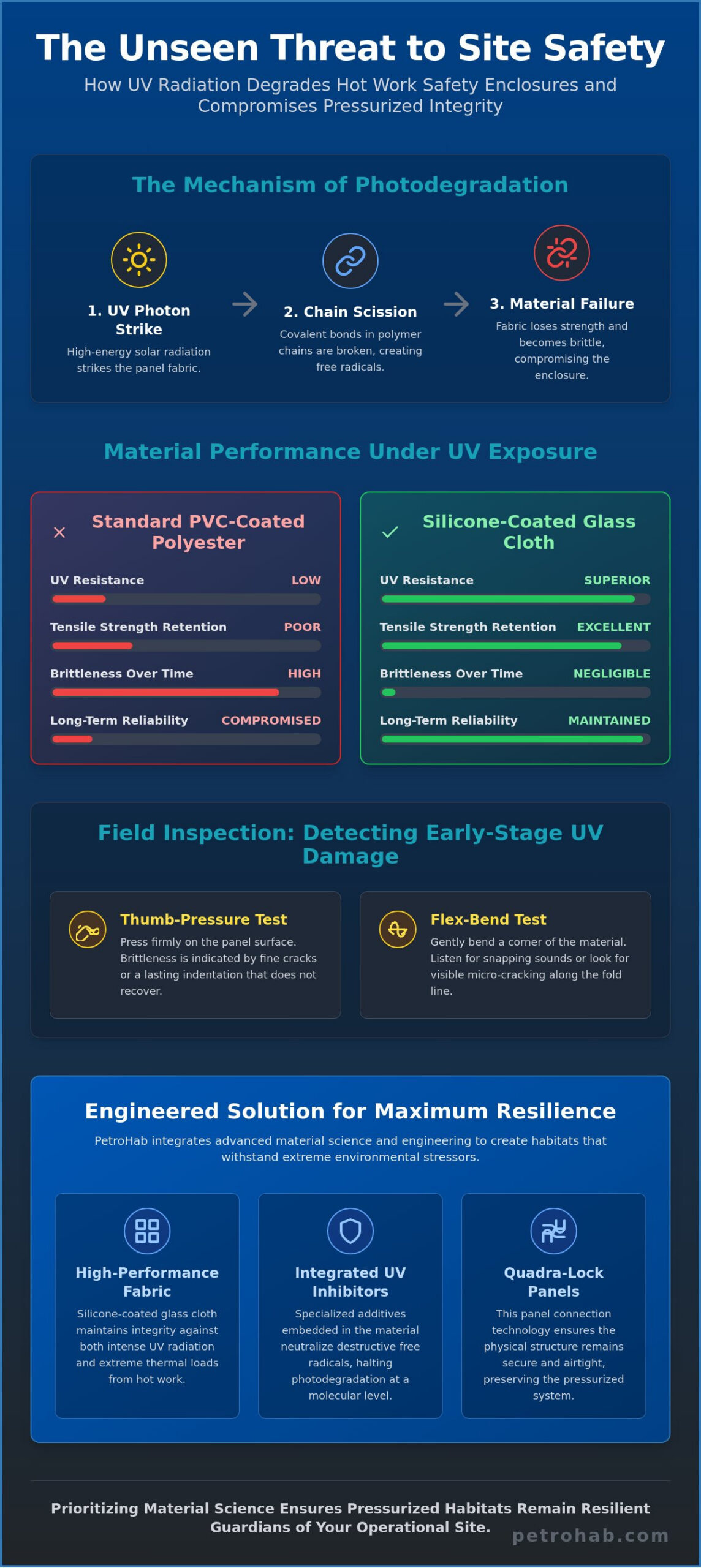
Photodegradation is the chemical alteration of polymers leading to structural failure. This process begins at the molecular level when high-energy UV photons strike the synthetic fibers of an enclosure. These photons carry sufficient energy to break the covalent bonds that hold the polymer chains together. This phenomenon, known as chain scission, results in a significant reduction in the material’s molecular weight. The Mechanisms of Photodegradation in Habitat Panel Polymers involve the creation of highly reactive free radicals. These radicals propagate a destructive chain reaction, accelerating the disintegration of untreated resins even after the initial solar exposure has ceased.
The technical impact on the UV resistance of habitat panel materials is severe and measurable. As the polymer chains break, the mechanical properties of the fabric degrade. Tensile strength, which is the material’s ability to resist pulling forces, drops sharply. Simultaneously, the “elongation at break” value decreases, meaning the material loses its elasticity and becomes prone to snapping rather than stretching. This loss of impact resistance ensures that a panel can no longer withstand the physical rigors of a heavy industrial site, such as contact with tools or high-velocity wind gusts.
Visual Indicators of Molecular Breakdown
Identifying the early stages of degradation is vital for risk mitigation. Safety inspectors should monitor for three primary visual cues:
- Chalking: The appearance of a white, powdery residue on the panel surface. This indicates that the protective resin is breaking down and releasing filler particles.
- Yellowing and Discoloration: A distinct shift in color suggests that the UV-inhibiting additives are depleted, leaving the base polymer vulnerable.
- Surface Crazing: The formation of a network of micro-fractures. These micro-cracks are the precursors to through-cracks that will eventually leak air.
The ‘Brittle Point’ and Pressure Loss
Once a material reaches its brittle point, it becomes a critical liability for Pressurized Welding Habitats. Brittle panels cannot maintain the integrity of the airtight seals required for positive pressure. A sudden tear in a UV-weakened panel can lead to rapid decompression. This creates an immediate hazard by allowing potentially explosive external gases to enter the workspace. For materials lacking proper stabilization, the useful operational life is often cut by more than half in high-exposure zones. To ensure your fleet meets these rigorous standards, you can evaluate our technical specifications for high-durability enclosures. Maintaining the UV resistance of habitat panel materials is not merely about equipment longevity; it is a fundamental requirement for preventing catastrophic seal failure during hot work operations.
Comparative Analysis: Standard vs. UV-Stabilized Panel Materials
Selecting the correct substrate is the first step in ensuring operational safety in high-exposure industrial sites. Standard PVC-coated polyesters are frequently used for general-purpose containment, but they lack the molecular stability required for pressurized welding enclosures. Under intense solar loads, these materials degrade rapidly, losing their ability to contain pressure. Silicone-coated glass cloths offer a superior alternative. These materials provide a higher threshold for both thermal resistance and chemical stability, making them the preferred choice for high-stakes environments. The UV resistance of habitat panel materials is significantly enhanced when these base fabrics are integrated with advanced chemical stabilizers during the manufacturing process.
Effective protection relies on the science of UV Inhibitors (UVI) and UV Stabilizers (UVS). While inhibitors work by absorbing and dissipating harmful radiation as low-level heat, stabilizers act as radical scavengers to stop the chemical chain reactions discussed in previous sections. You can find more technical data on these chemical behaviors in this Comparative Analysis of UV-Resistant Plastics. In high-quality panels, these additives migrate to the surface over time. This creates a sacrificial layer of protection that renews itself, ensuring the core fibers remain shielded from the sun. While UV-stabilized panels demand a higher initial investment, the total cost of ownership is lower. You avoid the frequent replacement costs and operational downtime associated with brittle, failing fabrics.
Performance Benchmarks for HWSE Panels
Engineers must look for materials that have undergone rigorous testing under ASTM G154 or G155 standards. These accelerated weathering tests simulate years of solar exposure in a controlled environment. A high-performance panel should retain at least 80% of its original tensile strength after 1,000 hours of continuous UV exposure. Material color also plays a role in degradation rates. While lighter-colored materials generally reflect more UV radiation, dark-colored panels can absorb more heat, potentially accelerating thermal degradation if the polymer is not correctly stabilized. Choosing a material that meets these benchmarks is essential for maintaining the integrity of the Quadra-Lock system.
The Limitations of Surface Coatings
It’s vital to distinguish between topical UV sprays and integrated masterbatch stabilization. Topical coatings are often marketed as a quick fix, but they’re inherently fragile in heavy industrial settings. Constant abrasion from wind-blown sand, personnel movement, and equipment handling quickly strips away surface-only protection. Once this thin layer is gone, the underlying material is completely exposed. Integrated masterbatch stabilization incorporates the UV resistance of habitat panel materials directly into the polymer matrix. This ensures that the protection is permanent and resistant to mechanical wear. Relying on topical treatments requires a constant, unreliable maintenance schedule that introduces unnecessary risk to the habitat’s pressure integrity.
Maintenance and Inspection Protocols for UV-Exposed Habitats
Rigorous maintenance protocols are the only defense against the progressive nature of solar damage. Safety managers must move beyond casual visual checks and implement a structured pre-deployment inspection checklist for every HWSE. This process ensures that the UV resistance of habitat panel materials remains within acceptable safety margins before the enclosure is pressurized. Failure to document these checks can lead to compliance gaps under the latest Hazardous Environment Standards, which dictate strict equipment integrity requirements for 2026.
Field testing for material brittleness is a primary component of these protocols. We recommend two definitive methods. The ‘thumb-pressure’ test involves applying firm pressure to a folded section of the panel. If the material exhibits permanent deformation or microscopic cracking at the fold, the polymer matrix has failed. The ‘flex-bend’ method requires bending a corner of the panel 180 degrees. An audible snapping sound or visible surface fracturing indicates that the material has reached its brittle point. Any panel failing these tests must be removed from service immediately to prevent a loss of positive pressure during hot work.
Inspection frequency should be dictated by the cumulative exposure hours and the local UV index. In regions where the UV index frequently exceeds 8, such as offshore equatorial sites, daily inspections are mandatory. For lower-exposure environments, a weekly deep-dive inspection is sufficient. All findings must be logged to track the lifecycle of the asset and ensure that the UV resistance of habitat panel materials is not being overextended.
Field Identification of UV Damage
Inspectors must use tactile feedback to identify the loss of plasticizers. UV-damaged fabric often feels “crisp” or leathery compared to the supple texture of new silicone-coated glass cloth. Focus your inspection on high-stress areas. The seams and Quadra-Lock attachment points are particularly vulnerable as they bear the mechanical load of the pressurized environment. It’s also important to differentiate between surface dirt and deep-seated photodegradation. While dirt can be cleaned, the yellowed, chalky appearance of molecular breakdown is irreversible and signifies a compromise in structural safety.
Storage and Lifecycle Management
Proper storage prevents “shadow degradation,” where panels are unevenly exposed to light while folded, creating weak spots along the fold lines. Modular panels should be stored in opaque, climate-controlled containers when not in use. Establishing clear retirement criteria is essential. Even high-performance panels have a finite lifespan. We recommend a maximum service life based on documented exposure data rather than just years in service. Utilizing protective covers during non-operational hours can significantly extend the life of these high-value assets. To optimize your fleet management, you can contact our technical team for a detailed inspection guide tailored to your specific operational environment.
PetroHab’s Engineering Solution: Quadra-Lock and UV-Resistant Technology
PetroHab defines the industry benchmark by treating UV resistance not as an optional feature, but as a critical engineering requirement. Our design philosophy centers on the reality that environmental degradation is a primary threat to habitat integrity. We’ve engineered our Hot Work Safety Enclosure (HWSE) to survive where others fail. By selecting proprietary silicone-coated fiberglass, we ensure the UV resistance of habitat panel materials exceeds the demands of high-UV offshore corridors. This technical precision ensures that every PetroHab enclosure remains a resilient barrier against ignition sources, even after prolonged exposure to aggressive solar radiation.
The integration of these materials with our Advanced Hot Work Safety Systems provides a comprehensive risk mitigation strategy. In high-UV offshore environments, such as the Gulf of Mexico and Middle Eastern energy corridors, PetroHab HWSE units have consistently maintained pressure integrity during long-term deployments. While standard fabrics often show signs of early-stage fatigue in these zones, our panels remain supple and secure. This performance is a direct result of our commitment to material science and mechanical engineering, ensuring that safety is never compromised by the elements.
The Quadra-Lock Advantage in Environmental Stability
The patented Quadra-Lock system is fundamental to our environmental stability strategy. Unlike traditional zipper or hook-and-loop fasteners that degrade and fail under UV exposure, the Quadra-Lock interlocking mechanism provides a secure, mechanical seal. This design minimizes stress concentrations across the fabric surface. By distributing the internal pressure load evenly, we prevent the micro-tearing that often occurs in UV-weakened materials. Our proprietary material blends are tested to ensure they meet and exceed international safety standards, providing long-term reliability for both our rental fleet and permanent sales clients. This mechanical durability complements the UV resistance of habitat panel materials, creating a system that is as resilient as it is safe.
Uncompromising Safety for Global Energy Leaders
We understand that technical precision in panel engineering is essential for protecting personnel and high-value assets. PetroHab’s hardware is designed to support the rigorous requirements of the Permit-to-Work (PTW) system. When safety managers specify our HWSE, they’re choosing a system built on a foundation of reliability and safety excellence. We don’t accept compromises in material durability because we know the high stakes of industrial hot work. If you’re managing operations in a high-exposure environment, don’t leave your pressure containment to chance. Contact PetroHab today for a technical consultation to ensure your site is protected by the industry’s most resilient habitat technology.
Securing Operational Integrity in Extreme Solar Environments
Maintaining the UV resistance of habitat panel materials is a fundamental requirement for the safe execution of hot work in 2026. As we’ve examined, the chemical process of photodegradation can turn a reliable safety enclosure into a structural liability if it’s not managed through engineered material selection and rigorous inspection protocols. You must prioritize materials that have been validated against international ASTM weathering standards to ensure positive pressure remains constant throughout the project lifecycle. This technical oversight prevents the brittleness and seal failure that compromise industrial safety.
PetroHab provides the definitive solution for high-exposure sites. Our patented Quadra-Lock technology ensures superior seal integrity, while our global track record in the world’s harshest UV environments proves the durability of our systems. By integrating advanced stabilization directly into the fabric matrix, we eliminate the risks associated with surface-only coatings. We invite you to Request a Technical Consultation for Your Next Offshore Project to verify your fleet’s compliance and safety readiness. Protecting your personnel and high-value assets begins with choosing equipment designed to withstand the relentless energy of the sun.
Frequently Asked Questions
How do I know if my habitat panels are UV-resistant?
You verify UV resistance by reviewing the manufacturer’s material technical data sheet for specific international testing certifications. High-performance panels must meet ASTM G154 or G155 standards for accelerated weathering. If a panel is constructed from silicone-coated glass cloth rather than basic PVC, it typically possesses superior baseline UV resistance of habitat panel materials.
What is the difference between UV inhibitors and UV stabilizers in safety panels?
UV inhibitors act as chemical filters that absorb radiation and convert it into harmless heat energy. UV stabilizers function as radical scavengers that intercept and neutralize the free radicals created during the photodegradation process. Combining both provides the most robust defense against molecular chain scission in harsh offshore environments.
Can I use a fire-resistant spray to add UV protection to my panels?
No, fire-resistant sprays don’t provide reliable UV protection and can actually interfere with the material’s original safety ratings. Integrated masterbatch stabilization is the only method that ensures the UV resistance of habitat panel materials remains effective under industrial abrasion. Topical treatments are fragile and fail quickly in high-wind or high-traffic zones.
How often should I inspect my HWSE panels for solar damage?
Inspection frequency depends on the local UV index and cumulative exposure hours. In regions with a UV index above 8, conduct daily tactile and visual checks. For lower-exposure sites, a weekly comprehensive inspection is sufficient to identify early signs of chalking or surface crazing before they compromise the habitat’s integrity.
Does UV damage affect the ATEX or IECEx certification of a habitat?
Yes, significant UV damage can void the ATEX or IECEx certification of an HWSE. These certifications are based on the equipment’s ability to maintain a pressurized environment and resist mechanical stress. If photodegradation makes the panels brittle or prone to tearing, the enclosure no longer meets the safety parameters defined by international regulatory standards.
What happens if a habitat panel fails while hot work is in progress?
If a panel fails during hot work, the enclosure will experience a rapid loss of positive pressure. This allows potentially explosive gases to enter the workspace from the external environment. In such a scenario, an automatic shutdown system like Safe-Stop must immediately terminate all ignition sources to prevent a catastrophic accident.
Are lighter-colored panels better for UV resistance than darker ones?
Lighter-colored panels generally reflect more solar radiation, which can reduce heat gain, but color isn’t a definitive indicator of durability. The chemical stabilization of the polymer matrix is the primary factor in long-term performance. A well-engineered dark panel with high-grade stabilizers will outperform a light-colored panel that lacks proper UV inhibitors.
Can UV damage be repaired, or must the entire panel be replaced?
UV damage is a molecular-level failure and can’t be repaired with patches or topical coatings. Once a panel reaches its brittle point or exhibits surface crazing, its structural integrity is permanently compromised. You must replace the affected panels to ensure the Quadra-Lock system maintains its safety performance and pressure containment capabilities.