Blog Posts
Welding Enclosure for Offshore Platform: The 2026 Safety & Compliance Guide
With 182 fires and two explosions recorded by BSEE in 2025, the margin for error during offshore hot work has effectively vanished. For safety managers, the choice often feels like a lose-lose scenario: risk a catastrophic ignition in a hydrocarbon-rich zone or absorb the $1.5 million daily revenue loss associated with a full production shutdown. You understand that maintaining 100% uptime isn’t just about efficiency; it’s about engineering the risk out of the environment. Deploying a certified welding enclosure for offshore platform maintenance is the only viable method to bridge this gap between operational continuity and absolute personnel safety.
This 2026 guide provides the technical expertise you need to master the regulatory standards and mechanical requirements for pressurized habitats. You’ll learn how to secure BSEE waivers for hot work within the 10-foot exclusion zone and ensure your systems meet IEC 60079-13 functional safety standards. We’ll analyze the critical role of Quadra-Lock panel technology in maintaining positive pressure and how Safe-Stop automatic shutdown systems provide an uncompromising layer of protection. By the end of this analysis, you’ll have a definitive blueprint for executing zero-ignition hot work on live offshore assets.
Key Takeaways
- Understand how positive pressure containment prevents hydrocarbon ingress, allowing for hot work in hazardous Zone 1 and Zone 2 environments.
- Learn why patented Quadra-Lock technology provides a superior airtight seal compared to standard hook-and-loop or zipper-based systems.
- Discover the specific process for securing BSEE waivers to deploy a welding enclosure for offshore platform repairs without shutting down live production assets.
- Master the integration of Safe-Stop technology to automate equipment shutdown upon gas detection or loss of enclosure pressure.
- Implement operational best practices, including site-specific risk assessments and deck-anchoring techniques, to ensure total stability on offshore platforms.
What is a Pressurized Welding Enclosure for Offshore Use?
A Hot Work Safety Enclosure (HWSE) is a high-integrity, modular habitat designed to isolate ignition sources from hazardous environments. Unlike basic fiberglass welding tents that merely catch sparks, a welding enclosure for offshore platform use is a pressurized system engineered for the extreme conditions of the energy sector. It creates a controlled environment where personnel can perform welding, grinding, and cutting operations while surrounded by potentially explosive atmospheres. The primary objective is to facilitate essential repairs on live assets without requiring a total production shutdown.
The high-integrity design of an HWSE offers several advantages over generic alternatives:
- Atmospheric Isolation: Prevents the ingress of flammable hydrocarbons through positive pressure.
- Fire Resistance: Panels meet stringent standards for continuous exposure to sparks and molten slag.
- Modular Flexibility: Adapts to complex platform geometries, wellbays, and piping configurations.
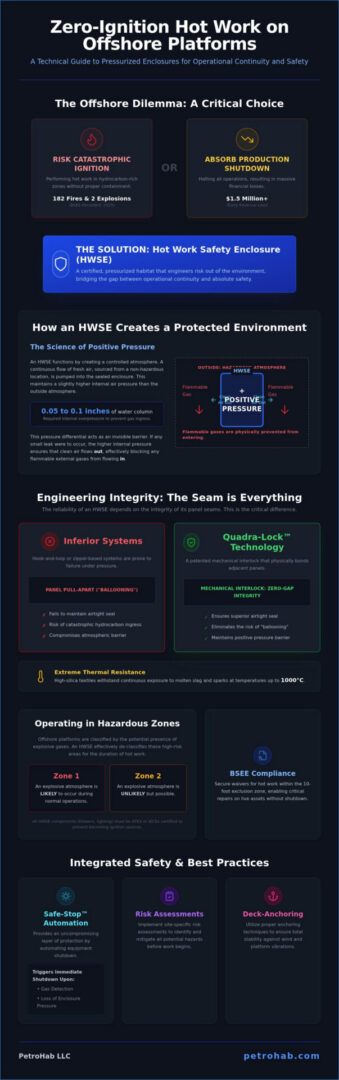
The system functions through a combination of physical containment and atmospheric control. By sealing the work area and introducing a continuous flow of air, the enclosure maintains a higher internal pressure than the surrounding atmosphere. This pressure differential acts as a physical barrier. If a leak occurs, air flows out of the enclosure, preventing flammable gases from entering. Maintaining this integrity allows operators to avoid the immense costs of unplanned downtime while adhering to Hot work safety standards.
The Science of Positive Pressure
To ensure total isolation, the internal environment is typically maintained at an overpressure between 0.05 and 0.1 inches of water column. This specific range is sufficient to counteract external wind speeds and atmospheric fluctuations common on offshore decks. Technicians utilize manometers to provide continuous verification of these pressure levels. If the pressure falls below the safety threshold, the system triggers an immediate alarm. It’s vital that the air intake is sourced from a verified non-hazardous location via flexible ducting to ensure no hydrocarbons are introduced to the personnel inside the habitat.
Hazardous Zone Classifications (Zone 1 & 2)
Offshore platforms are categorized by the frequency and duration of explosive gas presence. Zone 1 identifies areas where an explosive atmosphere is likely to occur during normal operations, while Zone 2 covers areas where such an atmosphere is unlikely but possible. A pressurized welding habitat effectively de-classifies these areas for the duration of the task. By creating a localized area of protection, the enclosure permits hot work in high-risk locations. All integrated components, including blowers and lighting systems, must carry ATEX or IECEx certification to ensure they don’t become ignition sources in these sensitive environments.
Engineering Integrity: The Quadra-Lock Advantage
The mechanical reliability of a welding enclosure for offshore platform operations depends entirely on the integrity of its panel seams. While inferior systems rely on hook-and-loop fasteners or industrial zippers, these methods often fail to maintain an airtight seal when subjected to internal pressurization or external environmental stress. Quadra-Lock technology establishes a superior standard by utilizing a mechanical interlock that physically bonds adjacent panels. Quadra-Lock is a patented interlocking system that ensures zero-gap integrity for pressurized environments. This design eliminates the risk of ballooning, a common failure mode where panels pull apart under pressure, compromising the atmospheric barrier and risking hydrocarbon ingress.
The fabric itself is engineered for extreme thermal resistance. PetroHab utilizes high-silica textiles capable of withstanding continuous exposure to molten slag and sparks at temperatures reaching 1000°C. This level of protection is critical for maintaining BSEE Compliance during heavy-duty welding tasks on live assets. Unlike standard fiberglass materials that may degrade or become brittle, these high-silica panels retain their structural flexibility and fire-retardant properties throughout the duration of the offshore deployment. This engineering ensures that the enclosure remains a resilient fortress against the thermal energy generated during hot work.
Modular Flexibility for Complex Platform Layouts
Offshore decks are rarely open spaces; they’re dense networks of piping, valves, and structural beams. The modular nature of Quadra-Lock panels allows engineers to construct a custom habitat around these obstructions. Whether you’re encapsulating a single wellhead or a large processing vessel, the panels can be configured to fit the specific geometry of the asset. This versatility significantly reduces mobilization time, as the lightweight, foldable components are easily transported and assembled without heavy lifting equipment. You can explore how these Quadra-Lock panels adapt to your specific platform layout to maximize efficiency.
Offshore Durability and Environmental Resistance
Equipment on offshore platforms faces constant exposure to saline mist, high-velocity winds, and intense UV radiation. The hardware used in our systems is selected for its corrosion resistance to prevent structural failure in maritime environments. By ensuring that every connection point is mechanically secure, the enclosure remains stable even during the gusty conditions typical of the Gulf of Mexico or the North Sea. For managers seeking to minimize risk, choosing a system with high environmental resilience is a prerequisite for safety. This durability ensures the system performs reliably across its entire service life, protecting both personnel and high-value production equipment from environmental degradation.
BSEE Compliance and Offshore Regulatory Standards
The Bureau of Safety and Environmental Enforcement (BSEE) maintains rigid standards for hot work to protect personnel and assets. Current regulations prohibit welding within 10 feet of pressurized process equipment or wellbays unless the facility is shut-in. For Tier 1 assets, the financial impact of such a shutdown is unsustainable. Operators bypass this restriction by securing a waiver, which is contingent upon the use of a certified hot work safety enclosure.
The 2025 BSEE fire and explosion statistics, which include 182 fires and two explosions, demonstrate the high-stakes nature of these operations. High-integrity systems are required to mitigate these risks. Beyond the US Outer Continental Shelf, safety managers must also align with NFPA 51B and OSHA standards for fire protection and confined space safety. A high-performance welding enclosure for offshore platform repairs serves as the primary engineering control to meet these collective requirements.
The Permit-to-Work (PTW) Integration
Integrating the habitat into the offshore Permit-to-Work (PTW) system is essential for operational safety. This protocol ensures that the habitat’s localized de-classification is recognized by all platform personnel. While automated technology provides continuous monitoring, a human Fire Watch is still required to oversee the operation. Before the first spark is struck, technicians must complete comprehensive documentation verifying habitat integrity. This includes logging manometer pressure readings and ensuring gas detection systems are calibrated. These records provide the necessary evidence of compliance for regulatory audits.
Global Compliance: ATEX, IECEx, and Beyond
Procurement teams must prioritize hazardous environment standards when selecting equipment for international deployments. In the UK North Sea and Brazilian offshore sectors, the certification of the entire system is a mandatory requirement. It is insufficient to have individual ATEX-certified components; the assembly itself must be validated for use in Zone 1 or Zone 2 environments. Using a system with Quadra-Lock panels ensures the structural integrity required to meet these global mandates. This comprehensive approach to certification guarantees that safety protocols remain uniform regardless of the platform’s geographic location.
Operational Best Practices for Offshore Deployment
Deploying a welding enclosure for offshore platform maintenance requires more than just mechanical assembly; it demands a rigorous operational protocol. Before any hardware reaches the deck, a Site-Specific Risk Assessment (SSRA) must be conducted to identify potential ignition sources and gas migration paths. This assessment dictates the placement of the habitat and the routing of air intake ducts to ensure the source remains in a non-hazardous area. Once on-site, technicians must secure the enclosure using specialized anchoring techniques designed for grated offshore decks. Standard weights are often insufficient; mechanical fasteners or ratcheting systems ensure the habitat remains immobile during high winds, preserving the integrity of the pressurized seal.
Continuous monitoring is the next pillar of operational safety. Sensors must be positioned at the air intake to ensure only clean air enters the habitat, while internal sensors detect any potential accumulation of fumes. Maintenance of the system involves a daily inspection of the Quadra-Lock panels. Technicians look for signs of thermal degradation from welding slag or mechanical wear on the interlocking seams. Any compromise in the panel structure can lead to pressure loss, triggering an immediate work stoppage. This proactive approach ensures the safety barrier remains impenetrable throughout the task duration.
Optimizing Platform Uptime
The primary economic driver for using an HWSE is the preservation of production. A typical production shut-in can result in losses exceeding $500,000 per day. By utilizing a pressurized habitat, operators can schedule critical repairs during live operations rather than waiting for expensive, multi-week turnarounds. This shift in strategy transforms maintenance from a liability into a manageable operational task. Partnering with experienced hot work safety enclosure suppliers who provide on-site supervision ensures that these systems are managed by experts, further reducing the risk of unplanned downtime.
Personnel Training and Supervision
Technology is only as effective as the personnel operating it. Human error accounts for approximately 85% of industrial safety incidents, making rigorous training a necessity. Certified PetroHab technicians oversee the initial setup to ensure the Quadra-Lock system is perfectly sealed and the pressure levels are stabilized. They also provide essential training to offshore crews regarding emergency shutdown procedures. This hands-on supervision ensures that everyone on the deck understands the logic of the safety barrier and knows exactly how to respond if an alarm sounds. For a customized solution that prioritizes your crew’s safety, contact PetroHab today to discuss your platform’s specific requirements.
The PetroHab Solution: HWSE and Safe-Stop Integration
PetroHab provides a unified safety architecture where the physical enclosure and the electronic monitoring system work in tandem. The PetroHab Hot Work Safety Enclosure (HWSE) utilizes patented Quadra-Lock technology to maintain a high-integrity seal, but the true operational intelligence lies in the Safe-Stop Automatic Shutdown System. This “brain” of the welding enclosure for offshore platform use ensures that every variable is monitored in real-time. If the system detects a breach in pressure or the presence of hydrocarbons, it initiates an immediate, fail-safe shutdown of all hot work equipment, effectively engineering the hazard out of the environment.
The Petro-Habitat represents more than just a modular structure; it’s a comprehensive safety ecosystem. Because the HWSE is modular, it allows for rapid mobilization to any global offshore site. This modularity means the enclosure can be configured for wellbays, process decks, or confined spaces with minimal lead time. By integrating Quadra-Lock panels with Safe-Stop technology, PetroHab provides a turnkey solution that meets the most stringent international safety mandates while protecting high-value assets from ignition risks.
Safe-Stop Technology: Beyond Manual Monitoring
Modern hot work safety systems in 2026 are moving toward full automation to eliminate human latency. Safe-Stop monitors the Lower Explosive Limit (LEL) and internal pressure simultaneously. If LEL levels exceed the safety threshold or pressure drops, the system cuts power to the welding tools within milliseconds. Redundancy is built into the architecture. Should the safety system lose primary power, the default state is a total shutdown of the welding equipment. This ensures no spark can be struck without active, verified monitoring of the atmosphere.
Global Support and Procurement Options
Choosing between leasing and purchasing depends on the operator’s long-term maintenance strategy. Leasing offers flexibility for short-term repairs, while purchasing provides a permanent asset for ongoing platform integrity programs. PetroHab supports both models through a global network including Houston, Brazil, and the UK. This reach ensures that on-site supervision and technical support are available wherever the asset is located. To secure your site and maintain 100% uptime, contact PetroHab for a specialized offshore welding enclosure quote to review your specific compliance needs.
Securing Future Operational Continuity
The transition to zero-ignition hot work requires a shift from reactive monitoring to proactive engineering. By implementing a high-integrity welding enclosure for offshore platform repairs, operators eliminate the volatile variables that lead to industrial accidents. You’ve seen how patented Quadra-Lock technology creates an impenetrable barrier against hydrocarbon ingress, while the Safe-Stop system provides the automated logic necessary to prevent ignition in Zone 1 and Zone 2 environments. These systems don’t just meet BSEE standards; they redefine them by ensuring 100% production uptime during critical maintenance cycles.
PetroHab remains committed to your site’s safety through global on-site supervision and comprehensive technician training. Our certified Safe-Stop automatic shutdown systems represent the pinnacle of current safety technology, protecting your personnel and high-value assets with uncompromising reliability. The path to risk-free offshore welding starts with a calculated, technological remedy designed for the harshest maritime conditions. Request a Technical Consultation for Your Offshore Project today to integrate these advanced protections into your next deployment. We look forward to partnering in your mission for operational excellence.
Frequently Asked Questions
What is the BSEE 10-foot rule for offshore welding?
BSEE prohibits hot work within 10 feet of pressurized process equipment or wellbays unless the platform is shut-in. This rule is designed to prevent ignitions in hydrocarbon-rich zones. However, operators can secure a specific waiver by deploying a certified welding enclosure for offshore platform use. This allows for critical repairs while maintaining production uptime, provided that the habitat maintains positive pressure and is monitored by an automated system that engineers the risk out of the environment.
How does a pressurized welding enclosure prevent explosions?
The system creates an overpressure environment, typically between 0.05 and 0.1 inches of water column. This positive pressure ensures that air only flows from the inside of the enclosure to the outside. Because gas cannot move against this pressure gradient, flammable hydrocarbons are physically blocked from entering the habitat. This isolation effectively removes the “fuel” component from the fire triangle, allowing welding to proceed safely even in hazardous Zone 1 and Zone 2 environments.
Can PetroHab habitats be used in ATEX Zone 1 environments?
Yes, our systems are engineered for both Zone 1 and Zone 2 environments. By providing a localized area of protection, the habitat de-classifies the interior space for the duration of the hot work. All electrical components, including blowers and gas sensors, carry ATEX or IECEx certifications to ensure they are not ignition sources. This makes the PetroHab HWSE a reliable choice for the most volatile areas of an offshore asset during live production cycles.
What is the mandatory terminology for the interlocking panel system in safety documentation?
In all safety and technical documentation, the term Quadra-Lock must be used to describe our proprietary interlocking panel system. Any other terms are technically inaccurate and must be excluded from official records. The Quadra-Lock system is the only recognized standard for ensuring the zero-gap integrity required for pressurized environments. Using the correct terminology ensures that your safety protocols and BSEE waiver applications accurately reflect the high-integrity engineering and patented technology behind the habitat.
How quickly can a modular welding enclosure be assembled offshore?
Mobilization and setup are optimized for the fast-paced offshore environment. Most modular configurations can be fully assembled and pressurized within a single shift. Because the Quadra-Lock panels are lightweight and foldable, they can be manually transported through narrow platform corridors without heavy machinery. This rapid deployment capability is essential for addressing urgent repairs that would otherwise lead to costly, unplanned production downtime on live assets where revenue losses exceed $500,000 per day.
What triggers the Safe-Stop automatic shutdown system?
The Safe-Stop system is programmed to cut power to welding equipment instantly if safety parameters are breached. Triggers include the detection of flammable gas at the air intake or inside the habitat, as well as a loss of internal positive pressure. By automating this response, the system effectively eliminates the human delay factor. This ensures that no ignition source remains active if the atmospheric integrity of the welding enclosure for offshore platform maintenance is compromised during live operations.
Are PetroHab enclosures suitable for both onshore and offshore applications?
While specifically engineered for the rigors of offshore decks, these systems are equally effective for onshore refineries and chemical plants. The modular nature of the HWSE allows it to adapt to various industrial geometries, from wellheads to large processing vessels. Whether the hazard is a saline maritime environment or a land-based hydrocarbon zone, the goal remains the same: isolating the ignition source and maintaining absolute personnel safety through pressurized containment and automated monitoring.
What materials are used to ensure fire resistance in welding habitats?
We utilize high-silica fabrics certified to ANSI/FM 4950 standards. These materials are specifically designed to withstand continuous contact with molten slag and sparks at temperatures up to 1000°C. Unlike standard fiberglass, this specialized textile maintains its structural integrity and flexibility under extreme thermal energy. This ensures that the physical barrier of the habitat remains impenetrable, protecting both the platform’s high-value infrastructure and the personnel working inside the enclosure from catastrophic fire risks.