
Blog Posts
Welding Habitat Installation Procedure: A Technical Guide to HWSE Deployment
A single day of unplanned production downtime on a Tier 1 offshore platform averages over $1.5 million in lost revenue. For safety managers and engineers, the pressure to maintain operational continuity while managing ignition risks in hazardous zones is a constant challenge. Executing a precise welding habitat installation procedure is the only way to bridge the gap between high-stakes hot work and absolute site integrity. You recognize that in the energy sector, there’s no margin for error when it comes to explosive atmospheres or regulatory non-compliance.
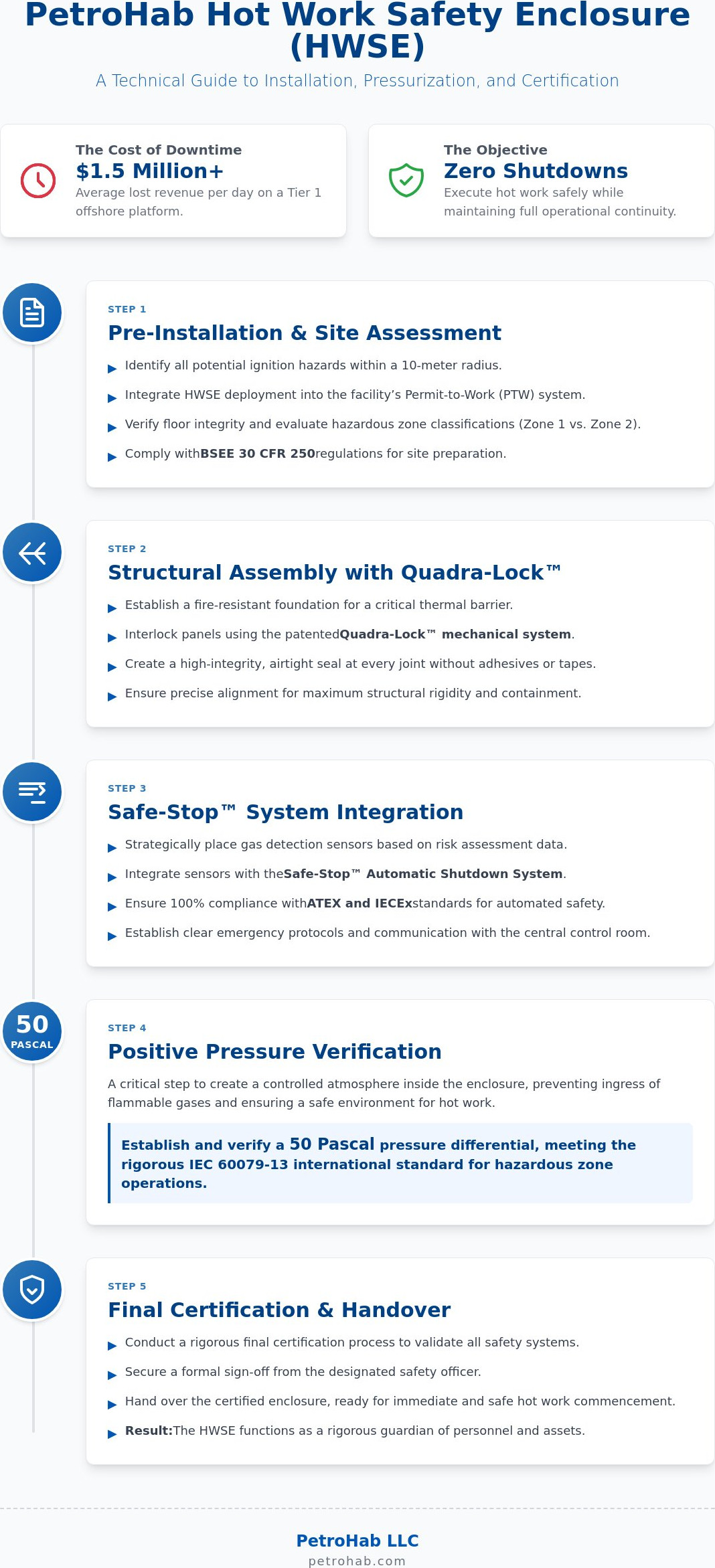
This technical guide provides the protocols required to install and certify a PetroHab Hot Work Safety Enclosure (HWSE) for immediate deployment. You’ll master the engineering requirements for maintaining a 50 Pascal pressure differential and ensuring your setup meets 2026 ATEX guidelines and BSEE 30 CFR 250 standards. We’ll detail the assembly of patented Quadra-Lock panels and the integration of the Safe-Stop Automatic Shutdown System. This walkthrough ensures your enclosure functions as a rigorous guardian of personnel and high-value assets, allowing for safe hot work without facility shutdowns.
Key Takeaways
- Identify specific ignition hazards and determine enclosure dimensions through a comprehensive pre-installation site assessment.
- Utilize patented Quadra-Lock technology to assemble a modular, airtight structural framework designed for rapid deployment in high-stakes environments.
- Master the welding habitat installation procedure to correctly integrate the Safe-Stop™ Automatic Shutdown System and gas detection sensors.
- Establish and verify a 50 Pascal pressure differential to meet international IEC 60079-13 standards for hazardous zone operations.
- Secure operational continuity by completing a rigorous final certification process and safety officer sign-off before commencing hot work.
Pre-Installation Protocols and Site Assessment
Successful hot work in hazardous environments begins long before the first panel is locked. A rigorous welding habitat installation procedure demands a comprehensive site assessment to eliminate variables that compromise safety. Engineers must define the specific scope of work and identify every potential ignition hazard within a 10 meter radius, as per BSEE 30 CFR 250 regulations. This initial phase identifies the technical requirements for the PetroHab Hot Work Safety Enclosure (HWSE) and ensures the site can support the structural load and floor integrity necessary for a pressurized seal.
Integrating the HWSE deployment into the facility’s Permit-to-Work (PTW) system is a non-negotiable step. This ensures the habitat isn’t an isolated component but a synchronized part of the site’s broader safety ecosystem. Before moving equipment, technicians must verify that all components, specifically the patented Quadra-Lock panels and Safe-Stop Automatic Shutdown Systems, are present, certified, and damage-free. Adhering to Positive Pressure Enclosure Principles serves as the foundation for risk mitigation on offshore platforms and refineries.
To better understand this concept, watch this helpful video:
Hazardous Zone Classification and Risk Assessment
Evaluating the difference between Zone 1 and Zone 2 environments determines the necessary habitat specifications. Technicians must identify hydrocarbon leak paths, such as valves or flanges, that could impact habitat placement. We document baseline gas levels before any equipment arrives to establish a clear safety delta. This data informs the placement of gas detectors and the configuration of the Safe-Stop system to ensure 100% compliance with ATEX and IECEx standards. Identifying these risks early prevents the catastrophic failure of containment systems during live production.
Logistical Preparation and Personnel Safety
Logistical failures often lead to unplanned downtime. All installation personnel must be trained in PetroHab’s procedural standards to ensure the Quadra-Lock panels are correctly interlocked for an airtight seal. We confirm the availability of clean, compressed air or dedicated blowers for habitat pressurisation early in the process. Clear communication channels between the habitat installation team and the central control room are established to manage emergency protocols. This structured approach prevents the $1.5 million per day losses associated with production interruptions while maintaining a rigorous safety posture.
Structural Assembly Using Quadra-Lock Technology
The transition from site assessment to physical construction requires a methodical approach to ensure the enclosure remains airtight. Technicians begin by establishing the habitat footprint using high-grade, fire-resistant flooring and sills. This foundation provides the critical thermal barrier between the hot work area and the facility deck. Once the base is secure, the vertical framework is erected to support the weight of the containment system. This stage of the welding habitat installation procedure is where the structural integrity of the HWSE is first verified, ensuring the footprint aligns perfectly with the pre-installation survey dimensions.
Erecting the enclosure involves interlocking the first tier of Quadra-Lock panels into the floor sills. Unlike generic modular systems that rely on external adhesives or temporary fasteners, this system utilizes a patented mechanical interlocking mechanism. This design creates a high-integrity seal at every joint, effectively isolating the internal environment from external hydrocarbon risks. The roof section is the final primary structural component. It must be secured with the same precision to prevent any pressure loss during the subsequent activation of the blowers.
The Quadra-Lock Interlocking Procedure
Achieving a flush fit depends on the precise alignment of the male and female edges of the Quadra-Lock panels. Technicians must ensure each panel is fully seated before moving to the next. This interlocking design is engineered to eliminate the need for external adhesives, tapes, or secondary sealants which can degrade in harsh offshore environments. As each tier is added, the structural rigidity of the enclosure increases. A correctly assembled PetroHab HWSE feels monolithic, providing a durable and resilient barrier that protects both personnel and high-value assets from ignition sources.
Managing Enclosure Penetrations
Hazardous zone environments rarely offer a clear, unobstructed space for habitat placement. Structural members, piping, and conduit often intersect the enclosure’s path. Technicians must seal these penetrations using specialized kits designed to wrap around irregular shapes. Maintaining the integrity of the fire-resistant barrier at these exit points is mandatory to meet OSHA Hot Work Safety Standards. Every penetration is a potential leak path; therefore, the seal quality on beams or pipes must be double-checked before the pressurization phase. This meticulous attention to detail ensures that the enclosure remains a definitive technological remedy for industrial hazards.
Integrating the Safe-Stop™ Automatic Shutdown System
A structural barrier only provides passive protection; the Safe-Stop Automatic Shutdown System transforms the PetroHab HWSE into an active safety device. This integration phase of the welding habitat installation procedure is critical for ensuring that hot work equipment is instantly isolated if hazardous conditions arise. The Safe-Stop control unit must be positioned in a visible, accessible location outside the habitat. This allows safety supervisors to monitor the system’s status and response without entering the enclosure, maintaining a clear line of sight between the control interface and the facility’s safety team.
Deploying ATEX-certified gas detectors is the next procedural step. Technicians must install sensors at both the air intake and inside the enclosure to provide comprehensive monitoring of the internal and external atmospheres. These detectors link directly to the Safe-Stop system, creating an automated safety loop that overrides human error. Once the sensors are positioned, the welding power source is connected to the control unit’s power interrupt circuit. This configuration ensures that the system can terminate all ignition sources within milliseconds of a safety breach, fulfilling the rigorous requirements of IEC 60079-13.
Gas Detection and Sensor Calibration
Calibration of the gas detection loop must align with the July 2026 safety standards. Technicians set the Lower Explosive Limit (LEL) thresholds to trigger an automatic shutdown if flammable gas concentrations reach 10% LEL. This conservative threshold provides a necessary safety buffer in Zone 1 and Zone 2 environments. We test the sensor response time during this phase to verify that the signal travels from the detector to the control unit without latency. Every detection loop is checked for fail-safe status; the system must default to a shutdown state if a sensor cable is severed or power is lost. This meticulous calibration ensures that the Quadra-Lock panels aren’t just a container, but a monitored safety environment.
Power Isolation and Emergency Stop Protocols
The Safe-Stop system acts as a master interrupt for all hot work equipment. Welding machines and grinders are hard-wired into the power interrupt circuit to ensure total isolation during a trip event. Technicians must conduct a functional test of the manual emergency stop buttons located both inside and outside the habitat. During these tests, we verify that the system provides simultaneous audible and visual alarms to alert the entire site of a shutdown. These alarms must be distinct from standard facility sirens to prevent confusion. Establishing these protocols ensures that the HWSE operates as a seasoned veteran of the field, protecting personnel and high-value assets with uncompromising technical precision.
Establishing and Testing Positive Pressure Integrity
Once the structural assembly is complete, the enclosure must be transformed into a pressurized environment. This phase of the welding habitat installation procedure begins with the activation of the air intake blowers. These units draw air from a verified hydrocarbon-free source and force it into the habitat to create a positive pressure differential. Technicians must monitor the manometer constantly during this startup phase to ensure the internal pressure reaches a minimum differential of 0.1 inches of water column (25 Pa). This pressure serves as the definitive technological remedy that prevents flammable gases from entering the work area during live production.
A rigorous leak test follows the initial pressurization. Technicians inspect every Quadra-Lock joint and penetration point while the system is under load. Because the Quadra-Lock mechanism is engineered for an airtight fit, any detected pressure drop usually indicates an improperly seated panel or an incomplete seal around a structural member. Adjusting the air ducting ensures uniform distribution throughout the enclosure. This step is a vital part of the welding habitat installation procedure to eliminate stagnant pockets where welding fumes or heat could accumulate, ensuring the environment remains tenable for personnel over long shifts.
Maintaining the Pressure Differential
Preserving internal pressure during personnel movement is achieved through the use of integrated airlock doors. These doors function as a mechanical buffer, ensuring that at least one barrier remains sealed at all times. If pressure loss occurs, technicians should first troubleshoot the airlock seals and the intake blower filters. We document all stable pressure readings meticulously to provide a clear audit trail for the final safety sign-off. If you require specialized configurations for your site, you can contact PetroHab for technical support regarding custom HWSE deployment.
Ventilation and Air Exchange Rates
Safety managers must calculate the required air exchange rate based on the total habitat volume and the expected density of welding fumes. A high exchange rate is mandatory to maintain visibility and air quality within the enclosure. It’s critical to verify that the intake air is sourced from an area confirmed to be free of combustible gases. Technicians also verify the placement of exhaust vents, ensuring they’re positioned to drive airflow away from the welder’s breathing zone and toward the facility’s designated discharge points. This methodical approach to ventilation ensures that the HWSE meets all international technical certifications for hazardous zone operations.
Final Certification and Operational Handover
The final phase of the welding habitat installation procedure involves a rigorous certification process to ensure the enclosure is ready for immediate hot work. Technicians must complete a comprehensive HWSE installation checklist, verifying the structural integrity of every Quadra-Lock panel and the calibration of the Safe-Stop system. This documentation serves as the definitive proof that the site meets the 50 Pascal pressure requirement and the 10% LEL shutdown threshold. Sign-off occurs only when every technical parameter is met, reflecting an unwavering commitment to personnel safety.
A joint walk-through with the facility safety officer and the welding supervisor follows the technical verification. This inspection ensures that all stakeholders understand the habitat’s operational boundaries. We identify every emergency egress route and confirm the Safe-Stop control unit is clearly visible to the outside watchman. This collaborative approach instills absolute confidence in the safety manager before live production resumes. It’s a critical step in the transition from setup to active work.
Before the first arc is struck, the welding team receives a detailed briefing on Safe-Stop operation and emergency protocols. They must recognize the system’s automated responses and know how to react during a trip event. We establish a strict schedule for periodic pressure and gas detection checks. These checks occur at the start of every shift and at designated intervals to ensure the enclosure remains a resilient barrier against external hazards. Maintaining this rhythm is essential for ongoing risk mitigation.
Safety Compliance Documentation
Compliance is anchored in meticulous technical documentation. Every deployment requires an archived installation certificate that becomes part of the permanent project safety record. For deeper context on regulatory requirements, refer to our Hazardous Environment Standards Guide. Keeping ATEX and IECEx certifications on-site is mandatory for 2026 offshore operations, providing the linguistic anchors for quality that safety managers expect in high-stakes environments. This data provides the transparency needed for rigorous safety audits.
The PetroHab Advantage: Technical Supervision
Complex installations often demand direct technical supervision to ensure zero-error deployment. A certified PetroHab technician understands the granular details of industrial hazards and the welding habitat installation procedure better than anyone else in the field. They ensure the unique engineering behind Pressurized Welding Habitats is fully leveraged to protect high-value assets. Professional oversight mitigates risk and prevents the high costs associated with unplanned downtime. Contact PetroHab for on-site installation support and training to ensure your next project meets the industry benchmark for safety excellence.
Securing Operational Continuity Through Procedural Excellence
The successful execution of a welding habitat installation procedure is the defining factor in protecting high-value assets and personnel from catastrophic ignition events. By combining the structural integrity of patented Quadra-Lock panels with the active protection of the Safe-Stop Automatic Shutdown System, you transform a hazardous work area into a controlled environment. This methodical approach ensures 100% safety compliance while maintaining production schedules on offshore platforms and refineries worldwide.
Relying on ATEX and IECEx certified systems provides the technical assurance safety managers require in high-stakes heavy industry. PetroHab remains the industry benchmark, offering global 24/7 technical support to guide your team through complex deployments and regulatory audits. Don’t leave site integrity to chance when precision engineering is available to mitigate every risk.
Take the next step in industrial safety by securing expert oversight for your upcoming project. Request a Quote for HWSE Installation and Supervision and ensure your site operates with the resilience and discipline it deserves. We look forward to partnering with you on your next mission-critical maintenance operation.
Frequently Asked Questions
How long does a standard welding habitat installation procedure take?
A standard welding habitat installation procedure typically requires four to eight hours for a mid-sized enclosure. This timeline accounts for the site survey, structural assembly, and the integration of the Safe-Stop system. Complex environments with multiple pipe penetrations or irregular structural members may extend this duration. Efficient deployment is a direct result of the modular Quadra-Lock panel design, which simplifies interlocking without sacrificing seal integrity.
What is the required pressure differential for an HWSE to be considered safe?
The required pressure differential is a minimum of 50 Pascals (0.2 inches of water column) relative to the external atmosphere. Maintaining this positive pressure is essential to satisfy IEC 60079-13 and ATEX Zone 1 requirements. Technicians monitor this via a manometer throughout the shift. If the pressure drops below the 25 Pascal safety threshold, the Safe-Stop system will automatically terminate hot work power to prevent the entry of flammable gases.
Can a welding habitat be installed in a Zone 1 hazardous area?
Yes, a pressurized welding habitat can be installed in Zone 1 hazardous areas where explosive atmospheres are likely to occur. The HWSE acts as a definitive technological remedy by preventing flammable gases from entering the work environment. This deployment must be accompanied by active gas detection and an automatic shutdown system to comply with international safety standards and facility Permit-to-Work protocols for hot work.
What happens if the Safe-Stop system detects gas during welding?
If the Safe-Stop system detects flammable gas at concentrations of 10% LEL, it instantly isolates all power to the welding equipment. This millisecond response prevents ignition in the event of a hydrocarbon release. The system simultaneously activates audible and visual alarms to alert personnel. Operations cannot resume until the atmosphere is verified as clear and the system is manually reset by a designated safety officer.
Are Quadra-Lock panels compatible with other modular habitat systems?
Quadra-Lock panels are not compatible with third-party modular systems. The patented interlocking mechanism is specifically engineered to provide a flush, airtight seal for PetroHab HWSE units. Mixing components from different manufacturers compromises the structural integrity and certification of the habitat. Using authentic Quadra-Lock technology ensures that the enclosure remains a reliable guardian of site safety and high-value assets in hazardous environments.
How often should the habitat integrity be re-tested during a project?
Integrity testing must occur at the start of every work shift and following any modification to the habitat structure. Technicians conduct a leak test and verify pressure readings on the manometer to ensure the enclosure remains airtight. Re-testing is also mandatory after significant weather events or if the enclosure is moved. These periodic checks are vital for maintaining 100% safety compliance throughout the project duration.
What are the ventilation requirements for welding in a pressurized enclosure?
Ventilation must provide enough air exchange to remove welding fumes and maintain tenable air quality for personnel. The intake air must be drawn from a confirmed hydrocarbon-free zone and filtered to prevent contaminants from entering the enclosure. Proper ventilation is a core component of the welding habitat installation procedure to ensure the environment remains safe for continuous hot work without heat or fume buildup.
Does the installation procedure change for offshore vs onshore environments?
The fundamental installation steps are consistent, but offshore environments demand stricter adherence to BSEE 30 CFR 250 regulations. Offshore habitats must also account for higher wind loads and limited deck space, often requiring specialized penetration kits for complex pipework. Onshore procedures may focus more on ground stability and proximity to process equipment, but both require the same rigorous pressure testing and Safe-Stop integration.