Blog Posts
Welding Habitat Technology Comparison: 2026 Industrial Safety Standards
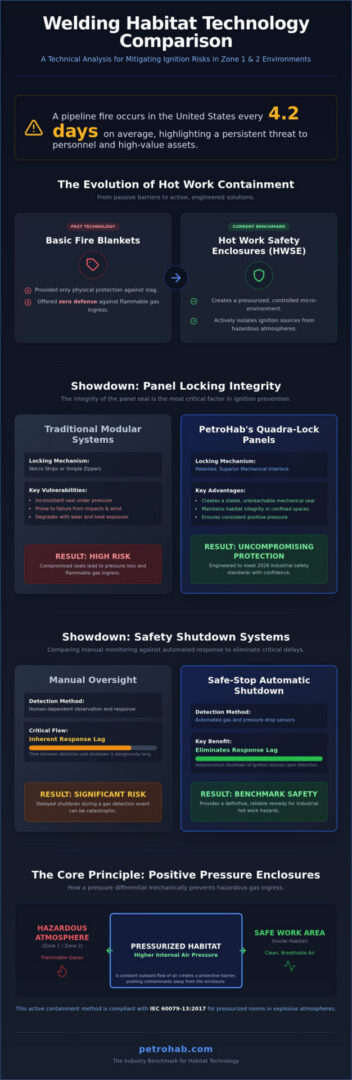
A pipeline fire occurs in the United States every 4.2 days on average. For safety engineers and asset managers partnering with PetroHab LLC, this figure represents a persistent threat to personnel and high-value assets in Zone 1 and Zone 2 environments. You recognize that managing hot work permits while minimizing operational downtime requires more than just basic containment. This technical welding habitat technology comparison analyzes the mechanical integrity of pressurized enclosures to help you meet 2026 industrial safety standards with absolute confidence.
We’ll examine the functional differences between modular architectures and the critical role of automatic shutdown systems in hazardous zones. By comparing the structural reliability of Quadra-Lock panels against traditional modular setups, you’ll understand how to maintain habitat integrity in confined offshore spaces. We also detail why the Safe-Stop automatic shutdown system has become the benchmark for ignition prevention in volatile atmospheres. This guide provides the technical clarity needed to select a Hot Work Safety Enclosure (HWSE) that ensures operational excellence and uncompromising protection.
Key Takeaways
- Identify why pressurized containment is essential for mitigating ignition risks in Zone 1 and Zone 2 hazardous environments.
- Utilize this welding habitat technology comparison to evaluate the structural integrity and setup efficiency of modular panel systems.
- Compare the reliability of the Safe-Stop Automatic Shutdown System against manual monitoring to eliminate response lag during gas detection events.
- Examine how patented Quadra-Lock technology ensures enclosure stability and spark containment for high-value asset protection.
- Determine the technical requirements for selecting a compliant HWSE that aligns with 2026 industrial safety standards.
The Evolution of Welding Habitats in Hazardous Environments
Industrial safety standards have undergone a significant transformation, moving away from rudimentary spark containment toward engineered containment systems. In the past, technicians relied on basic fire blankets to manage weld splatter. These materials provided physical protection against slag but offered zero defense against the ingress of flammable gases. This welding habitat technology comparison examines how the industry has adopted sophisticated Hot Work Safety Enclosures (HWSE) to mitigate the risks inherent in volatile environments. By creating a controlled micro-environment, PetroHab LLC enables critical maintenance to proceed without requiring a costly facility-wide shutdown, which is vital for maintaining production targets in 2026.
Understanding Hot Work Safety Enclosures (HWSE)
An HWSE is defined as a specialized, pressurized environment designed to isolate ignition sources from hazardous atmospheres. It’s not just a barrier; it’s a comprehensive safety solution that creates a physical and atmospheric partition. The system consists of several critical components: fire-resistant modular panels, intake ducting, and advanced monitoring sensors. These systems must integrate directly into a facility’s Permit-to-Work (PTW) protocols to ensure a seamless safety workflow. When a habitat is correctly deployed by PetroHab LLC, it acts as an active guardian, ensuring that hot work only proceeds when the internal environment remains within strict safety parameters, protecting both the personnel inside and the high-value assets outside.
The Necessity of Pressurization
The core of habitat safety lies in the physics of atmospheric control. A modern habitat functions as a positive pressure enclosure, maintaining an internal air pressure higher than the surrounding atmosphere. This pressure differential creates a constant outward flow of air, which mechanically prevents hydrocarbons and other flammable vapors from entering the enclosure. This technology is a prerequisite for hot work in Zone 1 and Zone 2 areas where the risk of ignition is highest. Maintaining a safe atmosphere also involves continuous air exchange to ensure breathable conditions for the workforce inside, preventing the buildup of welding fumes.
Regulatory standards like IEC 60079-13:2017 emphasize the importance of these pressurized rooms in explosive atmospheres. A detailed welding habitat technology comparison reveals that automated pressurization systems provide a level of reliability that manual containment cannot match. By automating the detection of pressure drops or gas ingress, PetroHab LLC provides a definitive remedy for the hazards of industrial hot work. This transition from passive fire blankets to active, monitored enclosures represents the most significant safety advancement in the energy sector over the last decade.
Core Technologies: Modular Panels vs. Flexible Enclosures
A comprehensive welding habitat technology comparison starts with the structural foundation of the containment system. In the high-stakes environments of oil and gas facilities, the choice between rigid modular panels and flexible “tent” enclosures determines the habitat’s ultimate reliability. Rigid panels provide the structural integrity required to withstand industrial-grade slag and environmental stress. In contrast, flexible systems often struggle to maintain a consistent seal under the pressure of high-wind offshore conditions or physical impacts. Modularity also dictates operational efficiency; systems that balance ease of transport with mechanical strength reduce the logistical burden on safety managers during mobilization.
The integrity of the seal is the most critical factor in ignition prevention. Panel interlocking represents the primary failure point in many habitat designs. If the connection points are compromised, the system cannot maintain the positive pressure required by OSHA safety standards. A breach in the seal allows pressurized air to escape and flammable gases to enter, creating an immediate hazard. Durability factors must also be considered, as panels must resist high-heat slag and environmental wear without degrading over time or losing their fire-retardant properties.
The Engineering of Quadra-Lock Technology
PetroHab LLC’s patented Quadra-Lock Panels address these mechanical vulnerabilities by creating a superior mechanical seal. Unlike systems that rely on Velcro or simple zippers, these panels utilize a robust interlocking design that eliminates gaps. This engineering prevents spark escape and ensures that positive pressure is maintained throughout the hot work operation. The system’s versatility allows for assembly around complex piping and structural beams, making it a reliable choice for high-value asset protection. For managers facing difficult site layouts, deploying Quadra-Lock Panels ensures a secure fit regardless of the environment’s complexity.
Flexible Habitats: Limitations and Risks
Flexible habitats, while lightweight, present significant risks in Zone 1 and Zone 2 areas. Fabric-based enclosures are inherently vulnerable to punctures and tears from sharp tools or heavy equipment. These punctures lead to immediate pressure loss, rendering the habitat ineffective. Additionally, maintaining positive pressure in flexible systems is notoriously difficult in high-wind conditions, as the fabric can billow and break the seal at the floor or entry points. The trade-off for lightweight materials is often a reduction in the industrial-grade protection necessary for hazardous work, making rigid modular systems the safer alternative for 2026 industrial standards.
Safety Shutdown Systems: Manual Oversight vs. Automatic Safe-Stop
Structural integrity is only the first layer of defense in hazardous environment hot work. A rigorous welding habitat technology comparison must prioritize the electronic governance of the work zone. Historically, safety protocols relied on manual oversight, where a designated technician monitored gas levels and maintained a fire watch. This method is inherently flawed due to human response lag and the potential for error in high-stress scenarios. If a hydrocarbon release occurs, the seconds required for a human to recognize an alarm and manually sever power can be the difference between a controlled incident and a catastrophic explosion.
Automatic shutdown systems (ASDS) provide a definitive remedy to these risks by removing the human element from the initial emergency response. These systems integrate gas detection and pressure sensors directly with the power supply of the welding equipment. When safety thresholds are breached, the system initiates a fail-safe power isolation. This technical approach aligns with the safety and health guidelines established by the American Welding Society, which emphasizes the necessity of rigorous ignition prevention in volatile atmospheres. By automating the shutdown process, asset managers ensure that the ignition source is neutralized before flammable gases can reach a critical concentration.
The Safe-Stop Automatic Shutdown System Advantage
The Safe-Stop Automatic Shutdown System offers a sophisticated level of protection through continuous environmental monitoring. It tracks both internal habitat pressure and external gas concentrations in real time. If the internal pressure drops below the required safety margin or if gas levels exceed 10% of the Lower Explosive Limit (LEL), the system executes an instantaneous power isolation. Visual and audible alarms provide immediate notification to personnel, facilitating a structured evacuation. This hard-wired response ensures that hot work only occurs within a verified safe envelope, protecting both the workforce and high-value assets.
ATEX and IECEx Certification for Monitoring Systems
In any welding habitat technology comparison, the certification of the control system is as important as the enclosure itself. It’s critical to distinguish between the fire-resistance of the panels and the explosive atmosphere certification of the electronics. The Safe-Stop system carries ATEX and IECEx certifications, confirming that the monitoring unit itself is not an ignition source. These systems utilize precision manometers to verify habitat integrity, providing safety managers with empirical data to support their risk mitigation strategies. This level of technical compliance is mandatory for maintaining operations in Zone 1 and Zone 2 areas where safety standards are non-negotiable.
Evaluating HWSE Integrity: Panel Locking and Fire Resistance
The mechanical integrity of a Hot Work Safety Enclosure (HWSE) is the ultimate safeguard against ignition in hazardous zones. While previous sections of this welding habitat technology comparison focused on pressurization and shutdown logic, the physical composition of the enclosure panels is equally critical. Material science dictates that panels must exceed NFPA 51B standards to provide adequate protection against high-heat slag and molten metal. High-quality habitats utilize specialized, fire-resistant fabrics that maintain structural stability even when subjected to continuous spark impingement. Panel thickness also plays a dual role, providing both thermal insulation for personnel and a robust barrier against environmental wear.
Air management within the habitat depends on sophisticated ducting technology. It’s not enough to simply pressurize the space; the system must ensure fresh air intake is sourced from a verified safe location, away from potential hydrocarbon vents or exhaust. This prevents the ingress of toxins or flammable vapors into the work area. When evaluating habitat integrity, engineers must prioritize systems where the air intake and exhaust are as durable as the enclosure itself.
Critical Questions for Procurement and Safety Managers
Selecting a compliant HWSE requires a rigorous vetting process. Safety managers must move beyond surface-level specifications and ask technical questions regarding the system’s operational limits. For teams prioritizing asset protection, implementing a PetroHab Hot Work Safety Enclosure provides a system engineered for both durability and ease of deployment.
- Connection Security: How is the panel-to-panel connection secured? Systems like Quadra-Lock use a mechanical interlock to prevent pressure loss.
- Logistical Compatibility: Is the habitat modular enough to fit through standard offshore hatches? Operational downtime increases if the system requires heavy lifting equipment for deployment.
- Temperature Ratings: What is the certified temperature rating? Panels must be capable of withstanding the extreme heat generated by industrial welding without losing their fire-retardant properties.
Maintenance and Inspection Protocols
Maintaining the high standards of an HWSE requires disciplined inspection routines. Before every deployment, technicians must conduct a pre-deployment check to identify panel wear, punctures, or compromised seals. On-site supervision is mandatory to ensure the habitat remains within its certified operating parameters throughout the duration of the permit. Additionally, components of the Safe-Stop Automatic Shutdown System require strict recertification schedules to verify that gas sensors and pressure manometers are calibrated correctly. This rigorous approach ensures that the habitat remains a reliable guardian of the industrial site.
PetroHab HWSE: The Industry Benchmark for Habitat Technology
PetroHab has established itself as the industry benchmark through a rigorous commitment to engineering and safety. Global oil and gas majors select the PetroHab Hot Work Safety Enclosure (HWSE) because it transitions safety from a procedural requirement to a mechanical certainty. This welding habitat technology comparison demonstrates that while individual components matter, the synergy between proprietary systems provides the highest level of risk mitigation. By integrating physical containment with electronic governance, PetroHab delivers a definitive remedy for the hazards of hot work in volatile environments.
The integration of Quadra-Lock Panels with the Safe-Stop Automatic Shutdown System creates a unified defense. While the panels provide the physical seal against spark escape, the shutdown system offers continuous monitoring of the internal and external atmosphere. This dual-layered approach ensures that hot work only occurs when the environment is verified safe. By neutralizing ignition sources the moment a safety threshold is breached, PetroHab maintains an unwavering standard of protection for personnel and high-value assets. Operational efficiency is a natural byproduct of this reliability; the system minimizes downtime by allowing production to continue in adjacent zones during maintenance.
Global availability ensures that these safety standards are met across international borders. With major operations in Houston, Brazil, and the UK, PetroHab supports the energy sector’s most critical projects. The brand acts as a safety partner, providing the logistics and technical expertise required to maintain compliance with 2026 industrial standards on a global scale.
Custom Solutions for Complex Hazardous Sites
PetroHab designs tailored enclosures for the most complex hazardous sites, including offshore platforms, refineries, and FPSOs. These environments present unique challenges, such as high-vibration areas and intricate pipe networks that traditional “tent” systems cannot accommodate. The modularity of Quadra-Lock Panels allows for a precise fit around any structural obstacle. To ensure these systems are utilized to their full potential, PetroHab emphasizes professional training for habitat technicians. This commitment to expertise is central to the mission of achieving zero-incident hot work in every deployment.
Next Steps: Rental vs. Purchase for 2026 Projects
For 2026 projects, asset managers must evaluate the ROI of leasing versus owning modular HWSE systems. Rental agreements provide flexibility for short-term maintenance shutdowns, ensuring that the latest technology is always on-site without a permanent capital expenditure. Conversely, purchasing systems offers long-term facility protection for ongoing maintenance programs. PetroHab supports both models with comprehensive maintenance and recertification programs to ensure equipment remains in peak condition. Contact PetroHab for a specialized welding habitat technology comparison and quote to determine the most effective safety strategy for your high-value assets.
Advancing Safety Excellence in 2026 Hot Work Operations
The 2026 industrial landscape demands a move from reactive containment to proactive safety engineering. This welding habitat technology comparison highlights that structural reliability and automated monitoring are non-negotiable for Zone 1 and Zone 2 environments. You’ve seen how the mechanical seal of Quadra-Lock technology eliminates the risks associated with flexible enclosures. You also understand how Safe-Stop systems provide an instantaneous fail-safe that manual oversight cannot replicate.
PetroHab remains the uncompromising partner for energy leaders worldwide. We combine a decade of global safety leadership with fully certified Safe-Stop systems to protect your personnel and high-value assets. Don’t leave your facility’s integrity to chance. Our technical experts are ready to help you implement a compliant HWSE strategy that maximizes operational uptime while maintaining absolute control over ignition risks.
Request a Technical Consultation for Your Hot Work Project to ensure your next maintenance cycle meets the highest global standards. We look forward to securing your site.
Frequently Asked Questions
What is the primary difference between a welding habitat and a standard fire blanket?
A welding habitat provides active atmospheric control through pressurization, whereas a fire blanket is merely a passive physical barrier. While blankets only shield against sparks and slag, a pressurized habitat mechanically prevents the ingress of flammable gases. This welding habitat technology comparison reveals that active systems are mandatory for hot work in Zone 1 and Zone 2 areas where gas ignition is a constant threat. Passive barriers are insufficient for modern industrial standards.
How does the Safe-Stop automatic shutdown system work in the event of a gas leak?
The Safe-Stop automatic shutdown system initiates an instantaneous power isolation to all welding equipment when gas levels reach 10% of the Lower Explosive Limit (LEL). It utilizes continuous monitoring sensors to detect hydrocarbons in the intake air or surrounding environment. By hard-wiring the gas detector to the power source, the system removes human response lag. This ensures the ignition source is neutralized before a hazardous concentration can reach the work area, providing a definitive remedy.
Is the Quadra-Lock panel system compatible with all offshore platform configurations?
Yes, the Quadra-Lock panel system is designed for high versatility across diverse offshore platform configurations. The modular architecture allows panels to be assembled around complex piping, structural beams, and confined spaces. Because each panel interlocks mechanically, the enclosure maintains structural integrity and positive pressure even in irregular layouts. This flexibility is essential for FPSOs and platforms where space is limited and obstructions are frequent, ensuring a secure fit for every maintenance project.
What international safety standards should a welding habitat meet in 2026?
In 2026, a welding habitat must comply with IEC 60079-13:2017 for pressurized rooms in explosive atmospheres. Additionally, the system should meet ANSI Z49.1-2021 for welding safety and utilize panels that exceed NFPA 51B fire resistance requirements. This welding habitat technology comparison emphasizes that all electronic monitoring components must carry current ATEX or IECEx certifications. These anchors for quality ensure that the shutdown system does not act as an ignition source within hazardous zones.
Can PetroHab habitats be used for both onshore and offshore hot work?
PetroHab habitats are engineered for both onshore and offshore applications. They protect assets in refineries and chemical plants just as effectively as they do on offshore drilling rigs. The modular Quadra-Lock panels are durable enough to withstand high-wind offshore environments while remaining light enough for easy transport to inland facilities. This cross-sector reliability makes them the preferred choice for global energy majors managing diverse asset portfolios across the United States, Brazil, and the UK.
How is positive pressure maintained if the habitat door is opened?
Positive pressure is maintained through a high-volume air intake system that creates a constant outward airflow. When the door is opened, the system’s fans compensate by pushing air out at a velocity that prevents flammable gases from entering. However, doors should only be opened briefly for personnel transit. Sophisticated systems utilize manometers to monitor pressure drops and will trigger an alarm if the door remains open long enough to compromise habitat integrity and safety.
What is the typical setup time for a modular PetroHab HWSE?
The typical setup time for a standard modular PetroHab HWSE is approximately two to four hours depending on site complexity. The patented Quadra-Lock panels are designed for rapid assembly without specialized tools, significantly reducing the labor hours required compared to legacy fabric systems. This efficiency minimizes operational downtime, allowing hot work permits to be executed promptly. It ensures that safety managers can maintain tight schedules without compromising the technical integrity of the enclosure.
Do I need a certified technician to supervise the operation of a pressurized habitat?
A certified technician is required to install, supervise, and decommission a pressurized habitat. This professional oversight ensures that the habitat is properly sealed, the Safe-Stop system is calibrated, and the positive pressure is monitored throughout the operation. Professional training for technicians is a critical component of PetroHab’s commitment to zero-incident hot work. It ensures that all safety protocols are strictly followed in hazardous environments to protect personnel and high-value assets.