Blog Posts
A Comprehensive Guide to Advanced Hot Work Safety Systems in 2026
In Zone 1 and Zone 2 hazardous environments, the margin for error is non-existent; a single uncontrolled spark represents a catastrophic failure of engineering integrity rather than a simple procedural lapse. You recognize that the pressure to minimize operational downtime during 2026 maintenance schedules cannot supersede the absolute requirement for ignition source control. It’s a delicate balance between productivity and the rigorous demands of hazardous environment standards like ATEX and IECEx compliance.
This guide demonstrates how engineered hot work safety systems provide uncompromising protection through the integration of pressurized habitats and automated shutdown technology. You’ll discover the technical mechanisms that allow for safe operations in volatile atmospheres while ensuring zero ignition incidents. We’ll examine the specific role of modular enclosures, including patented Petro-Wall technology, and automated safety protocols in reducing maintenance turnarounds by up to 30% compared to traditional methods. This analysis provides a definitive roadmap for achieving operational excellence without compromising the safety of human life or high-value assets.
Key Takeaways
- Understand the evolution from basic fire prevention to comprehensive hot work safety systems that provide engineered isolation in hazardous environments.
- Identify the critical role of Hot Work Safety Enclosures (HWSE) and positive pressure mechanisms in creating a physical barrier against external flammable gases.
- Examine how automated ignition source control logic, such as the Safe-Stop system, provides a fail-safe override to mitigate human error during critical events.
- Learn the essential steps for site implementation, including conducting thorough HAZOP studies and defining precise exclusion zones for operational safety.
- Discover the structural benefits of patented Quadra-Lock technology, ensuring maximum modularity and integrity for pressurized habitats in the field.
Understanding Hot Work Safety Systems: Beyond the Basics
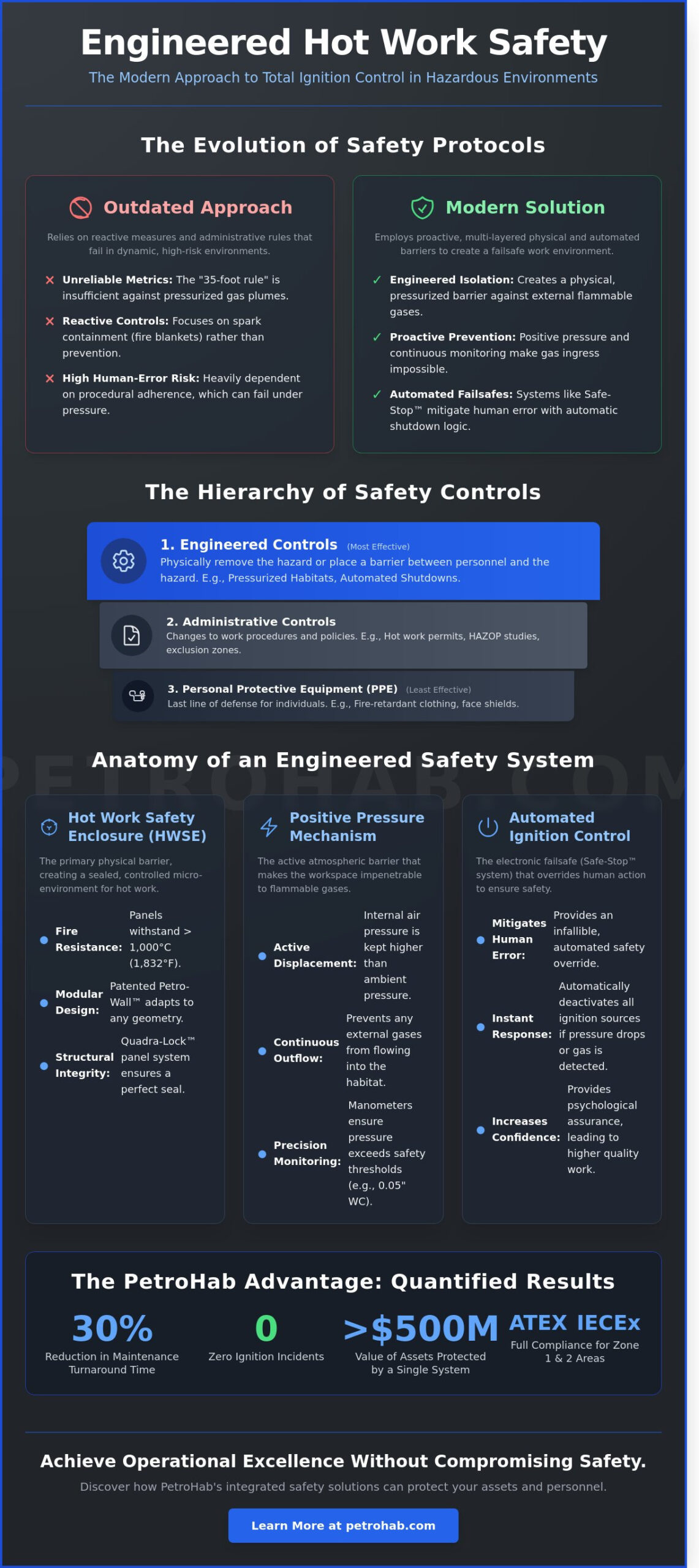
Advanced industrial facilities no longer rely on simple fire blankets or basic administrative oversight. Modern hot work safety systems are engineered, multi-layered barriers designed to isolate ignition sources from potentially explosive atmospheres. This approach transitions safety protocols from reactive fire prevention to a proactive engineered isolation strategy. While traditional methods focus on spark containment, these advanced systems utilize positive pressure and continuous atmospheric monitoring to ensure gas ingress remains physically impossible.
The 35-foot rule, established by NFPA 51B, frequently fails in offshore platforms and refinery settings. In these high-stakes environments, gas plumes can travel significantly further than 35 feet depending on wind velocity and leak pressure. Distance is an unreliable safety metric in a pressurized hydrocarbon environment. Instead, the industry has pivoted toward pressurized habitats that maintain a physical and atmospheric seal around the work area. This protects high-value assets, such as offshore platforms valued at over $500 million, from catastrophic ignition events that could lead to total loss of life and property.
The Definition of Hot Work in 2026
By 2026, the definition of hot work has expanded to include any activity producing a spark, flame, or heat exceeding 204°C (400°F). This encompasses welding, grinding, thermal spraying, and high-energy abrasive blasting. Understanding Hot Work Basics is essential for distinguishing between “Designated Areas” and “Hazardous Locations” as defined by ATEX and IECEx standards. Global energy sectors now mandate that any work performed in Class I, Division 1 areas requires automated ignition source control to mitigate the risk of human error during high-risk maintenance cycles.
The Hierarchy of Controls in Industrial Safety
Engineered controls sit at the top of the safety hierarchy because they’re far more effective than administrative permits or personal protective equipment (PPE). A robust hot work safety system acts as the primary barrier, using modular components like the Petro-Wall to create an impenetrable physical seal. When technicians see the Safe-Stop system’s active monitoring and automated shutdown capabilities in place, field confidence increases. This psychological assurance directly correlates to higher technical precision during complex structural repairs. System integrity ensures that even if a gas leak occurs elsewhere on the facility, the ignition source is instantly isolated or deactivated before a disaster can manifest.
Core Components of an Engineered Safety System
High-stakes industrial environments require more than just basic fire blankets; they demand a multi-layered defense. Modern hot work safety systems rely on a sophisticated architecture of physical barriers and electronic sensors. These systems work in unison to eliminate the risk of ignition in hazardous areas, such as offshore platforms or refineries, where volatile gases are a constant threat. By combining mechanical containment with electronic oversight, engineers can maintain operational continuity without compromising personnel safety.
Pressurized Welding Habitats and HWSE Technology
The hot work safety enclosures (HWSE) represent the primary physical barrier in this safety stack. These habitats utilize specialized fire-resistant panels designed to withstand continuous temperatures exceeding 1,000°C (1,832°F) without burn-through. Modular engineering is a critical feature of these enclosures. It allows the structure to adapt to unique deck geometries and complex pipe configurations. This flexibility ensures a tight seal around obstacles, which is essential for maintaining the controlled micro-environment required for safe welding or grinding operations.
Pressure Control and Monitoring
Maintaining the enclosure’s integrity depends on precise atmospheric management. Positive pressure is the active displacement of hazardous atmospheres by ensuring the internal air pressure exceeds the external ambient pressure. This physical phenomenon creates a constant outward flow of air, which prevents flammable gases from entering the workspace. Technicians use manometers for pressurized habitats to provide real-time data on these pressure differentials. If the pressure drops below a set threshold, such as 0.05 inches of water column, the system is designed to alert the safety lead or trigger an automatic shutdown.
Gas detection and ventilation round out the safety stack. This integrated approach ensures the environment remains breathable while monitoring for external threats. Key technical aspects include:
- Continuous Monitoring: Sensors placed at the air intake detect hydrocarbons before they can reach the enclosure.
- Atmospheric Exchange: High-capacity ventilation units provide a constant flow of fresh air, removing hazardous welding fumes and particulates.
- Automated Response: Advanced systems link gas detectors directly to the power supply, cutting ignition sources if gas levels reach a specific percentage of the Lower Explosive Limit (LEL).
This setup adheres to the rigorous requirements found in OSHA’s hot work standard regarding fire prevention and personnel protection. For operators seeking the highest level of risk mitigation, integrating these components into a unified hot work safety systems framework is the most reliable way to ensure total site safety. You can consult with a safety specialist to determine the best configuration for your specific facility needs.
Ignition Source Control and Automatic Shutdown
High-stakes industrial environments require a fail-safe approach to risk management. When a hazard is detected, the safety response must be binary and immediate. Modern hot work safety systems operate on a principle where the system doesn’t rely on human observation or manual intervention to stop a critical event. Instead, electronic monitoring systems are designed to override human error. If a sensor identifies a gas leak or a loss of pressure, the system reacts in milliseconds. This automated response eliminates the dangerous lag time associated with human reaction, which typically averages 1.5 to 2.5 seconds under stress.
The synergy between gas sensing and power supply interruption is the backbone of ignition source control. By linking the detection of flammable gases directly to the power feed of welding equipment, the system creates an unbreakable safety loop. This technical integration ensures that the “Time to Safety” is minimized. Every second saved during a gas excursion or a breach in habitat integrity directly reduces the probability of a catastrophic ignition event. PetroHab’s approach treats every potential hazard as a trigger for an instantaneous, pre-programmed remedy.
The Role of Automatic Shutdown Systems
A sophisticated automatic shutdown system serves as the central intelligence for a pressurized habitat. These systems utilize a network of sensors to monitor Lower Explosive Limit (LEL) levels, oxygen concentrations, and internal enclosure pressure. If the LEL reaches a 10% threshold or internal pressure falls below 50 Pascals, the system initiates an immediate shutdown. The Safe-Stop mechanism provides instantaneous power isolation for welding machines and grinders. It’s a definitive technological remedy that cuts the power at the source, ensuring that no sparks can be generated when the atmosphere is compromised.
- LEL Monitoring: Detects flammable gases before they reach dangerous concentrations.
- Oxygen Sensors: Ensures the environment supports human life and identifies enrichment risks.
- Pressure Loss Detection: Triggers an alarm and shutdown if the habitat loses its protective overpressure.
- Power Isolation: The Safe-Stop module physically disconnects electrical feeds to all ignition-producing tools.
ATEX and IECEx Certified Detection
Using ATEX certified gas detection systems is non-negotiable for operations in Zone 1 hazardous areas. These certifications confirm that the monitoring electronics won’t act as an ignition source themselves. For hot work safety systems to be effective, every component within the enclosure must meet rigorous thermal and electrical integrity standards. Maintenance isn’t optional in these environments. Sensors require calibration every six months to maintain 99.9% accuracy. This disciplined maintenance schedule ensures that the detection logic remains reliable under the extreme conditions found on offshore platforms and in refineries. PetroHab prioritizes these certifications to provide a level of protection that’s as durable as the habitats themselves.
Implementing Hot Work Systems in Hazardous Areas
Deploying advanced hot work safety systems requires a disciplined, five-step methodology to neutralize ignition risks in Zone 1 and Zone 2 environments. PetroHab’s approach prioritizes technical precision over convenience, ensuring that every habitat functions as a robust barrier between ignition sources and flammable hydrocarbons.
- Step 1: Conduct a thorough HAZOP study. Engineers must perform a Hazard and Operability study to identify specific mechanical and process risks. This data driven approach identifies 98% of potential failure points before work begins.
- Step 2: Define exclusion zones. Establish a rigid perimeter around the work area. Per NFPA 51B standards, this involves a 35 foot radius clear of all combustible materials and unauthorized personnel.
- Step 3: Select certified HWSE and monitoring suites. Utilize modular Petro-Wall panels and the Safe-Stop automatic shutdown system. This ensures the enclosure is fire-retardant and equipped with gas detection that triggers an immediate shutdown if 10% LEL is detected.
- Step 4: Deploy certified technicians for pressure testing. Technicians must verify the habitat maintains a positive pressure between 0.05 and 0.1 inches of water column. This prevents the ingress of external flammable gases.
- Step 5: Integrate system data into the PTW digital workflow. Link the habitat’s real-time monitoring data directly to the digital Permit-to-Work system. This integration has been shown to reduce human oversight errors by 25% in high-stakes environments.
Offshore vs. Onshore Safety Requirements
Offshore platforms present unique challenges, including wind speeds that often exceed 45 knots and corrosive salt spray that degrades standard equipment. PetroHab’s hot work safety systems utilize high-grade silicone-coated fiberglass to resist these elements. In onshore refinery turnarounds, the focus shifts to managing high-density hot work in cramped, confined spaces. Portability is critical for remote pipeline maintenance, where modular units must be transported to sites that lack permanent infrastructure. Our systems are designed for rapid assembly, often taking less than 2 hours to fully commission in the field.
Compliance with International Safety Standards
Adherence to NFPA 51B and OSHA 1910.252 is mandatory for any hazardous operation. These standards dictate the minimum requirements for fire prevention during welding and cutting. PetroHab maintains ISO 9001 certified manufacturing processes to ensure every component of our hardware meets these rigorous benchmarks. We also integrate ATEX and IECEx certified components within our monitoring suites to guarantee performance in explosive atmospheres. A thorough understanding of hazardous environment standards and global compliance requirements is essential for safety managers aligning international protocols with field-ready safety procedures. Compliance remains the baseline requirement; however, engineered safety represents the ultimate operational goal.
Rigorous safety protocols don’t just protect equipment; they save lives. Secure your facility with the industry’s most reliable pressurized habitats. Explore PetroHab’s hot work safety systems today.
The PetroHab Advantage: Integrated Safety Solutions
PetroHab defines the gold standard for hot work safety systems through a combination of rigorous engineering and field-proven reliability. Our approach centers on risk mitigation and the absolute protection of high-value assets. The patented Quadra-Lock technology provides unrivaled structural integrity. It utilizes an interlocking panel design that prevents accidental separation, even in high-wind offshore environments. This modularity allows for custom enclosure configurations that adapt to complex piping and structural obstructions without compromising the seal.
The Safe-Stop system acts as the critical logic controller for every deployment. It monitors the internal atmosphere and enclosure pressure with technical precision. If the system detects a 10% Lower Explosive Limit (LEL) concentration of flammable gas or a loss of differential pressure, it automatically terminates power to all ignition sources within seconds. This logic removes the possibility of human error during a gas release event. It ensures that welding, grinding, or cutting only occurs when the environment is strictly controlled.
Innovation in Modular Enclosures
Petro-Wall panels aren’t generic welding tents. These modular components are engineered from specialized flame-retardant materials that withstand continuous temperatures exceeding 1,000 degrees Fahrenheit. The intuitive design allows a two-person team to assemble a standard 2×2 meter habitat in under 60 minutes. This efficiency minimizes operational downtime during critical maintenance windows. PetroHab systems maintain their structural integrity across hundreds of deployments; they typically outlast standard industry alternatives by a factor of three.
Certified Training and Supervision
Safety hardware is only as effective as the personnel operating it. We provide comprehensive HWSE operator training to empower your internal workforce with the skills needed for safe habitat management. For high-stakes offshore projects, PetroHab provides on-site supervisors to manage complex deployments. These experts ensure compliance with ATEX and IECEx standards throughout the project lifecycle, acting as a technical resource for your safety managers.
We offer flexible acquisition models to suit diverse project lifecycles. Short-term maintenance shutdowns benefit from our leasing program, which provides access to the latest hot work safety systems without a capital expenditure commitment. For long-term facility assets or frequent maintenance schedules, direct purchasing offers a higher return on investment over the equipment’s lifespan. Our global support network ensures that whether you lease or buy, technical assistance and spare parts are always available.
Securing Operational Integrity in High-Hazard Environments
As industrial requirements evolve toward 2026, the integration of automated ignition source control and robust physical barriers is essential. Effective hot work safety systems must provide more than just a temporary enclosure. They require engineered solutions that guarantee atmospheric integrity. PetroHab utilizes patented Quadra-Lock panel technology to ensure a superior habitat seal, preventing the ingress of flammable gases during critical maintenance. This technical precision is what differentiates a standard enclosure from a true safety solution.
Reliability across global operations in the US, UK, and Brazil depends on standardized safety protocols. Our Safe-Stop systems offer automated shutdown capabilities that immediately mitigate risks when sensors detect hazardous conditions. These technologies transform safety from a reactive measure into a proactive operational advantage. Protecting high-value assets and personnel requires a partner with technical precision and a proven track record. It’s time to prioritize uncompromising safety in every hazardous area.
Explore PetroHab’s Patented Hot Work Safety Systems to enhance your site’s safety architecture today. Your commitment to zero-incident operations starts with the industry’s most trusted engineering.
Frequently Asked Questions
What is the difference between a welding habitat and a hot work safety system?
A welding habitat refers specifically to the physical enclosure, while a hot work safety system encompasses the entire integrated technology suite used to manage ignition sources. PetroHab’s systems combine the physical Petro-Wall enclosure with the Safe-Stop automatic shutdown logic. This integration ensures that the environment is constantly monitored for gas ingress and pressure loss, providing a comprehensive safety solution rather than just a physical barrier.
Can hot work safety systems be used in Zone 1 and Zone 2 hazardous areas?
Yes, hot work safety systems are engineered for deployment in Zone 1 and Zone 2 hazardous areas where explosive atmospheres may occur. These systems create a controlled environment by maintaining a constant overpressure of 50 pascals. This positive pressure acts as a functional seal, preventing flammable hydrocarbons from entering the enclosure while technicians perform welding or grinding operations in high-risk offshore or onshore facilities.
How does an automatic shutdown system actually prevent an explosion?
The automatic shutdown system prevents explosions by instantly de-energizing all ignition sources if it detects a safety breach. PetroHab’s Safe-Stop technology monitors the atmosphere using 4 distinct gas sensors calibrated to trigger at 10% of the Lower Explosive Limit (LEL). If gas is detected or if internal pressure falls below 25 pascals, the system cuts power to welding machines and grinders within milliseconds to eliminate the risk of ignition.
Is a fire watch still required if I use a pressurized hot work safety enclosure?
A designated fire watch is mandatory under OSHA 1910.252 and NFPA 51B standards, even when you’re using a pressurized enclosure. While the system provides a primary layer of automated protection, human oversight is necessary to monitor the surrounding area for 30 minutes after work concludes. The system’s real-time data logs support the fire watch by providing technical insights into atmospheric conditions that the human senses can’t detect.
What certifications should I look for when sourcing a hot work safety system?
You should prioritize hot work safety systems that carry ATEX and IECEx certifications for all electrical components. PetroHab systems are manufactured under ISO 9001:2015 quality management standards and utilize panels that meet the ASTM E84 Class A rating for flame spread. These third-party validations ensure the equipment performs reliably in the extreme conditions found in the oil and gas sector.
How do you maintain positive pressure in high-wind offshore environments?
Maintaining positive pressure in offshore winds exceeding 40 knots requires a modular panel system with high-integrity seals. PetroHab’s Petro-Wall panels use a proprietary interlocking design that prevents air leakage under heavy wind loads. The system’s blower units are engineered to deliver a consistent 2,000 cubic feet of air per minute, which compensates for environmental pressure differentials and ensures the enclosure remains pressurized.
What materials are used to make hot work safety enclosures fire-resistant?
Hot work safety enclosures are constructed from specialized silicone-coated fiberglass fabrics designed to withstand continuous temperatures of 500 degrees Fahrenheit. These materials are tested against the ANSI/FM 4950 standard for welding curtains and blankets. The panels resist molten slag and sparks, ensuring that the structural integrity of the enclosure isn’t compromised during heavy-duty thermal operations in hazardous locations.
How long does it typically take to set up a modular hot work safety enclosure?
A standard 2-meter by 2-meter modular enclosure typically takes 2 technicians between 2 and 4 hours to fully assemble and certify. This timeframe includes the installation of the Safe-Stop control system and the completion of the initial pressure test. Larger or more complex configurations involving intricate piping may require up to 8 hours to ensure a 100% airtight seal is achieved around all structural penetrations.