Blog Posts
Alternatives to Facility Shutdown for Welding: A Guide to Live Hot Work
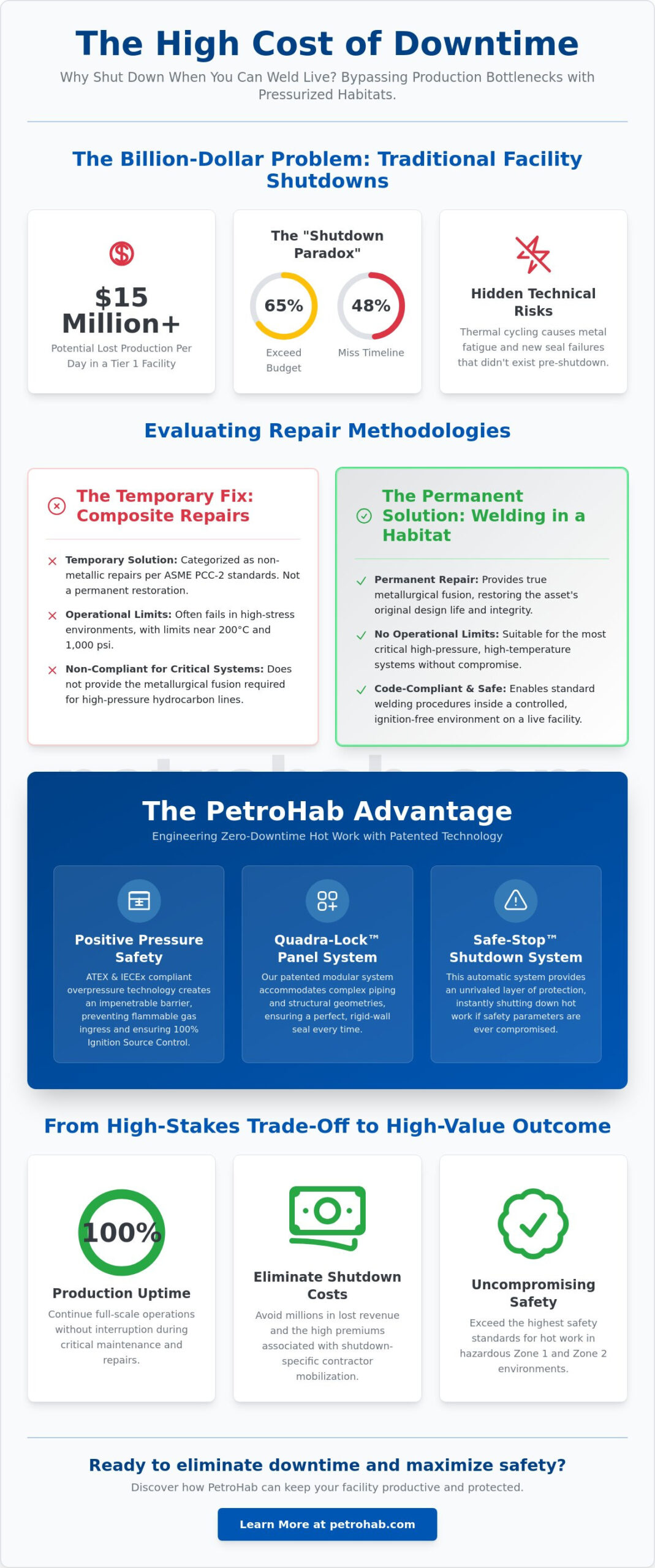
A single day of unplanned downtime in a Tier 1 hydrocarbon facility can cost upwards of $15 million in lost production according to industry benchmarks. Most safety managers accept these staggering losses as an unavoidable cost of maintaining ignition source control during critical repairs. You’ve likely managed the grueling permit-to-work (PTW) delays and the logistical nightmare of a full site outage just to perform a few structural welds. It’s a high-stakes trade-off between operational output and personnel safety that often feels mandatory in hazardous environments.
However, you don’t have to sacrifice your production schedule to maintain rigorous safety standards. It’s possible to bypass these operational bottlenecks by utilizing advanced alternatives to facility shutdown for welding. This guide demonstrates how to maintain 100% production while ensuring an uncompromising safety environment for your crew. We’ll explore the integration of ATEX and IECEx compliant pressurized habitats, featuring our patented Quadra-Lock modular wall system and the Safe-Stop automated shutdown technology to ensure your facility remains protected and profitable.
Key Takeaways
- Quantify the true financial impact of production loss and discover why traditional scheduled outages often exceed their projected time and budget.
- Evaluate various alternatives to facility shutdown for welding to determine the structural limitations of composite repairs and mechanical clamps in high-pressure systems.
- Understand the engineering behind overpressure technology and how Ignition Source Control (ISC) protocols ensure safety within hazardous Zone 1 and Zone 2 environments.
- Learn to strategically implement hot work safety enclosures using the modular Quadra-Lock panel system to accommodate complex piping geometries.
- Discover how the Safe-Stop automatic shutdown system provides an unrivaled layer of protection, enabling critical maintenance without compromising facility uptime.
The Operational Cost of Traditional Facility Shutdowns
Traditional facility shutdowns represent a significant capital liability for energy producers. While scheduled outages are intended to facilitate critical maintenance, they often introduce substantial financial and operational instability. For a refinery processing 250,000 barrels per day, even a minor delay in restarting operations can result in millions of dollars in unrealized revenue. This volatility is a primary reason why senior engineers now prioritize alternatives to facility shutdown for welding and other hot work tasks.
To better understand the mechanical processes involved in live maintenance, watch this helpful video:
The “shutdown paradox” describes the phenomenon where the complexity of an outage scales exponentially with its duration. Industry data suggests that 65% of scheduled turnarounds exceed their initial budget, and nearly half fail to meet their original timeline. These delays often stem from the discovery of secondary issues during the cooling phase or the inherent risks of transient operations. Adhering to rigorous Hot Work Safety Practices is especially critical during these periods, as the transition from a dormant state back to full production is statistically the most hazardous phase of plant operation.
Economic Drivers for Live Maintenance
Upstream offshore assets face daily revenue losses that can exceed $1.2 million during total shutdowns. Beyond lost production, the cost of contractor mobilization is a major factor. Specialized crews often require high premiums for short, high-intensity windows, and the logistics of transporting personnel to remote sites add substantial surcharges. Lost production opportunity in a refinery turnaround is the quantified net profit lost for every hour the facility remains offline instead of processing crude into marketable products.
Technical Constraints of Traditional Shutdowns
Rapid cooling and reheating cycles impose severe thermal stress on high-pressure vessels and piping systems. This thermal cycling can lead to metal fatigue or seal failures that didn’t exist prior to the shutdown. Furthermore, the complexity of purging and gas-freeing an entire facility for a single, minor repair is technically inefficient. By reviewing the definitive guide to hot work safety enclosures, engineers can see how localized isolation provides a superior alternative. Utilizing a pressurized habitat with the Quadra-Lock panel system allows for 100% ignition source control without requiring a total system depressurization. This modular approach ensures that alternatives to facility shutdown for welding remain the gold standard for maintaining operational integrity.
Evaluating Alternatives to Shutdown-Based Welding
Selecting the correct methodology for pressurized pipe repair requires a rigorous assessment of risk versus operational uptime. While several alternatives to facility shutdown for welding exist, they often present trade-offs in long-term reliability. Engineers must weigh the immediate convenience of cold-work solutions against the permanent structural integrity provided by traditional welding conducted within a controlled environment.
Composites vs. Welding: A Technical Comparison
Composite repairs involve wrapping damaged sections with resin-impregnated fibers. According to ASME PCC-2 standards, these are categorized as non-metallic repairs and are often restricted to temporary or semi-permanent applications. They don’t provide the metallurgical fusion required for high-pressure systems. Most composite systems reach their limit when temperatures exceed 200°C or pressures surpass 1,000 psi. For critical hydrocarbon lines, welding remains the only method to restore the original design life of the asset. It provides a permanent, code-compliant solution that composite wraps simply cannot match in high-stress environments.
The “Habitat” Approach to Live Maintenance
The pressurized Hot Work Safety Enclosure (HWSE) functions as a controlled micro-environment, isolating the ignition source from the surrounding hazardous atmosphere. PetroHab utilizes the patented Quadra-Lock panel system to ensure a spark-proof seal that resists high-temperature slag. This technology effectively bridges the gap between risky cold-work alternatives and the massive financial loss of a full facility shutdown. By maintaining a positive pressure between 0.05 mbar and 0.10 mbar, the habitat prevents the ingress of flammable gases, allowing welding to proceed safely while the plant remains live.
Adherence to OSHA General Requirements for welding and fire prevention is a core component of this approach. HWSE systems automate safety compliance by integrating gas detection and the Safe-Stop system. This setup shuts down power to welding tools if it detects a loss of pressure or the presence of hydrocarbons. This shift in the risk profile makes live welding in a habitat significantly more controlled than traditional open-air welding performed during a partial shutdown. You can explore the granular details of this equipment in our pressurized welding habitats technology guide.
- Mechanical Clamps: These rely on gaskets that can fail under thermal cycling; they don’t offer the structural permanence of a weld.
- Cold-Work Solutions: Useful for minor leaks but insufficient for structural repairs on high-vibration equipment.
- HWSE Systems: The gold standard for maintaining production while executing high-integrity repairs.
PetroHab provides these specialized systems to ensure your site remains operational and secure. Contact us to learn more about our hot work safety solutions and how they protect high-value assets during live maintenance.
How Pressurized Habitats Enable Safe Hot Work in Hazardous Zones
Pressurized habitats function as the primary engineering control for conducting hot work in high-risk environments. These systems serve as viable alternatives to facility shutdown for welding by isolating the ignition source from the surrounding atmosphere. The core principle involves maintaining an internal pressure higher than the external environment, effectively forcing air out through any micro-leaks rather than allowing flammable gases in. This barrier is essential for operations in refineries and offshore platforms where hydrocarbon releases are a constant threat.
The Mechanics of Positive Pressure
Precision instrumentation is mandatory for maintaining this barrier. Technicians use sensitive manometers to monitor and maintain a minimum 0.1-inch water column (25 Pa) differential. This pressure gradient ensures that even if a seal is compromised, the outward flow of air prevents hydrocarbon ingress. Air intake systems draw from a remote, verified non-hazardous source, typically located 20 to 50 feet away from the work area. To maintain air quality and manage heat, the system targets high air changes per hour (ACH). A typical setup achieves 20 to 60 ACH, ensuring that welding fumes are purged and the internal temperature remains within operational limits.
Compliance with International Safety Standards
Adherence to global protocols isn’t optional; it’s a fundamental requirement for risk mitigation. Every electrical component within the enclosure must meet ATEX or IECEx requirements to prevent internal sparks. Operations must strictly follow the NFPA 51B Standard for fire prevention. This standard dictates the protocols for fire watches and the management of combustibles during hot work. For a deeper look at these requirements, safety managers should review advanced hot work safety systems to understand how integrated monitoring protects high-value assets during live operations.
Ignition source control (ISC) protocols are the backbone of Zone 1 and Zone 2 operations. Continuous gas monitoring serves as the first line of defense. Sensors detect hydrocarbons at a threshold as low as 10% of the Lower Explosive Limit (LEL), triggering an immediate shutdown of the welding equipment via an automated safety system. The physical integrity of the habitat relies on the Quadra-Lock panel system. These fire-resistant panels contain sparks and slag effectively, preventing any hot particles from escaping the enclosure. This multi-layered approach provides a controlled environment that maintains operational continuity, proving that these systems are the most reliable alternatives to facility shutdown for welding in the energy sector.
The combination of positive pressure, automated gas detection, and modular fire-resistant materials creates a redundant safety net. It allows for critical maintenance to proceed without the massive financial losses associated with total plant de-pressurization. By using these engineered solutions, operators maintain the integrity of their site while ensuring that human life and infrastructure remain protected from the inherent risks of hot work.
Strategic Implementation of HWSE for Live Facilities
Deploying a Hot Work Safety Enclosure (HWSE) requires more than hardware. It demands a systematic integration into the facility’s existing safety architecture. When operators seek alternatives to facility shutdown for welding, they must prioritize a meticulous pre-job assessment. This process begins with continuous gas testing using sensors calibrated to 10% of the Lower Explosive Limit (LEL). Technicians must evaluate the site layout to position air intakes in verified non-hazardous areas, ensuring the habitat remains pressurized with clean, breathable air at all times.
Site Preparation and Risk Assessment
Safety leads must identify all potential hydrocarbon leak sources within a 15-meter radius of the hot work site. This involves checking flange integrity and valve seals on adjacent live lines. A detailed pre-ignition checklist ensures the habitat maintains a minimum overpressure of 0.1 inches of water column (25 Pa). This positive pressure acts as a physical barrier against gas ingress. Engineers should establish clear boundaries for power supply routing to prevent cable damage in high-traffic zones. Every potential ignition source must be accounted for before work commences.
The Role of Modular Engineering
The efficacy of an HWSE depends on its ability to conform to existing infrastructure. PetroHab utilizes Quadra-Lock technology to facilitate rapid assembly around complex piping geometries. These modular panels interconnect to create a gas-tight seal even when penetrating irregular surfaces or multi-pipe configurations. In offshore environments where wind speeds can exceed 50 knots, the durability of these flame-retardant panels is critical. The Quadra-Lock system ensures structural integrity is never compromised by external environmental stressors, providing a resilient barrier that protects both personnel and assets.
Effective implementation requires integrating the habitat into the site’s Permit-to-Work (PTW) system. This isn’t a standalone procedure; it’s a core component of the facility’s risk management strategy. Every technician involved must undergo rigorous training to manage the Safe-Stop system, which automatically cuts power to welding equipment if pressure drops or gas is detected. Supervision by a dedicated habitat technician ensures that the enclosure functions as the gold standard in hot work safety throughout the duration of the project. This level of control makes these systems the primary alternatives to facility shutdown for welding in high-consequence environments.
To ensure your next project adheres to the highest safety standards, consult with the experts at PetroHab today.
The PetroHab Advantage: Engineering Zero-Downtime Hot Work
PetroHab provides the specialized engineering required to maintain production during critical maintenance. By deploying pressurized habitats, operators gain viable alternatives to facility shutdown for welding and other spark-producing activities. These systems don’t just provide a physical barrier. They establish a controlled environment where ignition risks are neutralized through automated logic and superior structural integrity. PetroHab’s presence across major energy hubs, including Houston, Dubai, and Southeast Asia, ensures that technical expertise is available on-site within 24 to 48 hours of mobilization.
Safe-Stop: The Ultimate Ignition Source Control
The Safe-Stop system functions as the central intelligence of the habitat. It continuously monitors for flammable gases and loss of internal pressure. If the system detects gas concentrations at 10 percent of the Lower Explosive Limit (LEL) or a drop in differential pressure below 50 Pascals, it immediately terminates power to all welding equipment and shuts down gas flow. This 360-degree safety loop removes the human error factor from Ignition Source Control (ISC). Safe-Stop stands as the industry benchmark for ISC by ensuring that hot work cannot exist in the presence of a hydrocarbon threat.
Quadra-Lock: Superior Modular Integrity
The Quadra-Lock panel system represents a significant shift from traditional, loosely fastened welding blankets. Its patented locking mechanism creates a continuous, rigid seal that eliminates gaps where sparks or molten slag might escape. Each panel is constructed from high-grade, fire-resistant materials capable of withstanding temperatures exceeding 1,000 degrees Celsius. Quadra-Lock is the mandatory replacement for outdated enclosure designs because its modular nature allows for custom configurations around complex piping and structural steel. This flexibility reduces setup times by 30 percent compared to non-modular alternatives.
Utilizing PetroHab technology allows operators to compress project timelines and avoid the multi-million dollar losses associated with full facility outages. Superior habitat integrity ensures that live work remains a safe, predictable component of asset management. By integrating ATEX and IECEx certified components, PetroHab guarantees compliance with the most stringent global safety standards. This systematic approach to risk mitigation provides the confidence needed to execute hot work in high-risk areas without interrupting the flow of product.
- Rapid Mobilization: Global logistics reach ensures technicians and equipment arrive at remote offshore or onshore sites within 48 hours.
- Enhanced ISC: Automated shutdown protocols eliminate the reliance on manual gas monitoring alone.
- Structural Rigidity: The Quadra-Lock system maintains its seal even in high-wind offshore environments.
- Certified Safety: Every component meets or exceeds ISO and international safety certifications for hazardous environments.
Choosing PetroHab means choosing a partner dedicated to the zero-accident philosophy. Our engineering team works directly with your safety managers to identify specific site hazards before the first panel is locked. This proactive engagement turns complex welding tasks into routine maintenance, protecting both your personnel and your bottom line.
Securing Operational Continuity Through Advanced Hot Work Engineering
Maintaining production during critical repairs requires a shift from traditional maintenance models to advanced engineering solutions. The adoption of pressurized Hot Work Safety Enclosures (HWSE) eliminates the necessity of total site isolation. It’s a strategy that preserves revenue while ensuring personnel safety. PetroHab’s systems provide the necessary alternatives to facility shutdown for welding by utilizing a modular approach to ignition source control.
Our technology relies on the patented Quadra-Lock panel system. This design ensures superior enclosure integrity by interlocking panels without the gaps found in traditional enclosures. The Safe-Stop automatic shutdown system provides unrivaled ignition source control (ISC) by monitoring internal gas levels and pressure. These systems maintain global compliance with ATEX and IECEx standards, meeting the rigorous demands of the energy sector. Choosing PetroHab means integrating a safety partner that prioritizes zero-downtime operations through meticulous engineering. You don’t have to compromise between safety and profitability when utilizing the industry’s gold standard in habitat technology.
Request a Quote for Pressurized Welding Habitat Rental to secure your facility’s operational future. Your next maintenance project can proceed with absolute confidence and safety.
Frequently Asked Questions
Is it truly safe to weld on a live oil and gas facility?
Yes, welding on a live facility is safe when you use a pressurized Hot Work Safety Enclosure (HWSE) to isolate the ignition source. This technology creates a physical barrier between the welding arc and potential hydrocarbons in the plant. PetroHab systems maintain a positive pressure of 0.05 mbar, ensuring that external gases can’t enter the workspace. This method has been a standard industry practice for over 20 years for maintaining operational uptime.
What are the main alternatives to shutting down a plant for welding?
The primary alternatives to facility shutdown for welding include the use of pressurized habitats, cold cutting tools, and mechanical piping connectors. Among these, the pressurized habitat is the most effective solution for permanent structural repairs and complex piping work. By deploying a modular Quadra-Lock enclosure, operators can continue production across 100% of the facility while welding occurs in a localized area. This technology eliminates the multi-day downtime required for a full plant purge.
How does a pressurized habitat prevent an explosion during hot work?
A pressurized habitat prevents explosions by maintaining an internal air pressure that’s higher than the atmospheric pressure outside. This positive pressure creates a constant outward airflow that blocks flammable gases from entering the enclosure. The system uses redundant fans to maintain a 50 Pascal pressure differential. If this pressure drops below the 25 Pascal safety threshold, the Safe-Stop system automatically terminates power to the welding equipment in less than 0.5 seconds.
What happens if gas is detected near the welding habitat?
If the external gas detectors identify hydrocarbons at 10% of the Lower Explosive Limit (LEL), the Safe-Stop system triggers an immediate shutdown. This automated response cuts power to all ignition sources inside the habitat instantly to prevent an accident. The system also activates audible and visual alarms to alert the 24/7 fire watch and site personnel. This ensures that hot work only occurs when the surrounding atmosphere is confirmed to be within safe parameters.
Are pressurized habitats compliant with ATEX and IECEx standards?
Yes, all PetroHab components are engineered to meet or exceed ATEX and IECEx Zone 1 and Zone 2 requirements. Our systems comply with the IEC 60079-13 standard for pressurized rooms and enclosures. This certification ensures that every electrical component, from the intake fans to the control logic, is safe for use in hazardous areas. We provide full documentation for each deployment to satisfy 100% of regulatory audit and safety insurance requirements.
How long does it take to set up a hot work safety enclosure?
A standard 2×2 meter Quadra-Lock habitat can be fully assembled and commissioned in 4 to 6 hours by a trained two-person crew. The modular design allows for rapid configuration around complex piping and structural beams. Once the physical structure is built, the automated gas detection and pressure testing protocols take approximately 45 minutes to complete. This rapid deployment minimizes preparation time compared to the 48 hours often needed for nitrogen purging and venting.
Can habitats be used in offshore environments like oil rigs?
Habitats are specifically designed for the rigorous demands of offshore oil rigs and FPSO vessels. The Quadra-Lock panels are constructed from silicone-coated fiberglass cloth that withstands continuous temperatures of 1,000 degrees Celsius. These enclosures have been successfully deployed on over 500 offshore platforms globally to facilitate deck repairs and piping upgrades without stopping production. They provide essential protection against high winds and salt spray while maintaining the integrity of the hot work site.
Do I need a special permit for welding inside a habitat on a live plant?
Yes, you’ll still require a Hot Work Permit, but the habitat changes the risk profile from high risk to managed risk within the plant’s Permit to Work (PTW) system. Most safety managers categorize habitat-contained welding as a controlled activity under ISO 17776 standards. The presence of a Safe-Stop system and continuous gas monitoring often simplifies the approval process. It’s standard practice to include the habitat technical specifications and the operator certification in the permit application package.