Blog Posts
Decommissioning a Hot Work Habitat Safely: A Comprehensive Industrial Protocol
Decommissioning is not the end of a safety protocol; it’s a distinct high-risk operation requiring specialized pressurized containment strategies. Many safety managers mistakenly believe the danger subsides once the welding torches are extinguished. However, the transition from a pressurized environment back to an ambient hazardous zone presents critical risks, including residual ignition sources and the premature loss of positive pressure. You understand that maintaining site integrity during this final phase is just as vital as the initial setup.
This guide ensures you master the rigorous protocols for decommissioning a hot work habitat safely while adhering to ATEX and IECEx standards. By following a structured industrial protocol, you can achieve a zero-incident phase and protect your high-value HWSE assets. We’ll examine the technical requirements for certified technicians under ISO 9001 guidelines, including the mandatory 40-hour training program. We also detail the management of complex Permit-to-Work transitions and the systematic dismantling of Quadra-Lock panels. These steps ensure absolute control over the work environment until the site is fully restored and the hazard is neutralized.
Key Takeaways
- Identify the critical “danger window” where residual heat remains an ignition risk even after active hot work has concluded.
- Implement the rigorous technical protocols required for decommissioning a hot work habitat safely while maintaining site integrity.
- Leverage the structural stability of Quadra-Lock panel technology to prevent accidental collapse during sequential dismantling.
- Integrate the decommissioning phase into the master Permit-to-Work (PTW) system to manage the transition from pressurized to ambient environments.
- Establish post-project maintenance routines, including professional inspection and decontamination, to ensure the longevity of HWSE assets.
The Critical Risks of Decommissioning Hot Work Habitats
Habitat decommissioning represents the critical transition from a controlled, pressurized safety state back to the standard ambient environment of a hazardous site. This phase isn’t merely a logistical teardown; it’s a high-stakes operational shift. Engineers must recognize that decommissioning a hot work habitat safely requires the same level of technical oversight as the initial installation. The primary objective is to prevent the introduction of flammable gases while the internal environment remains vulnerable.
A significant threat exists within the “danger window,” which is the period immediately following the cessation of hot work. Although the welding arc is extinguished, the workpiece often retains enough thermal energy to exceed the auto-ignition temperature of surrounding hydrocarbons. A Positive pressure enclosure effectively mitigates this risk during operation, but premature depressurization can allow flammable vapors to reach these residual ignition sources. Personnel must also manage the physical hazards of dismantling heavy components in congested industrial spaces.
To better understand the complexities of this transition, watch this technical overview:
Residual Ignition Sources and Cooling Periods
Management of residual heat is non-negotiable. Safety protocols must establish mandatory cooling periods based on the material mass and peak temperatures reached during welding. Technicians utilize thermal imaging cameras to verify that the workpiece temperature has dropped below critical thresholds before any breach of the enclosure occurs. This process also involves the meticulous containment of slag and spark residue. You must ensure that no smoldering materials remain hidden within the floor panels or near structural supports during the dismantling process.
Maintaining Site Integrity During Depressurization
Site integrity depends on the continuous operation of safety systems until the risk is eliminated. Specialized pressurized welding habitats must remain fully energized and pressurized at 50 Pascals until final gas tests confirm the absence of hydrocarbons in the immediate vicinity. External factors like high-velocity winds or sudden atmospheric pressure changes can disrupt the enclosure’s stability if the teardown is poorly timed. The Safe-Stop Automatic Shutdown System must remain powered and functional until the final Quadra-Lock panel is breached. Maintaining these standards is the only way to ensure you are decommissioning a hot work habitat safely without compromising personnel or assets.
Pre-Decommissioning: Transitioning from Hot Work to Cold Site
The transition from active hot work to a cold site is a critical juncture that demands meticulous planning. Many safety failures occur when teams treat the end of welding as the end of the hazard. Decommissioning a hot work habitat safely requires you to integrate this phase directly into the master Permit-to-Work (PTW) system. This ensures that the transition is documented and authorized by the HSE supervisor. Before dismantling begins, you must conduct a pre-teardown safety meeting. This briefing aligns the welding team and safety personnel on the specific sequence of operations and emergency protocols.
Compliance with OSHA hot work regulations mandates that all ignition sources are properly managed. This includes rigorous Lock-out/Tag-out (LOTO) procedures for all welding machines and electrical tools located inside the enclosure. You can’t assume a tool is safe just because it’s switched off; physical isolation is the only acceptable standard. Simultaneously, technicians must verify the calibration of all gas detection systems. If sensors have drifted during the work shift, they won’t provide the accurate data needed during the vulnerable depressurization phase.
Gas Monitoring Continuity and Safe-Stop Integration
The Safe-Stop Automatic Shutdown System must remain active throughout the entire teardown process. While the enclosure’s seal is eventually compromised, the system continues to monitor for hydrocarbon ingress in the immediate vicinity. You’ll need to manage alarm thresholds carefully as the enclosure is no longer fully pressurized. If gas is detected during panel removal, the protocol is immediate evacuation and site isolation. There’s no room for hesitation when the physical barrier is being dismantled.
The Role of On-site Supervision
Decommissioning a hot work habitat safely isn’t a task for general labor. Industry standards, including ISO 9001 safety management systems, require a certified habitat technician to oversee the process. These professionals ensure that the “Safe to Dismantle” status is accurately documented in the site safety log. They brief all personnel on the specific exit sequence to prevent congestion or accidental damage to HWSE assets. For those managing high-stakes environments, seeking professional guidance on pressurized habitats is a prerequisite for operational excellence.
Structural Integrity and the Quadra-Lock Advantage During Teardown
Maintaining structural stability is paramount when dismantling a pressurized enclosure. Generic systems often suffer from instability once the initial seals are breached. The PetroHab Hot Work Safety Enclosure (HWSE) utilizes Quadra-Lock Panels to ensure that each section remains secure until intentionally released. This engineering prevents the accidental structural collapse that can occur when internal pressure is lost and external forces, such as wind or gravity, take over. Decommissioning a hot work habitat safely depends on the physical integrity of the unit until the final piece is removed and stored.
A methodical, sequential teardown is the only way to preserve site safety. Technicians must follow a pre-determined order, typically starting from the roof and moving downward, to keep the center of gravity low and stable. This process is particularly critical when managing penetrations like pipes and structural beams. These areas require careful handling to avoid tearing the modular panels or damaging the seals that interface with the asset. Adhering to EPA hot work permit requirements ensures that all regulatory and safety benchmarks are met before the first panel is even touched.
Avoiding Panel Damage and Maintaining Seal Integrity
The Quadra-Lock mechanism allows for rapid assembly, but it requires technical precision during disengagement. Technicians should never use excessive force to separate components. Forcing a panel can warp the frame or damage the interlocking teeth, rendering the unit unsafe for future use. As each panel is removed, technicians must inspect the seals and gaskets for wear or heat damage. In offshore environments, the risk of panel “sailing” is high. A single 1-meter panel can act as a sail in high winds, creating a significant hazard for technicians on deck. You must secure each panel immediately upon removal to maintain control of the work area.
Handling Modular HWSE Components Safely
Ergonomics play a vital role in protecting personnel during the final phase of the project. While the panels are modular, their fire-resistant construction adds weight that requires disciplined handling. Technicians must use proper lifting techniques to avoid musculoskeletal injuries during the repeated movements of a teardown. Once removed, Quadra-Lock panels must be stacked and palletized on level ground. Improper stacking leads to warping, which compromises the seal of the habitat in future deployments. Finally, inventory management is essential. Every component, from the Safe-Stop sensors to the air ducting, must be accounted for and logged. This meticulousness ensures that decommissioning a hot work habitat safely results in a project that is as organized at the end as it was at the beginning.
Step-by-Step Guide: Decommissioning Your HWSE Safely
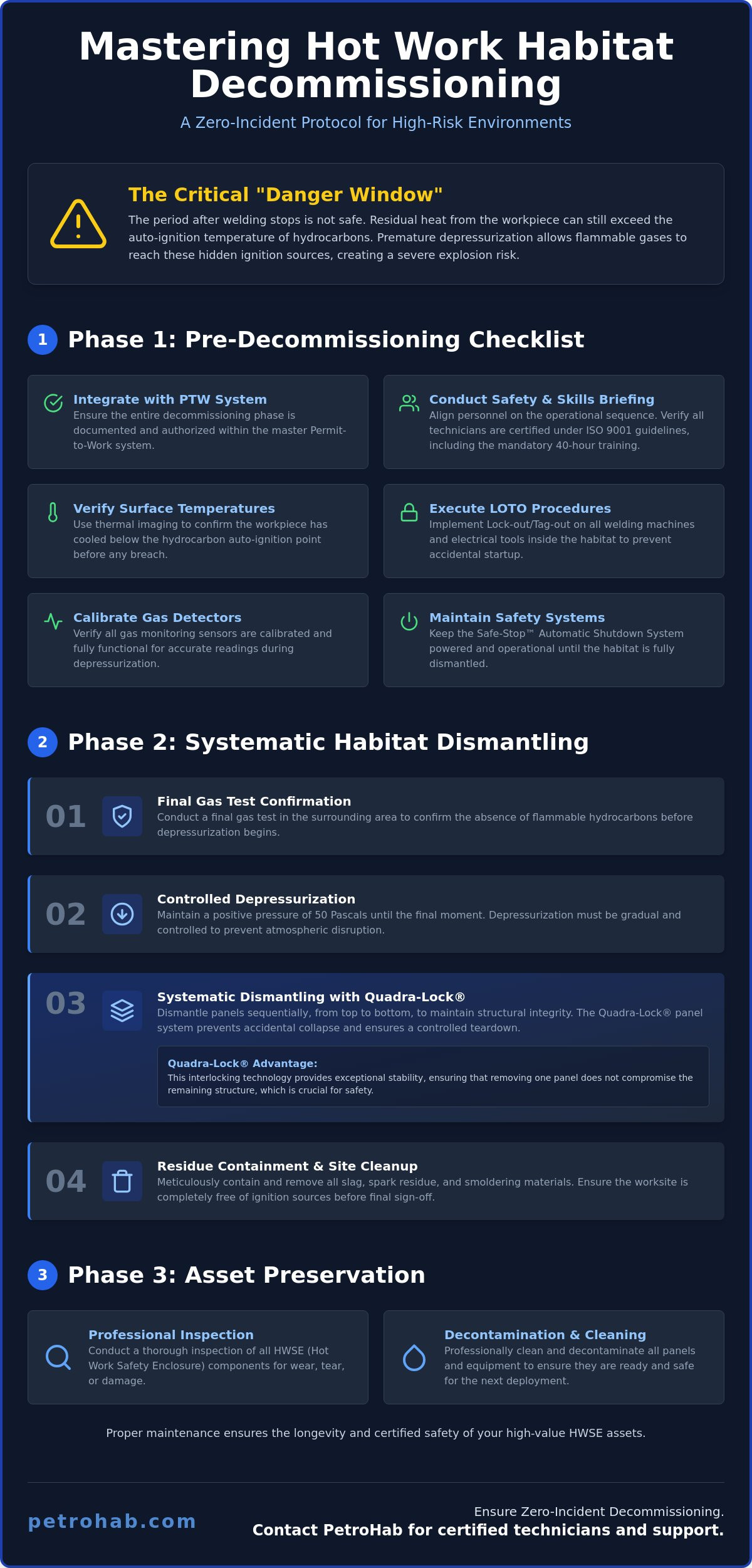
Precision defines the success of the decommissioning phase. The process begins with a rigorous final inspection. You must confirm that all hot work operations are officially concluded and that the workpiece has reached ambient temperature. De-energize all welding leads and auxiliary equipment inside the enclosure. Only then should you disconnect the Safe-Stop system and secondary power sources. This systematic power down prevents electrical hazards and ensures that the system doesn’t trigger a false alarm during the physical teardown.
Decommissioning a hot work habitat safely requires a controlled depressurization protocol. Never breach the enclosure while it is under full pressure. Gradually reduce the blower output to allow the internal atmosphere to equalize with the external environment. This slow transition is critical. It prevents the sudden ingress of potentially flammable gases before the site is fully stabilized. Technicians must remain vigilant, monitoring gas levels throughout this period to ensure the safety barrier remains effective until the final moment.
Once the pressure is neutralized, begin the sequential removal of the Quadra-Lock panels. Always start at the roof and work your way down to the base. This top-down method maintains the structural stability of the walls for as long as possible. It also prevents the risk of panels falling inward or outward unexpectedly. As each panel is detached, move it immediately to a designated staging area. This keeps the work floor clear and reduces trip hazards.
The final stage is site restoration. You must clear the work area of all industrial debris, including slag, discarded welding rods, and consumables. Every HWSE component, from the smallest fastener to the main blower unit, must be accounted for and inspected. A clean, restored site signifies the formal end of the hazard window. For industry-leading protection, ensure your team utilizes pressurized welding enclosures for every high-stakes project.
Depressurization and Air Flow Management
Effective air flow management is essential during the cooling and depressurization phase. Use PetroHab Air Ducting to vent residual fumes or smoke before the first panel is removed. This step is particularly important in confined offshore modules where ventilation is limited. Technicians must monitor manometers during the pressure drop. Any unexpected fluctuations could indicate a change in the external atmosphere or a breach in site integrity. This transition from forced ventilation to natural atmospheric air must be documented and controlled.
Compliance and Final Documentation
Accountability is the cornerstone of safety excellence. You must cross-reference every step of the teardown with current hazardous environment standards to ensure global compliance. Once the site is cleared, the HSE supervisor signs off the Permit-to-Work (PTW). This action formally closes the high-risk operation. Finally, file a post-job safety report (PJSR). This document provides the necessary data for corporate safety auditing and helps refine future safety protocols. It serves as a permanent record of a zero-incident decommissioning phase.
Post-Project Maintenance and PetroHab Support
Industrial environments are punishing. After the process of decommissioning a hot work habitat safely is finished, the physical assets require immediate attention. Panels used in offshore platforms or petrochemical refineries often accumulate corrosive salt spray or volatile chemical residues. You must implement a standardized cleaning protocol to neutralize these substances. This isn’t just a matter of aesthetics; it’s a technical requirement to preserve the structural integrity of the HWSE. Neglecting decontamination leads to material degradation and can compromise the fire-resistance ratings of the system over time.
Professional inspection serves as the final audit of the project’s success. For leased equipment, this phase is critical. PetroHab’s technical team conducts a granular assessment of every component, checking for micro-fractures in the Quadra-Lock mechanisms and assessing the wear on specialized gaskets. This rigorous approach guarantees that every system in the fleet remains compliant with international safety certifications. If any component shows signs of thermal stress or mechanical fatigue, it’s removed from service for repair or replacement.
Long-term storage requires a controlled environment to ensure equipment longevity. Quadra-Lock panels are engineered for extreme conditions, yet their fire-resistant properties are best preserved in climate-controlled facilities. Stacking panels in high-humidity or high-heat storage units without proper ventilation can lead to warping. This damage prevents a perfect seal during the next deployment, which compromises the positive pressure required for safety. Meticulous storage is an investment in the reliability of your next hot work operation.
Inspecting the Safe-Stop and Monitoring Hardware
The Safe-Stop system is the electronic heart of the habitat. Maintenance involves post-operation sensor calibration to ensure gas detection accuracy remains within factory specifications. Safe-Stop sensors are precision instruments that operate in Zone 1 and Zone 2 environments where accuracy is the difference between safety and disaster. Technicians must perform battery health checks and verify the integrity of all cabling. Any hardware that fails these rigorous diagnostic tests is pulled from service immediately. This uncompromising stance on equipment health is what defines the PetroHab standard.
Training and Competency for Future Decommissioning
Competency is not static. It requires constant reinforcement through real-world application and formal education. Reviewing the decommissioning phase allows safety managers to identify “Lessons Learned” and update site-specific protocols. PetroHab acts as a strategic partner by offering specialized training for your personnel. By analyzing the data from your post-job safety reports, we help you refine your internal Permit-to-Work transitions. You can schedule a consultation for on-site supervision and technical training to ensure your team remains proficient in the latest safety standards. This collaborative approach ensures that the next time your team is tasked with decommissioning a hot work habitat safely, they do so with absolute confidence and technical mastery.
Achieving Operational Excellence in Habitat Decommissioning
Operational excellence requires a commitment to safety that extends beyond the final weld. You’ve learned that decommissioning a hot work habitat safely is a technical operation defined by sequential control and continuous monitoring. Success depends on maintaining positive pressure until all ignition risks are neutralized and utilizing the structural stability of the patented Quadra-Lock panel technology. By integrating the teardown into your master Permit-to-Work system, you eliminate the “danger window” and protect your site from hydrocarbon ingress during the final transition.
PetroHab remains your dedicated partner in risk mitigation. Our Safe-Stop systems provide the 24/7 automated gas and pressure monitoring required for the most volatile environments. With a global track record in demanding offshore and onshore sites, we provide the engineering and expertise necessary for zero-incident project completions. Don’t leave the final phase of your safety protocol to chance. Our team is ready to assist with technical oversight and industry-leading equipment.
Contact PetroHab for Certified On-Site Supervision and HWSE Leasing to secure your next project. We look forward to supporting your commitment to industrial safety and operational integrity.
Frequently Asked Questions
What is the most dangerous part of decommissioning a hot work habitat?
The transition window immediately following the loss of positive pressure is the most hazardous phase. During this time, residual heat in the workpiece may still exceed the auto-ignition temperature of surrounding hydrocarbons. If the enclosure is breached before the metal has cooled sufficiently, flammable gases can reach the heat source. This risk makes decommissioning a hot work habitat safely a high-stakes technical task that requires constant atmospheric monitoring.
How long should I wait after welding before dismantling the HWSE?
You must wait until the workpiece temperature drops below the site-specific auto-ignition threshold. There isn’t a universal time limit because cooling depends on the material mass and the peak temperatures reached during the operation. Technicians use thermal imaging cameras to verify that the environment is safe for teardown. Dismantling should only begin once the HSE supervisor confirms that all residual ignition sources are neutralized.
Can I turn off the gas detection system once the welding is finished?
No, the gas detection system must remain fully operational until the final panel is removed. The Safe-Stop Automatic Shutdown System continues to provide a critical layer of protection during the depressurization phase. It alerts the team to any hydrocarbon ingress that occurs while the physical barrier is being dismantled. Deactivating sensors prematurely exposes the crew to undetected atmospheric hazards during a vulnerable stage of the project.
Do I need a separate permit for decommissioning the enclosure?
Decommissioning is typically managed under a distinct phase of the Permit-to-Work (PTW) system. The transition from active hot work to habitat dismantling requires a formal handover and a new safety assessment. This process ensures that the HSE supervisor has verified the cooling of materials and the isolation of all welding equipment before the teardown crew enters the area. It prevents unauthorized breaches of the pressurized environment.
How do Quadra-Lock panels improve the safety of the teardown process?
Quadra-Lock panels feature a patented interlocking mechanism that maintains structural stability even after the initial seals are breached. Unlike generic modular systems, these panels don’t collapse unexpectedly when internal pressure is lost. This superior structural integrity allows for a controlled, sequential teardown. It ensures the enclosure remains a rigid protective shell until each individual 1-meter panel is intentionally released by a certified technician.
What happens if gas is detected while we are removing the panels?
If the Safe-Stop system detects gas during dismantling, the team must execute an immediate evacuation protocol. The site is isolated and all power to the area is cut. Because the enclosure’s physical barrier is compromised during panel removal, the risk of a flash fire is significantly higher. Work only resumes once the atmosphere is cleared and the HSE supervisor re-issues a safe entry permit after a thorough inspection.
Are there specific storage requirements for fire-resistant habitat panels?
Quadra-Lock panels should be stored in climate-controlled environments to preserve their specialized fire-resistant properties. High humidity or extreme temperature fluctuations can cause the frames to warp or the seals to degrade. You must stack the panels flat on level pallets to prevent mechanical distortion. Proper storage ensures that the panels maintain a perfect, airtight seal during their next deployment in a hazardous environment.
Should I use a third-party technician to oversee the decommissioning?
Industry best practices and ISO 9001 standards require a certified technician to manage the entire lifecycle of a pressurized habitat. These experts possess the 40-hour training required to handle the complexities of decommissioning a hot work habitat safely. Utilizing a certified professional ensures that the teardown follows rigorous technical protocols. It also protects your high-value HWSE assets from damage caused by improper handling or forced disengagement of the locking mechanisms.