Blog Posts
Developing a SIMOPS Hot Work Safety Plan: The 2026 Engineering Guide
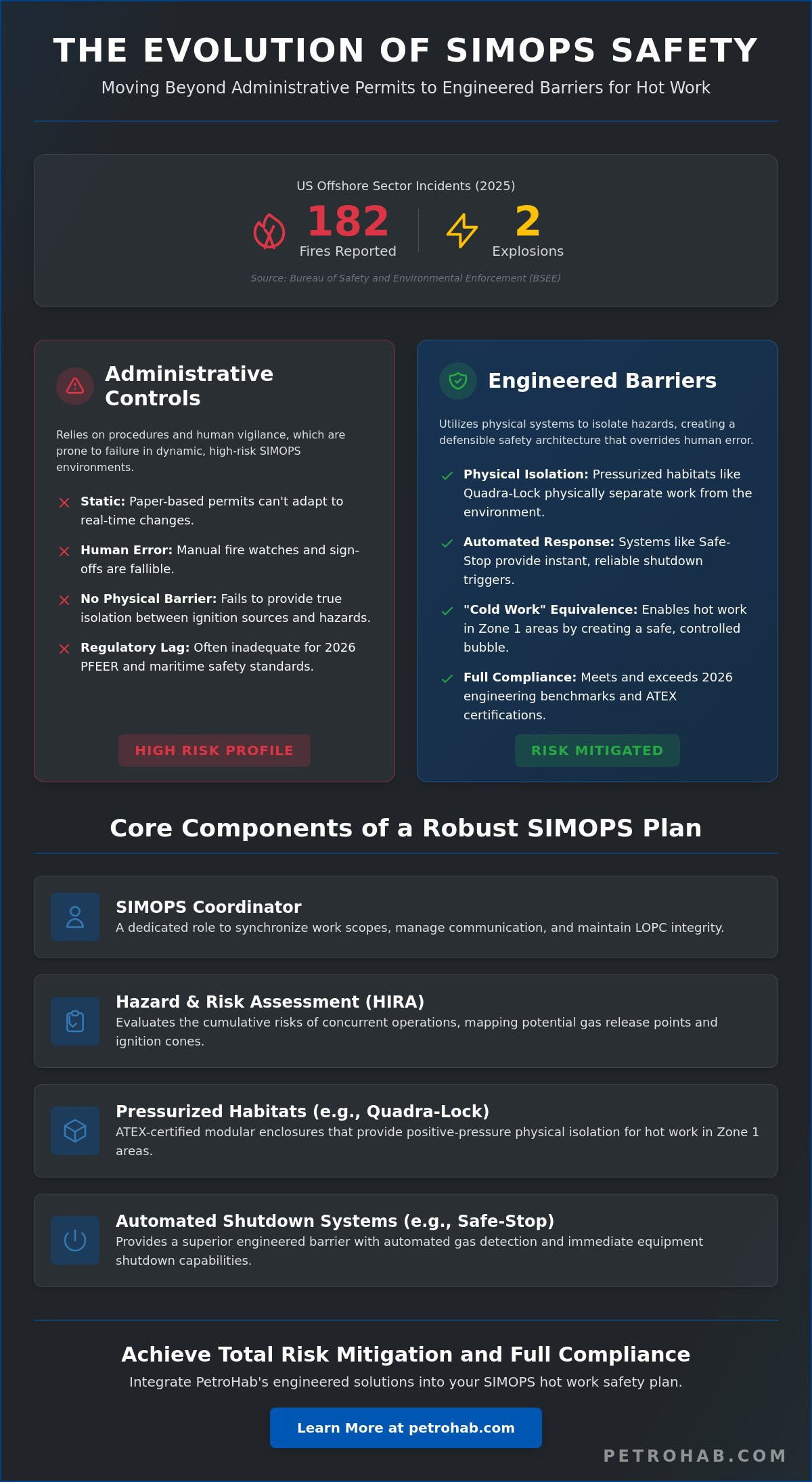
Relying solely on administrative permits to manage simultaneous operations is no longer a defensible engineering strategy in high-risk environments. You recognize that the pressure to minimize downtime often creates a conflict between maintenance requirements and the necessity of maintaining LOPC integrity. Developing a comprehensive SIMOPS hot work safety plan is essential, especially given that the Bureau of Safety and Environmental Enforcement reported 182 fires and 2 explosions in the US offshore sector during 2025. These incidents highlight the failure of traditional barriers to manage conflicting work scopes in tight, hazardous spaces.
You’ll learn how to implement a robust safety architecture that ensures zero ignition incidents while allowing for concurrent welding and production. This guide demonstrates how to integrate the Quadra-Lock pressurized habitat into your operational framework to achieve total risk mitigation and full compliance with international safety standards. We’ll analyze the January 22, 2026, PFEER regulatory updates, the January 1, 2026, UK maritime safety revisions, and the deployment of modular, ATEX-certified systems to provide the physical isolation required in Zone 1 hazardous areas. This technical approach, utilizing patented Quadra-Lock and Safe-Stop technologies, guarantees that your facility remains productive and fully aligned with the latest 2026 engineering benchmarks.
Key Takeaways
- Define the critical role of the SIMOPS Coordinator in synchronizing conflicting work scopes to maintain Loss of Primary Containment (LOPC) integrity.
- Identify the specific Hazard Identification and Risk Assessment (HIRA) requirements necessary to evaluate the cumulative risks of concurrent production and welding.
- Learn why automated shutdown systems like Safe-Stop provide a superior engineered barrier compared to the inherent limitations of manual fire watches.
- Master the technical deployment of the Quadra-Lock enclosure, including precise air intake positioning relative to prevailing winds for maximum safety.
- Integrate pressurized habitats into your SIMOPS hot work safety plan to achieve cold work equivalence and ensure zero ignition incidents in Zone 1 environments.
Understanding SIMOPS and the Critical Role of Hot Work Safety
In the 2026 energy sector, Simultaneous Operations (SIMOPS) refers to the execution of two or more independent work scopes within the same physical or functional area. This coordination is governed by the updated Prevention of Fire and Explosion, and Emergency Response (PFEER) Regulations, which took effect on January 22, 2026. A SIMOPS hot work safety plan acts as the primary defense against catastrophic ignition incidents during these high-density activity windows. It’s not just a coordination tool. It’s a life-critical framework designed to prevent the convergence of ignition sources and flammable atmospheres.
Hot work remains the most volatile variable in concurrent operations. The 2025 BSEE data confirms this volatility, recording 182 fires and 2 explosions in US offshore sectors. These figures underscore the inherent danger when welding or grinding occurs near active production streams. Maintaining high standards for Occupational safety and health requires recognizing that an ignition source doesn’t just threaten the immediate task. It risks the integrity of the entire facility. Effective risk management demands that we move beyond simple awareness and toward rigorous, engineered isolation.
To better understand the fundamental principles of simultaneous operations, watch this technical overview:
Identifying SIMOPS Hazards in Refineries and Platforms
Managing hazards on refineries and offshore platforms requires precise mapping of potential gas release points. Engineers must account for the “Cone of Exposure,” where sparks or molten slag can travel far beyond the immediate work area. In 2026, managing the interface between production, drilling, and maintenance crews is more complex due to aging infrastructure and tighter production schedules. You can’t rely on luck. You need engineered separation to ensure that a minor leak in a production manifold doesn’t meet a welding arc ten meters away. This requires a SIMOPS hot work safety plan that identifies every potential leak path and implements a physical barrier to intercept it.
The Limitations of Traditional Hot Work Permits
Traditional hot work permits are often inadequate for modern SIMOPS environments. Paper-based systems are static. They don’t react to real-time changes in wind direction or sudden pressure drops in process piping. True safety requires physical isolation that achieves “Cold Work” equivalence. Integrating hazardous environment standards into your framework is a necessity for 2026 compliance. Only a pressurized, modular barrier like the Quadra-Lock system provides the physical protection needed to override the failures of administrative sign-offs. By isolating the ignition source from the surrounding environment, you eliminate the risk of human error in the permit-to-work process.
Core Components of a Robust SIMOPS Hot Work Safety Plan
A successful SIMOPS hot work safety plan requires more than just high-level oversight. It demands a rigid chain of command led by a dedicated SIMOPS Coordinator. This individual synchronizes the communication protocols between drilling, production, and maintenance teams. Their role is to ensure that every stakeholder understands the real-time status of the facility. Without this centralized control, the risk of conflicting work scopes increases exponentially. This coordination is the first line of defense in preventing the convergence of hazardous conditions.
Risk assessment must evolve beyond generic checklists. Engineers must conduct a Hazard Identification and Risk Assessment (HIRA) that specifically addresses the cumulative risks of simultaneous activities. You need to evaluate how a localized incident inside a habitat could impact emergency escape routes or nearby high-pressure manifolds. For a detailed framework on these requirements, consult this Comprehensive Guide to Simultaneous Operations. In 2026, regulatory expectations demand that Emergency Response Plans (ERP) include specific protocols for habitat failures. If a system loses positive pressure, the response must be instantaneous and automated.
Automated monitoring provides the real-time site visibility that manual fire watches cannot match. Integrated sensor arrays track pressure differentials and gas concentrations continuously. If the SIMOPS hot work safety plan identifies a breach in integrity, the system must trigger an automated sequence to isolate the ignition source within milliseconds. This level of technical control is essential for maintaining LOPC integrity in high-density work zones.
Ignition Source Control and Pressurization
Pressurized welding habitats function as a definitive physical barrier. By maintaining an internal pressure of approximately 0.1 to 0.5 inches of water gauge above ambient levels, the system prevents the ingress of flammable gases. This “room within a room” engineering ensures that the ignition source remains isolated from the external environment. Continuous gas monitoring at the air intake is a non-negotiable requirement. If sensors detect hydrocarbons at levels exceeding 10% LEL, the Safe-Stop system immediately terminates power to all welding equipment.
Modular Barriers and Space Constraints
The Quadra-Lock system is engineered to navigate the tight constraints of offshore platforms and refineries. Its modular panels allow engineers to construct enclosures around existing piping, valves, and structural obstructions without sacrificing structural integrity. This flexibility is critical for rapid assembly and disassembly. It allows maintenance crews to minimize the duration of SIMOPS windows while maintaining the gold standard in safety. Implementing the right engineered safety solutions ensures that your facility maintains production without compromising on risk mitigation.
Engineered Barriers vs. Administrative Controls in SIMOPS
Administrative controls like fire watches are inherently fallible. They rely on human perception, focus, and reaction times. In contrast, engineered barriers provide a definitive physical separation between ignition sources and potential fuel. Within a robust SIMOPS hot work safety plan, the objective is to achieve ‘Cold Work’ equivalence. This means the risk level of welding inside a pressurized enclosure is technically identical to performing the same task in a non-hazardous environment. This physical isolation is the only way to satisfy the January 2026 PFEER requirements while maintaining live production on an active platform. It moves the safety burden from the observer to the infrastructure.
The economic argument for engineered barriers is equally compelling. A total production shutdown for maintenance can result in millions of dollars in lost revenue per day. Deploying a Hot Work Safety Enclosure (HWSE) allows operations to continue uninterrupted. By investing in high-integrity hot work safety systems, operators mitigate the primary risk of ignition without the financial penalty of downtime. This transition from administrative oversight to engineered protection is the benchmark of 2026 safety management. It provides a measurable return on investment through risk reduction and operational continuity.
The Safe-Stop Advantage: Automated Ignition Control
Human error remains a persistent threat in complex environments. The Safe-Stop system removes this variable by utilizing automatic shutdown logic. It employs a 2-out-of-3 voting architecture for gas detection across multiple sensors. This configuration ensures that a single faulty sensor doesn’t cause a nuisance trip, while two positive detections trigger an immediate, fail-safe isolation of power to all ignition sources. The system interfaces directly with the facility’s main Emergency Shutdown (ESD) system. This integration ensures a coordinated, plant-wide response during a Loss of Primary Containment (LOPC) event, protecting both personnel and assets.
Quadra-Lock: The Engineering Behind the Barrier
The physical integrity of the barrier itself is paramount. Quadra-Lock technology uses patented interlocking panels to create a gas-tight seal that withstands the high-vibration environments typical of offshore platforms and refineries. These panels are modular yet provide the structural rigidity of a permanent installation. They are designed to resist the mechanical stresses of a working rig while maintaining the internal positive pressure required for safety. Quadra-Lock defines the industry standard for modular HWSE integrity by ensuring that positive pressure is maintained even under extreme operational stress.
Implementation Checklist: Deploying Habitats within SIMOPS
Execution of a SIMOPS hot work safety plan transitions from engineering theory to operational reality during the deployment phase. This process demands a rigorous, sequential checklist to ensure that the engineered barrier performs to its exact design specifications. This isn’t merely an assembly task. It’s a synchronization of hardware, personnel, and environmental variables. Each step must be verified before the first arc is struck to maintain the integrity of the facility.
Pre-deployment begins with a technical site survey. You must position the air intake in a location verified as hydrocarbon-free. This requires analyzing prevailing wind patterns and local topography to prevent the intake of toxic or flammable gases. Installation involves the assembly of the Quadra-Lock interlocking panels. Once the structure is secure, technicians perform a pressure integrity test. We verify that the internal environment maintains a constant positive pressure differential of at least 0.1 inches of water gauge. Integration follows with the calibration of gas detectors. You must test the Safe-Stop shutdown logic to ensure power is severed to the welding equipment within milliseconds of a gas detection event or a loss of pressure.
Operation requires continuous, real-time monitoring. Synchronizing the habitat status with the facility’s Permit-to-Work (PTW) system ensures that hot work only occurs when all concurrent activities are in a stable state. Close-out is the final critical step. De-pressurization must be controlled and monitored. The safe removal of hardware ensures that no residual hazards remain in the work area, allowing the zone to return to standard operating status without delay.
Pre-Work Site Assessment for Pressurized Units
Identifying ‘Dead Zones’ is an engineering priority. These are stagnant areas where gas could accumulate near the habitat despite ambient ventilation. Engineers calculate air change rates to ensure both welder safety and efficient fume extraction. This calculation prevents the buildup of hazardous gases within the enclosure. For detailed airflow specifications and technical requirements, refer to the pressurized welding habitat technology guide. Accurate air change rates are essential for maintaining a breathable atmosphere while performing high-intensity welding tasks.
Managing the SIMOPS Interface
Daily SIMOPS meetings are mandatory for operational success. These sessions coordinate the habitat’s status with other departments, such as drilling or production crews. Every participant on-site holds ‘Stop Work Authority.’ If environmental conditions change or an unplanned gas release occurs, the SIMOPS hot work safety plan is overridden immediately. Documenting hourly pressure logs and gas test results is essential for audit compliance. This rigorous documentation maintains the gold standard in safety and provides a clear record of risk mitigation. Secure your facility today by contacting our engineers for a custom SIMOPS risk assessment.
The PetroHab Solution: Elevating SIMOPS Safety Standards
PetroHab LLC operates as the global vanguard of hot work safety, providing the engineered solutions necessary to execute a complex SIMOPS hot work safety plan. Our worldwide presence ensures that whether your project is in the North Sea or the Gulf of Mexico, you have access to the same unrivaled safety standards. The core of our offering is the integration of the Safe-Stop and Quadra-Lock systems. These technologies have maintained a flawless operational record across thousands of high-stakes deployments. We don’t just provide equipment. We provide the technical certainty required to operate in the most hazardous Zone 1 environments.
Effective risk mitigation depends on both hardware and human performance. PetroHab LLC provides comprehensive on-site supervision and specialized training to ensure your crew is SIMOPS-ready. This proactive approach ensures that every technician understands the nuances of habitat pressurization and ignition source control. By standardizing these procedures, operators significantly reduce the probability of human error during concurrent activities. This level of preparation is essential for maintaining the integrity of the facility during high-density maintenance windows.
For long-term facility maintenance, we offer flexible procurement models. Whether you choose a leasing arrangement for short-term turnarounds or a full purchase for permanent brownfield modifications, our commitment to integrity remains constant. This flexibility allows safety managers to align their SIMOPS hot work safety plan with specific budgetary and operational timelines without compromising on the quality of the engineered barriers. Our hardware is built to last. It ensures that your investment provides protection for years to come.
Uncompromising Technical Precision
Technical certifications like ATEX and IECEx are non-negotiable in the 2026 industrial landscape. PetroHab LLC systems meet these rigorous standards, ensuring that every component is suitable for use in explosive atmospheres. Our habitats utilize high-durability, fire-resistant materials capable of withstanding the extreme corrosive environments of offshore platforms. We specialize in custom engineering for congested spaces where standard enclosures cannot fit. This precision ensures that even the most complex piping configurations are fully isolated from ignition sources, preventing any possibility of a catastrophic event.
Becoming a Strategic Safety Partner
PetroHab LLC acts as a critical safety partner throughout the entire project lifecycle. From initial procurement to final deployment and de-mobilization, our technical support is unrivaled. By implementing our engineered isolation systems, facilities consistently report a reduction in Total Recordable Incident Rates (TRIR). We move beyond the role of a vendor to become a guardian of your assets and personnel. It’s time to elevate your operational standards and ensure the safety of your workforce. Request a consultation for your SIMOPS hot work safety plan to secure your facility’s future and achieve zero ignition incidents.
Securing Operational Continuity through Engineered Isolation
The 2026 regulatory landscape, defined by the January 22 PFEER updates, leaves no room for ambiguous safety protocols. You’ve seen that relying on manual fire watches is a legacy approach that fails to account for the dynamic risks of simultaneous operations. A robust SIMOPS hot work safety plan must prioritize physical isolation and automated ignition control to protect your high-value assets and personnel. By transitioning to engineered barriers, you eliminate the threat of ignition while maintaining live production. This methodology ensures that maintenance doesn’t become a catalyst for catastrophe.
PetroHab LLC provides the technical infrastructure necessary to meet these uncompromising standards. Our patented Quadra-Lock technology ensures a gas-tight seal in congested spaces; our ATEX and IECEx certified Safe-Stop systems provide fail-safe power isolation. We support global projects with 24/7 technical assistance, ensuring your crews remain competent and compliant. We act as a strategic partner in your risk mitigation journey, moving beyond simple equipment supply to provide total operational assurance. It’s time to set the gold standard for your facility.
Optimize your SIMOPS safety with PetroHab LLC’s Quadra-Lock technology. We look forward to helping you achieve a zero-incident workplace and ensuring your operations remain resilient against the hazards of hot work.
Frequently Asked Questions
What is the definition of SIMOPS in the oil and gas industry?
SIMOPS refers to the simultaneous execution of distinct operations, such as production and maintenance, within a shared physical boundary. Industry standards from the IOGP define these as activities that can interfere with one another. Managing these requires a synchronized approach to prevent cumulative risks from escalating into a major accident. This definition is essential for establishing the boundaries of any hazardous work zone.
How does a pressurized habitat fit into a SIMOPS hot work safety plan?
A pressurized habitat serves as the primary engineered barrier within a SIMOPS hot work safety plan. It provides physical isolation by maintaining an internal pressure higher than the external environment. This prevents flammable gases from reaching the ignition source. It effectively transforms a high-risk welding task into a controlled operation. The habitat is the central hardware component that allows for production continuity while maintenance is performed.
Is an automatic shutdown system mandatory for SIMOPS hot work?
Automatic shutdown systems are technically mandatory for managing ignition sources in Zone 1 hazardous areas during concurrent operations. Systems like Safe-Stop provide an unrivaled layer of protection by removing the possibility of human delay. Manual intervention is too slow to prevent ignition if a gas plume reaches a welding arc. These systems are now the gold standard for offshore and onshore asset protection.
Can welding be performed safely during drilling operations?
Welding can be performed safely during drilling if a pressurized habitat is deployed and all LOPC risks are mitigated. The SIMOPS coordinator must verify that the habitat’s air intake is located in a gas-free area. Rigorous monitoring ensures that drilling-related gas releases don’t compromise the hot work enclosure’s integrity. This allows for critical repairs without the need for a total rig shutdown.
What are the primary engineered barriers used in SIMOPS?
The primary engineered barriers include Hot Work Safety Enclosures (HWSE), continuous gas detection arrays, and automated ignition source control systems. These hardware solutions are superior to administrative controls. They provide a physical and logical shield that remains active even if personnel are distracted or emergency conditions change. By utilizing ATEX-certified components, these barriers ensure compliance with the latest 2026 safety standards.
How do Quadra-Lock panels improve SIMOPS safety compared to standard welding tents?
Quadra-Lock panels offer a gas-tight, interlocking seal that standard welding tents cannot provide. While tents only contain sparks, Quadra-Lock technology isolates the atmosphere entirely. This patented system maintains structural integrity in high-wind offshore environments, ensuring that positive pressure is never lost during critical welding tasks. It represents a significant advancement over legacy spark-containment methods.
What happens if gas is detected near a hot work habitat during SIMOPS?
If gas is detected, the Safe-Stop system immediately terminates power to all welding and grinding equipment. This happens automatically within milliseconds of the sensors reaching a pre-set threshold, typically 10% LEL. Personnel then follow the established Emergency Response Plan to secure the area and investigate the source of the leak. This sequence ensures the protection of high-value assets and personnel.
Who is responsible for the SIMOPS hot work safety plan on-site?
The SIMOPS Coordinator holds the primary responsibility for the SIMOPS hot work safety plan on-site. They work under the authority of the Offshore Installation Manager (OIM) or the refinery manager. Their duty is to ensure that all departments communicate and that the engineered barriers are fully functional before any hot work begins. This role is critical for maintaining the safety rhythm of the entire facility.