Blog Posts
Executing Safe Hot Work in Zone 2 Hazardous Areas: The 2026 Engineering Guide
Accepting a production shutdown for essential maintenance is no longer a technical necessity; it’s a failure of risk management strategy. You recognize that every hour of offline production erodes your annual margins, yet the fear of a catastrophic ignition event during hot work in Zone 2 hazardous area often forces your hand. It’s a difficult balance between meeting 2026 operational demands and adhering to the rigid requirements of ATEX and IECEx standards.
This guide provides the technical framework to master ignition-source control while maintaining 100% operational uptime. We’ll demonstrate how to utilize patented Quadra-Lock modular systems and Safe-Stop technology to isolate hazards effectively. You’ll learn to implement the latest engineering protocols that ensure full regulatory compliance while maintaining a zero-incident safety record. We’ll detail the transition from high-risk manual monitoring to automated, pressurized habitats that act as an active guardian for your high-value assets and personnel.
Key Takeaways
- Understand the technical parameters of Zone 2 environments according to IEC 60079-10-1 and the critical “10-hour rule” for gas atmosphere frequency.
- Deploy modular Quadra-Lock panel technology to maintain positive pressure barriers that prevent hydrocarbon ingress during maintenance operations.
- Implement automated ignition source control by integrating gas detection with the Safe-Stop shutdown system for immediate power isolation.
- Establish rigorous Permit-to-Work (PTW) protocols and pre-operational gas testing to ensure safety during hot work in Zone 2 hazardous area.
- Evaluate the economic benefits of using pressurized habitats to maximize ROI and maintain the gold standard in hot work safety.
Defining Zone 2 Hazardous Areas: Risks and Regulatory Requirements
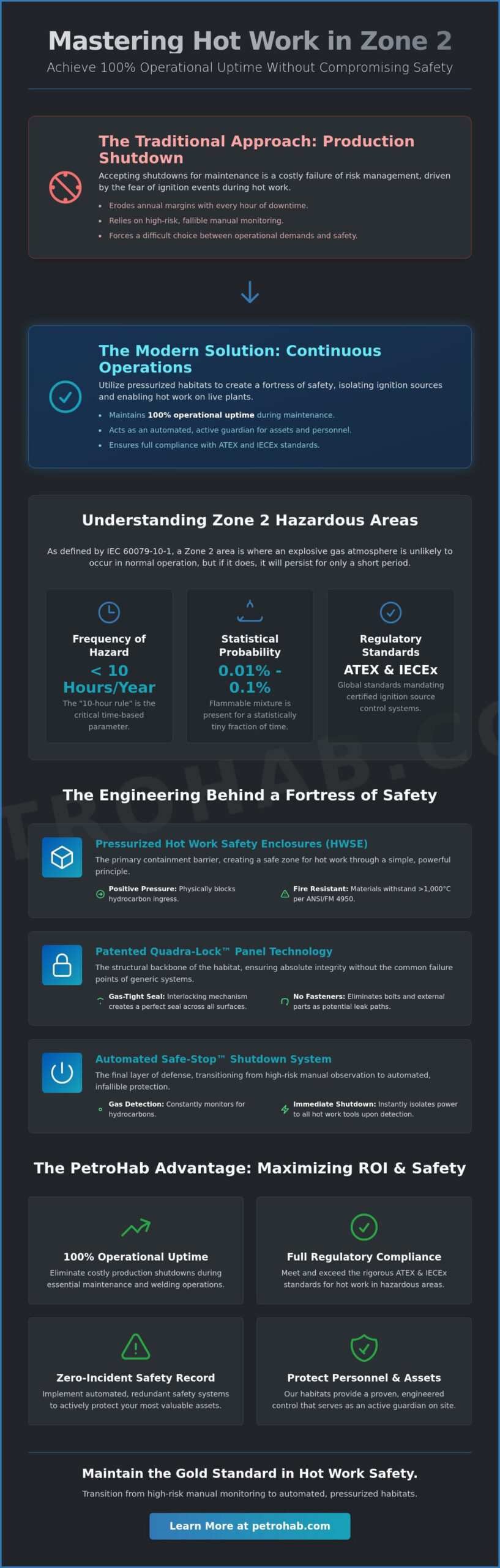
Engineering safe operations requires a precise understanding of Defining Zone 2 Hazardous Areas as specified by IEC 60079-10-1 and the ATEX 2014/34/EU directive. In these environments, explosive gas atmospheres aren’t expected during normal operations. However, if they occur, they persist for a short duration, typically defined as less than 10 hours per year. This statistical probability doesn’t eliminate risk; rather, it demands specialized ignition source control to prevent catastrophic failures during maintenance.
Common Zone 2 environments include offshore production platforms, oil refineries, and chemical processing plants where primary containment systems are robust. While the likelihood of a gas release is lower than in Zone 1, the high-value nature of these assets makes the consequences of an ignition event equally severe. Performing hot work in Zone 2 hazardous area locations requires a rigorous assessment of ventilation and containment integrity to ensure that any accidental release doesn’t meet an ignition source.
To better understand this concept, watch this helpful video:
The Probability Framework for Explosive Atmospheres
Classification relies on the distinction between normal operation and abnormal occurrences like gasket failures or seal leaks. Effective ventilation can often downgrade a Zone 1 area to Zone 2 by ensuring that leaked gases disperse rapidly. A Zone 2 location is technically defined as an area where a flammable mixture is statistically present between 0.01% and 0.1% of the time. This narrow window requires safety managers to implement redundant protection layers, as the absence of gas isn’t guaranteed.
Regulatory Compliance: ATEX vs. IECEx in 2026
Global operators must align with updated hazardous environment standards to maintain legal and operational standing. These standards govern both electrical and non-electrical equipment, mandating that any hot work in Zone 2 hazardous area sites utilizes certified ignition source control systems. Failure to implement pressurized isolation through technologies like the Quadra-Lock modular wall system exposes operators to massive legal liabilities and insurance disqualifications. In 2026, compliance isn’t just about equipment labels; it’s about the verifiable integrity of the entire safety habitat and its automated shutdown capabilities.
Implementing Pressurized Hot Work Safety Enclosures (HWSE)
A pressurized welding habitat functions as the primary containment barrier when performing hot work in Zone 2 hazardous area. The mechanics rely on the principle of positive pressure, where the internal atmosphere is maintained at a higher pressure than the external environment. This pressure gradient acts as a physical block, preventing the ingress of heavier-than-air hydrocarbons or flammable vapors that might be present in the surrounding facility. By isolating the ignition source, the enclosure allows for maintenance activities without requiring a full plant shutdown.
Materials used in these enclosures must meet stringent fire-resistance standards. Walls and flooring typically consist of silicone-coated fiberglass or specialized fabrics that comply with ANSI/FM 4950 requirements. These materials are designed to withstand slag, sparks, and molten metal at temperatures exceeding 1,000 degrees Celsius. In congested Zone 2 environments, optimizing the enclosure’s footprint is essential. Modular systems allow engineers to construct habitats that occupy up to 25% less space than traditional rigid structures, fitting into tight gaps between process vessels and structural steel.
The Engineering Behind Quadra-Lock Panels
Structural integrity depends on the patented Quadra-Lock panel technology. This interlocking mechanism creates a gas-tight seal across the entire surface of the habitat. Because the system doesn’t rely on external fasteners or mechanical bolts, it eliminates common failure points found in generic enclosures. The Quadra-Lock design ensures that panels remain securely joined even under the stress of high-velocity industrial winds or internal pressure surges. This modular flexibility is vital for custom configurations, as it allows the habitat to be built around existing 12-inch piping, complex valves, or structural beams while maintaining a sealed environment.
Maintaining Positive Pressure Integrity
Maintaining a constant pressure differential is the core requirement for habitat safety. Operational standards dictate a minimum internal pressure of 0.05 inches of water gauge (12.5 Pascals) above the ambient pressure. Real-time monitoring is achieved through integrated manometers and digital pressure sensors that trigger an immediate shutdown of the ignition source if pressure falls below the setpoint. Adhering to Regulatory Requirements for ventilation and fire protection is non-negotiable for site compliance. To ensure the atmosphere remains breathable and clear of welding fumes, the system must achieve at least six air changes per hour, which effectively dilutes contaminants and regulates internal temperatures. This continuous exchange of air ensures that the environment inside the habitat remains stable during extended hot work in Zone 2 hazardous area operations. If your facility requires high-integrity protection, evaluating a modular HWSE solution is the next logical step for risk mitigation.
Automated Mitigation: The Safe-Stop Shutdown System
Manual monitoring alone cannot guarantee safety during hot work in Zone 2 hazardous area environments. Human observers face inherent physiological limitations, including fatigue and delayed reaction times, which often exceed 250 milliseconds. In high-risk oil and gas settings, this delay is unacceptable. The Safe-Stop system replaces human hesitation with automated, definitive control. It functions as the central intelligence of the habitat, continuously analyzing environmental data to ensure ignition source control remains absolute. This technology acts as a redundant layer of protection that never sleeps and never loses focus.
The system’s logic relies on a tripartite monitoring strategy. It evaluates internal overpressure, the presence of flammable or toxic gases, and consistent airflow. If any parameter deviates from the established safety threshold, the system initiates a “fail-to-safe” protocol. This automation removes the burden of critical decision-making from personnel during an emergency, ensuring that the work area remains protected even if operators are distracted or incapacitated. It’s a fundamental shift from reactive safety to proactive, automated mitigation.
Gas Detection and Sensor Calibration
Effective mitigation starts with the strategic placement of LEL (Lower Explosive Limit) sensors. These sensors are positioned at the air intake and inside the Quadra-Lock enclosure to identify gas ingress before it reaches an ignition source. Beyond flammable vapors, the system monitors toxic gases like H2S, which poses a lethal threat at concentrations as low as 100 ppm. Utilizing ATEX-certified sensing equipment within hot work safety systems is a non-negotiable requirement for 2026 engineering standards. Routine calibration ensures these sensors maintain a 100% accuracy rate, preventing false negatives that could lead to catastrophic ignition during hot work in Zone 2 hazardous area operations.
Emergency Shutdown (ESD) Integration
The Safe-Stop system’s primary function is its seamless integration with the site’s power distribution. When a hazard is detected, the system isolates power to welding machines and grinders within 50 milliseconds. This rapid response is critical for maintaining compliance with OSHA Hot Work Regulations, which mandate strict control over heat-producing equipment in volatile spaces. Upon shutdown, the system activates high-intensity visual strobes and 110-decibel audible alarms. These protocols ensure site-wide awareness, allowing for a coordinated response. Engineers must perform a full logic test and commissioning sequence before every shift to verify that the shutdown sequence remains functional and responsive.
Operational Best Practices for Live Plant Maintenance
Maintaining operational continuity during hot work in Zone 2 hazardous area requires a rigorous adherence to the Permit-to-Work (PTW) system. This process isn’t merely administrative; it’s the primary layer of defense. In 2024, industry data indicated that 35% of ignition incidents resulted from inadequate permit handovers. A compliant PTW for Zone 2 must include a tripartite sign-off between the safety officer, the welding lead, and the habitat technician.
Before any ignition source is introduced, the pre-operational checklist must be executed. This involves multi-point gas testing at 15-minute intervals before the strike. Technicians must inspect the Quadra-Lock panel joints to ensure an airtight seal. Within the pressurized enclosure, the environment is reclassified as a Non-hazardous Area, provided that the internal pressure remains at least 50 Pascals (0.2 inches of water column) above the ambient pressure. This pressure differential is the mechanical barrier that prevents the ingress of hydrocarbons.
Personnel training is non-negotiable. Every worker entering the HWSE must hold certifications aligned with ISO 17894 standards. They must demonstrate proficiency in operating the Safe-Stop system, which automatically isolates power to welding equipment if pressure drops or gas is detected. Operational discipline ensures that the safety systems are never bypassed, maintaining the integrity of the work site throughout the project duration.
The Hot Work Permit Lifecycle
The lifecycle begins with a joint site inspection and ends only when the area is declared cold. Continuous gas monitoring is the standard for 2026. Fixed sensors at the air intake and inside the enclosure provide real-time data to the Safe-Stop control hub. Every shift change requires a formal re-validation of the permit. This creates a digital audit trail that ensures compliance with ATEX and IECEx operational requirements, providing a transparent record for safety audits.
Habitat Ventilation and Air Quality
Executing hot work in Zone 2 hazardous area generates significant thermal loads and welding fumes. To mitigate heat stress, the ventilation system must provide a minimum of 20 air changes per hour. Air ducting must source clean air from a verified remote location, typically 15 to 25 meters away from the potential leak source. High-capacity blowers maintain positive pressure while extracting particulate matter. This ensures that technicians remain focused and avoid the cognitive decline associated with high-temperature environments. Worker comfort is a direct contributor to operational safety.
Protect your assets with the industry gold standard in ignition source control. Explore our Quadra-Lock habitat solutions today.
The PetroHab Advantage: Maximizing ROI in Zone 2
Operational efficiency in high-risk environments requires more than basic compliance. It demands a strategic approach to risk mitigation that protects both personnel and the bottom line. When conducting hot work in Zone 2 hazardous area, the financial implications of a full plant shutdown are staggering. Industry data indicates that unplanned downtime for a medium-sized refinery can result in losses ranging from $500,000 to over $2.5 million per day. PetroHab systems provide a definitive technological remedy, allowing for continuous production while maintaining rigorous safety standards.
- Versatility: The modular design of the Quadra-Lock panel system accommodates complex geometries in both offshore platforms and onshore refineries.
- Technical Support: Certified on-site supervisors manage ignition source control and ensure all pressurized habitats function within ATEX and IECEx parameters.
- Patented Safety: Integrating the Safe-Stop system provides an automated shutdown mechanism that reacts to gas detection or loss of pressure in milliseconds.
PetroHab doesn’t just provide equipment; it delivers an engineered environment. By utilizing the Quadra-Lock interlocking panel technology, engineers can construct enclosures around T-sections, valves, and structural beams that traditional habitats can’t navigate. This precision ensures that hot work in Zone 2 hazardous area remains isolated from volatile gases, preserving the integrity of the entire facility.
Minimizing Downtime and Project Timelines
Maintenance managers often face the dilemma of delaying critical repairs or halting production. PetroHab eliminates this conflict by enabling hot work on the critical path without depressurizing entire systems. During a 2023 maintenance campaign on a North Sea asset, the use of live welding within a pressurized enclosure reduced the project timeline by 12 days. This efficiency stems from the ability to isolate ignition sources at the point of work. Preventing one emergency shutdown through proactive habitat use pays for the entire safety infrastructure for a decade.
Leasing vs. Ownership for Global Operations
Choosing between leasing and purchasing depends on the frequency of your turnaround cycles. Leasing offers strategic flexibility for short-term projects, providing access to the latest HWSE technology without the burden of long-term asset management. PetroHab maintains a global logistics network to ensure rapid deployment to any industrial hub. For managers overseeing global fleets, this availability reduces lead times and simplifies procurement. Adopting a certified hot work safety enclosure represents the gold standard for 2026, ensuring that every project is executed with uncompromising precision and expert oversight.
Securing Operational Continuity in 2026
Maintaining safety during hot work in Zone 2 hazardous area environments requires a shift from passive observation to active engineering control. PetroHab’s pressurized Hot Work Safety Enclosures (HWSE) utilize patented Quadra-Lock panel technology to achieve unrivaled seal integrity. This system effectively eliminates the risk of hydrocarbon ingress. When paired with Safe-Stop systems, facilities benefit from an automated “fail-to-safe” mechanism that shuts down ignition sources in under 5 seconds if a loss of pressure or gas detection occurs.
Compliance isn’t optional in high-stakes energy sectors. Our solutions meet global ATEX, IECEx, and ISO standards, ensuring your site adheres to the most rigorous 2026 regulatory frameworks. By prioritizing these engineered safeguards, you protect high-value assets and minimize costly downtime. We’ve spent decades refining these technologies to ensure every weld and grind happens within a controlled, verified environment. Let’s work together to eliminate risk on your next shutdown.
Request a Technical Consultation for Your Zone 2 Project
Frequently Asked Questions
Is hot work allowed in a Zone 2 hazardous area?
Hot work is permitted in a Zone 2 hazardous area when technicians utilize a pressurized Hot Work Safety Enclosure (HWSE) and a rigorous permit system. This setup isolates the ignition source from the surrounding environment. According to IEC 60079-13 standards, these habitats maintain a positive pressure that prevents flammable gases from entering the workspace. It’s a critical safety protocol for maintaining production while conducting essential repairs.
Can a pressurized habitat be used for grinding in Zone 2?
You can safely perform grinding and other hot work in Zone 2 hazardous area locations by using a pressurized habitat. The Quadra-Lock panel system contains all sparks and slag within the enclosure. At the same time, the positive pressure environment ensures that no external hydrocarbons reach the grinding equipment. This dual-layer protection makes it possible to conduct high-heat tasks without shutting down the entire facility.
What happens if the positive pressure is lost in the enclosure?
The Safe-Stop system automatically isolates all power to the enclosure if positive pressure is lost. If the internal pressure drops below the 25 Pascal set point, the system cuts electricity to tools in less than 0.5 seconds. This rapid response prevents the risk of ignition if the external atmosphere enters the habitat. Personnel must then investigate the leak and restore pressure before the system allows a manual restart.
How does the Safe-Stop system differ from standard gas detectors?
Safe-Stop differs from standard detectors because it’s an active shutdown system rather than a passive alarm. While basic gas monitors only notify workers of a hazard, Safe-Stop controls the power supply to all hot work equipment. It monitors the LEL levels at the air intake and inside the habitat. If gas concentrations reach 10 percent of the LEL, the system immediately kills the power to eliminate the ignition risk.
Is ATEX certification required for all equipment inside the habitat?
You don’t need ATEX-certified tools inside the habitat because the HWSE creates a non-hazardous environment. This allows engineers to use standard industrial welding machines and grinders. However, the habitat’s external components, such as the Safe-Stop control unit and the air blowers, must be ATEX or IECEx certified for Zone 2. This ensures the safety system itself doesn’t become an ignition source in the hazardous area.
How long does it take to set up a PetroHab HWSE in a Zone 2 area?
Setup for a standard PetroHab HWSE in a Zone 2 area typically takes between 2 and 4 hours. A team of two technicians can assemble the modular Quadra-Lock panels quickly due to their interlocking design. Complex sites with multiple pipe penetrations might require additional time for custom sealing. Once assembled, the system undergoes a 15 minute pressure test to verify enclosure integrity before work begins.
What is the minimum pressure required inside a hot work habitat?
The minimum operating pressure required inside a hot work habitat is 50 Pascals. This level of overpressure ensures a constant outward airflow, even during moderate wind gusts on offshore platforms. The Safe-Stop system monitors this pressure continuously. If it falls to 30 Pascals, a visual alarm triggers. If it reaches the 25 Pascal limit, the system initiates a total power shutdown for all ignition sources.
Can PetroHab systems be used for both onshore and offshore projects?
PetroHab systems are fully compatible with both onshore and offshore industrial projects. The Quadra-Lock panels are built from silicone-coated fiberglass that resists the corrosive salt spray found in marine environments. Since 2011, these habitats have been deployed on over 500 assets worldwide, from desert refineries to North Sea platforms. Their modular nature allows for easy transport and assembly in the restricted spaces common to offshore rigs.