
Blog Posts
H2S Gas: Hazards, OSHA Exposure Limits and Industrial Uses
A gas used to produce sulfur can also become a life-threatening workplace hazard. H2S, or hydrogen sulfide, is a colorless, flammable gas that can impair workers’ ability to detect it by smell. In the United States, OSHA sets a 20 ppm ceiling and a 50 ppm maximum peak for 10 minutes.
That contrast matters in industrial settings: hydrogen sulfide has useful applications, but exposure can quickly threaten health, and odor is not a dependable warning. Understanding the gas, how OSHA’s limits apply, and the effects of exposure helps safety teams make informed decisions about workplace controls.
This article explains hydrogen sulfide’s key properties, exposure hazards, and OSHA limits, then examines its industrial use in sulfur production. It also covers how hot-work enclosures and gas-monitoring shutdown systems can support risk management when hazardous atmospheres are a concern.
Key Takeaways
- Understand why hydrogen sulfide can collect in low-lying or poorly ventilated spaces and what that means for hazard assessment.
- Learn how to interpret OSHA’s exposure limits alongside workplace monitoring and respiratory protection controls.
- Recognize how exposure effects vary with concentration and duration, and why serious inhalation cases need medical monitoring.
- Explore how industry uses hydrogen sulfide to produce sulfur and where pressurized hot-work enclosures can support risk control.
What is Hydrogen Sulfide or H2S?
H2S is hydrogen sulfide, a gas used to produce sulfur and sulfuric acid, as well as pharmaceutical products and pesticides. It can form naturally or arise in industrial processes, so understanding its properties helps workers recognize where exposure and ignition hazards may occur.
Chemical Composition and Gas Properties
Each H2S molecule contains two hydrogen atoms bonded to one sulfur atom. The colorless gas has a distinctive rotten-egg odor and a relative density of 1.19 compared with air. Its odor is not a dependable warning of a hazardous concentration. The National Institute for Occupational Safety and Health identifies 100 ppm hydrogen sulfide as immediately dangerous to life or health.
Formation and Common Locations
Bacteria produce hydrogen sulfide as they break down organic matter in oxygen-deprived environments. Industrial sources include petroleum refining, mining, biogas production, pulp and paper manufacturing, aquaculture, and wastewater treatment. Because the gas is heavier than air, it can move along the ground and accumulate in low-lying, enclosed, or poorly ventilated spaces. Tanks, pits, and similar areas therefore need careful assessment before work begins.
Exposure Routes
Inhalation is the primary exposure route, and the gas is rapidly absorbed through the lungs. Skin absorption is minimal, but liquid hydrogen sulfide can cause frostbite on contact. Portable gas monitors can alert workers to immediate hazards, while colorimetric tubes provide spot checks. Measure concentrations with monitoring equipment rather than relying on smell, and maintain and calibrate detectors according to the manufacturer’s specifications.
Flammability and Combustion
Hydrogen sulfide is highly flammable, and mixtures with air can explode within its explosive limits of 4.3-46%. This makes ignition control important wherever a release could mix with air. Burning the gas generates sulfur dioxide, which can irritate the respiratory system. Moisture can also contribute to sulfuric acid formation and metal corrosion, adding equipment damage to the exposure and fire hazards.
OSHA permissible exposure limits
In the United States, workplace rules set limits on hydrogen sulfide concentrations. Environmental effects depend on release conditions; the limits below address worker exposure, not environmental emissions.
According to the Occupational Safety and Health Administration, the US OSHA permissible exposure limit for hydrogen sulfide is a 20 ppm ceiling, with a 50 ppm maximum peak for 10 minutes. The peak allowance applies once, with no other exposure. A ceiling limit is intended to constrain airborne concentration, not establish a target for routine work. Monitoring helps identify changing conditions before exposure reaches a limit.
The National Institute for Occupational Safety and Health recommends a 10 ppm ceiling for 10 minutes. This is a recommended exposure limit, distinct from OSHA’s permissible exposure limit. NIOSH guidance also identifies 100 ppm as immediately dangerous to life or health. Workers should understand which limit applies to their task and use detection equipment to assess the atmosphere.
Exposure effects and emergency risk
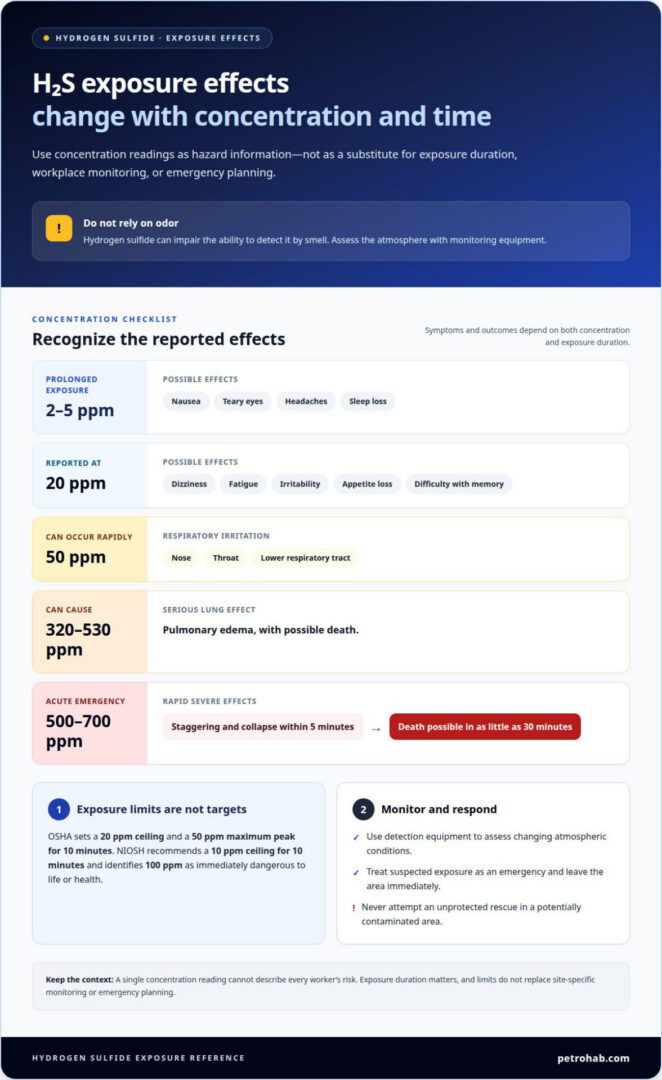
Symptoms vary with concentration and exposure duration. At 20 ppm, reported effects include dizziness, fatigue, headache, irritability, appetite loss, and difficulty with memory. At 50 ppm, irritation of the nose, throat, and lower respiratory tract can occur rapidly. The gas can also impair a worker’s ability to rely on odor as a warning.
Higher concentrations create a severe emergency. Exposure at 500 to 700 ppm can cause staggering and collapse within 5 minutes, with death possible in as little as 30 minutes. These figures underscore why an alarm, evacuation procedure, and trained response matter. Never attempt an unprotected rescue in a potentially contaminated area.
Limits support exposure control, but they don’t replace site-specific monitoring or emergency planning. For welding work in hazardous industrial settings, PetroHab Hot Work Safety Enclosure (HWSE) is a hot-work control to consider alongside atmospheric detection and established procedures.
What are the hazards and risks associated with H2S gas exposure?
H2S exposure can affect the eyes, lungs, and nervous system, with severity shaped by concentration and duration. Symptoms may progress even after a worker leaves the contaminated area.
Health Effects at Different Concentrations
At 2 to 5 ppm, prolonged exposure may cause nausea, teary eyes, headaches, and sleep loss. At 20 ppm, reported effects include dizziness, fatigue, irritability, appetite loss, and difficulty with memory. Concentrations of 320-530 ppm can cause pulmonary edema, with possible death. Readings need context: exposure duration influences the potential health effects, so a single measurement cannot describe every worker’s risk.
Acute Neurological and Respiratory Effects
Acute H2S poisoning can disrupt breathing and neurological function. Affected workers may develop coughing, difficulty breathing, dizziness, or confusion. Severe exposure can cause shock, convulsions, coma, and death. At 500 to 700 ppm, staggering and collapse can occur within 5 minutes, and death may occur in as little as 30 minutes. Treat suspected exposure as an emergency and leave the area immediately.
Long-Term Health Effects
Some exposure incidents can cause health effects that persist after the initial event. Respiratory symptoms may range from rhinitis to acute respiratory failure, while moderate exposure can lead to potentially long-term respiratory problems. Outcomes depend on the exposure conditions and resulting injury. Workers should report persistent breathing problems or other continuing symptoms after an incident instead of assuming they will resolve on their own.
Delayed Pulmonary Effects
Lung complications may emerge after an initial period without obvious symptoms. Pulmonary effects from acute exposure may take up to 72 hours to become apparent. According to the Agency for Toxic Substances and Disease Registry, patients seriously exposed to hydrogen sulfide by inhalation should be monitored for 24 hours because pulmonary edema may be delayed. This monitoring helps address a risk that early symptoms alone may not reveal.
Industrial uses and sulfur production
Hydrogen sulfide has industrial uses beyond its role as a hazardous gas: manufacturers use it to produce sulfur and sulfuric acid. It is also used in producing pharmaceutical products and pesticides. These applications make the gas a chemical feedstock, so controlling occupational exposure is essential wherever it is handled in production or processing.
In sulfur production, hydrogen sulfide is converted into a useful sulfur product. This recovery route lets industrial operations process a hazardous gas stream while supplying sulfur for other uses. Sulfuric acid production is another related application. The process varies by plant and feed stream, but the central purpose is to turn hydrogen sulfide into products rather than treat it only as waste gas.
Its useful role does not reduce the immediate hazard. Hydrogen sulfide is flammable, and a release can create both exposure and fire risks. The gas may have a rotten-egg odor, but workers should not use smell to judge whether an area is clear. Reliable detection and controlled handling matter during maintenance, transfers, and other work near equipment containing the gas.
Hydrogen sulfide is also used in pesticide and pharmaceutical manufacturing, where it may serve as a starting material or process chemical. In each setting, operators need to account for the equipment, gas pathways, and work activity. A release can affect personnel before symptoms are obvious, so occupational controls should never depend on workers noticing an odor or irritation.
For hot work near hazardous process areas, separate ignition control from gas detection and exposure procedures. PetroHab’s Hot Work Safety Enclosure is designed for industrial hot-work applications. Explore the enclosure as a potential control for welding work where process hazards must be managed.
PetroHab: PetroHab Hot Work Safety Enclosure (HWSE)
PetroHab Hot Work Safety Enclosures (HWSE) provide a dedicated enclosure for hot work in industrial environments. They are relevant when welding takes place near process hazards that call for controls over ignition, gas levels, and enclosure pressure.
An enclosure works alongside, not instead of, site-specific gas detection, exposure controls, and emergency procedures. PetroHab’s Safe-Stop Safety Shutdown System monitors differential pressure and gas levels to support shutdown response when monitored conditions require it. PetroHab also provides pressurized welding enclosures with Quadra-Lock® panels.
Safety managers planning welding in a hazardous area should evaluate how an enclosure fits the work scope and the site’s existing controls. Contact PetroHab to discuss a Hot Work Safety Enclosure for your application.
Put H2S Controls Into the Work Plan
Use the next planning cycle to connect H2S hazards with the specific hot-work task, work area, and response plan. Assign clear responsibility for each control, especially when site conditions or work scopes change. This makes the relationship between gas detection, ignition controls, and worker procedures explicit.
For welding in hazardous industrial environments, PetroHab’s Hot Work Safety Enclosure (HWSE), Safe-Stop Automatic Shutdown System, and Quadra-Lock Panels can support hot-work controls. Integrate these options with atmospheric monitoring and the site’s established emergency procedures. Consider how H2S risks affect the enclosure and shutdown requirements for the planned work.
Bring the project requirements into a discussion about how H2S hazards intersect with welding controls. Contact PetroHab about H2S safety to discuss the enclosure and related offerings for your application. A disciplined plan gives your team a practical foundation for moving forward.
Frequently Asked Questions
H2S – What Is That?
H2S is the chemical formula for hydrogen sulfide, a compound containing two hydrogen atoms bonded to one sulfur atom. Its molar mass is 34.08 g·mol−1. In industrial settings, it can be a feedstock for sulfur-related production rather than only an unwanted byproduct. The distinction matters because useful process material still requires controlled handling and exposure prevention.
How Toxic is H2S?
Hydrogen sulfide can be acutely toxic, and odor cannot reliably indicate the danger. At 100 ppm, loss of smell can occur in as little as 2 minutes, removing a warning workers might otherwise notice. At 700 ppm and above, collapse and unconsciousness can occur within 1 to 2 breaths, with death possible within minutes. Treat alarms and measured readings as the relevant warning signals.
How fast can H2S gas kill you?
At very high concentrations, hydrogen sulfide can cause collapse within breaths and death within minutes. The danger depends on concentration and exposure duration, so there is no single timeline for every incident. A suspected release calls for immediate evacuation, not an attempt to locate the leak. Rescue should be left to trained responders equipped with appropriate respiratory protection.
How to protect yourself from H2S gas?
Use atmospheric monitoring, ventilation, and respiratory protection as part of a site-specific exposure-control plan. Before entering an area where hydrogen sulfide may be present, have a qualified person test the air with monitoring equipment. Keep detectors maintained and calibrated according to the manufacturer’s specifications. If an alarm activates or symptoms develop, leave immediately and follow the site emergency procedure.
What Can H2S be Used For?
Hydrogen sulfide is used to produce sulfur and sulfuric acid, as well as pharmaceutical products and pesticides. In sulfur production, it is a chemical input that can be converted into a useful industrial material. Its role in manufacturing does not remove the need for exposure controls: process design and work procedures must account for the gas wherever it is handled.
What Might Cause H2S to Combust?
Combustion can occur when flammable hydrogen sulfide mixes with air and encounters an ignition source. In industrial settings, potential sources include hot work, sparks, and open flames. A release near welding therefore calls for coordinated gas detection and ignition controls. Work planning should account for the process area and nearby equipment, rather than treating welding as separate from the surrounding hazards.