Blog Posts
Habitat for Welding on Storage Tanks with Residual Product: The 2026 Engineering Guide
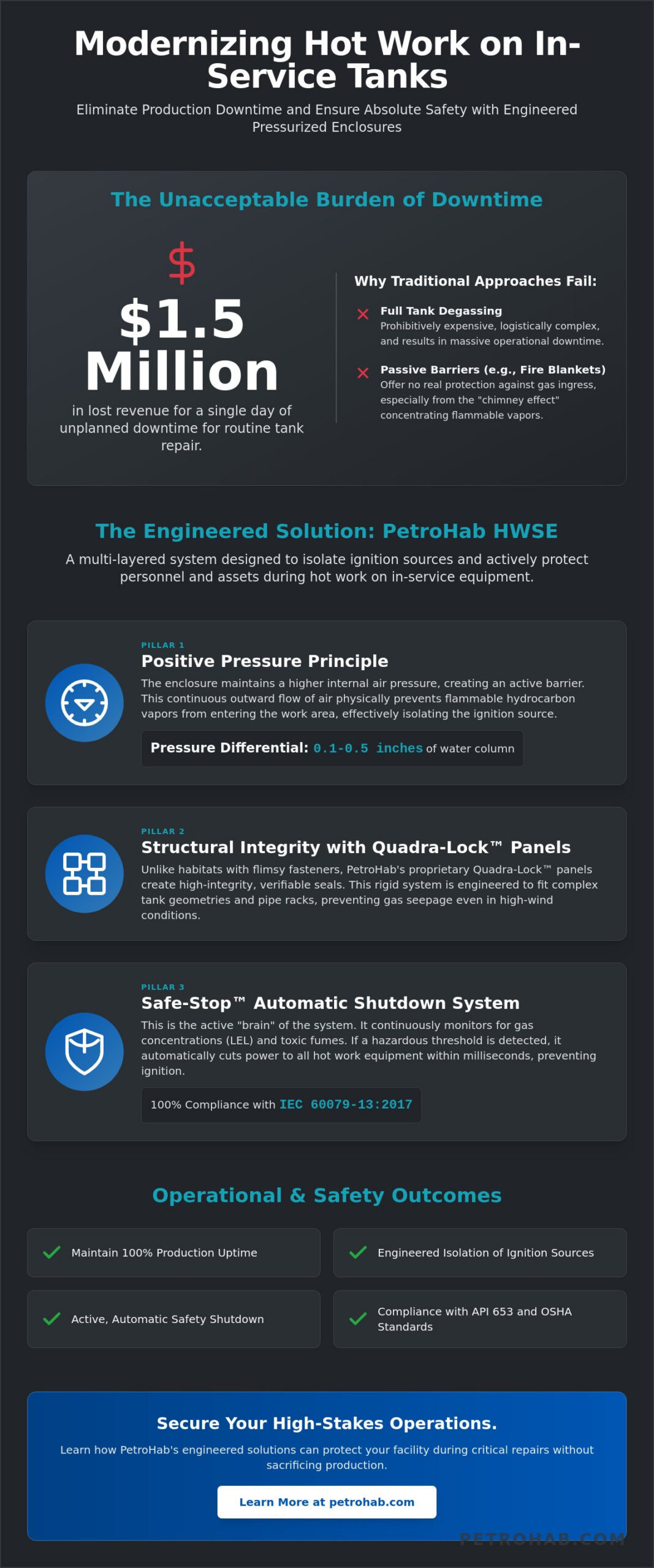
Can your facility justify $1.5 million in lost revenue for a single day of unplanned downtime to perform a routine tank repair? For tier 1 industrial operations, this is an unacceptable operational burden. You recognize that the traditional requirement for full tank degassing is often prohibitively expensive and logistically complex. However, the risk of catastrophic ignition from hydrocarbon vapors remains a constant threat to personnel and assets. Deploying a specialized habitat for welding on storage tanks with residual product provides the engineered pressurized containment necessary to isolate ignition sources from hazardous atmospheres effectively.
This 2026 engineering guide details how to maintain production while executing critical repairs on in-service tanks. You’ll learn the technical specifications of the PetroHab Hot Work Safety Enclosure (HWSE) and how Quadra-Lock panels provide the thermal resistance required for high-intensity welding. We also examine the integration of the Safe-Stop Automatic Shutdown System to ensure 100% compliance with IEC 60079-13:2017. This overview covers the essential protocols for atmospheric monitoring and meeting API 653 standards, providing the rigorous framework needed to protect your facility during high-stakes hot work operations.
Key Takeaways
- Identify how the “chimney effect” concentrates flammable vapors and why traditional degassing isn’t always the most efficient path to safety.
- Master the physics of positive pressure to maintain a specific pressure differential, effectively isolating ignition sources within a habitat for welding on storage tanks with residual product.
- Evaluate the structural advantages of Quadra-Lock Panels for creating high-integrity seals around complex tank geometries and pipe racks.
- Understand the integration of the Safe-Stop Automatic Shutdown System as an active safety “brain” that monitors gas concentrations and cuts power within milliseconds of an LEL spike.
- Establish rigorous operational best practices, including pre-work atmospheric testing and continuous supervision, to protect personnel and high-value assets.
The Risks of Using a Habitat for Welding on Storage Tanks with Residual Product
Welding on tanks containing residual hydrocarbons presents an immediate threat to life and asset integrity. Volatile organic compounds (VOCs) don’t just vanish when a tank is drained; they linger in sludge and scale, ready to ignite if exposed to a single spark. When you deploy a habitat for welding on storage tanks with residual product, you aren’t just shielding sparks. You’re managing a volatile environment where passive tools like fire blankets or screens are insufficient. These traditional methods offer no protection against gas ingress in hydrocarbon-rich zones. A properly engineered hot work safety enclosure from PetroHab LLC acts as the primary safety barrier, providing a controlled environment that physical shields cannot replicate.
The “chimney effect” represents a specific danger in storage tank maintenance. Vapors within the tank can rise and concentrate at the work site, creating an explosive atmosphere where you least expect it. Without active management, these vapors bypass simple physical barriers. To better understand the technical scale of these operations, watch this video illustrating the welding process on large vertical storage tanks:
Understanding Residual Product Hazards: Sludge and Vapors
Residual sludge trapped in tank floors or behind internal baffles poses a hidden risk. During heat-intensive welding, the tank wall acts as a thermal conductor. This heat causes the sludge to off-gas, releasing flammable vapors directly into the vicinity of the hot work. Ambient temperature also plays a critical role. High temperatures increase vapor pressure within the work zone, which can lead to rapid LEL spikes. A rigorous risk assessment by PetroHab LLC technicians must identify the flash point of remaining tank contents to determine the required pressure differential for the hot work safety enclosure.
Why Atmospheric Isolation Trumps Simple Containment
There’s a fundamental distinction between a physical barrier and an engineered atmospheric seal. Traditional welding habitats often fail in high-vapor environments because they rely on flimsy fasteners that allow gas to seep through gaps during wind gusts. In contrast, an engineered Positive pressure enclosure utilizes high-integrity Quadra-Lock panels to maintain a consistent, verifiable seal. Atmospheric isolation is the exclusion of hazardous gases via positive pressure. This approach moves beyond simple containment by actively pushing potential contaminants away from the ignition source, ensuring the safety of personnel and high-value assets.
How Positive Pressure Habitats Isolate Ignition Sources
The core of industrial safety in volatile environments lies in the application of fluid dynamics. A habitat for welding on storage tanks with residual product functions by maintaining an internal atmosphere at a higher pressure than the surrounding hazardous environment. By establishing a pressure differential between 0.1 and 0.5 inches of water column, the system ensures that any leakage occurs from the inside out. This outward flow of air creates an active barrier that prevents flammable hydrocarbon vapors from entering the enclosure even if a seal is momentarily compromised.
Achieving this level of control requires high-performance blowers capable of maintaining consistent air changes per hour (ACPH). This continuous airflow serves a dual purpose. It removes toxic welding fumes to protect personnel and ensures that the internal atmosphere remains well below the Lower Explosive Limit (LEL). Adhering to OSHA fire prevention standards is mandatory during these high-stakes operations. These pressurized welding habitats effectively reclassify a Zone 1 or Zone 2 area into a controlled environment where hot work can proceed without halting production.
The Role of Air Ducting and Intake Location
The integrity of the internal atmosphere depends entirely on the quality of the intake air. Engineers must position air intakes in confirmed non-hazardous areas, often located upwind and at a significant distance from potential leak sources. Using specialized PetroHab Air Ducting allows for the maintenance of laminar flow throughout the enclosure. This configuration prevents “dead zones” where heavy vapors might otherwise accumulate. Technicians must continuously monitor intake air quality to ensure that external contaminants are not inadvertently drawn into the work area.
Measuring Integrity with Manometers and Gauges
Permit-to-work compliance in high-risk environments relies on verifiable, real-time data. Manometers and digital pressure gauges act as the primary diagnostic tools for habitat integrity. These instruments detect subtle pressure drops that might indicate a compromised seal or a mechanical failure in the blower system. If the pressure falls below the calibrated threshold, the system must trigger an immediate response. The relationship between enclosure volume and blower capacity is a critical engineering calculation. Larger enclosures require significantly higher CFM (cubic feet per minute) ratings to maintain the necessary pressure differential. For facilities seeking to optimize these safety protocols, reviewing the technical specifications of Petro-Habitats ensures that equipment matches the specific demands of the site.
Ensuring Structural Integrity with Quadra-Lock Panel Technology
A habitat for welding on storage tanks with residual product is only as reliable as its physical seal. While previous sections detailed the physics of pressure, the enclosure’s structural build is what maintains that pressure against environmental variables. High wind loads and mechanical vibration can easily compromise secondary barriers that rely on hook-and-loop fasteners. These gaps create potential pathways for spark escape or gas ingress. According to the European Commission analysis of welding accidents, inadequate containment is a recurring factor in major industrial incidents involving contractors.
PetroHab LLC utilizes silicone-coated fiberglass panels designed to withstand continuous exposure to sparks and molten slag at temperatures reaching 550°C. This material science is paired with an interlocking system that ensures the pressurized seal remains intact. By eliminating the vulnerabilities of traditional curtains, this technology provides a rigid, verifiable boundary for hot work operations. It’s a definitive technological remedy for the hazardous conditions found in tank farms.
Modular Efficiency for Tank Maintenance Turnarounds
Refinery environments present complex geometries that require flexible containment solutions. Standard enclosures must adapt to tank nozzles, manways, and staircases without leaking air. The modularity of the Quadra-Lock system allows for rapid configuration around these obstacles. This speed of deployment is vital for meeting tight turnaround schedules. Because the panels are interlocking rather than custom-sewn, they offer consistent durability and reusability across multiple projects in harsh industrial settings. They’re designed to handle the granular details of industrial hazards better than generic alternatives.
The Quadra-Lock Structural Standard
Clarity in safety documentation is essential for regulatory compliance. You should recognize that Quadra-Lock is the engineered standard for high-integrity hot work enclosures. This interlocking mechanism provides 360-degree protection against spark escape, ensuring that ignition sources are fully isolated from the surrounding hazardous zone. Quadra-Lock panels provide structural rigidity to the pressurized volume. This rigidity prevents the enclosure from collapsing or ballooning during pressure fluctuations, maintaining the critical atmospheric seal at all times. This system acts as an active guardian, ensuring operational excellence during every shift.
Integrating Automatic Shutdown Systems for Active Protection
Physical containment is only one half of the safety equation. When using a habitat for welding on storage tanks with residual product, you face the persistent threat of sudden vapor release from heated sludge or leaking seals. A passive enclosure cannot respond to these dynamic changes; you need an automatic shutdown system to provide active monitoring and immediate response. The Safe-Stop system functions as the central processing unit of the habitat. It continuously evaluates environmental data to ensure conditions remain within safe operational parameters, providing a layer of protection that manual oversight cannot match.
This technology is critical for achieving compliance with IEC 60079-13:2017. This international standard governs the protection of equipment by pressurized rooms, known as ‘p’ type protection. By integrating automated controls, the enclosure moves from a simple barrier to a certified safety system. The most vital function is the immediate deactivation of all welding equipment and heat sources upon the detection of gas concentrations at 10% of the Lower Explosive Limit (LEL). This rapid response eliminates the ignition source in milliseconds, before a flammable mixture can reach it.
The Safe-Stop Shutdown Sequence
The system follows a rigorous, four-step protocol to mitigate risk during a detection event:
- Step 1: Continuous monitoring of internal habitat pressure and external LEL levels. Sensors provide real-time feedback to the control module.
- Step 2: Triggering audible and visual alarms if pressure drops below 0.1 inches water column. This warns technicians of a potential breach before an LEL spike occurs.
- Step 3: Immediate power isolation to welding machines and heat sources. The system cuts electricity in milliseconds, removing the threat.
- Step 4: Post-incident purge cycle. Before resuming hot work, the blower system must refresh the internal atmosphere to ensure no residual vapors remain.
Gas Detection Placement for Residual Product Vapors
Standard gas detection is often insufficient for tanks containing heavy residual products. Vapors from sludge can be denser than air and may accumulate near the base of the tank or around specific fittings. Strategic placement of sensors is mandatory. You must position ATEX-certified sensors near potential leak points such as tank seals, valves, and manways. It’s not enough to monitor the general area; sensors must be at the point of highest risk.
Monitoring shouldn’t be limited to flammable hydrocarbons. Residual sludge often contains high concentrations of H2S, which is both toxic and flammable. Safe-Stop integrates multiple sensor types to provide a comprehensive view of the atmospheric hazards. This multi-gas approach ensures that personnel are protected from both ignition risks and toxic exposure. To implement these advanced safety protocols at your facility, explore the full range of PetroHab safety systems today.
Operational Best Practices for Tank Welding Habitats
Engineering excellence depends as much on procedural discipline as it does on hardware. Before a single Quadra-Lock panel is joined, technicians must conduct comprehensive pre-work atmospheric testing. This establishes a baseline for gas concentrations, ensuring that the initial environment is within safe limits for enclosure setup. When deploying a habitat for welding on storage tanks with residual product, you must account for the dynamic nature of hydrocarbons. If sludge removal occurs in adjacent areas, the habitat serves as an active barrier. It allows maintenance teams to proceed with hot work while cleaning crews manage the residual product, provided the pressure differential remains constant.
Coordinating these activities requires integrated turnaround planning. Maintenance managers should map out the HWSE deployment to avoid conflicts with other high-risk tasks. This strategic alignment ensures that the safety enclosure does not become an obstacle, but rather a tool for operational efficiency. Proper planning also includes identifying the specific flash points of the residual product to calibrate the Safe-Stop system thresholds accurately.
On-site Supervision and Training
Successful deployment relies on the expertise of certified technicians who oversee habitat operations throughout every shift. These specialists monitor the Safe-Stop system and verify the structural integrity of the Quadra-Lock panels. Welders must also undergo specific training before entering the enclosure. This training focuses on emergency egress routes and immediate recognition of audible and visual alarms. Daily inspection routines are mandatory. Technicians verify that all interlocking joints are secure and that air intakes remain clear of potential contaminants. This rigorous oversight prevents minor mechanical issues from escalating into safety breaches.
Maximizing ROI During Tank Farm Turnarounds
The economic justification for engineered habitats is clear. Avoiding a total facility shutdown saves millions in lost revenue. A single day of downtime on a major platform can cost over $1.5 million. By using modular habitats, facilities can perform simultaneous operations (SIMOPS) safely. This allows for welding repairs on one tank while others remain in service or undergo separate maintenance. This flexibility accelerates the turnaround schedule and reduces the overall project duration. For short-term projects or specific maintenance windows, pressurized welding habitat rental offers a cost-effective solution to maintain compliance without capital expenditure. Requesting a technical consultation ensures the equipment configuration matches your specific tank farm requirements.
Advancing Safety in Hazardous Tank Environments
Executing hot work on in-service assets requires a shift from passive shielding to active atmospheric control. You’ve seen how the integration of positive pressure isolation and automated shutdown logic creates a resilient barrier against hydrocarbon ignition. By utilizing patented Quadra-Lock Technology, facilities can maintain structural integrity even under high wind loads. This engineering approach ensures that a habitat for welding on storage tanks with residual product remains the industry standard for risk mitigation. Reliability isn’t just a goal; it’s a requirement for modern industrial compliance.
The Safe-Stop Automatic Shutdown System provides the active monitoring necessary to protect your personnel from unpredictable LEL spikes. With global IECEx and ATEX compliance, these systems offer a verified solution for complex refinery turnarounds. You don’t have to choose between production uptime and worker safety. Implementing these rigorous protocols allows your team to perform critical maintenance with absolute confidence in their equipment. Request a technical consultation for your storage tank maintenance project to secure your facility’s future.
Frequently Asked Questions
Can you weld on a storage tank that still contains residual product?
Yes, you can perform hot work on tanks with residual product by using a habitat for welding on storage tanks with residual product. This approach requires strict adherence to API 653 and OSHA regulations. The system isolates the welding arc within a pressurized environment, preventing it from interacting with volatile organic compounds. It’s a proven method for maintaining production while addressing urgent structural repairs or modifications.
What is the minimum pressure required for a welding habitat on a tank farm?
The minimum required pressure for a pressurized welding habitat is 0.1 inches of water column. Operators typically maintain a range between 0.1 and 0.5 inches to ensure a consistent outward flow of air. This pressure differential is monitored in real time using manometers. If the pressure falls below the 0.1 threshold, the automatic shutdown system triggers an alarm to protect the work zone from gas ingress.
How does a pressurized habitat prevent hydrocarbon vapors from entering the work area?
Pressurized habitats prevent vapor ingress by creating a higher-pressure environment inside the work area. This pressure gradient ensures that air only moves from the inside to the outside. Because gas cannot flow against a higher-pressure stream, flammable vapors are physically blocked from reaching the ignition source. This active displacement is the primary mechanism for safety when using a habitat for welding on storage tanks with residual product.
What is the Safe-Stop automatic shutdown system?
Safe-Stop is an automated safety system that integrates gas detection with power isolation logic. It continuously monitors the environment for flammable gases and pressure drops. If gas levels reach 10% of the Lower Explosive Limit (LEL), the system cuts power to all welding equipment in milliseconds. This technology ensures that the habitat remains an active safety barrier rather than a passive enclosure, meeting IEC 60079-13:2017 requirements.
Why is Quadra-Lock technology preferred over traditional hook-and-loop enclosures?
Quadra-Lock technology is preferred because its interlocking panels eliminate the gaps common in hook-and-loop systems. These panels provide the structural rigidity necessary to withstand high wind loads and internal pressure. Unlike traditional curtains, the interlocking mechanism ensures a 360-degree seal that remains intact during heavy industrial use. This engineered design is critical for maintaining the atmospheric isolation required when performing hot work in Zone 1 or Zone 2 areas.
What regulatory standards govern hot work in hazardous tank environments?
Hot work on storage tanks is governed by API 653, OSHA 1910.252, and international standards like IEC 60079-13. These regulations define the requirements for atmospheric testing, fire prevention, and equipment protection in explosive atmospheres. Following these standards is essential for permit-to-work compliance. It ensures that every safety measure, from gas detection to pressurized containment, meets the rigorous benchmarks expected by global insurance providers and regulatory bodies.
Do I need a specialized technician to set up a welding habitat?
Certified technicians are required to oversee the deployment and operation of pressurized habitats. These specialists possess the training to calibrate Safe-Stop systems and verify the integrity of Quadra-Lock panels. They also manage the continuous atmospheric monitoring essential for safety. Having a dedicated expert on-site ensures that the habitat operates within its engineered specifications, providing a level of reliability that general maintenance staff cannot provide alone.
How does a habitat handle high wind speeds on offshore or coastal tank farms?
Coastal and offshore habitats manage high wind speeds through the structural strength of interlocking panels. These panels prevent the enclosure from deforming under pressure. High-capacity blowers also compensate for external wind force by maintaining the internal pressure differential. This combination of material science and mechanical power ensures that the enclosure remains a resilient safety barrier even in the harshest environmental conditions found at tank farms.