Blog Posts
Hot Work Fire Prevention on Offshore Platforms: The 2026 Engineering Guide
Relying on manual gas monitoring alone is no longer a viable risk strategy for high-stakes energy environments. You understand that the presence of hydrocarbon vapors makes every spark a potential catastrophe, yet shutting down production for critical repairs is an operational failure your facility cannot afford. Mastering hot work fire prevention on offshore platforms requires a shift from passive observation to active, engineered isolation. This guide provides the technical protocols to conduct safe welding and grinding on live assets without compromising your output or your safety record.
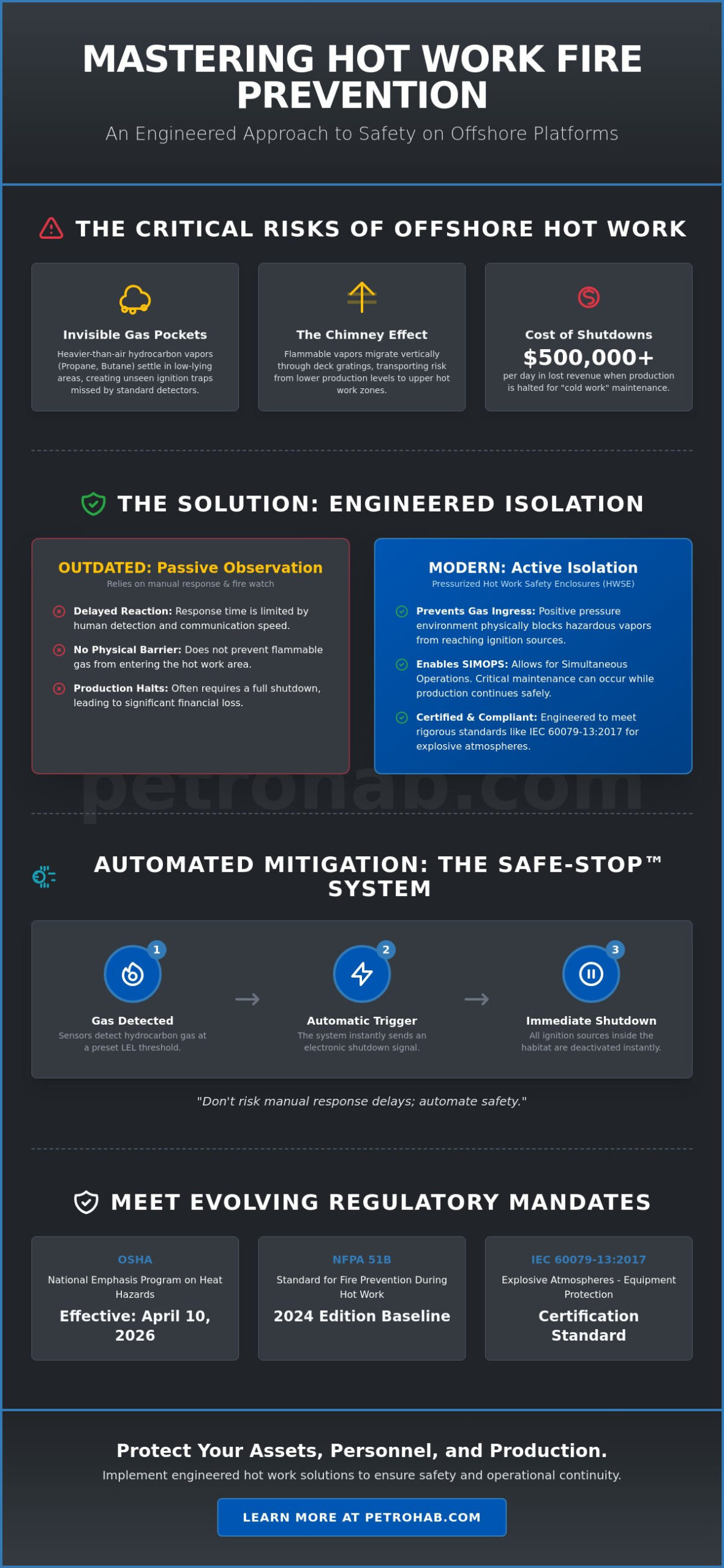
The regulatory landscape has become significantly more stringent as of early 2026. With the OSHA National Emphasis Program on heat hazards effective April 10, 2026, and the 2024 edition of NFPA 51B setting the baseline for compliance, safety managers must adopt more resilient systems. We’ll explore how to implement pressurized welding enclosures using modular Quadra-Lock panels and the Safe-Stop automatic shutdown system. These technologies meet the IEC 60079-13:2017 standard, providing a rigorous solution for ignition source control. You’ll learn to maintain BSEE compliance and optimize maintenance schedules through advanced habitat engineering that protects both human life and high-value assets.
Key Takeaways
- Identify how vapor migration and the chimney effect create invisible ignition paths across complex, multi-level offshore structures.
- Deploy engineered isolation using pressurized habitats to master hot work fire prevention on offshore platforms while maintaining continuous production.
- Don’t risk manual response delays; integrate Safe-Stop automated systems that immediately deactivate ignition sources if gas is detected.
- Standardize operational protocols including LEL testing and Permit-to-Work (PTW) procedures to meet the latest 2026 BSEE and OSHA safety mandates.
- Evaluate safety enclosures based on modularity and technical certifications like IEC 60079-13:2017 to ensure long-term operational integrity.
The Critical Risks of Hot Work on Offshore Platforms
Offshore hot work encompasses any process involving welding, grinding, or thermal cutting on assets where volatile hydrocarbons are processed and stored. These activities introduce high-temperature ignition sources into environments characterized by pressurized lines and complex piping networks. Unlike onshore facilities, offshore platforms are compact, multi-level environments where ignition sources and fuel sources exist in constant proximity. Implementing robust hot work fire prevention on offshore platforms is the only way to safeguard high-value assets and prevent catastrophic environmental discharge. The core challenge for safety managers remains the necessity of performing essential maintenance without halting the flow of oil and gas.
One unique risk in these environments is the “chimney effect,” where heat and vapors migrate vertically through deck gratings and stairwells. This movement can transport flammable gases from lower production decks to upper levels where maintenance is occurring. Adhering to fundamental Hot Work Safety Principles is critical, but standard fire watch protocols often fail to account for this three-dimensional migration of risk. When an ignition occurs in these high-stakes settings, the consequences include immediate asset loss, severe structural damage, and long-term environmental impact.
To better understand the complexity of these environments, watch this video on offshore rig safety:
Invisible Hazards: Hydrocarbon Vapors and Gas Pockets
Hydrocarbon vapors don’t always behave predictably. Gases such as propane and butane are heavier than air, meaning they settle in low-lying deck areas and recessed spaces. These accumulations form “blind spots” where fixed gas detection systems, often mounted higher for lighter methane, may not trigger an alarm. Vapor migration can lead to gas pockets forming far from the original leak source, waiting for a stray spark to bridge the gap. The Lower Explosive Limit (LEL) is the minimum concentration of a combustible gas or vapor in air that can ignite when exposed to an ignition source.
The Economic Impact of Production Shutdowns
Choosing “cold work” maintenance requires a full production shutdown. In the offshore sector, these interruptions result in massive financial losses, often exceeding $500,000 per day depending on the asset’s flow rate. Utilizing advanced HWSE technology allows operators to perform simultaneous operations (SIMOPS). By creating a pressurized environment that isolates the ignition source from the surrounding atmosphere, production continues while essential repairs proceed. This engineered approach transforms maintenance from a liability into a controlled, efficient process that protects the bottom line.
Engineering Active Isolation: The Role of Pressurized HWSE
Passive safety strategies like fire watches are necessary but insufficient for high-volatility environments. While many operators rely heavily on OSHA Fire Watch Guidelines, these protocols focus on human observation rather than physical prevention. True hot work fire prevention on offshore platforms requires active isolation through pressurization. This engineered approach creates a physical barrier that prevents the ingress of flammable gases into the workspace. By maintaining an internal pressure higher than the external atmosphere, the system ensures that even if a gas leak occurs nearby, the hazardous vapors cannot reach the ignition source.
Constructing a Hot Work Safety Enclosure (HWSE) on an offshore rig demands technical precision. Space is at a premium on production decks; therefore, modularity is a critical requirement for any habitat system. These enclosures are built using specialized flame-retardant panels, typically composed of silicone-coated fiberglass designed to withstand continuous spark exposure. This modularity allows safety teams to assemble the habitat around complex piping and structural members that would otherwise obstruct a standard enclosure. It’s a calculated solution for high-stakes maintenance where every square foot of deck space is optimized for production.
The Science of Positive Pressure Habitats
The integrity of a pressurized habitat depends on a continuous supply of breathable air. Air intake systems utilize powerful blowers to pull clean air from a verified remote location, ensuring the habitat remains free of contaminants. Technicians use manometers to monitor the pressure differential in real time. A standard operating pressure of 0.1 to 0.5 inches of water column is typically maintained to ensure effective gas exclusion. This airflow also serves a secondary purpose; it provides essential cooling for personnel. With the 2026 OSHA focus on heat illness prevention, maintaining high exchange rates inside the enclosure is now a regulatory necessity for welder safety.
Maintaining Integrity with Quadra-Lock Panel Technology
Seal integrity is the most vulnerable point of any pressurized system. The patented Quadra-Lock Panels solve this by utilizing an interlocking mechanism that eliminates gaps between sections. This design prevents “hot spots” where sparks or slag could potentially escape the enclosure. Each panel connects securely to the next, creating a unified, airtight skin that withstands the rigors of the offshore environment. If you’re looking to upgrade your current safety protocols, consider how pressurized welding enclosures can provide a more resilient barrier than traditional fire blankets. This system ensures that ignition source control remains absolute throughout the duration of the hot work permit.
Automated Mitigation: Integrating Safe-Stop Shutdown Systems
Manual monitoring of hazardous atmospheres is a reactive strategy that often fails in the face of rapid gas ingress. While standard gas detectors alert personnel to danger, they don’t physically eliminate the risk. An Automatic Shutdown System (ASD) serves as the primary engineering control for hot work fire prevention on offshore platforms by bridging the gap between detection and isolation. In high-pressure environments, a gas release can reach an ignition source in milliseconds. Human response times, which include perceiving an alarm and manually deactivating equipment, are simply too slow to prevent an explosion in these high-velocity scenarios.
A sophisticated ASD functions as the central intelligence of the pressurized habitat. It monitors a specialized array of sensors to ensure the work environment remains within safe operational parameters. These mandatory sensors include:
- Lower Explosive Limit (LEL): Detects combustible gas concentrations before they reach a flashpoint.
- Hydrogen Sulfide (H2S): Monitors for toxic gas presence common in offshore production.
- Oxygen (O2): Ensures levels don’t drop below 19.5% or exceed 23.5% to prevent asphyxiation or oxygen enrichment.
- Internal Pressure: Verifies that the habitat maintains the positive pressure differential required to exclude external gases.
The system’s “fail-safe” state is its most critical feature. If any sensor detects a value outside of pre-set safety limits, the ASD triggers an immediate power cut to all ignition sources, including welding machines and grinders. This instantaneous shutdown ensures that the work area is rendered inert before a hazardous atmosphere can penetrate the enclosure.
How Safe-Stop Systems Function in Zone 1 and 2
In Zone 1 and Zone 2 hazardous areas, the integration between habitat integrity and power control must be absolute. The Safe-Stop system achieves this by linking the habitat’s internal pressure sensor directly to the welding power source. If the pressure drops below the required 0.1 inches of water column, the system terminates power within seconds. Offshore crews are alerted through high-intensity visual strobes and audible alarms that cut through the ambient noise of a production deck. This automation removes the element of human error from the safety equation, ensuring that hot work fire prevention on offshore platforms is governed by logic-based technical protocols rather than manual intervention.
ATEX and IECEx Compliance for Monitoring Hardware
Hardware deployed in offshore hazardous zones must be intrinsically safe to prevent the equipment itself from becoming an ignition source. PetroHab LLC ensures all monitoring components meet rigorous ATEX and IECEx certifications, specifically adhering to the IEC 60079-13:2017 standard for pressurized rooms. Reliability depends on regular calibration of gas detection sensors, as sensor drift can lead to false negatives in volatile environments. These hazardous environment standards dictate equipment selection and maintenance schedules to ensure the system’s integrity remains unrivaled throughout its operational life.
Operational Protocols for Offshore Hot Work Fire Prevention
Engineering controls provide the physical barrier, but operational discipline ensures those controls remain effective. Hot work fire prevention on offshore platforms relies on a rigorous Permit-to-Work (PTW) system that dictates every action from mobilization to demobilization. This process isn’t merely a checklist; it’s a strategic safety contract between the installation management and the technical team. Before any spark is generated, the site undergoes a comprehensive atmospheric and physical assessment. Continuous gas testing is mandatory, with a 0% LEL (Lower Explosive Limit) reading required before any hot work permit is officially authorized.
The Permit-to-Work (PTW) Lifecycle
The PTW lifecycle begins with a joint site inspection involving the Offshore Installation Manager (OIM), the HSE lead, and the Habitat Supervisor. During this phase, the team identifies all local vents, drains, and open-ended lines within a 35-foot radius that require isolation. The second stage involves the physical sealing of these potential vapor sources to prevent migration. Finally, the Habitat Technician verifies the clean air source for the blower. This intake must be positioned in a verified area, upwind and far from any potential exhaust or gas release points, to ensure the integrity of the pressurized environment.
On-site Supervision and Competency Training
Human error is a variable that must be minimized through specialized training and uncompromising supervision. Certified PetroHab technicians are critical for the correct assembly of Quadra-Lock panels and the precise calibration of the Safe-Stop system. These experts monitor the control console throughout the operation, interpreting sensor data and managing the positive pressure differential. The Fire Watch role is equally vital; this individual monitors the external area, maintaining a clear line of sight to the habitat and ensuring fire suppression equipment is staged for immediate use. Continuous communication between the habitat technician and the platform control room ensures that any asset-wide emergency is communicated to the welding team instantly.
Emergency egress procedures are a mandatory component of the pre-work toolbox talk. Workers inside the HWSE must be able to exit the enclosure in under 10 seconds. Modern habitats utilize quick-release fasteners and high-visibility exit markers, ensuring that if the asset’s general alarm sounds, personnel can evacuate without obstruction. To ensure your facility meets these rigorous standards, you can consult with our experts on offshore habitat systems to implement these protocols on your next project.
Selecting the Right Offshore Safety Enclosure Supplier
Selecting a partner for hot work fire prevention on offshore platforms requires a technical audit of their engineering standards and hardware capabilities. You can’t compromise on third-party certifications. A reputable supplier must provide hardware that carries ATEX and IECEx compliance, specifically adhering to the IEC 60079-13:2017 standard for pressurized rooms. These certifications aren’t merely badges; they’re technical guarantees that the equipment won’t become an ignition source in a volatile environment. Additionally, ISO 9001 certification ensures that every panel and sensor is manufactured under a rigorous quality management system, providing the reliability your safety managers demand.
Physical constraints on an offshore rig dictate the necessity of lightweight, modular designs. High-density production decks leave little room for oversized equipment, and crane lift capacities often limit the weight of maintenance modules. You need a system that technicians can manually transport through tight corridors and assemble around existing infrastructure. Suppliers offering patented technologies like Quadra-Lock provide a distinct advantage. This system ensures verified seal integrity through interlocking panels, eliminating the gaps common in inferior, “wrap-around” style habitats. If a supplier can’t demonstrate how their system maintains a consistent pressure differential in high-wind conditions, they aren’t equipped for the offshore sector.
Procurement Criteria: Leasing vs. Purchase
Your procurement strategy should align with your asset’s maintenance lifecycle. Leasing is often the most efficient choice for short-term projects or major turnarounds (TARs). It provides immediate access to the latest pressurized habitat technology without the logistical burden of long-term storage and sensor calibration. For assets requiring continuous, year-round maintenance, purchasing a PetroHab HWSE offers a significant long-term ROI. Owning the system allows your on-site teams to deploy the enclosure instantly for emergency repairs, bypassing the mobilization delays associated with shipping equipment from shore. For a deeper analysis of these financial and operational factors, review our procurement guide.
The PetroHab Advantage in Offshore Environments
PetroHab provides a resilient solution engineered specifically for the harsh conditions of the energy sector. Our Quadra-Lock panels are built to withstand the corrosive effects of salt spray and the mechanical stress of high-wind offshore environments. We support global operations through strategic service hubs in Houston, Dundee, and Brazil, ensuring that expert technicians and certified hardware are available regardless of your asset’s location. This global footprint combined with our unrivaled technology positions PetroHab as the gold standard in hot work safety. We act as a critical safety partner, delivering the engineering precision required to protect your personnel and high-value assets from the risks of hydrocarbon ignition.
Advancing Offshore Safety Through Engineered Isolation
Effective hot work fire prevention on offshore platforms requires a transition from reactive observation to proactive, technical control. We’ve established that passive fire watches cannot match the physical protection provided by pressurized habitats. By utilizing Quadra-Lock panel technology, you ensure verified seal integrity that prevents spark escape and gas ingress even in high-wind conditions. Integrating the Safe-Stop automatic shutdown system adds a critical layer of safety, providing immediate ignition source control that complies with the rigorous IEC 60079-13:2017 standards. These engineering solutions allow production to continue without interruption while maintaining the highest safety protocols for your personnel.
Protecting high-value assets and human life is a continuous commitment to operational excellence. Our team provides global 24/7 technical supervision and ATEX certified hardware to secure your facility’s future and meet 2026 regulatory demands. Don’t leave your risk management to chance when engineered certainty is available. Request a Technical Consultation for Your Offshore Hot Work Project today to secure your site. We’re ready to partner with you to eliminate workplace accidents in the most hazardous environments on earth.
Frequently Asked Questions
What is the primary difference between a welding habitat and a standard fire blanket?
A welding habitat provides active isolation through pressurization, while a fire blanket is a passive barrier designed only to catch sparks. Habitats physically exclude flammable gases by maintaining a higher internal pressure relative to the external atmosphere. Fire blankets don’t prevent gas ingress and offer no protection against hydrocarbon vapor ignition, making them insufficient for hot work fire prevention on offshore platforms in volatile environments.
How does a pressurized habitat prevent hydrocarbon gas from entering the work area?
Pressurized habitats utilize the physics of positive pressure to exclude hazardous gases. By maintaining an internal pressure of 0.1 to 0.5 inches of water column above the ambient atmosphere, the system ensures that air only flows out of the enclosure. This outward flow prevents heavier-than-air hydrocarbon vapors from penetrating the workspace, creating a secure environment for high-temperature operations.
What happens if the pressure inside the hot work safety enclosure drops?
If the internal pressure drops below the calibrated safety threshold, the Safe-Stop system triggers an immediate shutdown. This automated mitigation system cuts power to all welding machines and ignition sources in seconds. This fail-safe mechanism ensures that work cannot continue if the physical barrier of positive pressure is compromised, preventing accidental ignition of external vapors.
Can hot work be performed on a live offshore platform during production?
Yes, hot work can be performed on live assets through the use of simultaneous operations (SIMOPS) protocols. Pressurized habitats isolate the ignition source from the surrounding production environment, allowing maintenance to proceed without a full facility shutdown. This approach minimizes production downtime and prevents the significant financial losses associated with “cold work” maintenance schedules.
What certifications should I look for in an offshore hot work safety system?
You should prioritize systems certified to ATEX and IECEx standards, specifically the IEC 60079-13:2017 standard for pressurized rooms. These certifications verify that the hardware is intrinsically safe and capable of operating in Zone 1 and Zone 2 hazardous areas. ISO 9001 certification is also critical to ensure consistent manufacturing quality and component reliability across the entire system.
How many fire watches are required for offshore hot work inside a habitat?
Standard protocols usually require one dedicated fire watch positioned outside the habitat with an unobstructed view of the work area. This individual must be trained to use fire suppression equipment and maintain constant communication with the habitat technician. Their role is to monitor for external hazards and manage emergency egress if the asset’s general alarm sounds.
What is the maximum LEL allowed for hot work to proceed on an oil rig?
The maximum allowable Lower Explosive Limit (LEL) for hot work to proceed is 0%. Any reading above 0% LEL during pre-work gas testing mandates an immediate halt to operations and a thorough investigation of the gas source. Continuous monitoring via the Safe-Stop system ensures that hot work fire prevention on offshore platforms remains absolute throughout the permit’s duration.
How quickly can a modular HWSE be deployed in a restricted offshore space?
A modular HWSE can typically be assembled and pressurized within 4 to 6 hours depending on the complexity of the surrounding piping. The use of interlocking Quadra-Lock panels allows technicians to build the enclosure around structural obstructions that would delay traditional habitats. This rapid deployment capability is essential for addressing emergency repairs without disrupting the asset’s tight operational schedule.