Blog Posts
Hot Work Habitat Containment in Flammable or Toxic Gas Areas
A barrier alone does not make hot work routine in an area where flammable or toxic gas may be present. Planning hot work habitat containment during safety-critical asset revamps starts with understanding how gas hazards affect where, when and under what controls ignition-producing work can proceed.
That caution matters because welding, cutting and grinding introduce ignition sources, and conditions around the work face can change. Containment must fit the hazard assessment and work scope; it does not replace site controls. During a revamp, teams need to manage exposure around active assets while coordinating permits, gas monitoring and site-specific restrictions.
This article explains how gas hazards shape hot-work decisions and what containment can and cannot control. It covers how modular panels and portable pressurised enclosures can define a work area, how a habitat fits into the wider control plan, and why planning for it before the hot-work scope is finalised helps clarify the work boundary.
Key Takeaways
- Gas hazards shape whether hot work can proceed and which controls must be coordinated around the work area.
- Understand how hot-work restrictions affect permits, gas monitoring and the boundaries of the planned work.
- Modular panels can define a containment area; the design must suit the work scope and site conditions.
- Include a portable pressurised enclosure in planning before the hot-work scope is frozen, and consider Quadra-Lock Panels for modular containment.
Hot work in environments with flammable or toxic gases
Welding, cutting and grinding introduce ignition sources where flammable gases, vapours or hydrocarbons may be present. Toxic gases create an additional exposure hazard, so containment planning must address both ignition and worker exposure.
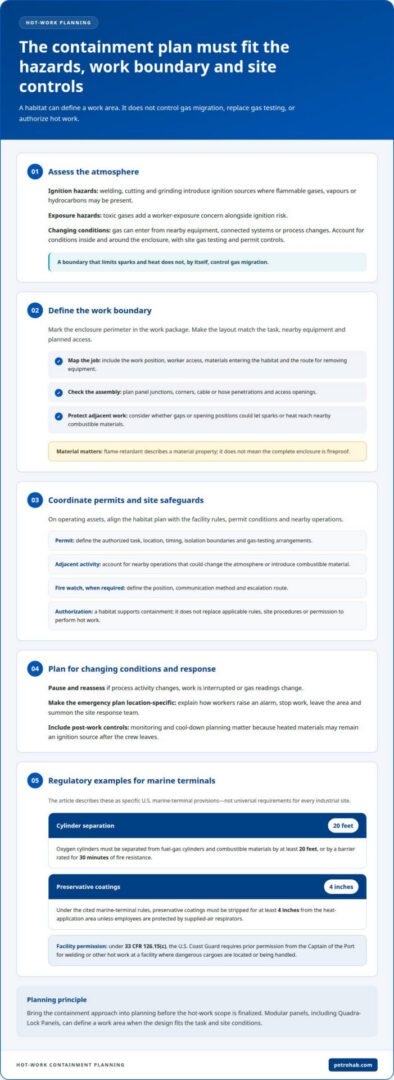
Gas can enter a work area from nearby equipment, connected systems or changing process conditions. A boundary that limits sparks and heat does not, by itself, control gas migration or eliminate the need for site gas testing and permit controls. The work plan must account for conditions both inside and around the enclosure.
U.S. Occupational Safety and Health Administration marine-terminal rules require oxygen cylinders to be separated from fuel-gas cylinders and combustible materials by at least 20 feet or by a barrier rated for 30 minutes of fire resistance. This specific rule illustrates why cylinder storage and combustible materials belong in the hot-work hazard review.
Coatings create another ignition consideration. Under U.S. Occupational Safety and Health Administration marine-terminal rules, preservative coatings must be stripped for at least 4 inches from the heat-application area unless employees are protected by supplied-air respirators. The work boundary should therefore account for coating type and the heat-application area.
Containment Risks and Failure Modes
Hot-work containment can fail if its boundary, monitoring or work controls do not address the actual hazards. Gas intrusion, an overlooked combustible surface or sparks reaching material outside the enclosure can undermine the intended separation. During a revamp, changing equipment conditions may also make an earlier hazard assessment incomplete. Permit controls, gas testing and coordination with adjacent work remain essential.
Lessons from Habitat Incidents
Hot-work incidents show why ignition sources, gas conditions and work boundaries must be assessed together. The U.S. Chemical Safety and Hazard Investigation Board published a safety bulletin on preventing worker deaths during hot work in and around tanks in February 2010. For refinery, offshore-platform and power-plant work, the practical lesson is to define the work scope, assess nearby hazards, maintain gas monitoring, and coordinate controls before welding begins. Post-work monitoring and cool-down planning also matter because heated materials may remain an ignition source after the crew leaves.
Hot work restrictions in flammable or potentially flammable atmospheres
Hot-work restrictions depend on the facility, work location and hazards present. On operating assets, permits and coordinated controls determine whether welding can proceed and how the work area must be managed.
Standards and Regulations
U.S. hot-work requirements depend on the applicable workplace and facility rules; marine-terminal provisions address specific operations, not every industrial site. Under 33 CFR 126.15(c), the U.S. Coast Guard requires prior permission from the Captain of the Port for welding or other hot work at a facility where dangerous cargoes are located or being handled. Knowing the facility’s regulatory context matters because permission and permit conditions can affect the work plan.
A habitat supports containment, but it does not replace applicable rules, site procedures or authorization to perform hot work. The work package should identify the asset, task, hazards, work boundary and controls. It should also account for nearby operations that could change the atmosphere or introduce combustible material. These details help ensure the enclosure plan reflects the actual job, rather than treating containment as approval on its own.
Permits and Operating-Asset Safeguards
For work on operating assets, the permit should define the authorized task, location, timing, isolation boundaries and gas-testing arrangements. Isolation planning addresses process connections and energy sources that could expose workers or the work area to hazardous conditions. Where the permit or site procedure requires a fire watch, define the position, communication method and escalation route.
The emergency plan should reflect the work location and credible hazards. It should explain how workers raise an alarm, stop work, leave the area and summon the site response team. Permit controls must also address changing conditions: nearby process activity, interruptions or a change in gas readings may require work to pause and conditions to be reassessed. Coordination helps close gaps between operations and the hot-work crew.
For projects requiring a defined containment approach, pressurized welding enclosures can be considered as part of the work-package planning.
Modular flame-retardant panels
Modular panels create a defined boundary for tasks such as pipe-spool welding or valve repair. Their effectiveness depends on how the assembled enclosure fits the work area, nearby equipment and planned access. During a revamp, the layout should reflect the job’s actual footprint without obstructing adjacent operations or leaving uncontrolled openings.
Start with the work scope and mark the enclosure perimeter in the work package. Include the welding position, materials entering the habitat, worker access and the route for removing equipment. For a flange repair, for example, the panel layout must allow for the worker’s position and the space needed to handle welding equipment.
Pay close attention to panel junctions, corners and penetrations. A gap around a cable or hose can interrupt the intended boundary, while a poorly placed access opening can expose adjacent work to sparks. The assembly plan should identify each opening and explain how it will be managed during the task. This helps prevent sparks and heat from reaching nearby combustible materials.
Flame-retardant describes a material property; it does not guarantee that the entire enclosure is fireproof. Panel material, connections and the complete configuration all matter. A panel’s performance, for example, cannot be considered separately from a seam or penetration that creates a path beyond the boundary. Use material documentation and the approved work plan to guide the assembled system’s use.
Revamp conditions can change after installation. A relocated hose, added equipment or changed work position may affect the panel layout. If the scope changes, reassess access points and boundaries before continuing. This keeps the enclosure suited to the current task rather than relying on a layout designed for earlier conditions.
Panels support containment; they do not control the surrounding atmosphere or replace permits, gas testing and site procedures. Treat them as one part of the work plan, with clear roles for the enclosure, monitoring arrangements and controls for the operating asset.
Portable pressurised hot-work enclosure
A portable pressurised habitat defines an enclosure for hot work during asset revamps. Planning hot work habitat containment during safety-critical asset revamps means including the habitat in the work pack before the hot-work scope is finalised.
Containment Option Comparisons
Rigid enclosures use a fixed structure, while soft-wall habitats use flexible wall assemblies; modular panels can also create a defined boundary. The practical choice depends on the work location, access needs and revamp scope. No enclosure type replaces permits or gas controls. Compare how each configuration accommodates welding, personnel movement, equipment entry and connections through the enclosure.
Habitat Ventilation and Protection
Ventilation manages fumes and air movement; gas monitoring tracks atmospheric conditions, while fire protection addresses ignition response. The work plan should explain how these controls work together inside the habitat. Monitoring and shutdown arrangements can respond to changes in gas levels or pressure. Requirements depend on the task, site procedures and hazard assessment, not the enclosure alone.
Managing Sparks and Emissions
A habitat creates a boundary around welding and can help contain sparks, dust and debris within the work area. It does not automatically remove fumes or emissions. The work plan must address ventilation and suitable collection or extraction controls for the materials and process. For example, grinding and welding produce different airborne contaminants, so controls should match the task.
Plan around the work scope, location, access and required controls. Installation establishes the enclosure and its interfaces with equipment and services. Before work proceeds, inspect the assembled boundary, access points, monitoring and planned ventilation. After completion, removal should follow site work controls and address remaining hot material, debris and equipment. A clear sequence supports hot work habitat containment during safety-critical asset revamps from planning through demobilisation.
For revamp work requiring a pressurised enclosure, explore pressurised habitats as part of the work-package plan.
A pressurised habitat belongs in the work pack before the hot-work scope is finalised, so enclosure needs can be considered alongside access, ventilation and monitoring arrangements.
PetroHab: PetroHab Hot Work Safety Enclosure (HWSE)
PetroHab’s Hot Work Safety Enclosure (HWSE) provides a modular containment option for hot work in hazardous industrial environments. It can support revamps where welding must be planned alongside operating assets, site permits and atmospheric controls. PetroHab’s panel offering includes patented Quadra-Lock® interlocking technology, and its Petro-Habitat™ HWSE is a pressurised enclosure option.
The Safe-Stop Safety Shutdown System (SSS) monitors differential pressure and gas levels to support safety controls around hot-work operations. It forms part of a broader work plan, not a substitute for site procedures, permits or hazard assessment. Consider an enclosure when the project scope calls for a defined hot-work area and coordinated containment planning.
Contact PetroHab to discuss hot-work containment for your asset revamp.
Set containment priorities before the next revamp
Use the next planning meeting to align the hot-work scope with conditions around the asset. Identify the work boundary, interfaces with operating equipment and controls that must stay coordinated as the job progresses. This gives the project team a practical basis for deciding whether a pressurised enclosure fits the task and how to integrate containment into the work package. Early alignment makes hot work habitat containment during safety-critical asset revamps part of the execution plan, rather than a late adjustment.
PetroHab offers the Petro-Habitat™ HWSE, Safe-Stop Safety Shutdown System and Quadra-Lock® panels. Together, these options support enclosure, monitoring and modular containment within the wider site control plan.
Discuss your project requirements and next steps with Contact PetroHab about hot work containment. A clear scope is a strong starting point for controlled planning.
Frequently Asked Questions
How are hot work habitats designed for confined spaces and hazardous locations?
Hot-work habitats are configured around the space, task and controls required for the revamp. The Petro-Habitat™ HWSE uses interchangeable panels and Quadra-Lock® interlocking technology, with window and intrusion/protrusion panels and pneumatic air supply. All habitats are ATEX- and IECEx-certified. For work in a confined vessel, the configuration must account for access, equipment interfaces and personnel entry and exit. Align these design features with the permit and site controls before work begins.
What ventilation, gas monitoring, and fire protection are required inside a hot work habitat?
The work plan should specify how ventilation manages fumes and air movement, gas monitoring tracks atmospheric conditions, and fire protection addresses ignition response. Monitoring and shutdown arrangements should respond to changes in gas levels or pressure; requirements depend on the task, site procedures and hazard assessment.