Blog Posts
Hot Work Near Sensitive Electronic Equipment: A Technical Guide to Risk Mitigation
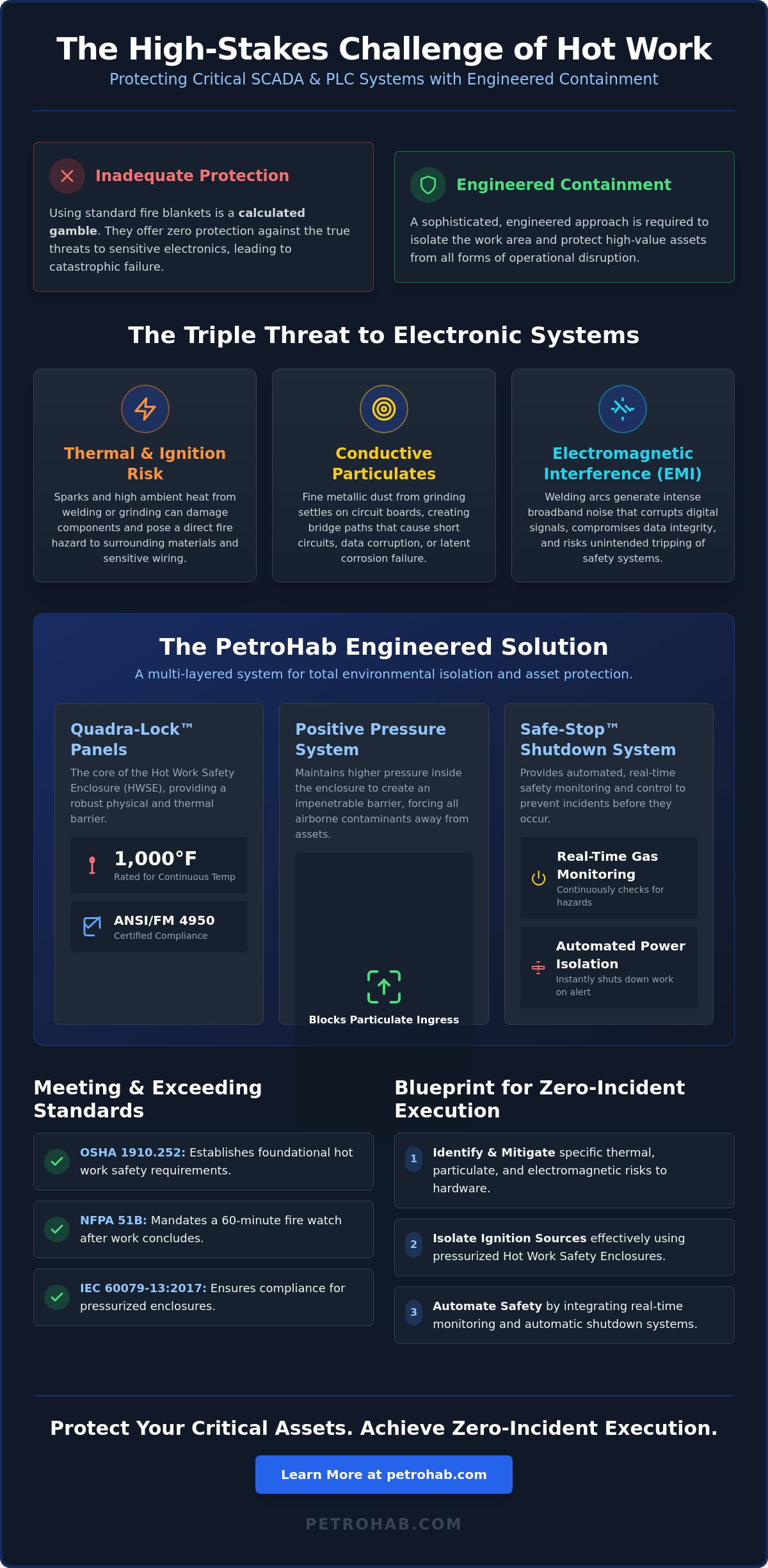
Deploying a standard fire blanket to protect a multi-million dollar SCADA system during welding operations isn’t a safety strategy; it’s a calculated gamble with catastrophic stakes. When you perform hot work near sensitive electronic equipment, the margin for error disappears. A single spark or a localized rise in ambient temperature can trigger hardware failure or disrupt critical control systems through electromagnetic interference. Precision is mandatory. You recognize that the complexity of these environments demands more than basic fire prevention. It requires a sophisticated, engineered approach to environmental isolation that addresses both ignition risks and delicate circuitry protection.
This technical guide provides the rigorous protocols and pressurized containment strategies required to perform hot work safely near high-value electronic assets. You’ll learn how to implement pressurized habitats using Quadra-Lock panels, which are rated for continuous temperatures of 1,000 degrees Fahrenheit and comply with ANSI/FM 4950 standards, to isolate ignition sources effectively. We will examine how PetroHab LLC integrates the Safe-Stop automatic shutdown system to maintain compliance with IEC60079-13:2017 standards. This overview establishes a blueprint for achieving zero-incident execution while protecting your most sensitive PLC and SCADA hardware from operational disruption.
Key Takeaways
- Identify the specific thermal and electromagnetic risks associated with hot work near sensitive electronic equipment to prevent catastrophic hardware failure.
- Master the application of NFPA 51B and OSHA 1910.252 standards to maintain stringent compliance in control-room environments.
- Discover how pressurized PetroHab Hot Work Safety Enclosures (HWSE) isolate ignition sources from flammable gases and conductive particulates.
- Learn to integrate the Safe-Stop Automatic Shutdown System for real-time gas monitoring and automated power isolation.
- Establish rigorous operational best practices and pre-deployment checklists to ensure the protection of high-value SCADA and PLC assets.
The Hazards of Hot Work Near Sensitive Electronic Equipment
Hot work in electronic-dense environments transcends basic fire safety. It encompasses any operation involving open flames or heat, such as welding, grinding, and soldering, performed within proximity to control rooms or server racks. What is Hot Work? At its core, it’s a process that introduces ignition sources into potentially volatile or high-value zones. In these specialized areas, the traditional focus on fire prevention isn’t enough. You’re dealing with a triple threat: thermal damage, conductive particulate ingress, and electromagnetic interference (EMI).
Standard fire blankets offer zero protection against fine metallic dust or electromagnetic surges. They’re designed to stop sparks, but they won’t prevent a PLC from crashing due to high-frequency noise. Performing hot work near sensitive electronic equipment requires a pressurized, engineered barrier to isolate the work from the environment. Without this isolation, you risk the integrity of the entire facility’s control architecture.
To better understand the fundamental differences between these permit types and their associated risks, watch this helpful video:
SCADA and PLC systems are the nervous system of industrial facilities. Managing risks during hot work near sensitive electronic equipment involves understanding that a single spark or a microscopic layer of conductive dust on a circuit board can cause a short circuit. This often leads to an uncommanded shutdown of the entire facility. The cost of such an event isn’t measured in equipment replacement alone, but in massive operational downtime and lost revenue. Precision in containment is the only reliable remedy.
Electromagnetic Interference (EMI) and Signal Integrity
Welding arcs generate intense broadband noise. This interference corrupts digital signals and can cause the unintended tripping of safety instrumented systems (SIS). Without proper shielding and isolation, the high-frequency energy from an arc can induce currents in nearby data cables. This compromises signal integrity and risks erratic machine behavior. Protecting these systems requires physical distance or specialized habitats that attenuate electromagnetic radiation.
Conductive Dust and Particulate Ingress
Grinding operations produce fine metallic particulates that are highly conductive. If they settle on circuit boards, they create bridge paths between pins, leading to immediate short circuits or latent corrosion. Managing this risk requires positive pressure within the work area. By maintaining a higher pressure inside a PetroHab LLC Hot Work Safety Enclosure (HWSE) constructed with Quadra-Lock panels, you ensure that no particulates escape the contained environment. This positive pressure creates an impenetrable barrier that keeps high-value assets clean and operational.
Regulatory Standards for Hot Work in High-Value Zones
Compliance in high-stakes industrial environments isn’t a matter of preference; it’s a legal and operational necessity. In the United States, OSHA hot work safety standards provide the foundational requirements for welding, cutting, and brazing. These regulations mandate that employers establish safe conditions before any ignition source is introduced. When you manage hot work near sensitive electronic equipment, these general rules require additional technical layers to address the unique vulnerabilities of control systems. NFPA 51B serves as the primary industry standard, and its 2024 edition requires a fire watch to remain on-site for at least 60 minutes after work concludes. This duration is critical in electronic zones where smoldering particulates can settle unnoticed in cable trays.
Control rooms and instrument houses often fall under complex ATEX or IECEx zone classifications. These international standards define the likelihood of explosive atmospheres and dictate the type of equipment allowed within them. To maintain compliance in these hazardous locations while performing hot work near sensitive electronic equipment, the use of a pressurized welding habitat is often the only viable solution. These systems allow for hot work to proceed by creating a localized environment that is physically isolated from the surrounding hazardous area. This engineering control ensures that your facility meets the latest safety mandates without requiring a total plant shutdown.
The Permit-to-Work (PTW) Process for Electronic Rooms
Standard permits don’t account for the sensitivity of digital assets. A specialized PTW for electronic-dense zones must include addendums for signal protection and particulate management. Before work begins, technicians must implement pre-work isolation protocols for safety instrumented systems. This prevents accidental trips caused by EMI or heat. The fire watch in these areas requires specific training to recognize risks beyond open flames, such as the accumulation of conductive grinding dust on rack-mounted hardware. If you’re looking to upgrade your procedural oversight, a PetroHab LLC Hot Work Safety Enclosure (HWSE) provides the structural framework to support these rigorous permits.
International Safety Standards and HWSE
PetroHab LLC enclosures are engineered to exceed global safety requirements through superior material science. We utilize Quadra-Lock panels, which are rated for continuous temperatures of 1,000 degrees Fahrenheit and intermittent exposure up to 2,000 degrees Fahrenheit. These panels are tested against ANSI/FM 4950 and NFPA 701 standards for flame propagation. Maintaining habitat integrity according to the most recent hazardous environment standards ensures that your operations remain protected against both thermal and atmospheric threats. This commitment to certified technology is what separates industry leaders from those who rely on insufficient, non-engineered solutions.
Utilizing PetroHab LLC HWSE for Electronic Asset Protection
Designing a containment solution for hot work near sensitive electronic equipment requires navigating complex geometries. Control rooms aren’t open voids; they’re filled with cable trays, server racks, and intricate instrumentation. PetroHab LLC Hot Work Safety Enclosures (HWSE) utilize a modular architecture that adapts to these obstructions. This flexibility allows engineers to construct a pressurized environment directly around existing assets without requiring equipment relocation. By sealing around penetrations with specialized gaskets, the habitat maintains a secure boundary even in the most congested confined spaces.
The primary defense mechanism of the HWSE is its positive pressure system. This system forces air out through any minor gaps, preventing the ingress of flammable gases or conductive particulates. Compliance with EPA hot work permit requirements is significantly simplified when using this technology. It provides a verifiable engineering control against ignition risks in facilities that manage hazardous substances. The modularity of the system ensures rapid deployment. In emergency repair scenarios, technicians can assemble a functional habitat in hours rather than days, minimizing the window of vulnerability for your digital infrastructure.
Quadra-Lock Panel Technology
The integrity of the enclosure depends on the panels themselves. PetroHab LLC uses the patented Quadra-Lock interlocking system to create a superior seal between each component. This design provides an airtight connection that traditional panel systems lack. It’s the definitive alternative to outdated concepts, offering enhanced durability and ignition resistance. Each Quadra-Lock panel consists of fire-retardant materials rated for continuous temperatures of 1,000 degrees Fahrenheit. They also withstand intermittent exposure up to 2,000 degrees Fahrenheit. These panels meet ANSI/FM 4950 and NFPA 701 fire test standards, ensuring that high-value electronics remain shielded from thermal stress and sparks.
Maintaining Positive Pressure Integrity
Constant monitoring is essential for safety. Technicians use manometers to track the pressure differential between the habitat and the external environment. This data ensures the enclosure remains effectively pressurized throughout the operation. High-capacity air ducting delivers a continuous flow of fresh air, which also helps manage heat buildup from welding activities. To ensure maximum safety and compliance, the habitat should maintain a minimum positive pressure of 0.05 inches (12.5 Pa) of water column relative to the outside atmosphere. This consistent airflow protects the interior personnel and prevents external contaminants from entering the work zone.
Automated Safety: The Safe-Stop Shutdown System
Manual atmospheric monitoring has inherent limitations. In high-stakes environments, human reaction time cannot match the speed of digital detection. The Safe-Stop Automatic Shutdown System bridges this critical gap by providing a continuous, automated layer of protection. When you perform hot work near sensitive electronic equipment, the margin for error is non-existent. This system acts as the primary ignition control mechanism, integrating advanced gas and pressure sensors directly with the welding power supply. By removing human hesitation from the safety equation, you ensure that any deviation from safe operating parameters results in an immediate cessation of hazardous activities.
The core of the Safe-Stop logic is its fail-safe power termination. If the system identifies a loss of habitat pressure or detects the presence of flammable gases, it terminates power to all hot work tools in milliseconds. This rapid response is vital for protecting expensive SCADA and PLC hardware from thermal damage or ignition events. Automated systems are no longer optional for heavy industry; they’re a technical requirement for safeguarding high-value assets. If you’re ready to secure your facility with the industry’s most reliable ignition control technology, explore the full range of PetroHab LLC safety solutions.
Gas Detection and Atmospheric Monitoring
Precision in sensor placement determines the effectiveness of your safety perimeter. Technicians must strategically position LEL (Lower Explosive Limit) sensors near the air intakes of electronic racks to detect migrating gases before they reach internal components. The Safe-Stop system, a core component of the PetroHab LLC technical suite, also monitors for toxic gases like H2S. Continuous monitoring ensures that the air quality within the enclosure remains within safe limits, preventing both fire risks and personnel exposure to hazardous fumes.
Redundancy and Reliability in Safety Systems
Reliability in safety hardware is verified through rigorous international certifications. The Safe-Stop system is certified to the latest version of the pressurized rooms standard, IEC60079-13:2017, and carries full ATEX certification. This ensures the components themselves don’t become ignition sources in volatile environments. It provides a secondary layer of protection that works in tandem with the physical barrier of the HWSE and its Quadra-Lock panels. Before any arc is struck, crews must verify system calibration using certified test gases to confirm that the shutdown logic is fully operational. This methodical approach to redundancy is what defines operational excellence in modern risk mitigation.
Operational Best Practices for High-Stakes Hot Work
Execution of hot work near sensitive electronic equipment demands more than just hardware; it requires a disciplined operational framework. Before a single arc is struck, safety managers must coordinate with IT and instrumentation departments. This coordination ensures that safety instrumented systems (SIS) are either bypassed or monitored by personnel who understand the signal implications of EMI. A comprehensive pre-deployment checklist is mandatory. This list should include the isolation of HVAC intakes and the verification of grounding for all welding equipment. If the environment doesn’t meet these baseline criteria, work cannot proceed.
The human element remains the final layer of protection. Only certified supervisors and technicians trained in pressurized habitat operations should manage these zones. Their expertise allows them to recognize subtle changes in environmental conditions that automated sensors might miss. Reliance on uncertified labor in electronic-dense areas is an unacceptable risk to facility integrity. It’s the responsibility of the site manager to verify that every team member understands the specific vulnerabilities of the hardware surrounding the work area.
Establishing a Safe Working Environment
Maintaining a secure perimeter around the PetroHab LLC HWSE prevents unauthorized entry and protects external cabling from accidental damage. Technicians must manage cable penetrations through the Quadra-Lock panels with precision. Using specialized seals and gaskets around these ingress points ensures the positive pressure remains constant. This level of detail is covered in specialized on-site training, which is essential for all personnel involved in high-stakes operations. Properly sealed penetrations prevent the escape of sparks and the entry of hazardous gases into the habitat.
Emergency Procedures and Contingency Planning
Every technician must understand the immediate response required if the Safe-Stop system triggers a shutdown. A shutdown indicates a breach in safety parameters, such as a loss of pressure or gas detection. In these instances, work must stop instantly and the ignition source must be isolated. Emergency egress routes must be clearly marked and kept free of obstructions. This is often challenging in equipment-dense control rooms, requiring a pre-work walkthrough to identify all potential exit paths.
Once the hot work is complete, the final phase is a meticulous post-work inspection. Technicians must verify that no conductive particulate residue remains on electronic surfaces or within rack enclosures. This prevents latent short circuits that could manifest days after the project concludes. PetroHab LLC remains committed to a zero-incident safety culture. We provide the tools and technical guidance necessary to protect your personnel and your most valuable digital assets in every industrial environment.
Advancing Industrial Safety Through Engineered Isolation
Effective risk mitigation in electronic-dense environments requires a transition from basic fire prevention to comprehensive environmental isolation. High-stakes operations demand the use of pressurized habitats to neutralize the triple threat of heat, conductive dust, and electromagnetic interference. By adhering to rigorous permitting processes and deploying automated ignition controls, you ensure that facility operations remain uninterrupted and compliant with international standards like NFPA 51B. These technical safeguards are essential for maintaining the integrity of critical control architectures.
Performing hot work near sensitive electronic equipment is a precise engineering challenge that leaves no room for speculative safety measures. PetroHab provides the definitive solution through patented Quadra-Lock technology and ATEX and IECEx certified components. Our global track record in offshore and refinery safety demonstrates an unwavering commitment to protecting personnel and high-value infrastructure. It’s time to elevate your site’s safety protocols to meet the demands of modern industrial environments. You can secure your high-value assets with a PetroHab HWSE today and establish a new benchmark for operational excellence. We look forward to partnering with your team to achieve zero-incident success.
Frequently Asked Questions
Is it safe to weld inside a control room with live servers?
Welding inside a control room with live servers is safe only when a pressurized Hot Work Safety Enclosure (HWSE) is deployed to isolate the work area. This engineered system prevents thermal transfer and electromagnetic interference from reaching critical hardware. Performing hot work near sensitive electronic equipment without such isolation risks catastrophic hardware failure or unintended system trips. You must implement these technical controls to ensure the continued integrity of your digital assets.
How does a pressurized habitat protect electronics from metallic dust?
Positive pressure creates a continuous outward airflow that prevents external contaminants and conductive particulates from entering the work area. This airflow ensures that metallic grinding dust generated during the work is contained within the habitat and cannot settle on nearby circuit boards. By maintaining a specific pressure differential, the habitat acts as an impenetrable barrier. It protects high-value electronic components from short circuits and long-term corrosion caused by particulate ingress.
What is the difference between Quadra-Lock and traditional welding blankets?
Quadra-Lock panels provide a structural, interlocking barrier that offers both fire resistance and environmental isolation, whereas blankets only provide basic spark protection. These panels are rated for 1,000 degrees Fahrenheit continuous exposure and meet ANSI/FM 4950 standards. Unlike blankets, Quadra-Lock panels facilitate the creation of a pressurized environment. This prevents the migration of flammable gases and conductive particulates that traditional blankets cannot stop, ensuring superior protection for nearby instrumentation.
Can the Safe-Stop system be used with any type of welding equipment?
The Safe-Stop Automatic Shutdown System integrates with most electric arc welding machines and other hot work power tools used in industrial settings. It monitors atmospheric conditions and habitat pressure in real-time, cutting power to the connected equipment if safety parameters are breached. This universal compatibility ensures that various hot work processes can be automated for safety. It provides a reliable fail-safe mechanism that protects personnel and hardware in equipment-dense zones.
What are the OSHA requirements for hot work near sensitive equipment?
OSHA 1910.252 requires that all fire hazards be removed or shielded before hot work begins, which necessitates stringent containment in electronic zones. While these regulations don’t name sensitive equipment specifically, the mandate for fire prevention and atmospheric testing remains absolute. Using an engineered enclosure ensures compliance by preventing the ignition of flammable gases. It also provides the thermal shielding required to protect high-value instrumentation from damage during welding or cutting operations.
How do you manage heat buildup inside a small HWSE near electronics?
Heat management is achieved through continuous air exchange provided by high-capacity blowers and specialized air ducting. These systems introduce fresh air while simultaneously exhausting heated air from the enclosure to maintain a stable internal temperature. In confined spaces near delicate hardware, technicians can also integrate portable cooling units. This ensures that the ambient temperature remains within the operational limits of both the workers and the nearby electronic racks, preventing thermal stress.
What happens if the positive pressure in the habitat is lost during work?
If the system detects a loss of positive pressure, the Safe-Stop system triggers an immediate fail-safe shutdown of all connected equipment. This termination occurs in milliseconds to prevent the ingress of flammable gases or conductive particulates into the habitat. Work cannot resume until the pressure differential is restored and the atmosphere is verified as safe. This automated response is a critical requirement for hot work near sensitive electronic equipment to prevent ignition events.
How long does it take to set up a PetroHab HWSE in an offshore control room?
Setup time typically ranges from two to four hours depending on the complexity of the existing infrastructure and cable penetrations. The modular design of the enclosure and the interlocking Quadra-Lock panels allow for rapid assembly even in cramped environments. This efficiency minimizes operational downtime while ensuring that a fully certified, pressurized barrier is established. It provides immediate protection for your digital infrastructure before any ignition source is introduced into the zone.