Blog Posts
Hot Work Risk Assessment Checklist: 2026 Industrial Safety Standards
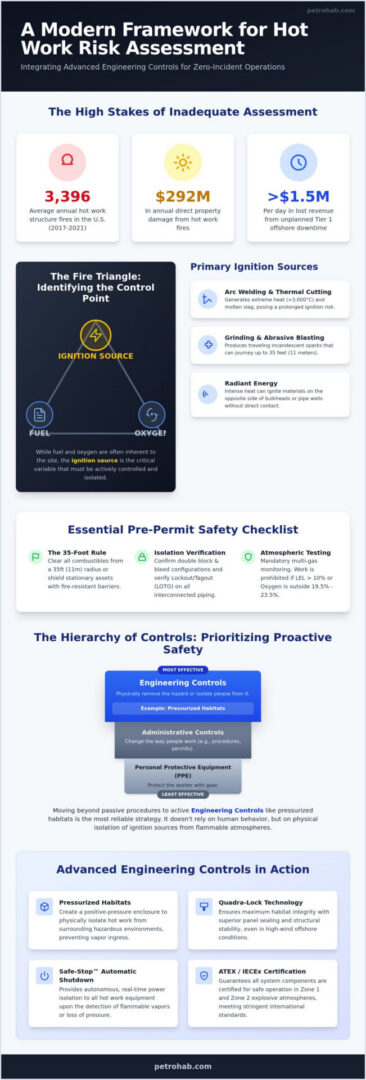
Between 2017 and 2021, the U.S. averaged 3,396 hot work structure fires annually, resulting in $292 million in direct property damage. You recognize that in high-stakes environments like refineries, a single spark isn’t just a safety violation; it’s a potential Tier 1 catastrophe. With unplanned downtime on Tier 1 offshore platforms costing over $1.5 million per day, balancing production with safety is a constant pressure. It demands a technical hot work risk assessment checklist that accounts for the latest 2026 regulatory shifts and technical standards.
This article provides a comprehensive framework for identifying latent hazards and implementing pressurized engineering controls to ensure facility-wide safety. We’ll examine the impact of the 2024 NFPA 51B updates, the 2026 OSHA National Emphasis Program, and how Quadra-Lock technology minimizes downtime through active environmental isolation. You’ll learn how to move beyond passive observation to achieve zero-incident operations using Safe-Stop automatic shutdown systems and ATEX certified enclosures. This methodical approach ensures that maintenance doesn’t compromise the integrity of your high-value assets.
Key Takeaways
- Modernize safety protocols by integrating 2026 industrial standards and regulatory updates into your comprehensive hot work risk assessment checklist.
- Execute rigorous pre-permit atmospheric testing and the 35-foot rule to identify and mitigate ignition risks before work commences.
- Prioritize engineering controls over administrative procedures by deploying pressurized habitats to isolate hazardous environments from active ignition sources.
- Ensure maximum enclosure integrity using Quadra-Lock technology, which provides superior seal performance and structural stability in high-wind conditions.
- Integrate Safe-Stop Automatic Shutdown Systems to provide autonomous, real-time power isolation upon the detection of flammable vapors.
Defining Hot Work Risks in Modern Industrial Environments
Industry standards for Defining Hot Work encompass any process that generates sparks, open flames, or heat sufficient to ignite flammable vapors or combustible materials. In the energy sector, these activities represent the highest risk factor for catastrophic ignition. A rigorous hot work risk assessment checklist must account for the intersection of three critical elements: fuel, oxygen, and an ignition source. While ambient oxygen and fuel sources like fugitive emissions are often inherent to the site, the ignition source is the only variable safety managers can’t afford to leave to chance.
Technical compliance relies heavily on ATEX and IECEx zone classifications. Zone 1 environments, where explosive atmospheres are likely to occur periodically, require the most stringent pressurized controls. Zone 2 areas, while less volatile, still demand a structured assessment to prevent a localized leak from meeting a welding arc. Effective hazard identification starts with understanding these classifications and the specific equipment required to operate safely within them.
Primary Ignition Sources in Refineries
Arc welding and thermal cutting operations serve as high-energy ignition risks, often reaching temperatures exceeding 3,000 degrees Celsius. These processes don’t just create localized heat; they produce molten slag that can remain viable for ignition long after the work stops. Grinding and abrasive blasting present a different challenge: traveling sparks. These incandescent particles can travel up to 35 feet, bypassing standard fire blankets and finding pathways into drainage systems or ventilation ducts where gas may have accumulated. Radiant energy also poses a risk, as intense heat can ignite materials on the opposite side of a bulkhead or pipe wall without direct contact.
The True Cost of Assessment Failure
Failure to implement a detailed hot work risk assessment checklist leads to consequences far beyond immediate property damage. It’s a risk that compromises the entire facility. While the average direct property damage from hot work fires exceeds $292 million annually, the operational impact is often more severe. For a Tier 1 offshore platform, unplanned downtime results in approximately $1.5 million in lost revenue every 24 hours. This financial burden is compounded by the necessity of emergency repairs and the logistical challenges of restoring production.
Beyond financial loss, non-compliance with OSHA and NFPA 51B standards exposes organizations to significant legal liability and regulatory fines. The 2026 update to OSHA’s National Emphasis Program signals a period of increased scrutiny for high-risk industries. Long-term health risks also factor into the cost. Inadequate ventilation during welding leads to toxic fume exposure, creating chronic respiratory issues for personnel. Safety management must prioritize pressurized habitats and automatic shutdown systems to mitigate these multifaceted risks simultaneously.
Pre-Permit Checklist: Atmospheric Testing and Site Preparation
Before any permit is issued, the physical workspace must be sterilized of ignition potential. The 35-foot (11-meter) rule remains the industry benchmark for clearing combustibles from the work radius. This involves moving portable materials and shielding stationary assets with fire-resistant barriers. Isolation verification is equally critical. Safety managers must confirm double block and bleed configurations and verify the Lockout/Tagout (LOTO) status of all interconnected piping to prevent accidental release. These foundational steps are the first entries on any professional hot work risk assessment checklist. The 2026 update to OSHA’s National Emphasis Program reinforces the need for this documented site preparation, ensuring that combustibles don’t become fuel for a localized fire.
Atmospheric testing protocols must be executed with calibrated multi-gas detectors. Rigorous monitoring for Lower Explosive Limit (LEL), Oxygen levels, and Hydrogen Sulfide (H2S) is mandatory. Following OSHA hot work safety standards, work shouldn’t proceed if LEL readings exceed 10% or if oxygen levels are outside the 19.5% to 23.5% range. Testing must extend to hidden hazards, including vapors trapped in insulation, equipment voids, or adjacent drainage systems that could be disturbed by thermal energy. Utilizing a pressurized welding enclosure provides an additional layer of protection by physically isolating the work area from these unpredictable external variables.
LEL Monitoring and Vapor Migration
Setting acceptable LEL limits for entry is only the first step. Complex piping networks often harbor vapor “pockets” that can migrate due to changes in ambient temperature or pressure. While periodic testing is standard, high-hazard zones demand continuous monitoring via fixed detection systems. This ensures that any atmospheric shift triggers an immediate response before an ignition event occurs. It’s vital to sample air at multiple heights, as different gases settle or rise based on their specific gravity.
Managing Combustible Dusts and Residues
Combustible dusts on overhead structures often go unnoticed but pose a severe secondary explosion risk. All tanks and vessels must undergo thorough cleaning and purging to remove residues before hot work begins. Ventilation plays a dual role here. It stabilizes the atmosphere by diluting potential contaminants and prevents the accumulation of welding fumes. A stable atmosphere is maintained through balanced airflow, ensuring that the environment remains within safe operating parameters throughout the duration of the task.
The Hierarchy of Controls: Moving from Administrative to Engineering
Modern industrial safety requires a fundamental shift in how we approach ignition prevention. While traditional safety protocols relied heavily on human vigilance, the 2026 landscape demands a more rigorous application of the hierarchy of controls. A technical hot work risk assessment checklist must prioritize the removal of hazards through engineering rather than relying solely on administrative procedures or personal protective equipment (PPE). By moving up the hierarchy, safety managers transition from managing the consequences of a fire to preventing the conditions that allow one to start.
Elimination and substitution represent the most effective tiers of this hierarchy. Before any permit is signed, engineers must determine if cold-cutting or mechanical bolting can replace thermal processes. If elimination isn’t feasible, substitution involves relocating the equipment to a designated non-hazardous workshop. However, for fixed refinery assets and offshore infrastructure, these options are rarely available. In these high-stakes environments, the focus must shift to robust engineering controls that physically separate the ignition source from potential fuel sources.
Engineering Isolation with HWSE
Pressurized welding enclosures represent the pinnacle of engineering controls in hazardous zones. These systems utilize the physics of positive pressure to create a safe internal environment. By maintaining a higher atmospheric pressure inside the habitat than the surrounding area, the system effectively forces flammable gases away from the ignition source. This overpressure ensures that even if a gas leak occurs nearby, the volatile vapors cannot enter the work area. For a deep dive into these systems, consult The Definitive Guide to Hot Work Safety Enclosures (HWSE) in 2026. This technological remedy provides a level of reliability that administrative permits alone cannot achieve.
Effective Fire Watch Protocols
Administrative controls remain a critical supporting layer, specifically through the implementation of Permit-to-Work (PTW) systems and fire watch duties. The 2024 update to NFPA 51B mandates a 60-minute post-work surveillance period, an increase from previous standards. This extended fire watch ensures that smoldering slag or radiant heat doesn’t lead to a delayed ignition. Clear communication chains between the welder, the fire watch, and the safety supervisor are essential. Every fire watch must be equipped with dedicated fire extinguishers and intrinsically safe communication devices to report any atmospheric changes immediately. While these steps are necessary, they function as a secondary defense to the primary engineering isolation provided by a PetroHab HWSE.
PPE serves as the final, least effective layer of the hot work risk assessment checklist. Flame-resistant clothing, welding helmets, and respiratory protection are vital for individual worker safety but do nothing to protect the facility itself. A serious safety strategy recognizes that PPE only mitigates injury after a failure has occurred. True facility-wide protection is only realized when engineering controls are prioritized at the center of the safety framework.
Habitat Integrity: Quadra-Lock Technology and Seal Assessment
Habitat integrity is the cornerstone of effective engineering controls in hazardous environments. A robust hot work risk assessment checklist must prioritize the physical barrier’s ability to maintain a gas-tight seal under operational stress. Traditional hook-and-loop fastening systems often fail to provide the necessary seal integrity, particularly when subjected to the internal pressures of a pressurized welding enclosure. In contrast, patented Quadra-Lock technology utilizes a mechanical interlocking system that ensures superior seal integrity and structural durability. This engineering approach allows the enclosure to withstand high winds and the volatile conditions of offshore platforms without compromising the safety of the interior work zone.
Verifying the fire-resistance of the enclosure is non-negotiable. All modular panels must meet international flame-retardant specifications to provide a reliable barrier against high-energy ignition sources like molten slag. Managing penetrations is another critical assessment point. Safety managers must evaluate how the system seals around existing pipes and structural beams to prevent gas ingress. Secure your facility with the industry benchmark for pressurized containment by choosing PetroHab Quadra-Lock technology solutions.
Assembling the Quadra-Lock System
During critical refinery turnarounds, setup speed directly impacts production uptime. The modular nature of Quadra-Lock panels allows for rapid assembly and precise adaptation to restricted footprints or complex structural geometries. Workers can quickly configure the enclosure around obstructions, ensuring that no gaps remain for fugitive emissions to enter. This modularity doesn’t just save time; it guarantees a consistent, gas-tight seal that is essential for maintaining habitat integrity throughout the project duration. Detailed engineering specifications for these systems are available in Pressurized Welding Habitats: The Definitive Guide to HWSE Technology.
Positive Pressure Verification
Maintaining positive pressure requires more than a functioning blower; it demands precise monitoring and verification. Safety supervisors use manometers to measure the differential pressure between the habitat interior and the external environment. This verification ensures that the system is effectively forcing flammable gases away from the ignition source at all times. Sourcing air from a certified non-hazardous intake point is mandatory to prevent the introduction of contaminants into the work area. Rigorous ducting requirements ensure a steady flow of clean air, which also helps manage heat stress and toxic fume accumulation during the welding process. A stable, overpressured environment is the primary defense against localized atmospheric changes.
Real-Time Mitigation: Safe-Stop and Automatic Shutdown Systems
Human vigilance has inherent limitations when monitoring for colorless, odorless gases in complex industrial environments. A modern hot work risk assessment checklist must account for these limitations by integrating automated hardware responses that function independently of human intervention. The Safe-Stop Automatic Shutdown System serves as this critical technological safeguard. It bridges the gap between environmental monitoring and active hazard mitigation by providing an autonomous, fail-safe mechanism that reacts to atmospheric changes in real-time. This system acts as an active guardian, ensuring that ignition sources are neutralized before flammable vapors can reach a critical concentration.
The integration of automated power isolation transforms the safety habitat from a passive barrier into an intelligent safety system. Milliseconds after a hazard is detected, the system terminates power to all welding equipment and tools. This immediate isolation is the most effective way to prevent an ignition event when containment is challenged by fugitive emissions or equipment failure. A hot work risk assessment checklist that relies solely on manual monitoring is incomplete in the high-stakes environment of 2026 industrial operations.
Safe-Stop: The Intelligent Safety Interface
Safe-Stop functions as the central logic controller for the pressurized welding enclosure. It monitors LEL concentrations and internal habitat pressure simultaneously using high-precision sensors. If the internal pressure falls below the required safety setpoint or if flammable gas is detected at the intake, the system triggers an immediate shutdown. High-intensity visual and audible alarm protocols activate instantly to alert personnel to evacuate the area. These units are designed for seamless integration with facility-wide Emergency Shutdown (ESD) systems, ensuring that a localized event triggers the appropriate refinery-wide safety response. This level of connectivity is essential for managing the complex risk profiles of modern energy infrastructure.
Continuous Improvement via Post-Work Data
Recording safety metrics is essential for post-project compliance and long-term risk reduction. Safe-Stop units utilize integrated data logging to record every gas detection event, pressure fluctuation, and system status change throughout the work duration. This data provides a logical, evidence-based trail for safety audits and regulatory reviews. Analyzing these logs allows safety managers to refine the hot work risk assessment checklist for future turnarounds by identifying recurring atmospheric trends or structural vulnerabilities. Effective safety management depends on this data-driven approach, combined with rigorous on-site supervision and uncompromising technician training. For more information on these integrated technologies, review A Comprehensive Guide to Advanced Hot Work Safety Systems in 2026.
Securing the Future of Industrial Safety
Achieving zero-incident operations in high-hazard energy environments requires more than a standard permit. It demands a fundamental shift toward pressurized isolation and automated response systems. By incorporating these engineering controls into your hot work risk assessment checklist, you replace the uncertainty of human vigilance with the calculated reliability of patented technology. This methodical approach ensures that maintenance work doesn’t compromise the safety of your personnel or the integrity of high-value assets.
PetroHab provides the rigorous engineering required for these high-stakes applications. Our patented Quadra-Lock Panel Technology maintains superior seal integrity in extreme conditions, while the Safe-Stop™ Automatic Shutdown System offers autonomous power isolation at the first sign of atmospheric change. Supported by global on-site supervision and training, these systems act as active guardians of your facility. We invite you to Request a Technical Consultation for Your Next Hot Work Project to verify your compliance with 2026 standards. Elevating your safety protocols today ensures operational excellence for the years to come.
Frequently Asked Questions
What are the most common hot work hazards in the oil and gas industry?
The primary hazards include fugitive hydrocarbon vapors, Hydrogen Sulfide (H2S), and combustible dust accumulations. These elements create a volatile environment when introduced to high-energy ignition sources like welding arcs or grinding sparks. Secondary risks involve radiant heat transferring through bulkheads and molten slag traveling beyond immediate work zones. Identifying these risks is the first step in any professional hot work risk assessment checklist to prevent catastrophic asset loss or personnel injury.
How does a pressurized welding habitat mitigate ignition risks?
A pressurized welding habitat mitigates risks by maintaining an internal atmosphere at a higher pressure than the surrounding external environment. This positive pressure creates a physical barrier that forces flammable gases and vapors away from the enclosure. By sourcing air from a non-hazardous intake point, the system ensures that the internal work zone remains free of explosive concentrations. This engineering control provides a reliable alternative to shutting down production during essential maintenance.
What is the 35-foot rule in hot work safety?
The 35-foot rule requires the removal or protection of all combustible materials within a 10.7-meter radius of the hot work site. This standard protocol prevents sparks or slag from igniting nearby fuel sources. If materials cannot be moved, they must be shielded with fire-resistant covers. This rule is a core component of the hot work risk assessment checklist and is mandated by NFPA 51B to minimize the risk of secondary fires.
Can hot work be performed in an ATEX Zone 1 area?
Yes, hot work can be performed in ATEX Zone 1 areas provided that pressurized engineering controls are implemented. Zone 1 indicates that an explosive atmosphere is likely to occur periodically. Standard administrative permits aren’t sufficient in these zones. Safety managers must deploy a PetroHab Hot Work Safety Enclosure (HWSE) and a Safe-Stop system to isolate the ignition source from the hazardous atmosphere. This combination ensures full regulatory compliance while maintaining operational uptime.
What is the difference between a fire watch and a safety supervisor?
A fire watch is a dedicated observer responsible for identifying and extinguishing incipient fires during and for 60 minutes after work completion. They have no other duties during this time. A safety supervisor, however, provides high-level oversight of the entire project. They verify the hot work risk assessment checklist, sign off on permits, and ensure that all engineering controls like Quadra-Lock panels are correctly installed and functioning before work begins.
What happens if a Safe-Stop system detects flammable gas during welding?
If the Safe-Stop Automatic Shutdown System detects flammable gas at the LEL intake, it immediately isolates power to all welding equipment. This millisecond response occurs autonomously, removing the ignition source before the gas reaches a dangerous concentration. Simultaneously, the system triggers high-intensity visual and audible alarms to initiate worker evacuation. This automated intervention provides a fail-safe layer of protection that human observation alone cannot match in high-stakes environments.
How often should hot work equipment be inspected for hazards?
Hot work equipment requires inspection before every shift and after any significant operational pause. Technicians must check for frayed cables, leaking hoses, and faulty grounding to prevent electrical or thermal failures. These inspections ensure that the tools themselves don’t become a hazard within the enclosure. Documenting these checks is a critical part of maintaining a comprehensive hot work risk assessment checklist and ensures that the system’s integrity is never compromised.
Are PetroHab enclosures compliant with NFPA 51B standards?
PetroHab Hot Work Safety Enclosures are fully compliant with NFPA 51B standards for fire prevention during welding and cutting. Our modular panels are manufactured using fire-resistant materials that meet international flame-retardant specifications. When combined with our patented Quadra-Lock technology and Safe-Stop systems, these enclosures exceed the basic requirements for pressurized habitats. This commitment to compliance ensures that your facility remains protected while adhering to the latest 2026 industrial safety standards.