Blog Posts
Industrial Fume Hoods and Welding Habitats: Managing Hazardous Vapours in 2026
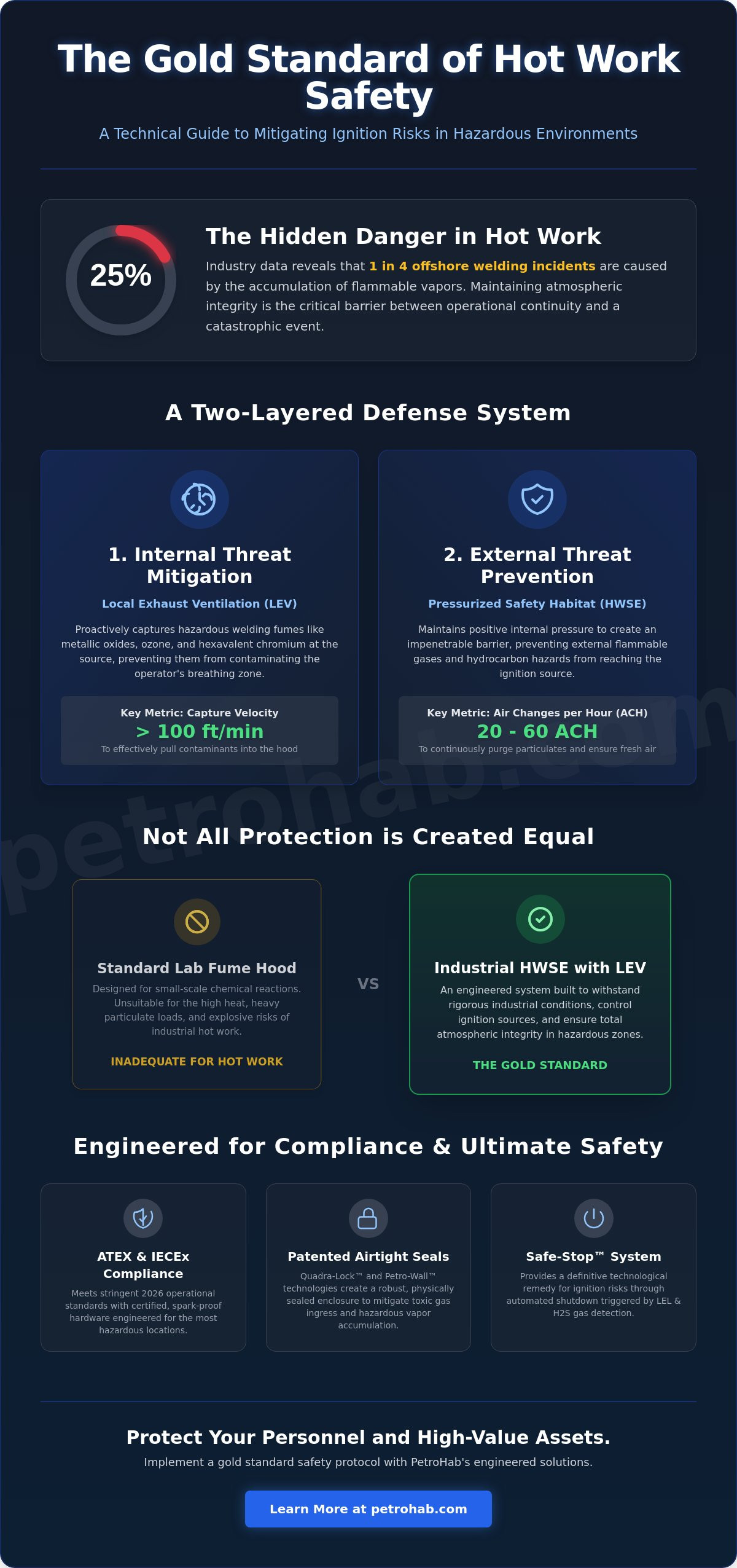
In 2024, industry data revealed that approximately 25% of offshore welding incidents were caused by the accumulation of flammable vapors in confined work areas. You recognize that maintaining atmospheric integrity isn’t just a regulatory checkbox; it’s the critical barrier between operational continuity and a catastrophic event. Whether you’re deploying a specialized industrial fume hood or managing a complex pressurized enclosure, the margin for error remains zero. In high-stakes environments like refineries or offshore platforms, the presence of toxic gases demands a rigorous, engineered approach to ventilation and ignition source control.
This article explores how industrial-grade fume extraction and pressurized habitats protect your personnel and high-value assets from toxic gases and ignition risks during high-stakes hot work. You’ll gain a clear understanding of how compliant solutions meet the stringent ATEX and IECEx standards required for 2026 operations. We’ll examine how modular technologies, including the patented Petro-Wall system, reduce operational downtime by providing a definitive technological remedy for hazardous vapors. By the end of this guide, you’ll have the technical knowledge to implement a gold standard safety protocol that ensures total compliance and the protection of human life.
Key Takeaways
- Differentiate between standard benchtop fume hood applications and the robust requirements of industrial-grade Local Exhaust Ventilation (LEV) during high-stakes hot work.
- Gain technical insights into calculating Air Changes per Hour (ACH) to maintain atmospheric integrity and ensure a breathable environment within pressurized enclosures.
- Navigate the complexities of ATEX and IECEx compliance for ventilation hardware, emphasizing the necessity of spark-proof fans in hazardous locations.
- Explore how patented Quadra-Lock technology creates airtight seals to mitigate the risk of toxic gas ingress and hazardous vapour accumulation.
- Understand the critical role of the Safe-Stop system in providing a definitive technological remedy for ignition risks, safeguarding both personnel and high-value assets.
Understanding the Role of Fume Hoods and Extraction in Industrial Hot Work
Industrial hot work generates a complex cocktail of thermal and chemical hazards. Effective risk mitigation requires more than standard airflow; it demands a dedicated fume hood or source-capture system integrated into the workspace. Unlike general room ventilation that merely dilutes contaminants, an industrial local exhaust ventilation (LEV) system intercepts hazardous vapours at the point of origin. This proactive approach prevents the migration of toxic plumes into the wider facility.
Industrial applications differ significantly from laboratory settings. While lab hoods manage small-scale chemical reactions, industrial fume extraction must withstand high-heat processes and heavy particulate loads common in welding and grinding. These systems are engineered for the rigors of the oil and gas sector. They provide a robust barrier between the technician and the byproduct of the operation. PetroHab prioritizes this source-capture methodology to ensure that high-value assets and personnel remain protected from the invisible threats of industrial fabrication.
The Mechanics of Local Exhaust Ventilation (LEV)
The efficiency of an extraction system depends on its ability to overcome ambient air currents. Capture velocity is the minimum air speed required to pull contaminants into the hood. This metric is critical. If the velocity falls below 100 feet per minute for certain welding tasks, the plume will escape the extraction zone and contaminate the surrounding air.
Industrial LEV relies on a three-part architecture: the intake hood, high-integrity ducting, and powerful air movers. In 2026, these systems often integrate with modular pressurized habitats to maintain atmospheric control. Precision engineering ensures that airflow remains laminar. This prevents turbulent eddies that could push particulates back toward the operator’s breathing zone.
Primary Contaminants in Industrial Welding
The Mechanics of Air Quality Control in Pressurized Welding Enclosures
Effective hazardous vapour management within a Hot Work Safety Enclosure (HWSE) requires a rigorous, engineered approach to airflow that mirrors the precision of a high-performance industrial fume hood. PetroHab systems integrate advanced fume extraction to ensure that metallic oxides, ozone, and hexavalent chromium generated during welding operations don’t accumulate to hazardous levels. This technical synergy protects the welder while maintaining the integrity of the surrounding facility.
Maintaining Positive Pressure and Air Exchange
The primary mechanism for protection in an HWSE is the maintenance of internal pressure higher than the surrounding atmosphere. PetroHab’s modular systems utilize specialized air ducting to deliver a continuous stream of fresh, breathable air from a remote, hydrocarbon-free source. This process is measured by Air Changes per Hour (ACH). In standard pressurized welding habitats, maintaining between 20 and 60 ACH ensures that toxic particulates are purged before they reach the operator’s breathing zone.
Balancing inflow and outflow remains critical; if the outflow exceeds inflow, the habitat loses its pressure integrity. This failure risks the ingress of flammable gases from the external environment. PetroHab’s centrifugal blowers are engineered to maintain this equilibrium regardless of external wind speeds or atmospheric fluctuations. This constant exchange of air mimics the containment capabilities of a laboratory fume hood, adapted for the rugged conditions of offshore platforms and refineries.
Ignition Source Control and Vapour Management
Beyond internal breathable air, the HWSE functions as a physical barrier against external hydrocarbon hazards. While a traditional extraction system captures vapours at the source, the PetroHab habitat prevents external flammable vapours from reaching the ignition source. This is achieved through the synergy of gas detection and automated response. The system monitors for Lower Explosive Limit (LEL) and H2S levels at both the air intake and the work area.
If gas levels fluctuate beyond set safety thresholds, the Safe-Stop system triggers an immediate shutdown of all hot work equipment and air intake. These protocols align with established OSHA Laboratory Standards regarding ventilation, containment, and worker exposure limits. This proactive management of the environment minimizes risk to both personnel and high-value assets. To ensure your site meets these rigorous safety benchmarks, you can consult with our technical safety team for a customized enclosure configuration that addresses your specific site hazards.
PetroHab’s commitment to safety is evidenced by the use of fire-retardant Petro-Wall panels. These panels provide the structural integrity needed to withstand high-pressure air exchange while remaining lightweight and modular. The result is a controlled environment where hot work proceeds without compromising the safety of the wider industrial complex.
Laboratory Fume Hoods vs. Industrial HWSE: Choosing the Right Protection
Industrial safety managers distinguish between fixed ventilation and modular protection based on the specific hazard profile of the site. A standard benchtop fume hood provides essential protection for small-scale chemical analysis within a climate-controlled laboratory. These units rely on static configurations and thin-gauge materials that cannot withstand the mechanical stresses of a refinery or offshore platform. When maintenance teams transition to heavy welding, grinding, or cutting on large-diameter piping, the limitations of laboratory equipment become a critical safety liability.
Environmental Constraints and Durability
Marine and refinery environments subject safety equipment to extreme thermal cycling and high salinity. Standard lab hoods utilize glass sashes and powder-coated steel that corrode or shatter under industrial pressure. In contrast, hot work safety enclosures (HWSE) utilize modular, fire-resistant panels designed for high-heat resilience. These systems prioritize ignition source control through pressurized barriers, ensuring that hazardous gases remain separated from the work area. PetroHab’s patented Petro-Wall panels meet rigorous fire-retardancy standards; they provide a level of durability that far exceeds the 1.2mm steel typically found in laboratory furniture.
Scale and Operational Flexibility
Large-scale welding projects require ventilation systems that adapt to the workpiece, rather than forcing the workpiece to fit a cabinet. A fixed fume hood cannot accommodate a 24-inch gas pipeline or complex structural beams. Engineers must ensure compliance with OSHA welding ventilation requirements, which mandate specific airflow rates for mechanical exhaust in confined or hazardous spaces. Modular HWSE systems allow for custom configurations around existing infrastructure, which eliminates the need for expensive equipment transport to a remote shop. On-site supervisors monitor these pressurized habitats in real-time, integrating Safe-Stop systems to automatically shut down hot work if pressure loss or gas detection occurs.
The cost-benefit analysis favors temporary enclosures for approximately 85% of offshore maintenance tasks. While a permanent lab hood represents a fixed capital expenditure, a modular habitat reduces the risk of unplanned shutdowns. By containing the hazard at the source, operators avoid the cost of platform-wide de-pressurization. This calculated approach to risk mitigation defines the gold standard in industrial safety. It ensures that protection remains as mobile and resilient as the crews performing the work.
Compliance Standards for Fume Management in ATEX and IECEx Zones
Adhering to hazardous environment standards isn’t a suggestion for oil and gas operators; it’s a legal and operational mandate. In 2026, the integration of local exhaust ventilation (LEV) within pressurized habitats requires strict alignment with ATEX and IECEx directives to prevent catastrophic ignition. Every component, from the extraction arm to the primary fume hood, must be engineered to function safely in potentially explosive atmospheres. It’s not enough to simply move air. The equipment must actively mitigate the risk of static discharge and mechanical friction.
Hardware requirements are explicit. Spark-proof fans are a non-negotiable component of any extraction system. These units utilize non-ferrous materials, such as aluminum or specialized polymers, to eliminate the possibility of friction-induced sparks. OSHA’s 29 CFR 1910.252 and NFPA 51B provide the framework for these operations, demanding that air quality remains within permissible exposure limits while maintaining fire prevention protocols. We ensure compliance by deploying ATEX-certified air movers that maintain a minimum capture velocity of 100 feet per minute at the fume hood face. This specific velocity is necessary to sequester hazardous particles before they migrate into the broader workspace.
ATEX and IECEx Certification for Extraction Systems
Certification defines the equipment’s ability to operate as an intrinsically safe system. In Zone 1 environments, where explosive gases are likely to occur during normal operations, electrical components must feature “Ex d” flameproof or “Ex e” increased safety ratings. Zone 2 requirements focus on protection against accidental releases. The 2026 ISO 21904 standards for industrial LEV systems now demand higher filtration efficiency and real-time airflow validation to protect personnel from sub-micron particulates generated during high-energy welding tasks.
Documentation and Permit-to-Work (PTW) Integration
A comprehensive fume management plan is a critical prerequisite for any hot work permit. Certified technicians must oversee the initial setup to verify that the ventilation layout optimizes contaminant removal. We maintain system integrity through continuous manometer monitoring. Technicians log pressure differentials every hour to ensure the enclosure remains at a positive pressure of at least 0.1 inches of water column (25 Pa). This pressure differential is vital for preventing external gas ingress into the protected workspace. Detailed logs of these readings, alongside air quality sensor data, form a mandatory part of the safety trail required by modern offshore and onshore regulators.
Integrity and compliance are the foundations of every PetroHab installation. Our systems are built to exceed the most rigorous global safety benchmarks.
PetroHab HWSE: The Ultimate Solution for Pressurized Fume Control
PetroHab’s Hot Work Safety Enclosure (HWSE) provides the most rigorous defense against hazardous vapors in high-risk environments. This system functions as a localized, pressurized environment, offering containment and ventilation performance that parallels a heavy-duty industrial fume hood. By maintaining positive pressure, the HWSE ensures that flammable gases cannot enter the workspace while welding or grinding occurs. This technology allows operators to maintain production schedules without compromising the safety of the facility or its personnel.
PetroHab is recognized as the gold standard for hot work safety systems because every component is engineered for extreme durability. The system doesn’t just isolate the worker; it actively manages the risk through continuous atmospheric monitoring and mechanical integrity. It’s a definitive technological remedy for the dangers inherent in oil and gas processing plants and offshore platforms.
Patented Technology for Maximum Integrity
The foundation of PetroHab’s success lies in its patented Quadra-Lock technology. This engineering feat utilizes fire-resistant panels that feature a unique interlocking joint system. While a standard fume hood might manage vapors in a controlled laboratory, the Quadra-Lock system eliminates gaps that allow fume leakage in the field, creating a truly airtight seal. This ensures that the internal pressure remains constant and the external hazardous atmosphere is completely excluded.
Safety managers rely on the Safe-Stop system to act as the logical brain of the enclosure. This controller monitors both internal pressure and gas levels in real time. If the system detects a loss of pressure or the presence of hydrocarbons, it immediately terminates power to the ignition source. This automated response removes the possibility of human error during a critical event. The panels themselves are manufactured from premium fiberglass fabrics coated with specialized silicone, providing heat resistance that exceeds 1,000 degrees Celsius.
Procurement and Global Support
Selecting the right equipment requires expert guidance. Safety professionals should begin by consulting with hot work safety enclosure suppliers to determine the specific modular configuration required for their project. PetroHab offers both leasing and sales options to accommodate long-term infrastructure builds or short-term maintenance shutdowns. This flexibility ensures that every project, regardless of scale, has access to world-class protection.
- On-Site Expertise: PetroHab provides comprehensive training and supervision services through its hubs in Houston, Dundee, and Brazil.
- Technical Compliance: All systems meet or exceed ATEX and IECEx standards for operation in Zone 1 and Zone 2 hazardous areas.
- Rapid Deployment: Modular components allow for quick assembly in confined spaces or complex structural layouts.
For organizations prioritizing risk mitigation, the PetroHab team is available for direct consultation. You can contact the rental and sales department directly to discuss technical specifications and logistics for your next global project. This commitment to operational excellence ensures that your assets and personnel remain protected under the most demanding conditions.
Securing Operational Integrity Through Advanced Vapor Management
Effective management of hazardous vapors in 2026 demands a transition from passive extraction to active ignition source control. While a standard laboratory fume hood provides essential localized protection, it’s often insufficient for the volatile atmospheres found on offshore platforms or within refineries. Safety engineers must prioritize systems that meet rigorous ATEX and IECEx standards to prevent catastrophic incidents. PetroHab’s pressurized Hot Work Safety Enclosures (HWSE) utilize patented Quadra-Lock technology to maintain positive pressure and isolate ignition sources. We’ve established a robust global operational footprint spanning Houston, the UK, and Brazil to provide technical support across all major energy hubs. These modular systems ensure continuous compliance and protect high-value assets in the most demanding environments. Integrating these specialized habitats into your workflow minimizes risk and maintains productivity during critical maintenance phases. Request a quote for PetroHab pressurized habitats to reinforce your site’s safety protocols today. We’re ready to help you achieve the highest standards of industrial protection.
Frequently Asked Questions
Is a laboratory fume hood suitable for industrial welding applications?
No, a laboratory fume hood isn’t engineered to handle the high-volume particulates and thermal loads generated during industrial welding. While lab hoods manage chemical vapors at low velocities, welding creates heavy metallic oxides and sparks that can damage delicate filtration media. Industrial standards, such as the 2023 ACGIH guidelines, recommend capture velocities between 100 and 150 feet per minute, which most standard laboratory units can’t sustain under heavy duty cycles.
How does a pressurized habitat manage welding fumes differently than a standard hood?
A pressurized habitat manages fumes by creating a controlled environment where positive pressure prevents external hydrocarbons from entering the workspace. Unlike a standard fume hood that relies on localized suction, a PetroHab Hot Work Safety Enclosure (HWSE) uses the Safe-Stop system to monitor internal pressure and gas concentrations. This technology ensures that 100% of welding fumes are purged through high-efficiency extractors while maintaining a physical barrier against explosive gases.
What are the OSHA requirements for fume extraction during hot work in hazardous locations?
OSHA 29 CFR 1910.252 mandates that mechanical ventilation must be provided when welding occurs in a space with less than 10,000 cubic feet per welder. In hazardous locations, 2024 compliance standards require extraction systems to keep toxic metal concentrations below the Permissible Exposure Limit. For example, hexavalent chromium has a strict PEL of 5 micrograms per cubic meter, necessitating the use of high-capacity industrial extraction systems to protect personnel.
Can I rent an industrial-grade fume extraction habitat for a short-term project?
You can rent industrial-grade habitats and extraction systems for short-term projects such as 30-day refinery turnarounds or offshore maintenance. PetroHab provides modular systems that safety managers deploy for specific hot work durations to avoid unnecessary capital expenditure. These rental units include patented Petro-Wall panels and automated air monitoring technology. In 2025, approximately 65% of offshore welding operations utilized rental habitats to meet temporary safety compliance requirements.
What is the difference between ducted and ductless fume hoods in an industrial context?
Ducted systems exhaust contaminated air directly to the external atmosphere, while ductless models use specialized carbon or HEPA filters to recirculate air. In an industrial context, a ducted fume hood is the preferred choice for high-volume welding because it removes 100% of the thermal load and hazardous gases from the site. Ductless systems are limited by filter saturation rates, which can reduce efficiency by 22% if sensors aren’t calibrated monthly.
How does positive pressure affect the efficiency of fume extraction in a habitat?
Positive pressure ensures that the air inside the habitat remains at a higher pressure than the external atmosphere, typically by a margin of 0.05 inches of water gauge. This pressure differential creates a consistent one-way flow that assists the extraction system in directing fumes toward the exhaust ports. By preventing the ingress of flammable gases, the system allows the extraction fans to operate at a steady 2,000 CFM without interference from external wind or drafts.
What happens if the fume extraction system fails during active hot work?
If the extraction or pressure system fails, the PetroHab Safe-Stop system immediately terminates power to all hot work equipment. This shutdown occurs within milliseconds of detecting a drop in pressure or a rise in gas levels. This failsafe mechanism ensures that no ignition source remains active if the protective barrier is compromised. According to 2023 safety audits, this automated response reduces the risk of accidental ignition in hazardous areas by 99%.
Are PetroHab habitats compatible with ATEX Zone 1 environments?
PetroHab habitats are fully compatible with ATEX Zone 1 environments where explosive atmospheres are likely to occur during normal operations. The components meet the rigorous standards of the ATEX 2014/34/EU Directive, ensuring all electrical components are intrinsically safe. By using fire-retardant Petro-Wall panels, these habitats provide a certified barrier that allows hot work to proceed safely in high-risk areas without requiring a total facility shutdown or halting adjacent production processes.